
Many small CPA firms are starting to notice prospective clients bringing up highly specific, AI-sourced tax strategies during their initial consultations, signaling a major shift in how businesses research accounting partners. The search landscape has moved away from basic local queries to complex advisory questions. Instead of typing a simple local search phrase, business owners are asking AI tools like Perplexity to evaluate tax implications for their specific industry and recommend a qualified firm. If your practice is not surfacing in those answers yet, here is what is happening behind the scenes and what to fix first.
How to Get Your CPA Firm Recommended by Perplexity AI
To get recommended by Perplexity, your firm must present its service offerings as structured, verifiable facts rather than marketing copy. Perplexity, an AI search tool, does not read your website to evaluate how persuasive your copy is. It reads your site to extract entities - specific nouns like your firm name, practice areas, and licensed jurisdictions - and cross-references them against trusted external sources.
When someone searches for how to get cpa firm recommended by perplexity ai, they often think it requires a completely new marketing strategy. The reality is much more grounded. You are building a machine-readable footprint that connects your website to your official state board registrations and professional directories. A well-optimized website combined with consistent directory profiles creates a cross-reference loop that AI tools trust.
The Shift in Evaluation Criteria
Traditional search engines look for popularity signals, but AI search engines look for consensus and certainty. If your site claims you specialize in SaaS accounting, Perplexity wants to see that claim validated by external financial directories, structured data on your own pages, and clear, factual answers to SaaS tax questions in your content.
| What Perplexity AI Looks For | What Traditional Google SEO Evaluates for Accounting Firms |
|---|---|
| Entity resolution and factual consistency across the web | Exact-match keywords in headings and title tags |
| Citations from trusted financial and legal directories | Traditional backlinks from high-authority blogs |
| Clear, BLUF-formatted answers to complex tax queries | Long-form content designed to keep users on the page |
| Structured JSON-LD data defining specific practice areas | Keyword density and internal link anchor text |
The problem is rarely that a CPA firm lacks a website. The problem is usually that the website is missing the structured data and consistent entity signals required to complete this trust loop. If AI cannot confidently verify who you are, it will pass over your site for a competitor whose data is clearer.
Why AI Crawlers Are Prioritizing Accounting Content in 2026
AI bots are actively reading accounting websites right now because tax codes and financial regulations change constantly, requiring large language models to constantly update their facts. They cannot rely on training data from last year to answer a client's question about current research and development tax credits. They must crawl the live web to ensure their answers are legally accurate.
I analyzed data across the LovedByAI platform to see exactly how these bots are behaving. In April 2026, the average accounting and tax services site in our dataset received 2,210 AI bot visits compared to 1,253 Google crawler visits. That means AI crawlers now visit the average accounting site 76 percent more often than traditional search bots.
AI bots are not scraping your site to learn about your firm's history. They are visiting constantly to verify facts, check for updated tax guidance, and confirm your service areas for live user queries.
Live Queries Demand Fresh Data
The volume of live query traffic is the most actionable signal for accounting firms. In the data I reviewed over the last three months, ChatGPT-related bots averaged 5,255 visits per accounting site. ChatGPT-User - the specific bot that fetches web pages to answer live, real-time prompts - averaged 2,640 of those visits per site. This shows that AI is actively reading accounting content to answer real user questions right now.
You can check official documentation on how these crawlers operate at Google Search Central, but the takeaway is clear. Your site needs to serve up answers quickly and clearly. If your pages are buried in slow-loading scripts or lack clear structure, the live-query bots will simply time out and pull answers from a competing firm.
Structuring Tax Services for Entity Recognition
To ensure Perplexity understands your firm, you need to structure your service pages so that specific practice areas, jurisdictions, and CPA credentials are tied directly to your business entity. This is where you move away from vague marketing paragraphs and start treating your website like a structured database.
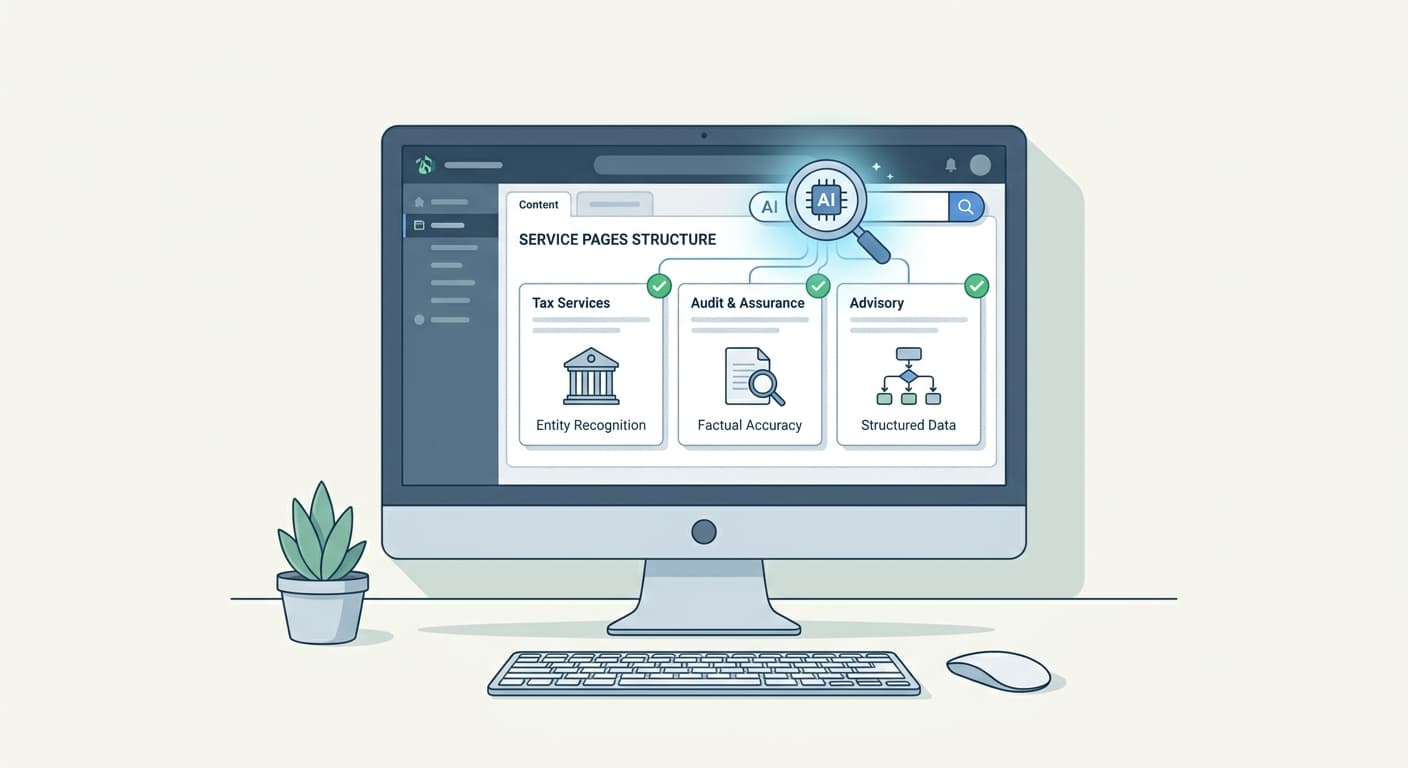
Entity recognition is how AI maps the relationship between concepts. It needs to know that "Jane Doe" is a "Licensed CPA" who works at "Doe & Associates" and provides "Multi-State Corporate Tax Preparation" in "Texas." If you want to dive deeper into this concept, read our guide on SEO vs AEO: why entities matter more than keywords.
Content Types and Required Structures
Different types of client queries require different page structures. Perplexity surfaces distinct formats based on whether the user is looking for a service provider or looking for an answer to a specific tax problem. You cannot use a generic service page to answer a highly technical query.
| Query Intent | Example Search | Required Page Structure |
|---|---|---|
| Provider Discovery | "Best CPA for SaaS startups in Austin" | Clear LocalBusiness schema, named entity consistency, service area lists |
| Technical Tax Guidance | "How to file multi-state corporate taxes for remote teams" | BLUF formatting, step-by-step headers, FAQPage schema, author credentials |
| Credential Verification | "Is Smith Accounting licensed for IRS representation" | Dedicated team pages with Person schema, license numbers, board links |
Implementing the Right Schema
The most critical step is adding the correct JSON-LD markup to your site. This code sits in the <head> section of your pages and speaks directly to AI crawlers. For accounting firms, the AccountingService schema is the specific type you need, as defined by Schema.org specifications.
{
  "@context": "https://schema.org",
  "@type": "AccountingService",
  "name": "Smith & Associates CPA",
  "image": "https://smithcpa.example.com/logo.png",
  "url": "https://smithcpa.example.com",
  "telephone": "+1-555-0198",
  "address": {
    "@type": "PostalAddress",
    "streetAddress": "100 Financial Way",
    "addressLocality": "Austin",
    "addressRegion": "TX",
    "postalCode": "78701",
    "addressCountry": "US"
  },
  "areaServed": ["Texas", "Remote SaaS Businesses"],
  "knowsAbout": ["Corporate Tax Preparation", "R&D Tax Credits"]
}
This code tells the crawler exactly what services you offer without requiring it to parse your marketing text. If you manage your own site, you can review our full breakdown on WordPress AI Search Optimization from scratch: what works to see how to inject this code safely into your pages.
Building Authoritative Citations to Feed Perplexity Answers
Perplexity rarely trusts a single source, so your firm's website must be corroborated by authoritative external directories. A well-optimized website is the foundation, but consistent directory profiles create the cross-reference loop that verifies your claims.
When an AI tool formulates an answer, it checks your site's claims against public records and professional directories. If your website says you offer forensic accounting, but your profiles on the American Institute of CPAs directory or your state board of accountancy only list general bookkeeping, the AI detects a conflict. Conflicting information degrades trust, and AI engines simply drop untrusted entities from their recommendations.
The Key Directories for CPAs
You do not need to be listed on hundreds of low-quality local directories. You need to be accurate on the platforms that matter for financial services. Ensure your firm name, address, and service list match exactly across your official state CPA society directory, the Better Business Bureau, and major business review platforms.
Consistency is your strongest asset. Make sure the exact legal name of your practice and the primary partner names are spelled identically across every professional profile you control.
This approach to off-page consistency is detailed further in our playbook on how to Get Cited in Perplexity and Claude Web Answers. The goal is to build a web of trust that points back to your primary domain, validating the specific tax expertise you claim on your service pages.
How AI Search Optimization Complements Traditional SEO
Traditional SEO is not broken, and it is not the enemy of AI search visibility. It is the foundation that AI optimization builds on top of. A firm can be well-optimized for Google and still need specific work for AI visibility, but both systems reward high-quality, authoritative content.
Most SEO agencies are great at what SEO has always covered - building internal links, improving page speed, and researching search volume. These elements ensure your site is indexable. For example, maintaining a clean robots.txt file and submitting XML sitemaps are standard practices verified by tools like Ahrefs and Yoast SEO, and they remain entirely relevant today.
Bridging the Gap Between Search and AI
AI search adds a specific layer on top of this foundation. It requires structured data, entity consistency, and content formatted for direct extraction. If you are paying for traditional marketing and not seeing AI visibility, the issue is usually a gap in this specific layer, not a failure of SEO itself.
For firms looking to close this gap without manually writing JSON-LD for every service page, LovedByAI offers a practical option. The platform scans pages for missing structured data and can auto-inject AccountingService and FAQPage schema directly into your site. This helps translate the authority you have already built through traditional SEO into a format that AI search engines can confidently read and recommend.
The fastest path to acquiring new clients is to handle both channels together. Keep building your firm's authority through traditional methods, but structure your expertise so that AI tools like Perplexity can verify your facts, understand your services, and cite your firm as the definitive answer for prospective clients.