What is LLM SEO?
LLM SEO is the practice of optimizing your website so AI-powered search engines like ChatGPT, Claude, Gemini, Perplexity, and Google AI Overviews understand, cite, and recommend your content to their users. If you have heard of Generative Engine Optimization (GEO) or Answer Engine Optimization (AEO), LLM SEO is the same concept described more directly: making your site work for large language models.
This guide is built on data, not theory. We analyzed crawling patterns, referral traffic, and optimization outcomes across more than 1,100 customer websites on the LovedByAI platform, using first-party server-log data that external tools like SimilarWeb cannot see. No recycled advice. Just what the numbers show.
AI bots are already crawling your site more than Google
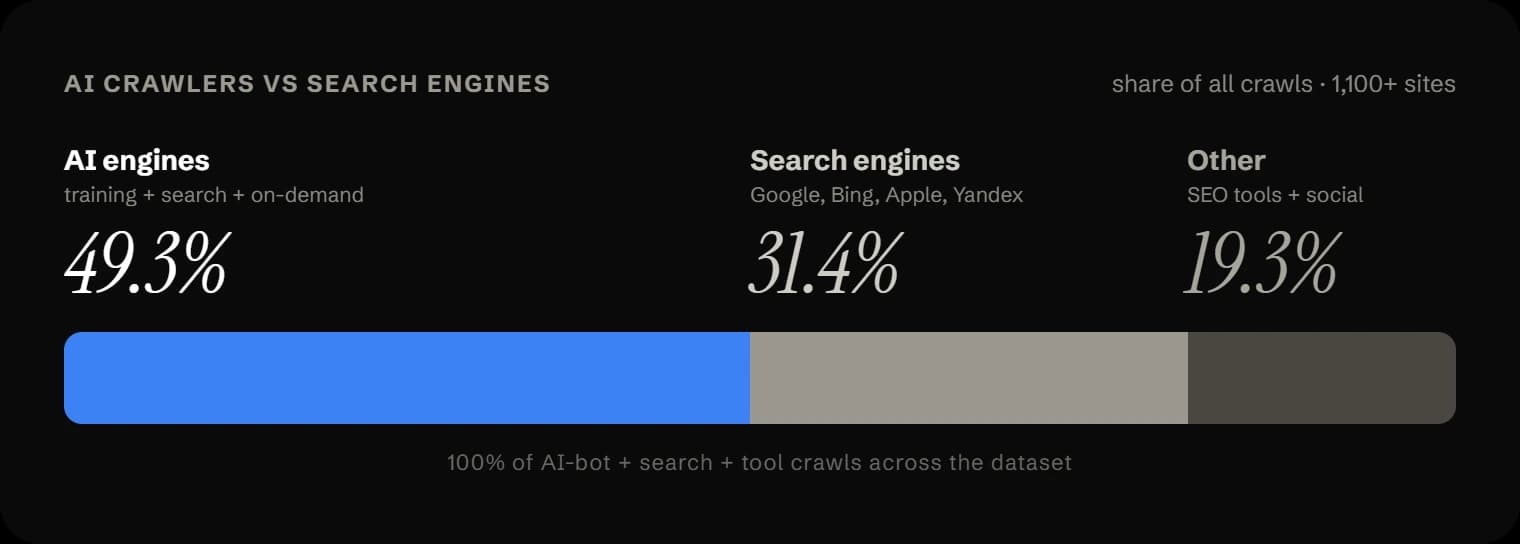
Before getting into strategy, you need to see the scale of what is already happening. Across the 1,100+ websites in our dataset, AI-related bots now generate far more crawl traffic than traditional search engines.
| Bot category | Share of crawls | Top bots in this category |
|---|---|---|
| AI Training | 44.8% | GPTBot, ClaudeBot, Meta-ExternalAgent, Amazonbot |
| Search Engines | 31.4% | Googlebot, Bingbot, Applebot, YandexBot |
| SEO Tools | 15.3% | AhrefsBot, SemrushBot |
| Social Media | 4.0% | facebookexternalhit, Twitterbot, LinkedInBot |
| AI Search | 3.1% | OAI-SearchBot, PerplexityBot, Claude-SearchBot |
| AI On Demand | 1.4% | ChatGPT-User, Perplexity-User |
Add up the three AI categories (training, search, and on-demand) and they account for roughly 49% of all crawl activity. Search engines sit at 31%. AI bots now out-crawl Google and Bing by more than 1.5 to 1, and the gap has widened over the past few months.
The two AI categories at the bottom deserve special attention. "AI Search" and "AI On Demand" are the crawlers that fire in real time when someone asks ChatGPT or Perplexity a question and the model decides to fetch live information from the web. OAI-SearchBot was detected on 916 of our sites and ChatGPT-User on 940, wider reach than any single training bot. When a user asks "what is the best ISA rate in 2026" and ChatGPT browses the web to answer, one of these is the crawler doing the fetching. Those are the crawls that can actually turn into a citation.
What this means for you: Your site is almost certainly being read by AI systems right now. The question is not whether AI bots will find you. It is whether they will recommend you when a user asks a relevant question.
The AI traffic funnel: what 1,100+ small and medium business websites teach us
We tracked the full journey from "an AI bot hits your site" to "ChatGPT sends you a visitor" across our entire customer base. The funnel reveals where the real opportunity lives, and it is brutal.
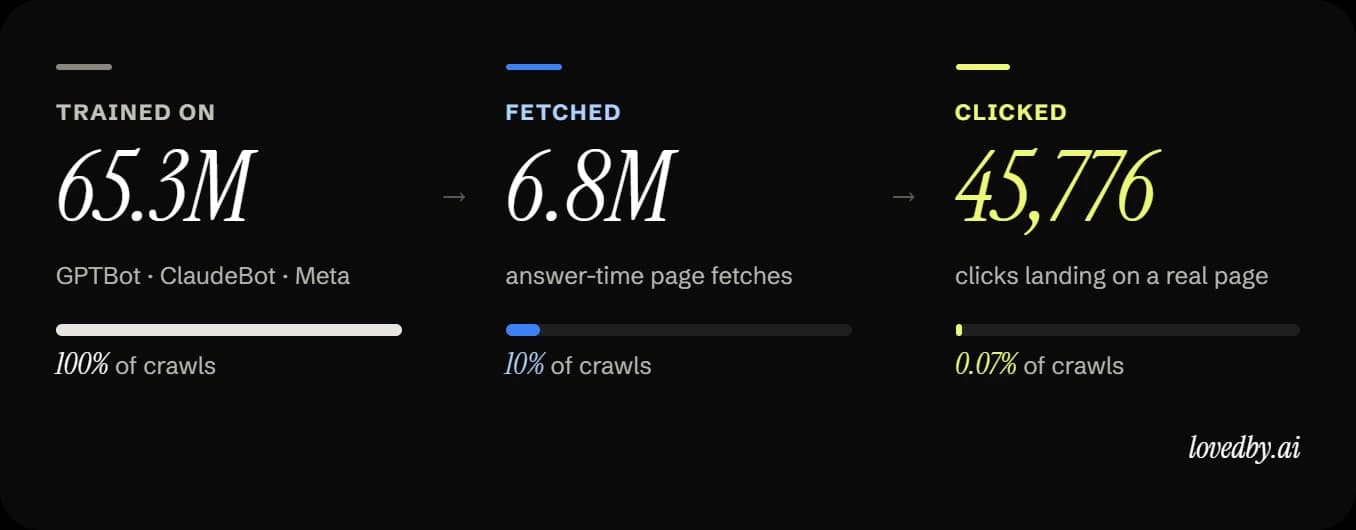
Raw crawl counts hide the real story. Most of those millions of crawls are AI training bots (GPTBot, ClaudeBot, Meta) building their models, and that activity does not send you a visitor today. The crawl that can actually earn you a click is the answer-time fetch: the live request a model makes when a user asks it a question. Between January and July 2026, AI bots logged 65.3 million training crawls across our sites, which narrowed to 6.8 million answer-time fetches, which produced 45,776 referral clicks. That is roughly one visitor for every 1,400 training crawls, and a 0.67% conversion from answer-time fetch to click. Being crawled is not the achievement. Being the source a model actually quotes is.
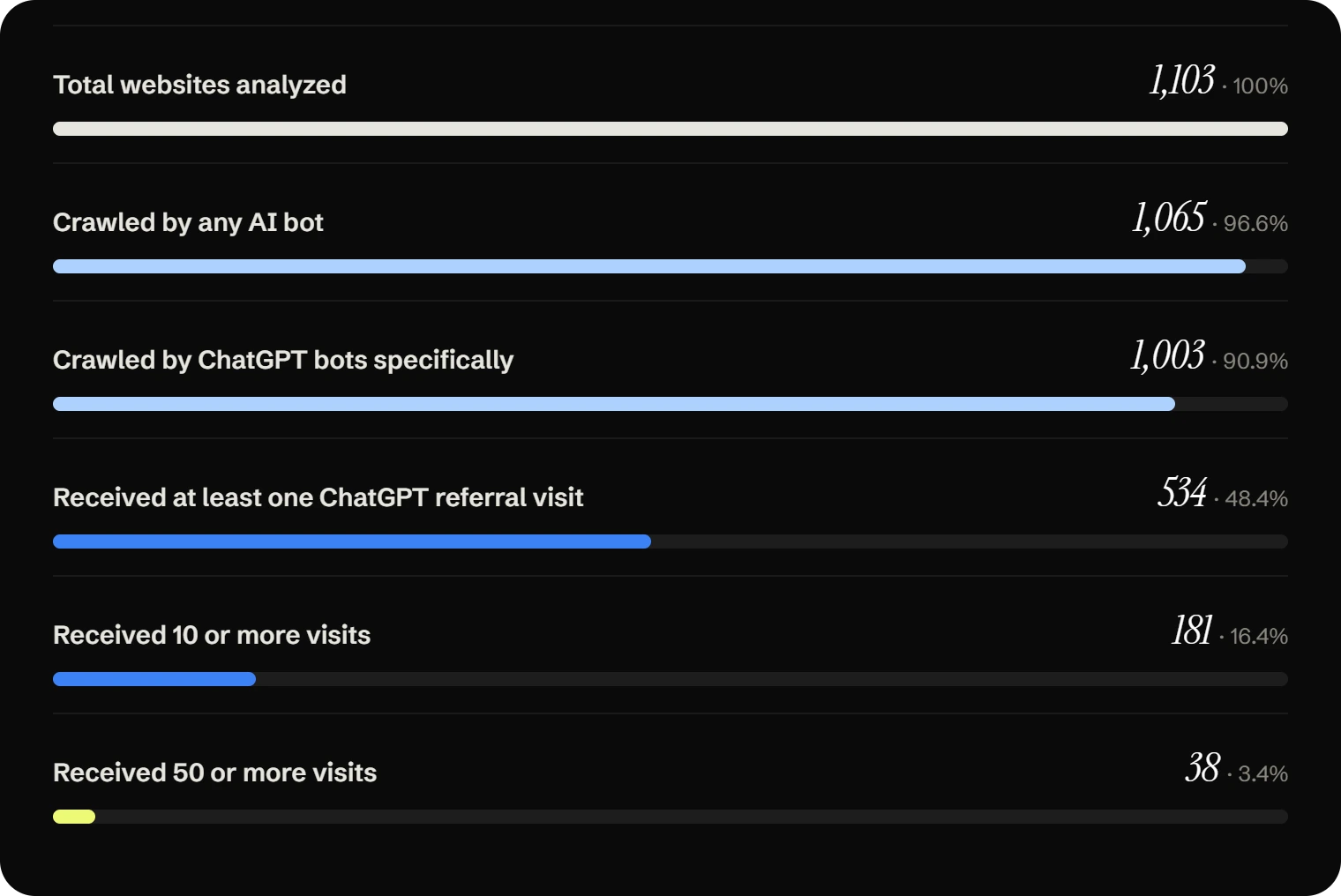
At the site level, the same compression shows up as a steady drop-off:
| Stage | Sites | % of total |
|---|---|---|
| Total websites analyzed | 1,103 | 100% |
| Crawled by any AI bot | 1,065 | 96.6% |
| Crawled by ChatGPT bots specifically | 1,003 | 90.9% |
| Received at least one ChatGPT referral visit | 534 | 48.4% |
| Received 10 or more visits | 181 | 16.4% |
| Received 50 or more visits | 38 | 3.4% |
Discovery is not the bottleneck
The drop from 96.6% (crawled) to 48.4% (received traffic) is where LLM SEO lives. Almost every site is being indexed by AI systems. Fewer than half get any visitors back. Getting found is essentially free; getting cited is the hard part.
Getting recommended is the real challenge
The hard part is what happens next: convincing the model that your content is worth citing when a user asks a question your page could answer. That gap between "crawled" and "cited" is the entire value of LLM SEO.
Among the 534 sites that do receive ChatGPT referral traffic, the distribution is heavily skewed. A small group of sites captures most of the traffic, while the median site gets only a handful of visits. LLM SEO is not a game where every participant gets a small slice. A few sites win big, most get very little, and many get nothing.
LLM SEO is not about getting found. Every site gets found. It is about getting recommended.
More content means more chances to match user questions
We split our dataset into two groups: sites that receive ChatGPT referral traffic and sites that do not. One variable dominated every other factor we tested.
| Group | Sites | Median pages indexed | Average pages indexed |
|---|---|---|---|
| Receives ChatGPT traffic | 520 | 164 | 604 |
| No ChatGPT traffic | 525 | 52 | 240 |
Sites receiving ChatGPT referrals had a median of 164 indexed pages. Sites without any AI referral traffic had a median of 52. That is more than a 3x gap at the median, and it was the single strongest predictor we tested.
The reason is straightforward. Every additional page you publish is another opportunity to match a long-tail keyword or niche use case that someone might ask an AI about. A site with 200 pages covering a topic in depth gives ChatGPT more material to draw from. A site with 50 pages provides fewer surfaces for the model to land on. An accountant with pages covering "tax brackets for freelancers," "VAT registration for small businesses," and "capital gains on rental property" has three chances to match three different user queries. An accountant with a single "services" page has one.
This does not mean you should publish 200 thin pages tomorrow. You already know this, and it is still true in 2026: quality content wins. A site full of low-value filler will not get cited regardless of volume. But if your competitor has 300 pages of solid content covering a topic and you have 30, they have a structural advantage that no amount of schema markup will overcome. Volume gives you more at-bats. Quality determines whether you hit.
Count your indexed pages today. If you have fewer than 100 pages of genuine, useful content, your most important work right now is creating more of it. Technical optimizations matter, but they cannot compensate for a thin content library.
It is not just ChatGPT anymore
For most of the last year, "AI referral traffic" effectively meant ChatGPT. That is changing fast. We broke referral visits down by platform, month over month, and while ChatGPT still sends the most traffic by a wide margin, Gemini, Claude, and Perplexity are all climbing quickly.
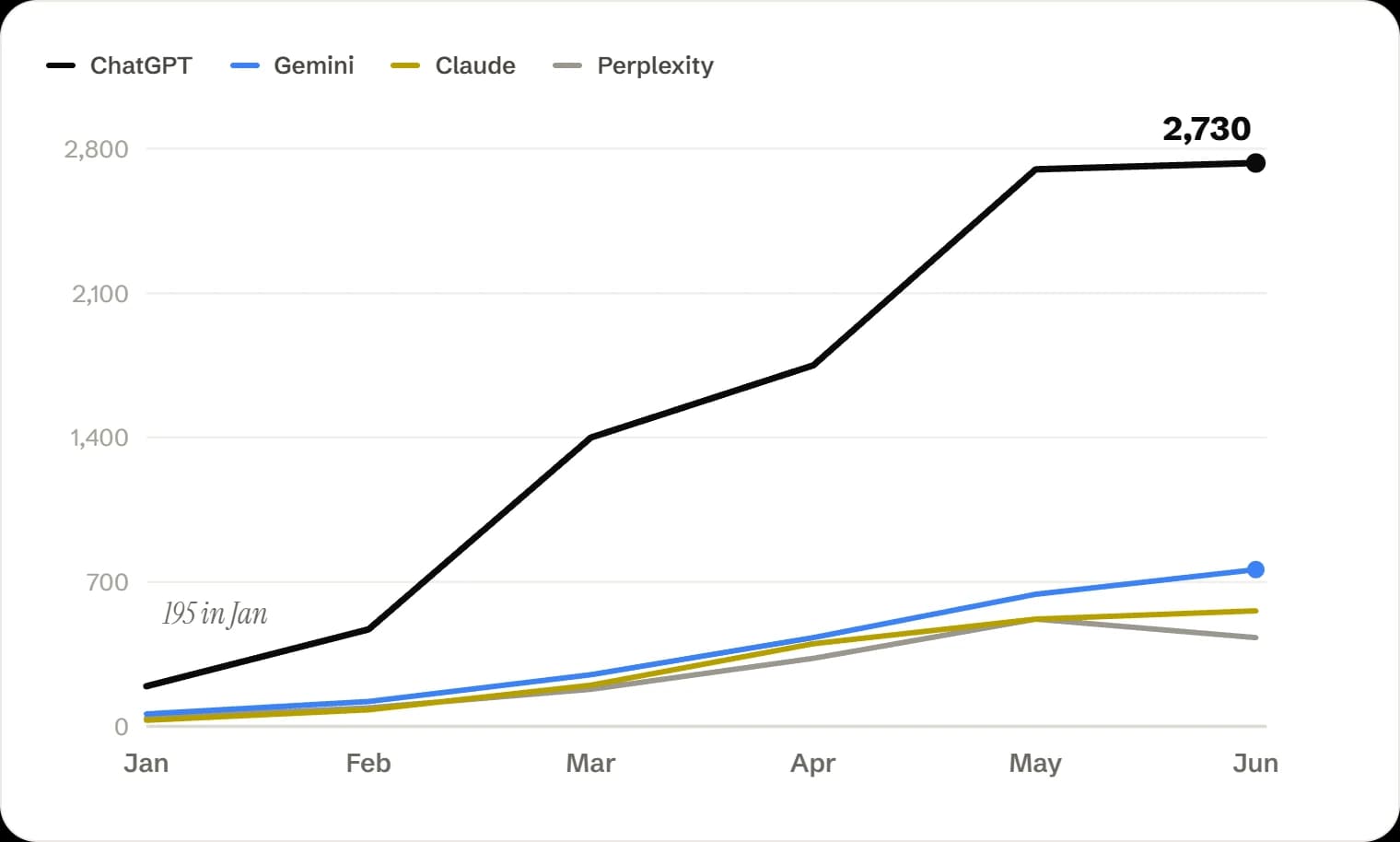
ChatGPT referral visits grew from 195 a month in January to 2,730 in June. The others grew faster off a smaller base: Gemini referrals rose roughly 19x over the same window, and Claude more than that. As a result, ChatGPT's share of AI referrals across our sites fell from about 72% to 64% in six months. The practical takeaway is simple. Do not optimize for one model. The fundamentals that make you citable (structured data, answer-first content, entity clarity, depth) work across all of them at once, which is why the same page usually starts earning Gemini and Perplexity visits soon after it earns its first ChatGPT ones.
Why does being crawled by AI not guarantee being cited?
Of the 1,003 sites crawled by ChatGPT's bots, 534 received any referral traffic back from chatgpt.com. That is a 53% conversion rate from "crawled" to "cited."
The other 47% had their content read by the AI and passed over during user conversations. Their pages were in the AI's reach, but the model chose to cite someone else, or to synthesize an answer without a specific source.
Three patterns separate cited sites from ignored ones
The dividing line between sites that get recommended and sites that get skipped is consistent across our dataset. Here is what the cited sites do differently.
1. They own a niche deeply instead of covering many topics thinly. The sites getting cited tend to own a focused topic rather than covering everything at surface level. A finance site that publishes 40 detailed pages about ISA savings accounts gets cited for ISA-related questions. A general business site that mentions ISAs once in a blog post does not. AI systems compare multiple sources before generating an answer, and depth signals authoritativeness.
2. They lead with the answer, not the background. Pages that open with the answer and then expand with supporting detail get picked up more often than pages that bury the main point after several paragraphs of context. LLMs are scanning for content they can confidently extract a response from. If you make the AI parse through 800 words of introduction to find your actual recommendation, a competitor who leads with the answer will win that citation.
3. They use structured data to confirm what their content is about. Sites with clean Organization schema, Article schema, and FAQ markup give the AI model machine-readable confirmation. Without structured data, the model relies entirely on parsing raw HTML and text, which introduces ambiguity. When two pages cover the same topic and one has clear schema markup, the structured page has an interpretive advantage.
Getting crawled proves your site is alive; getting cited proves your content is trusted. The technical barriers to discovery are essentially zero in 2026. Almost all of the competition in AI search optimization now happens in that gap between "found" and "recommended."
Does optimization actually close the gap? We measured it
The three patterns above are not just theory. On the sites where only some pages were optimized (usually because a plan covers a limited number of pages), we compared the optimized pages against the untouched pages on the same site. Across 116 such sites and 108,834 pages, optimized pages earned 173.5 AI referral visits per 1,000 pages in a 90-day window against 15.8 for untouched pages on the same domain. That is 11 times the traffic per page, and optimized pages came out ahead at 89 of the 102 sites that saw any AI traffic. Homepages are excluded from that comparison, because almost every homepage is optimized and so there is nothing to compare them against.
The obvious objection is that people optimize their best pages first. So we grouped every page by an internal importance score and compared like with like. Optimized pages earned more citations in three of the four tiers, up to 428.6 per 1,000 against 69.6 on top-priority pages. The exception is the bottom tier, where optimization bought no extra citations at all, 37.4 against 39.0. The effect is real but uneven, and it is largest on the pages that matter most. The biggest single lever turned out to be headings rewritten into the question they answer, ahead of structured data, which is not where most GEO advice points. We wrote up the full method, the definitions and the known limits in a separate study: does GEO optimization actually work?
What do the top-cited sites have in common?
The sites earning the most ChatGPT referral traffic in our data fall into two archetypes, and both work. Here are a few of the top performers (anonymized), with their referral visits and how many pages they have indexed.
| Top-cited site | ChatGPT visits | Pages indexed | What is going on |
|---|---|---|---|
| Volume publisher | 621 | 2,822 | Broad, deep library across a big topic |
| Education site | 441 | 2,203 | Hundreds of course and topic pages |
| Niche authority | 421 | 108 | Small site, definitive on one subject |
| Tech tool | 332 | 804 | Focused docs and use-case pages |
| Ultra-niche | 218 | 21 | Tiny, but owns its exact question |
Two factors consistently predict success: high volume of quality content or deep niche authority on a specific topic. Brand size is not the deciding factor. Look at the niche-authority site pulling 421 visits from just 108 pages, and the ultra-niche site earning 218 from only 21. If your handful of pages are the definitive resource on your subject, you can out-earn sites with thousands of pages that cover everything at surface level.
The sites getting zero ChatGPT traffic share the opposite pattern: thin service pages, generic "about us" content, and no real depth on any single topic. They exist, they get crawled, and they get passed over because there is nothing for the AI to confidently cite.
AI search rewards volume and specificity. A 50-page site that deeply covers one topic can outperform a 5,000-page site that covers everything at surface level. Either publish more quality content or go deeper on a focused niche. Both routes work.
How do I improve LLM SEO?
The practical work falls into four categories. Start with whichever area your site is weakest in.
Create relevant, valuable content
You already know that quality content matters. It is 2026 and this is still the single most effective strategy for search visibility, both traditional and AI-powered. Except now AI models are reading your pages alongside your human audience, and the bar for what counts as genuinely useful is higher than ever.
Answer real questions directly. Think about how people search when they use AI platforms: they ask full questions, not just keywords. Check your customer support inbox, your Google Search Console query report, and the "People Also Ask" boxes for your target keywords. Write pages that answer those questions starting with the answer in the first paragraph, not buried after an introduction. AI systems are looking for content they can extract a confident response from.
Go deep on your niche. AI systems compare your coverage of a topic against every other site that covers the same thing. If you are a plumber in Austin, or a dentist with a local practice, 30 solid pages about your area of expertise will outperform a single "services" page listing everything you do. Depth on a focused topic signals to the model that you are a genuine authority.
Structure content in chunks. Use clear H2 and H3 headings that match natural language questions. Each section should be self-contained enough that an AI could extract it as a standalone answer without needing the surrounding context to make sense. This is different from traditional blog writing where you build to a conclusion. For AI optimization, every section should stand alone.
Include Q&A sections. FAQ content, formatted with questions as headings and direct answers as the following paragraphs, is one of the easiest formats for AI models to parse. Pair this with FAQPage schema markup and you have given the model both the content and the machine-readable confirmation that the content answers a specific question.
Update stale content
If you have pages covering your key topics that were last updated in 2024, AI models may deprioritize them. Freshness matters because LLMs are increasingly designed to prefer recent information, especially for queries where the answer changes over time (pricing, statistics, "best of" lists, policy updates).
Review your top 20 pages by traffic. Update statistics, add recent examples, and revise any recommendations that have changed. Changing a date in the title is not enough. The actual content needs to reflect current information. A page titled "Best tools for 2024" will lose to a page with genuinely updated recommendations for 2026.
Build off-page E-E-A-T
Experience, Expertise, Authoritativeness, and Trustworthiness affect AI visibility just as they affect traditional search. AI models pull from many sources and cross-reference them. If multiple trustworthy sites mention or link to your business, the model gains confidence in recommending you.
- Get cited or quoted in industry publications that the AI is likely to have in its training data
- Maintain consistent business information across directories (name, address, phone, description)
- Build real backlinks through original research, guest posts, or genuinely useful tools
- Encourage authentic reviews on platforms relevant to your industry
There are no shortcuts here. E-E-A-T is the same concept as in traditional SEO, and AI models are evaluating these same trust signals.
Fix on-page technical signals
On-page optimization for LLMs comes down to removing ambiguity and making your content as easy to interpret as possible. Our on-page GEO guide covers the full checklist, but here are the essentials.
BLUF writing (Bottom Line Up Front). Put the most important answer at the top of each section. Do not make the AI (or the reader) scroll through context paragraphs to find the point. If your page is about "how much does a kitchen renovation cost," the first sentence after that heading should contain a number or a range.
Meta titles and descriptions. Write meta titles that clearly state what the page covers. AI systems use these as a signal for page relevance when deciding whether to fetch a page in response to a user query. A clear, descriptive title is one of the lowest-effort, highest-leverage signals you control.
Schema markup (JSON-LD). Add structured data for your Organization, Article content, FAQPage sections, and any product or service information. Complete, nested schema gives AI models machine-readable confirmation of what your page is about. It does not guarantee citations, but it removes the ambiguity that could cost you a recommendation when a competitor's page is easier to interpret. Google's structured data guidelines provide the technical specs.
Content chunking. Break long pages into sections with descriptive headings. Avoid walls of text. AI models process content in segments and need clear signals about where one topic ends and the next begins. A 3,000-word page with 8 well-labeled sections is far more useful to an AI than a 3,000-word page with one heading and a single continuous block of text.
Questions and answers in your headings. When your H2 is phrased as a question ("How much does a kitchen renovation cost?") and the following paragraph directly answers it, you have created an extraction-ready block. AI models can pull this question-answer pair directly into their response and cite your page as the source.
What are the best tools for LLM SEO optimization?
The right AI tools reduce the manual work without replacing the need for solid content. Here are five that cover different aspects of optimizing for AI search. If you want the full landscape, we compared 11 platforms in our roundup of the best LLM SEO tools.
1. LovedByAI
LovedByAI is built specifically for LLM SEO. It scans your pages for missing or broken structured data and auto-injects nested JSON-LD (Organization, Article, FAQPage, HowTo). It generates an llms.txt file, a machine-readable summary of your site in the format proposed at llmstxt.org. Coding agents read these files, but across 82 million logged crawler requests AI bots fetched llms.txt just 31 times in six months, so treat it as cheap insurance rather than a ranking factor and put the effort into your sitemap instead. It also reformats headings to match natural-language query patterns and creates AI-optimized versions of your content that LLMs can parse efficiently.
The crawl monitoring dashboard shows exactly which AI bots are hitting your site, how often, and which pages they are reading. This is the same monitoring system that produced the data in this guide.
You can do all of this manually: write your own JSON-LD, create your own llms.txt, and parse server logs for bot activity. LovedByAI handles the repetitive parts so you can focus on content.
2. Yoast SEO
Yoast is the most widely installed WordPress SEO plugin. It handles basic structured data (Article, Organization, BreadcrumbList), generates XML sitemaps, and provides content readability analysis. It does not include LLM-specific features like llms.txt generation or AI crawl monitoring, but it covers the SEO fundamentals that AI-focused optimization builds on top of. If your site currently has zero structured data, Yoast's free tier is a solid starting point.
3. All in One SEO (AIOSEO)
AIOSEO offers a more extensive schema builder than Yoast, including LocalBusiness, Product, Recipe, and Event schema types. If your site needs structured data beyond the basics, AIOSEO gives you more control without writing code. The pro version has a schema catalog with templates for dozens of content types, which is useful for e-commerce or local service businesses with complex page types.
4. Google Search Console and Bing Webmaster Tools
Google Search Console is free and essential. It shows which queries bring traffic to your site, flags indexing problems, and reports on your structured data implementation. Bing Webmaster Tools is equally important to set up alongside it: Bing powers Microsoft Copilot and several other AI-driven search surfaces, and it provides crawl diagnostics and keyword data that Google Search Console does not. For AI visibility specifically, use both tools to identify pages ranking between positions 5 and 20. These are your biggest opportunities: already relevant enough to rank, but not dominant enough to be the obvious citation source. Improving these pages will often produce the fastest gains.
5. Google Rich Results Test
The Rich Results Test validates your structured data against Google's schema requirements. Paste any URL and it tells you which schema types it found, whether they are valid, and what errors exist. Use it after adding or changing any JSON-LD to confirm the implementation is correct before waiting for results.
| Tool | Focus Area | Best For | Price |
|---|---|---|---|
| LovedByAI | Full LLM SEO stack | AI crawl monitoring, auto schema, llms.txt, AI-optimized pages | Free tier + paid plans |
| Yoast | General SEO + basic schema | WordPress sites with no structured data | Free + premium |
| AIOSEO | Advanced schema builder | Complex schema needs beyond basics | Free + pro |
| Google Search Console | Search performance data | Query analysis, ranking opportunities | Free |
| Rich Results Test | Schema validation | Checking JSON-LD correctness | Free |
Best LLM SEO analysis tool
If you want to see how AI-ready your site is right now, the LovedByAI GEO Checker runs a diagnostic scan across the factors that affect your AI search performance.
It checks structured data completeness, heading structure, content clarity, meta information, and crawl accessibility. The output is a score with specific, prioritized recommendations: what is working, what is missing, and what to fix first.
The scan is designed for the workflow we recommend: start with your most important page, fix what the report flags, then work through the rest of your site page by page. This approach catches the highest-impact issues first without burying you in a list of 500 low-priority warnings.
You do not need any specific tool to audit your site's AI readiness. You can check structured data with Google's Rich Results Test, review headings by reading your own page source, and inspect meta tags in your browser's developer tools. The GEO Checker packages these checks into a single scan and adds AI-specific analysis like llms.txt detection, entity clarity scoring, and bot crawl readiness that general SEO tools do not cover.