I get some version of this question every week. A law firm partner, an accounting practice owner, a financial advisor, an insurance agency owner - someone who is already spending real money on SEO and marketing, and who has heard enough about ChatGPT to be curious but not yet convinced.
"Is this actually real? Or is this just the next thing my agency is going to charge me for?"
Here is what the data says: 47% of Americans now use AI tools to find information and advice (Pew Research, 2025). That includes the same high-value clients who used to start their search on Google - and many of them are now asking ChatGPT to recommend a lawyer, accountant, or financial advisor before they ever visit a website.
The catch: most of those visits are invisible in your analytics. AI mobile apps strip referrer data, so a client who found you through ChatGPT often shows up in GA4 labeled as "Direct" - as if they typed your URL by hand. SparkToro estimates 53% of AI-driven clicks arrive this way. Which means most businesses are already receiving AI referral traffic. They just cannot see it.
Watch: how to measure ChatGPT and AI traffic in GA4
Is it actually driving new clients?
That is what this guide is really about - and I want to be straight with you about what the data actually shows, and where it is thin.
There are no published studies with clean "X chatgpt.com referrals became paying clients" figures. AI platforms do not release that data. Most businesses are not tracking it. But there is a growing body of first-hand accounts, and they are consistent enough to take seriously.
Chris Long, co-founder of the content agency Grow and Convert, wrote publicly that a real client found them through ChatGPT and became "a great paying client" - and then noted an important wrinkle: when he tried the same prompt himself in an incognito window, he could not reproduce the result. That detail alone is worth sitting with. AI search is not deterministic the way Google ranking is. What ChatGPT recommends depends on the user, the phrasing, the session. You will not always be able to confirm it is happening even when it is.
Lev Agranovich of US Fractional CFO Alliance received an inquiry that opened with "ChatGPT referred me to you" and matched exactly the type of founder they work with. Multiple agency founders have reported similar first lines in inbound emails. A San Francisco attorney found an SEO agency through ChatGPT and became a $19,000 client. A home inspection business owner said every month, more callers were telling him they found the company on ChatGPT.
The clearest company-level data point comes from Gumlet, a video SaaS company, which published a case study showing nearly 550 new users who reported first discovering the brand through ChatGPT, Perplexity, or Bing Copilot, with AI discovery contributing to roughly 20% of inbound revenue. This is a vendor case study, so I would not treat it as typical - SaaS products spread differently than local service businesses. But the directional signal matters.
On scale: Adobe reported that AI-driven referrals to U.S. retail sites increased more than tenfold between July 2024 and February 2025. An Ahrefs study of 3,000 websites found that 63% already received some AI referral traffic, with ChatGPT accounting for half of it. At the same time, Search Engine Land and Conductor data consistently show AI referrals averaging under 2% of total referral traffic for most sites - real, and growing fast, but not yet a primary channel.
The honest read: this is happening across professional services, agencies, local businesses, SaaS, and media. The attribution method is almost always the same - someone says "ChatGPT referred me" or "I found you on Perplexity" during an intake call or first email. Last-click analytics will not show you this. The only reliable tracking method is asking every new contact directly how they found you.
A 2026 BrightLocal survey of 1,002 US consumers puts the demand side in context: 45% now use AI tools for local business recommendations, up from 6% the year before. Among those users, 63% trust those recommendations. Someone who arrives after asking ChatGPT to recommend a family law attorney has already done the vetting work. That is structurally different from a cold organic click - it is closer to a referral. Which is exactly why, when it does convert, it tends to convert well.
The short answer
AI search can send clients to service businesses. It is happening right now. The businesses benefiting most are the ones where trust signals are clear, service pages are specific, and their web presence is consistent across every platform that matters.
But it is not automatic. And it is not yet reliable enough to replace other channels. The honest answer is: it depends on your category, your competition, and your current web presence. Some businesses are already receiving consultation inquiries from AI-referred visitors without knowing it. Others will wait months before seeing a single referring session.
This guide helps you figure out which situation you are in - and what to do first if you want to close the gap.
One thing I will tell you upfront: this is not a 30-day fix. If someone is promising you that, walk away. What I can tell you is that the foundational work is the same work you should be doing for your overall web presence anyway. AI optimization is not a new channel bolted on top of your marketing. It is largely a cleanup of the things that have always mattered - done properly, for the first time.
Which businesses are most likely to benefit first
Not all businesses are equal here. AI search is especially powerful for high-consideration, high-trust service categories - where a potential client spends hours or days deciding, and the first question they often ask is something like: "Who should I hire for this?"
Think about the difference between buying a book on Amazon and hiring an estate attorney. The book purchase takes thirty seconds. The attorney decision might take two weeks of research, three phone calls, and a dozen web searches. That research increasingly starts with an AI tool.
| Business Type | AI Lead Potential | Why |
|---|---|---|
| Law firms | ⭐⭐⭐⭐⭐ High | High-stakes, research-heavy decisions; clients ask AI for vetted recommendations |
| Accounting practices | ⭐⭐⭐⭐⭐ High | Seasonal, trust-dependent; clients use AI to shortlist before calling |
| Financial advisors | ⭐⭐⭐⭐ Strong | Long relationship decisions; AI asked for comparison and criteria |
| Medical / dental practices | ⭐⭐⭐⭐ Strong | Insurance + reputation questions dominate AI prompts |
| Real estate agents | ⭐⭐⭐ Moderate | Often superseded by portals (Zillow), but local specialist queries convert well |
| Home services (plumbing, HVAC) | ⭐⭐ Emerging | Mostly emergency decisions made quickly - AI referral less common |
| eCommerce / retail | ⭐ Low | Product searches route to Amazon, not service providers |
The pattern: the longer and more trust-dependent the sales cycle, the more valuable AI search becomes. If a client would normally spend time asking friends, reading reviews, or calling multiple offices before committing - they are now doing that research in ChatGPT.
The conditions that need to be true
This is where I see the most confusion. Business owners assume AI visibility is binary - you are either in the AI's answer or you are not. It is actually a confidence score. AI platforms are more or less willing to recommend your business based on how much they can verify about you.
Here are the conditions that matter most:
1. Your business information is consistent everywhere
If your Google Business Profile says your office is at 42 Main Street and your website says 42 Main St. - that inconsistency matters more than you think. AI tools cross-reference your information across multiple sources. Conflicts lower confidence. Your business name, address, phone number, and website URL need to match exactly across:
- Your website
- Google Business Profile
- Yelp
- Any industry-specific directories (Avvo for lawyers, Clutch for consultants, etc.)
2. Your service pages are specific, not generic
"We handle all your legal needs" is useless to an AI tool. It cannot recommend a service it cannot understand. Specific pages that directly answer potential client questions - "What does a business formation attorney cost in Austin?" - are what AI platforms cite.
Each core service you offer should have its own page with:
- The specific service named clearly in the H1
- The client type you serve
- Your city or service area
- What the outcome looks like
- At least one client-centric FAQ
3. You have credible third-party mentions
AI platforms verify business legitimacy by looking for consensus across the web. Your website alone is not enough. You need external sources - directories, review platforms, local press, professional associations - corroborating that your business exists, does what it says, and is located where it claims.
4. Your structured data is in place
Schema markup is the machine-readable layer of your website. It tells AI tools exactly what your business is, what it does, who it serves, and how to contact you. Without it, AI platforms have to guess - and they often guess wrong or skip you in favor of a competitor with cleaner data.
At minimum you need: LocalBusiness schema with your NAP data, FAQPage schema on your service pages, and Person schema if you are promoting individual attorneys or advisors by name.
5. AI bots can actually reach your content
Check your robots.txt file. If GPTBot, ClaudeBot, or PerplexityBot are blocked - intentionally or as collateral damage from a security plugin - AI crawlers cannot index your site. Your content is invisible to them, full stop.
Quick test: Open an incognito browser window and ask ChatGPT: "Who is [your name] at [your firm name]?" If it draws a blank or describes you inaccurately, that is a signal worth investigating, not ignoring.
Why many businesses do not show up yet
When I audit a business that is frustrated by not appearing in AI answers, the cause is almost always one of five things:
Inconsistent NAP data is the most common culprit and the easiest to fix. Spend an afternoon auditing every directory listing you can find and standardizing your name, address, and phone number.
Missing schema is the second most common. Most WordPress sites have inadequate schema even with a plugin installed - the plugin outputs something, but it is generic and incomplete. A full LocalBusiness block with your services, service area, hours, and a linked FAQPage is what actually moves the needle.
Generic service pages are harder to fix because they require new writing, but they pay dividends beyond AI search. An attorney whose services page says "we handle personal injury, family law, business litigation, and estate planning" in four bullets is invisible to an AI tool trying to match a specific query.
AI bots being blocked is surprisingly common - it often happens when a security plugin blocks all unrecognized crawlers, or when a developer adds a broad Disallow: / during maintenance and never reverts it.
No third-party corroboration is the long-term trust problem. If you are a well-established firm that has simply never claimed your directory listings or earned any external mentions, AI tools treat you as lower confidence than a two-year-old competitor who did the citation work.
Common bad advice (and what to ignore)
A lot of what is being published about AI SEO is either incomplete or actively misleading. Here is what to be skeptical of:
"Just add schema markup and you will show up"
Schema is necessary but not sufficient. It is one input among many. A business with perfect schema but no external citations, generic service pages, and inconsistent NAP data will still get skipped. Schema tells AI what your business is. Everything else tells AI whether to trust it.
"Write more blog posts targeting AI keywords"
This misunderstands how AI tools surface recommendations. They are not doing keyword matching the way Google's algorithm does. They are looking for credible, specific, verifiable information about your business. A hundred thin blog posts about "AI SEO tips" do nothing for your business's AI visibility. One specific service page for your target city that answers three real client questions does more than a year of blogging.
"AI SEO is completely different from regular SEO"
Partly true, partly not. AI platforms use the same web indexes Google does. If your site loads slowly, has broken links, or blocks crawlers, AI tools will not find you - same as Google. The layer on top is schema, citations, and specificity. You are not starting over.
"You need to be in ChatGPT's training data"
This confuses two completely different things: training data (baked in years ago) and real-time web retrieval (what ChatGPT uses when it browses the web to answer your question). Most AI tools that include business recommendations are using real-time retrieval. Your presence in a 2022 training dataset is irrelevant to whether ChatGPT recommends you today.
Why measuring AI traffic is harder than it looks
Before I walk through the two examples, I want to address something that frustrates almost every business owner I work with: the measurement problem.
AI search traffic is genuinely harder to track than organic search. Here is why:
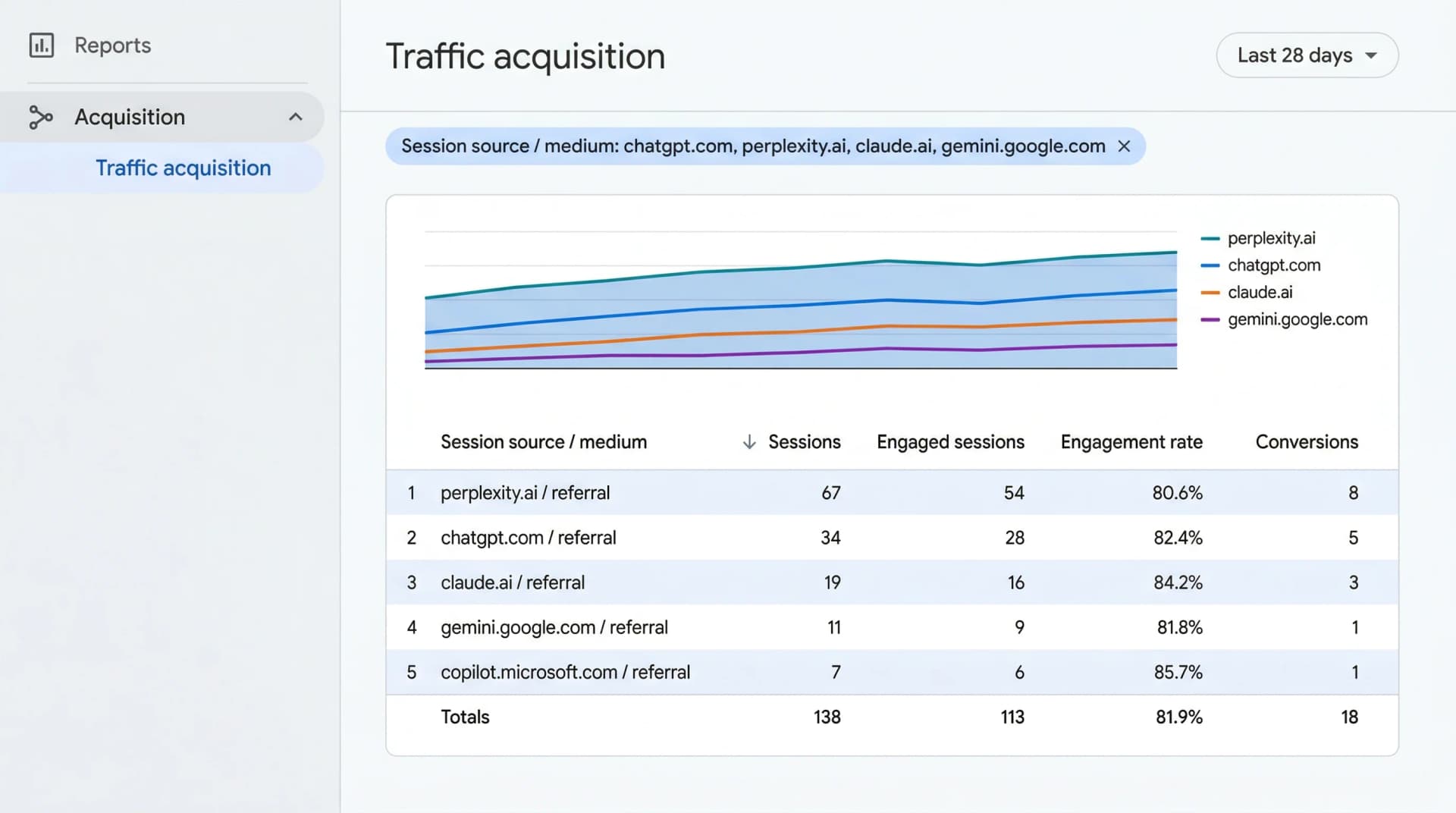
When someone asks ChatGPT for a lawyer on their phone and taps the link, that click often goes through the ChatGPT mobile app's internal browser. That browser strips the HTTP referrer header. Your GA4 records it as Direct traffic - the same category as someone who typed your URL directly into their browser. Our guide to ChatGPT traffic not showing in Google Analytics shows how to find it.
This is what analysts call dark traffic. The SparkToro estimate is that 53% of AI-driven clicks arrive as direct. Our own data across LovedByAI customers suggests the real number varies by industry and device mix, but it is consistently above 40%.
| Signal | What it means | Where to find it |
|---|---|---|
chatgpt.com / referral | Web-based ChatGPT click | GA4 → Traffic Acquisition |
perplexity.ai / referral | Perplexity web click | GA4 → Traffic Acquisition |
claude.ai / referral | Claude web click | GA4 → Traffic Acquisition |
| Direct spike on service page | Likely mobile AI referral | GA4 → Landing pages, filter Direct |
| New inquiry: "found you on ChatGPT" | Conversion from AI | Ask every intake |
The practical approach: use GA4 to track what you can see, watch your Direct traffic bucket for anomalies on specific pages, and ask every new client how they found you. The combination gives you a reasonable picture even when the attribution is imperfect.
A law firm example
Let us make this concrete. Take a solo family law attorney - call her Sarah Chen - practicing in a mid-size city. She has a five-year-old WordPress site, a Google Business Profile she claimed but rarely updates, and a Yelp listing that still shows her old address from when she moved offices three years ago.
A potential client in her city - going through a divorce, feeling overwhelmed - opens ChatGPT and types: "Who is a good family law attorney in [her city] who handles high-conflict custody cases?"
Here is what ChatGPT is evaluating in that moment:
- Can it find Sarah's business? Yes, her site is indexed.
- Does it know she handles family law? Probably - her homepage mentions it.
- Does it know she specializes in high-conflict custody? No - her service pages are generic.
- Can it verify her location? Conflicted - her website says one address, Yelp says another.
- Do external sources mention her? Avvo has a basic profile. That's it.
- Does she have reviews? Six on Google, none on Avvo.
The AI recommends someone else. Not because Sarah is less skilled - because her web presence gave the AI less to work with and less to trust.
What she needs:- A dedicated page for high-conflict custody cases that explains who she helps and what the process looks like
- Updated Yelp listing with her current address
- Avvo profile completed and linked from her website
LocalBusinessschema with her service area andFAQPageschema on her custody page- Five more Google reviews (a follow-up email to past clients is often enough)
None of this is exotic. It is all work that makes her practice better on every channel - not just AI.
An accounting example
Now take a ten-person accounting practice - mid-market clients, some business advisory work, CPA credentials across the team. Tax season is their peak. They spend money on Google Ads and have a reasonable website.
A business owner in an unfamiliar city types into Perplexity: "Which CPA firms in [city] handle small business tax returns and have experience with S-corps?"
Perplexity is doing something similar to ChatGPT: it is searching the web in real time, pulling from multiple sources, and synthesizing a recommendation. What does it find for this firm?
- Their website mentions "business tax services" once, on the services page
- No dedicated S-corp or small business content
- Google Business Profile has "Accounting" as the category - no sub-categories set
- LinkedIn company page exists but has 47 followers and no recent posts
- AICPA directory: not listed
- Local Chamber of Commerce: member, but no website link in their listing
Perplexity surfaces a larger regional firm that has an entire content hub about S-corp taxation and 200+ Google reviews. It also surfaces a solo CPA whose Thumbtack profile is extremely detailed.
The fix:- One well-written page dedicated to S-corp and small business tax returns - what it costs, what documents they need, what the process looks like
- AICPA directory listing activated and linked from the website
- Chamber listing updated with a website link
- Google Business Profile categories updated to include bookkeeping, tax planning, and business advisory
LocalBusinessschema withhasOfferCataloglinking their core services
Again - none of this requires a new website or a content marketing agency. It requires a focused afternoon of cleanup and one well-written service page.
Your practical first-check list
Before spending anything on AI optimization, run through this list. Everything here is either free or takes less than two hours:
| Check | What to look for | How to fix |
|---|---|---|
| Business information consistency | Compare your NAP (name, address, phone) across your website, Google Business Profile, Yelp, and LinkedIn | Update any mismatches to match your website exactly |
| AI bot access | Check yoursite.com/robots.txt for GPTBot, ClaudeBot, PerplexityBot | Remove any Disallow rules blocking these bots |
| Schema markup | Paste your homepage URL into schema.org/validator | Install a schema plugin or add LocalBusiness JSON-LD manually |
| Service page specificity | Read each service page aloud - would it answer a specific client question? | Add a client type, an outcome statement, and a 3-question FAQ to each page |
| Directory presence | Search your business name on Google, note which directories appear | Claim and complete profiles on the top 3 you find |
| AI visibility test | Ask Perplexity: "Who is [your name] at [your firm]?" | If it draws a blank or gives wrong info, start with NAP cleanup and schema |
| GA4 AI referrals | Filter Traffic Acquisition by chatgpt.com, perplexity.ai, claude.ai | If zero, check bot access and schema first |
The honest benchmark: If a potential client typed your name and city into Perplexity right now and it gave an accurate, confident description of what you do - you are in reasonable shape. If it hesitated, pulled the wrong information, or did not find you at all, the checklist above is your starting point.
Realistic expectations
I want to be honest about what AI search optimization can and cannot do:
What it can do:- Increase your visibility in AI-generated recommendations for local and specialty service queries
- Improve the accuracy with which AI tools describe your business
- Capture consultation inquiries from clients who prefer researching in AI tools rather than Google
- Strengthen your overall web presence (the work overlaps completely with traditional SEO and reputation management)
- Replace Google organic or paid as a primary lead channel for most businesses
- Guarantee placement - AI answers are generated, not ranked like search results
- Deliver 30-day results - the recrawl and reassessment cycle takes time
- Exactly how different AI platforms weight different signals (their ranking logic is not published)
- How much direct revenue is attributable to AI referrals across all business types - we have strong patterns in professional services but limited data in others
- How the channel will evolve as AI tools change their interfaces and ranking behavior
The businesses I have seen benefit most from this work treated it as a cleanup project first and a growth channel second. They fixed what was broken, got their information consistent, wrote service pages that actually answered real questions - and then started tracking the results. The AI traffic followed.
Where to start
If you want to know exactly where your site stands before doing anything else, the fastest path is a free GEO audit at LovedByAI. It scans your site for the specific signals AI platforms check - schema completeness, bot access, service page depth, and business information consistency - and gives you a prioritized list of what to fix first.
If you are already convinced and want to move faster, the LovedByAI plugin handles the schema, bot access, and structured data layer automatically - so you can focus your time on the service page writing and directory cleanup that no tool can do for you.
Either way, the first step is the same: know what you are actually dealing with before you spend another dollar optimizing for a channel you cannot yet measure. Sector-specific versions of this question are answered for GEO for law firms and IT support companies, with the rest on our industries hub.