
I recently spoke with a local consulting firm that started receiving a steady stream of highly qualified inquiries from ChatGPT. They did not achieve this by buying ads or tricking an algorithm. They simply structured their website to explicitly state their exact service offerings, operating areas, and credentials in a format that large language models can effortlessly parse.
When business owners ask me how to get ai chatbots to suggest my services, the answer is usually much more practical than they expect. You do not need to rebuild your entire marketing strategy. You just need to organize the facts about your business so that AI systems can read, verify, and cite them with confidence.
How to Get AI Chatbots to Suggest Your Services
AI Search engines do not guess. They look for consensus. To get recommended, you need to make your website the anchor of a consistent, cross-referenced identity loop. This means your site provides clear facts, and external directories verify those facts.
The search landscape is already shifting toward these direct-answer systems. A recent report from Gartner predicts that by 2026, traditional search engine volume will drop 25 percent as search marketing loses market share to AI chatbots and virtual agents. Adapting to this shift means ensuring your business is legible to these new platforms.
AI bots are not reading your site to learn about you. They are reading it to verify what other sources already say about you. If those sources and your site disagree, you lose the recommendation.
The problem for most small Service Businesses is not a lack of a website. The problem is inconsistency. If your website lists your address one way, but your local chamber of commerce directory lists it differently, the AI chatbot sees conflicting data. When an AI system encounters conflicting data, it skips your business and recommends a competitor with a cleaner digital footprint.
Your website remains your most important asset. A well-optimized website combined with consistent directory profiles creates the verification loop that AI tools trust. You establish the core facts on your own domain, and you ensure every other platform reflects those exact same facts.
Which AI Search Tools Should Your Business Prioritise?
You should focus your attention on the systems that are actively crawling local business data right now. Not all AI tools index the web the same way, and some are far more active in the professional services sector than others.
I analyzed crawler behavior across the professional services websites tracked on the LovedByAI platform. In the data I reviewed, ChatGPT-related bots (like GPTBot, ChatGPT-User, and OAI-SearchBot) averaged 14,734 visits per site over the last three months. This volume is significantly higher than any other AI system we track, making ChatGPT the undisputed priority for service businesses.
Following the Bot Traffic
Because ChatGPT is pulling this much data from service websites, structuring your content for OpenAI's crawlers is the most direct path to visibility. If you want a deeper look at the mechanics of this specific platform, it helps to understand exactly How to appear in ChatGPT results.
Other platforms like Claude and Perplexity are also sending crawlers, though at a smaller scale. These engines operate slightly differently, often prioritizing real-time web citations for complex queries. You can broaden your approach to Get cited in Perplexity and Claude web answers once your core ChatGPT foundation is secure.
What AI Search Optimization Adds on Top of Traditional SEO
Traditional SEO is not broken, and it is certainly not your enemy. In fact, strong traditional SEO builds the authority and structure that AI tools rely on. AI search optimization simply adds a specific layer of machine-readable facts on top of that existing foundation.
When you optimize for traditional search, you are largely helping Google's crawler parse links, keywords, and page hierarchy. When you optimize for AI, you are packaging your business facts into discrete concepts called entities. If you are curious about the technical difference, learning about SEO vs AEO: why entities matter more than keywords will clarify why this matters.
| What ChatGPT Looks For | What Traditional Google SEO Looks For |
|---|---|
| Explicit entity relationships and structured facts | Keyword density and topic clusters |
| Consensus across external directories | Inbound link profiles and domain authority |
| Direct, concise answers formatted as BLUF | Long-form content designed to keep users reading |
| Consistent NAP data verified by JSON-LD schema | Proper <title> tags and internal link text |
| Fast fact extraction without complex navigation | Deep site architecture and dwell time |
To bridge the gap between these two systems, you need to use structured data. Structured data is a standardized format for providing information about a page and classifying the page content. The most common format is JSON-LD, which is a script that sits invisibly in the <head> of your website.
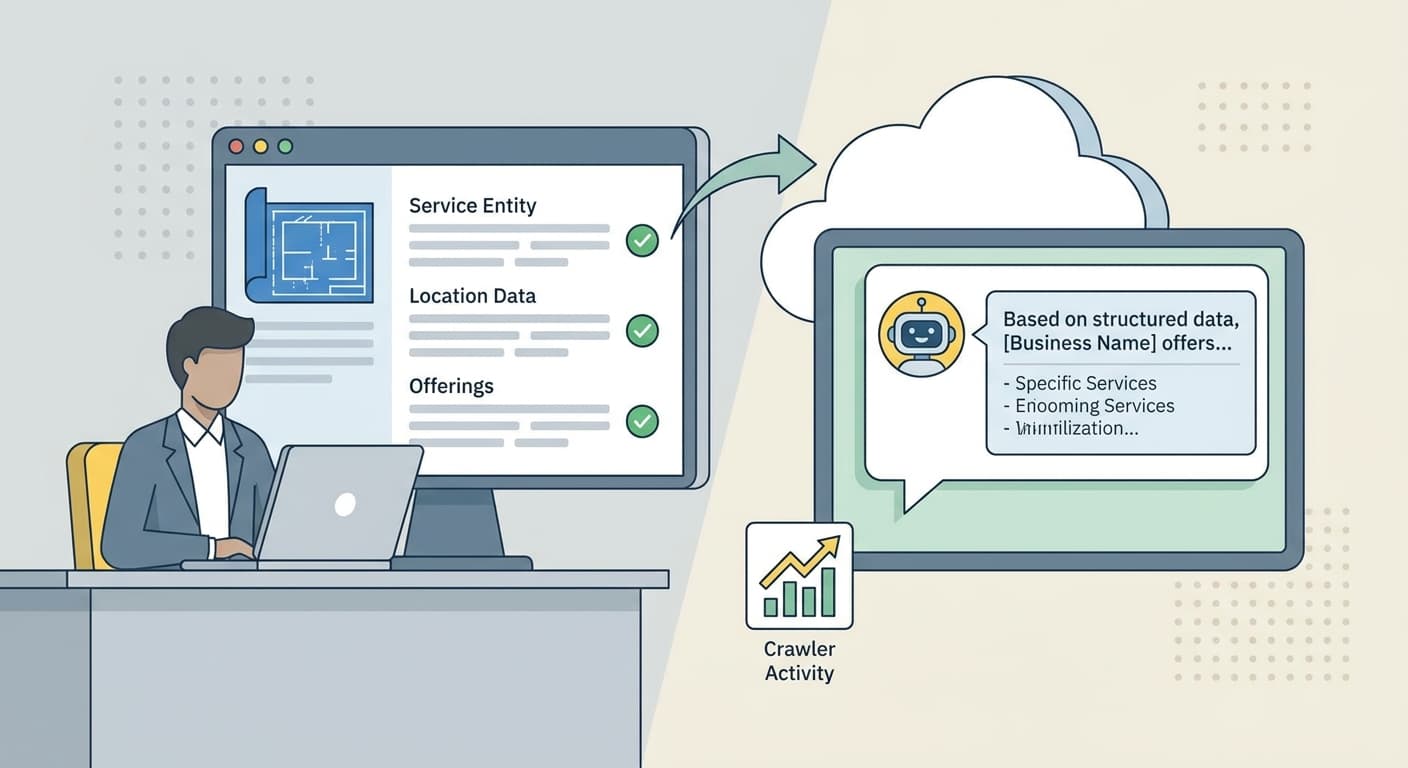
According to the official documentation from Google Search Central, adding this markup helps search engines understand the exact meaning of your content. AI chatbots use this exact same framework to confidently extract your business name, phone number, and service list without having to guess based on your paragraph text.
Structuring Your Service Pages for LLM Understanding
Large language models process information differently than human readers. A human might appreciate a clever introductory story about how your business was founded. An LLM just wants to know what you do, where you do it, and how a customer can contact you.
Your service pages should state the most important facts in the very first paragraph. Follow this with clear <h2> and <h3> headings that break your services down into specific, logical categories. Use bulleted lists for your service inclusions. This structural clarity reduces the processing power required for an AI bot to understand your page.
Adding the Technical Schema Layer
Once the visible text is clear, you need to add the hidden technical layer. This means implementing the correct vocabulary from Schema.org to label your services explicitly.
When you use JSON-LD, you are handing the AI a perfectly organized filing card about your business. Here is an example of what that code looks like for a specific service:
{
  "@context": "https://schema.org",
  "@type": "Service",
  "name": "Commercial Plumbing Maintenance",
  "serviceType": "Plumbing",
  "areaServed": {
    "@type": "City",
    "name": "Chicago"
  },
  "provider": {
    "@type": "LocalBusiness",
    "name": "Smith Plumbing Services",
    "telephone": "+1-555-0198"
  }
}
Choosing Your Implementation Path
You do not have to write this code manually. If you are comfortable editing your website, you can use free plugins to inject basic business schema into your pages, and our roundup of the best generative engine optimization tools covers the options worth comparing. This manual path works perfectly well if you only have a few core service pages to manage.
If handling code sounds risky or time-consuming, LovedByAI can help. The platform detects missing schema on your site and can auto-inject nested JSON-LD directly into your pages. It also helps reformat your content into an AI-friendly structure, ensuring that when ChatGPT's bots arrive, they find exactly the verified facts they need to recommend your business to a potential client. If you would rather read the version for your own sector first, we have guides for law firms, accountants and IT support companies.
