
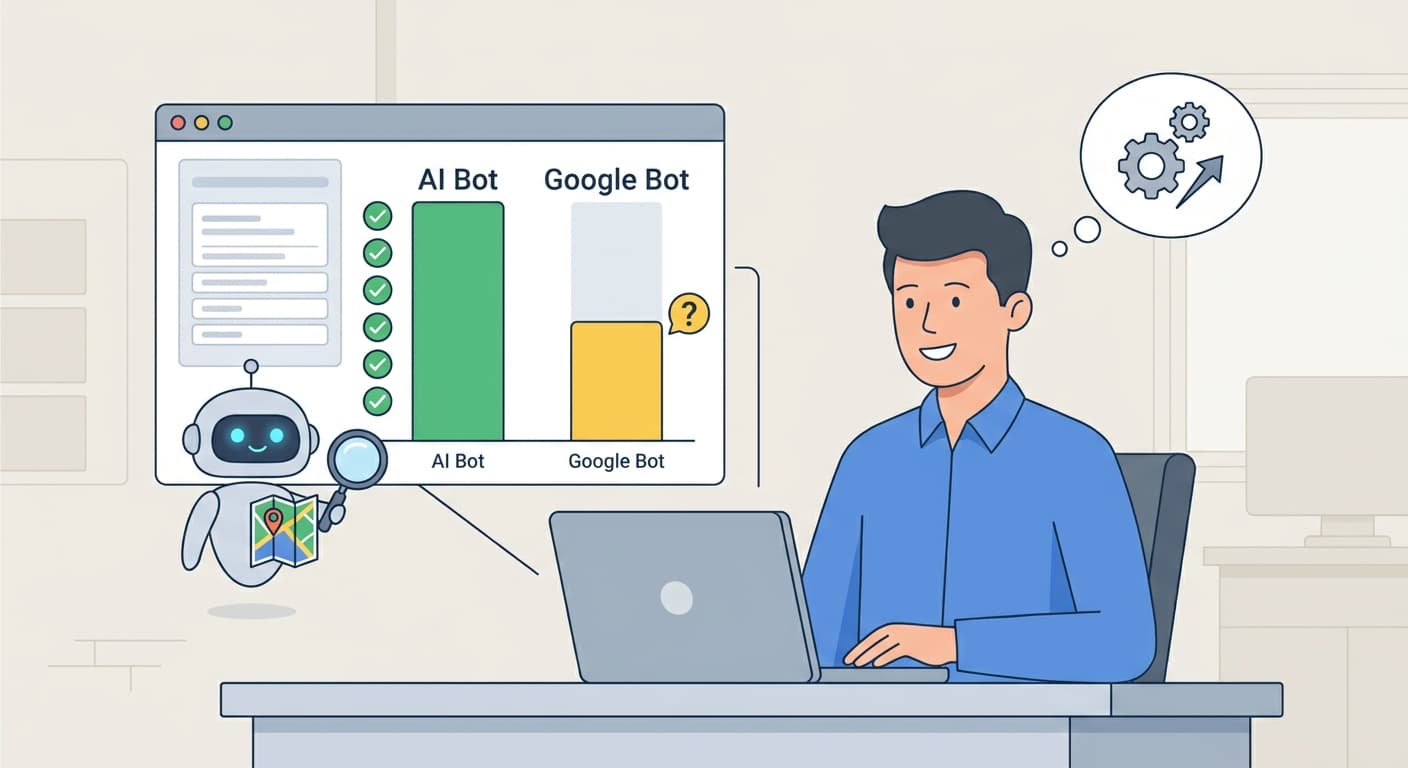
Looking at the data I review daily across the LovedByAI platform, I noticed a distinct shift early this year. The bots actively scanning local service websites are no longer primarily from Google. AI crawlers have quietly taken the lead, looking for facts to feed directly to searchers.
When potential clients search for a service provider today, they often ask a chat interface a direct question instead of scrolling through ten blue links. If your business is not appearing as a recommended answer, it is not because your website is broken. The search landscape has shifted, and AI engines simply evaluate trust differently than traditional search engines do.
How to Get Found on Perplexity AI: Your Core Strategy
To understand how to get found on Perplexity ai, you have to look at how the platform decides what is true. Perplexity does not just read your website in isolation. It relies on a cross-reference loop to verify your claims.
This loop requires two strong pillars. The first pillar is your own website, which needs to state exactly what you do, who you serve, and where you are located. The second pillar consists of trusted third-party directories like Yelp, Google Business Profile, or industry-specific registries.
Building the Verification Loop
Many business owners mistakenly believe that AI engines make websites irrelevant. That is entirely backwards. A well-optimized website combined with consistent directory profiles creates the exact cross-reference loop that AI tools trust.
AI bots are not reading your site to learn about you. They are reading it to verify what other sources already say about you. If those sources and your site disagree, you lose.
If your website says you offer commercial plumbing in Chicago, but your Yelp profile lists you as a residential plumber in Evanston, Perplexity gets confused. When an AI system encounters conflicting information, it does not try to guess which one is right. It simply skips your business and recommends a competitor with a consistent digital footprint. You can read more about how this works if you want to get cited in Perplexity.
Why AI Search Crawls Matter for Your Service Business
Website traffic from human visitors is the ultimate goal, but bot traffic is the leading indicator of whether you will ever get those visitors. If AI bots are not visiting your pages, your business cannot be synthesized into AI answers.
I analyzed crawler behavior across the professional service sites I track on the LovedByAI platform. Between January and April 2026, average AI bot visits per site grew fourfold, jumping from 4,086 to 15,845.
The Tipping Point for Local Search
By February 2026, these AI crawls had officially overtaken traditional Google crawls for the first time on the sites in our dataset. This is not a future trend to prepare for next year. It is the reality of how discovery works right now.
When an AI engine crawls your site that frequently, it is constantly checking for fresh, structured facts. If you update your service areas or business hours, the bots will notice quickly. You can read the Google Search Central guidelines to see how traditional crawling has evolved alongside these new AI behaviors.
How Perplexity Analyzes Your Site vs Traditional Google SEO
Traditional SEO is not obsolete, but it operates on a different set of rules than AI search. Google built its reputation by analyzing how pages link to one another. Perplexity built its system by analyzing the factual relationships between concepts.
If you are paying for an SEO service and not seeing results in AI platforms, the issue is usually a mismatch in priorities. Traditional SEO optimizes for how a crawler parses links and long articles. AI optimization focuses on extracting explicit answers.
| What Perplexity AI Looks For | What Traditional Google SEO Looks For |
|---|---|
| Authoritative citations | Backlinks |
| Entity relationships | Long-form content formatting |
| Clear direct answers | Keyword frequency |
The Shift from Keywords to Entities
To an AI engine, your business is an entity. An entity is simply a distinct, recognizable concept, like a specific business name, a person, or a service location, rather than just a typed keyword.
Perplexity wants to map the entity of your business to the entity of a specific service. It cares much less about how many times a keyword appears on your page. This is exactly why entities matter more than keywords when optimizing for modern discovery tools.
Which AI Crawlers to Prioritize for Your Website
Not all bots are created equal. To become a trusted citation, you need to ensure the crawlers powering the most popular AI platforms have clear, unrestricted access to your content.
In the proprietary data I reviewed, ChatGPT-related bots, specifically GPTBot, ChatGPT-User, and OAI-SearchBot, averaged 15,302 visits per site over the last three months. They are currently the most active AI crawlers in the local service space.
Checking Your Access Logs
You also need to ensure that the bot specific to Perplexity is welcome on your site. You can review the Perplexity crawler documentation to understand how their specific user-agent behaves.
If your website has aggressive firewall rules or an outdated configuration, it might be blocking these bots by mistake. A simple check of your server logs or a conversation with your hosting provider can confirm that these bots are getting through.
User-agent: PerplexityBot
Allow: /

User-agent: GPTBot
Allow: /
That basic configuration in your text file tells the AI platforms that your door is open. If you block them, you block your business from appearing in their answers entirely.
Structuring Your Content to Become a Trusted Citation
Giving bots access is only the first step. Once they arrive, you must provide them with explicit data so they do not have to guess what services you offer.
The most effective way to do this is with JSON-LD. JSON-LD is a specific format for adding code to your site that clearly labels your facts for machines. Instead of hoping the AI reads a paragraph and figures out your phone number, JSON-LD labels the number explicitly as your contact line.
{
  "@context": "https://schema.org",
  "@type": "LocalBusiness",
  "name": "Smith & Associates Accounting",
  "telephone": "+1-555-0198",
  "address": {
    "@type": "PostalAddress",
    "streetAddress": "100 Main Street",
    "addressLocality": "Chicago",
    "addressRegion": "IL",
    "postalCode": "60601"
  }
}
This structured data aligns perfectly with the Schema.org LocalBusiness specification. When Perplexity reads this code, it instantly registers your business name, category, and exact location without having to parse complex sentences.
Publishing Clear Answers
Beyond the code, your actual page text needs to be formatted for quick extraction. Place the most important information at the top of the page. If you offer emergency roofing repairs, state your response time and service radius in the first two sentences.
If you use WordPress, you can streamline this process significantly. Following a structured approach to WordPress AI search optimization ensures your pages load quickly and present information in a format that AI tools prefer.
You can try to implement all of these technical signals by hand, or you can check your site using our free tool to see exactly what AI bots can currently read about your business. Either way, the goal remains the same. You want to make it as easy as possible for Perplexity to understand your business, verify it against other sources, and present it confidently to your next client.