A freelance graphic designer launches a stunning new portfolio website, fills it with detailed case studies, and waits for the inquiries to roll in. Almost immediately, the digital footprint they establish across industry directories dictates how AI agents categorize, understand, and ultimately recommend their work to prospective clients.
If your portfolio is live but AI platforms are ignoring it, the issue is rarely the quality of your work. The search landscape has shifted toward systems that cross-reference multiple sources before making a recommendation. AI engines do not evaluate how beautiful your website design is. They evaluate how confidently they can verify your professional identity across the web.
Why Is ChatGPT Not Recommending Your Freelance Services?
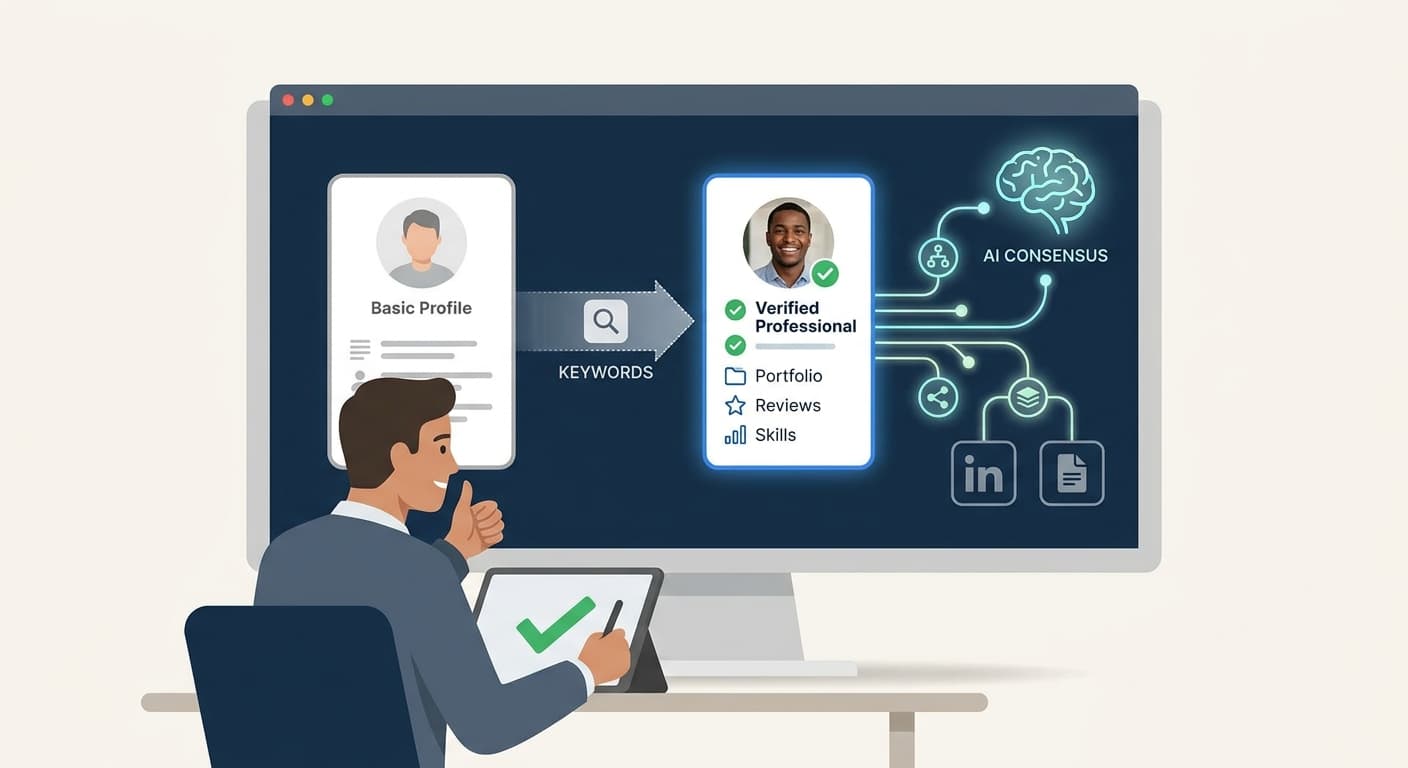
ChatGPT does not recommend your freelance services based solely on the text written on your homepage. It recommends professionals based on entity consensus. This means the system looks for agreement between your own website and trusted third-party platforms before it feels confident enough to present your name to a user.
Large language models are designed to predict the most accurate and helpful response to a prompt. When a potential client asks for a freelance web developer or a branding specialist, the AI evaluates its training data to find a verifiable answer. If it relies on a single source, it risks hallucinating or providing inaccurate information. To mitigate this risk, AI tools seek out multiple, independent sources that all tell the exact same story about who you are and what you do.
Your website serves as the anchor and the single source of truth for your business. Directory profiles, portfolio sites, and social media accounts validate that truth. When your website and your external profiles perfectly align, you create a powerful trust signal.
The Cross-Reference Loop
This verification process is called the cross-reference loop. It is the foundation of modern search visibility for independent professionals. When an AI tool receives a relevant query, it checks its index to see which names appear consistently across authoritative platforms.
If you want to understand How to Appear in ChatGPT Results, you have to give the AI a consistent entity to find. Inconsistency breaks the cross-reference loop. If your website says you are a brand strategist but your most active Directory Listings label you as a social media manager, the AI system gets confused. Rather than risking a bad recommendation, it simply skips you and recommends a freelancer with a clearer digital footprint.
| Evaluation Target | What Google Looks For | What ChatGPT Looks For |
|---|---|---|
| Core Content | Keyword mapping and search intent | Conversational context and direct answers |
| Trust Signals | Traditional backlinks and domain authority | Structured entity data and source consensus |
| Validation | Technical site speed and mobile usability | Third-party profile agreement and citations |
The Shift to AI: Analyzing Crawl Data Per Freelancer Site
AI Search bots are aggressively indexing independent professional sites right now. They are gathering the data required to build their internal maps of service providers.
I analyzed crawler behavior across professional services and consulting sites tracked on the LovedByAI platform. Between January and April 2026, average AI bot visits per site grew three times over. In January 2026, the average site still had more Google crawls (1,981) than AI crawls (999). By April 2026, AI crawls per site reached 3,402, entirely overtaking Google, and that ratio has held steady since.
AI bots are not just reading your portfolio to admire your work. They are scraping your site to verify your professional entity against the rest of the web.
What the Crawl Surge Means for Independent Workers
This proprietary data tells us that AI engines are actively seeking out detailed information about service providers. They are continuously updating their knowledge bases to provide better recommendations. The freelancers who capture this early visibility are the ones actively structuring their websites to welcome these bots and feed them clear data.
If your site is built on WordPress or a similar content management system, you have total control over what these crawlers see. You do not need a massive marketing budget or an agency on retainer to show up in these new Search Results. You just need to ensure the bots find a structured, unmistakable definition of your business every time they visit.
When bots visit your site thousands of times a month, they are looking for changes, updates, and confirmations of your core details. They want to see that your business name, your primary contact information, and your service offerings remain stable and clear.
Moving Beyond Keyword Stuffing
Because these systems are visiting more frequently to verify facts, the old method of stuffing location keywords into your page footer no longer provides a competitive edge. The focus has shifted from keyword density to clarity.
You need to focus on the transition from SEO vs AEO: why entities matter more than keywords. An entity is a distinct, well-defined concept. In this context, the entity is you as an independent professional offering a specific service. AI tools want to map queries to entities, not just match text strings to paragraphs.
Establishing Your Brand Entity Without a Marketing Team
You can establish a strong brand entity by adding JSON-LD schema markup to your website and matching it perfectly with your directory profiles. This single technical step bridges the gap between how humans read your portfolio and how machines interpret your business.
JSON-LD is a type of code you place in the <head> section of your website. It stands for JavaScript Object Notation for Linked Data. While it sounds highly technical, it is simply a standardized format for listing facts about your freelance practice in a way that AI crawlers can instantly digest.
Adding Professional Schema
For freelancers and independent consultants, the most effective schema type is usually the ProfessionalService or Person markup. This structured code tells the AI your exact business name, what services you offer, and where your other verified profiles live online.
When AI systems find this code, they do not have to guess what your website is about by parsing your creative copywriting. They read the facts directly. Here is a basic example of what this schema looks like when properly formatted.
{
  "@context": "https://schema.org",
  "@type": "ProfessionalService",
  "name": "Jane Doe Graphic Design",
  "image": "https://example.com/profile.jpg",
  "url": "https://example.com",
  "sameAs": [
    "https://www.linkedin.com/in/janedoe",
    "https://www.behance.net/janedoe",
    "https://www.upwork.com/freelancers/janedoe"
  ],
  "jobTitle": "Freelance Graphic Designer",
  "description": "Specializing in brand identity and digital illustration for small businesses."
}
This code acts as a digital business card specifically printed for AI crawlers. It leaves no room for ambiguity or misinterpretation.
Connecting the Dots with SameAs Links
Notice the sameAs field in the code block above. This field is the exact mechanism that builds your cross-reference loop. By listing your LinkedIn, Behance, Upwork, or GitHub profile URLs in this section, you explicitly tell the AI that the professional on this website is the exact same person found on those trusted platforms.
You can add this code manually using a free plugin like WPCode if you run a WordPress site. You simply paste the snippet and set it to load in your site header. Alternatively, tools like LovedByAI can auto-inject this schema across your pages, identifying missing fields and keeping your entity data consistent without requiring you to handle code directly.
Once your schema is in place, you must audit your external profiles. Check your name, your primary service title, and your contact information on every platform where you maintain an active presence. If you use "Jane Doe Graphic Design" on your website but "Jane Doe Creative" on LinkedIn, you need to pick one format and unify them across the internet.
Where AI Search Optimization Complements Traditional SEO
Optimizing for AI platforms does not replace traditional SEO. The two disciplines work closely together to build the authority, structure, and clarity that modern search tools demand. Traditional search engine optimization builds the foundation, while AI visibility layers on top of it.
Traditional SEO remains entirely relevant because AI tools look for high-quality sources to cite. Research consistently shows that a large majority of the pages cited by ChatGPT already have strong visibility in standard Google search results. SEO builds the initial authority that AI tools rely on when deciding who to trust.
The Role of Your Own Website
Your own website is the anchor for all of your marketing efforts. AI optimization is never about abandoning your site to focus entirely on directory listings or social media profiles. It is about making your site the definitive, machine-readable source of truth that those directories point back to.
When you Get Cited in Perplexity and Claude Web Answers, it is because those platforms traced the information back to the high-quality, properly structured pages you built and maintained. The directories act as supporting evidence, but your site is the primary asset.
Traditional SEO ensures your site is fast, accessible, and structured with clear HTML tags like <h1> and <h2>. AI optimization layers specific structured data, direct answers, and entity consistency on top of that framework. Both are necessary for a complete digital strategy.
A fast website with clear headings is great for Google. A fast website with clear headings, direct answers, and consistent entity schema is ready for AI search.
Next Steps for Your Freelance Practice
Start by taking a thorough inventory of your current digital footprint. List every directory, social platform, portfolio site, and freelance marketplace where your business is mentioned. Update every single profile to reflect the exact same business name, service description, and contact details.
Next, implement basic structured data on your website. Whether you write the JSON-LD manually, use a dedicated code snippet plugin, or deploy an automated tool, ensure the code points directly to your newly updated external profiles.
By completing this cross-reference loop, you eliminate confusion for the bots crawling your site. You give AI search tools the clear, undeniable consensus they need to confidently recommend your freelance services the next time a potential client asks for a recommendation.