When a potential client asks Google AI to find a freelance professional with niche industry experience, the AI skips standard image galleries and looks straight for clearly structured text linking your name to specific outcomes. Many independent professionals rely on visual portfolios because human clients want to see the final product. AI Search engines operate differently. They need clear, factual statements that prove what you did, who you did it for, and the results you achieved.
The search landscape has shifted for independent contractors. A well-designed website full of beautiful thumbnail images is no longer enough to guarantee discoverability. To establish trust with AI systems, you need a cross-reference loop. This means pairing a structured, text-rich website with consistent professional directory profiles. The goal is not to abandon your website for external directories. It is to make sure your website provides the factual foundation that other sources verify.
How to Get Your Freelance Portfolio to Show Up in Google AI
You must shift from a visual-heavy showcase to an entity-based structure that connects your name, skills, and client outcomes across your entire web presence. AI systems do not look at a graphic design or coding project and inherently understand its value. They read the text surrounding the project to categorize your expertise.
Figuring out how to get freelance portfolio to show up in google ai requires translating your visual work into factual data. If your portfolio currently consists of a grid of images that open in a lightbox, you are missing the context AI needs. Each project needs a dedicated page that explicitly names the client industry, the specific service provided, and the measurable outcome.
Building the Trust Loop
AI tools look for consensus before recommending a professional. If your website claims you are a freelance financial copywriter, Google AI wants to see that same claim mirrored on authoritative platforms. This is why a standalone website is powerful but incomplete on its own.
You build the trust loop by ensuring your name, title, and core services are identical on your website, your LinkedIn profile, and industry-specific directories. When an AI crawler reads your optimized website and then finds matching information on a high-authority directory, it builds confidence in your identity. That confidence translates into recommendations when a user searches for your specific freelance skillset.
Why AI Crawl Rates Are Outpacing Traditional Search Bots
AI bots are actively indexing freelance sites to build their knowledge graphs. Their activity is accelerating rapidly as platforms compete to provide the most accurate answers to complex user queries. A searcher is no longer just typing "freelance developer." They are typing "find me a freelance WordPress developer who has experience migrating e-commerce sites and improving load times."
I analyzed crawler behavior across professional services and freelance sites on the platform. Between January and March 2026, average AI bot visits per site grew significantly. In Jan 2026, the average site still had more Google crawls (1,981) than AI crawls (999). By March 2026, those AI bot visits had reached 2,665, a nearly 3x increase. By April 2026, AI crawler activity had overtaken traditional search bots entirely.
AI bots are not just reading your site to index keywords. They are reading it to extract factual relationships about your services, your clients, and your professional authority.
The Shift in Freelance Discovery
This surge in crawl activity aligns with broader market trends. The Upwork Freelance Forward 2023 report highlighted the massive growth of the independent workforce. As more professionals enter the market, clients use more specific, long-tail queries to filter candidates.
When you configure your portfolio to communicate clearly with these AI crawlers, you capture the attention of high-intent clients. These clients use conversational search to bypass generic job boards and find specialists. Your site needs to be ready when the bots arrive to categorize your expertise.
Structuring Your Case Studies for Google AI Overviews
AI Overviews need clear, text-based proof of your capabilities. A gallery of thumbnails wrapped in <div> tags and basic <img> elements will not provide the necessary context. You have to explain the business problem you solved.
Moving Beyond Image Tags
Traditional portfolios rely heavily on image alt text to describe projects. While alt text is helpful for accessibility and image search, it does not tell an AI engine about the scope of the project or your role in it. You need structured paragraphs and headings that outline the project brief, the execution, and the results. If you need a complete primer on setting up this technical foundation, you can review this guide on WordPress AI Search Optimization from scratch: what works.
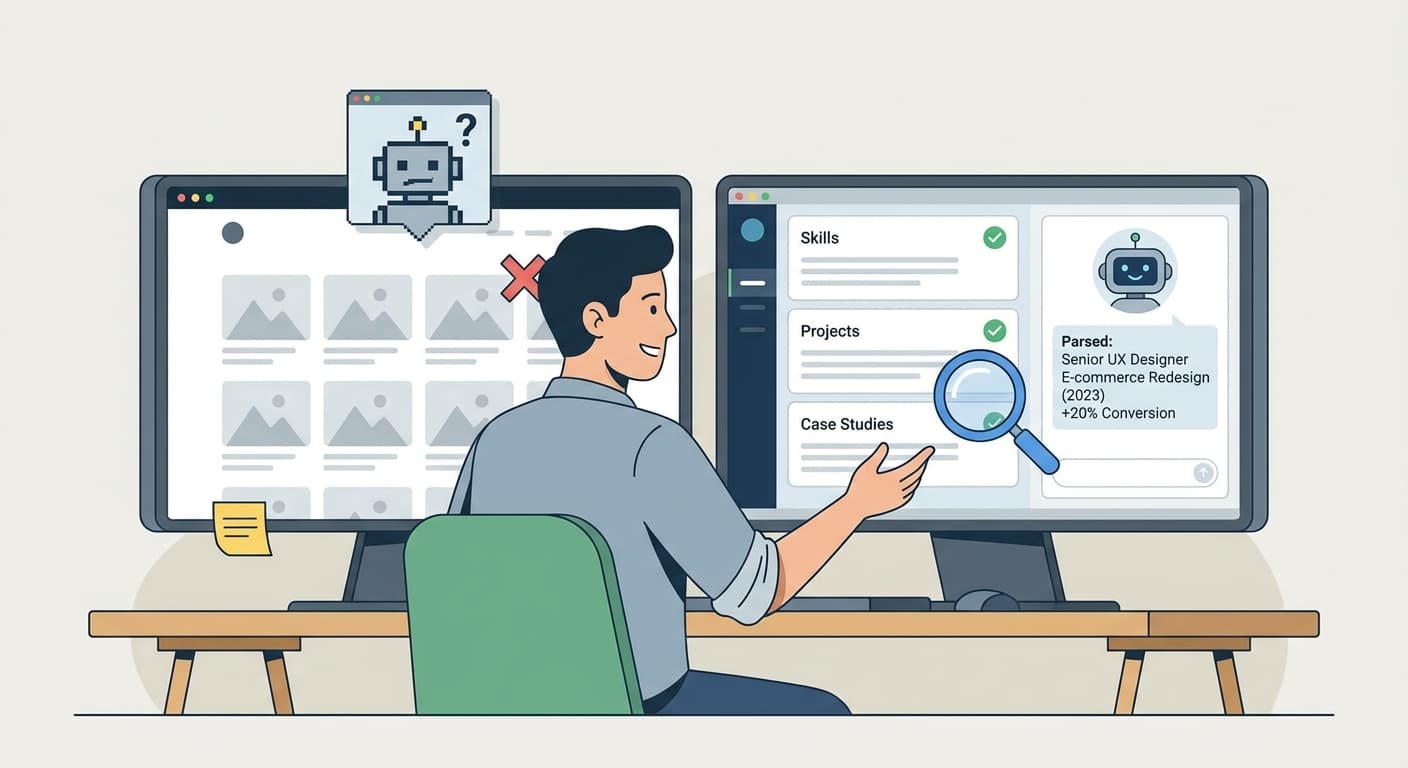
You can also use schema markup to define your projects clearly for search engines. Adding JSON-LD structured data to your individual portfolio pages tells the AI exactly what it is looking at. Here is a simplified example of how you might structure an article or case study:
{
  "@context": "https://schema.org",
  "@type": "Article",
  "headline": "B2B SaaS Website Redesign Case Study",
  "author": {
    "@type": "Person",
    "name": "Jane Doe",
    "jobTitle": "Freelance UX Designer"
  },
  "abstract": "Increased inbound lead conversion by 40 percent through a comprehensive UX overhaul and simplified checkout flow."
}
This code snippet lives in the <head> section of your portfolio page. It bypasses the need for the AI to guess what the page is about. It hands the bot a clean, machine-readable summary of the project and the outcome. You can learn more about formatting this data in the Schema.org Person markup documentation.
How AI Search Optimization Complements Traditional SEO
Optimizing for AI does not mean abandoning standard SEO. Traditional SEO builds the authority foundation that AI tools rely on. Google AI Overviews still evaluate the underlying quality and technical health of your website.
| Feature | Google AI Overviews | Traditional Google Search |
|---|---|---|
| Core Focus | Entity relationships and factual consensus | Keyword density and traditional content relevance |
| Proof of Work | Structured case studies and concrete outcomes | Image alt text and general portfolio pages |
| Authority Signals | Cross-referenced directory profiles | Standard backlinks from other websites |
The two systems work together. Traditional SEO ensures your pages load quickly, have secure connections, and feature logical site architecture. AI optimization layers on top of that by adding explicit factual relationships. You are essentially organizing your well-ranked content so that a large language model can synthesize it instantly.
Why Both Methods Matter
If you rank well in traditional search but lack clear entity definitions, an AI tool might skip your site when summarizing a topic because your content is too hard to parse. If you want to understand the technical difference between these two layers, read this breakdown on SEO vs AEO: why entities matter more than keywords.
The most effective portfolios maintain traditional best practices like fast hosting and mobile responsiveness. They simply add a layer of structured text, clear headings, and schema markup. You do not have to choose one strategy over the other.
Building Entity Authority as an Independent Professional
To AI, you are an entity. Your authority depends on a consistent cross-reference loop between your website and third-party platforms. When Google AI evaluates a freelance professional, it looks for external validation.
Maintaining Consistent Signals
Your name, your specific freelance title, and your contact information must match everywhere they appear online. If your website says you are a "Fractional CMO" but your LinkedIn says "Marketing Consultant," you are sending mixed signals. AI systems struggle with ambiguity. They prefer to cite sources that have a clear, unified identity across the web.
You can verify how Google interprets your structured data by running your pages through the official Google Search Central documentation tools. Checking your work ensures that the entity signals you are broadcasting are actually being received.
Consistency is the strongest signal you can send to an AI crawler. Every directory profile, social media account, and author bio should reinforce the exact same professional identity.
By structuring your portfolio around detailed case studies, utilizing basic schema markup, and keeping your professional profiles aligned, you give AI search engines exactly what they need. You transform your website from a simple visual gallery into a verifiable source of expertise. This makes your freelance business far more likely to surface when a client asks an AI to find the right specialist.