Why Traditional SEOs Fail at AI Search Optimization
Imagine paying an agency $2,000 a month for blog posts and backlinks, only to realize that average AI crawls per small service business site grew 33x between Dec 2025 and Mar 2026, and your current expert has not optimized for a single one of those 18,483 per-site AI bot visits.
!Traditional SEO vs Answer Engine Optimization focus areas
I see this happen constantly. A plumber, roofer, or financial advisor hires an agency to fix their search visibility. The agency runs their standard playbook of keyword research, content writing, and link building. Six months later, the business owner searches for their services on an AI platform and sees their competitors recommended instead.
The problem is not that traditional SEO is broken. The problem is that traditional search engines and AI Search tools process information in fundamentally different ways. When an agency applies a Google-first strategy to an AI platform, the result is usually zero visibility. If you are paying for optimization, you need to know exactly why the standard playbook fails in AI tools.
The Keyword Trap In An Entity World
Traditional SEO agencies base their entire strategy on keywords. They use tools to find out how many people search for "emergency plumber near me" or "best local tax advisor," and then they build pages specifically to target those exact phrases. They track rankings for those keywords and report on them monthly.
AI Search tools do not care about keywords. They do not maintain a traditional index of web pages mapped to search phrases. Instead, they organize information around entities. An entity is simply a distinct, recognized concept, like a specific business name, a person, or a geographical location.
When a user asks ChatGPT for a recommendation, the system is not scanning your site for keyword density. It is looking for a clear, verified entity that matches the context of the user's prompt. You can see SEO vs AEO: why entities matter more than keywords to understand exactly how this shift changes your content strategy. If your hired expert is only tracking keyword rankings, they are measuring the wrong system entirely.
AI bots do not read your website to learn about your keywords. They read your site to extract structured facts and verify them against other sources.
Ignoring The Right Crawlers
Every website owner knows about Googlebot. Traditional agencies spend significant time ensuring Googlebot can crawl and index a site efficiently. They check the robots.txt file and submit XML sitemaps to Google Search Console to keep the bots happy.
But focusing only on Google ignores the massive shift in how service businesses are discovered today. Across the LovedByAI dataset I reviewed, average AI crawls per small service business site grew 33x between Dec 2025 (565 visits) and Mar 2026 (18,483 visits). This marked the exact moment AI activity outpaced traditional Google crawls for these sites.
Even more importantly, I found that ChatGPT-related bots (GPTBot, ChatGPT-User, OAI-SearchBot) averaged 11,202 visits per small service business site over the last 3 months. If your agency does not know how to verify these specific bots, or if they accidentally block them in your site settings, your business simply will not exist in ChatGPT. Learning how to appear in ChatGPT results requires a deliberate strategy to welcome and feed these specific crawlers.
| Optimization Area | Traditional SEO Focus | AI Search Focus |
|---|---|---|
| Primary Goal | Rank a specific page URL | Provide a verified business entity |
| Content Strategy | Long-form articles and keyword density | Direct answers and structured facts |
| Technical Setup | HTML tags like <title> and <h1> | JSON-LD schema markup |
| Off-Site Signals | Backlink domain authority | Consistent directory citations |
Writing For Humans Instead Of Machines
A common tactic for traditional SEO is to write long, narrative blog posts. The goal is to keep humans on the page longer and signal to Google that the content is comprehensive. This often results in pages buried under paragraphs of introductory fluff before finally answering the actual question.
AI models use a process called Retrieval-Augmented Generation (RAG). This means when a user asks a question, the AI goes out to find specific, structured facts to build its answer. It does not want to read a five-minute story about the history of plumbing. It wants a direct answer wrapped in clear, machine-readable formatting.
If your agency is not formatting your core services with clean <h2> subheadings, bulleted <ul> lists, and explicit <table> elements, the AI will simply skip your page. The AI needs to extract the fact immediately. If the fact is hidden in a block of text, the crawler will move on to a competitor whose site is easier to parse.
Missing The Technical Translation Layer
Finally, traditional SEOs often misunderstand what makes a site technically sound for AI. They will ensure your site loads fast and looks good on a mobile phone. While those are good practices for human visitors, they do not help an AI crawler understand what your business actually does.
To be visible to AI, your site needs a translation layer. This is where schema markup comes in. Schema is a coded format (specifically JSON-LD) that sits invisibly in the <head> or <body> of your website and tells machines exactly what the page contains.
An expert focused on AI visibility will not just install a generic plugin. They will ensure your site outputs specific schema types, like LocalBusiness or FAQPage, using safe encoding functions like wp_json_encode if you are on WordPress. If your current agency cannot explain how they map your business details into structured data, they are not preparing you for AI search.
When Should You Hire Expert to Optimize for AI Search Results?
You are likely considering an expert because your current marketing spend is no longer producing the consultation calls it used to. The search landscape has shifted. Prospects are asking AI tools for plumber recommendations or financial advisor reviews instead of scrolling past ten blue links. If your business is missing from those AI answers, your current strategy needs an update.
The Breaking Point for Your Current Strategy
Most service businesses reach a plateau before they realize the rules have changed. You might have a marketing agency that sends you a monthly report showing steady organic traffic. But if that traffic does not translate into signed clients, the dashboard metrics do not matter. The first sign you need an AI search expert is this growing disconnect between your traditional search visibility and your actual lead volume.
If a traditional marketing agency tells you everything is working perfectly because you rank for specific local keywords, but your phone has stopped ringing, the gap is in how AI systems interpret your site. Traditional search optimization focuses heavily on keywords and backlinks. AI search visibility relies on entity relationships and structured data.
If your current consultant cannot explain the difference between those two approaches, it is time to look for specialized help. You need someone who understands the fundamental differences in how these systems operate.
| Focus Area | Traditional SEO Consultant | AI Search Expert |
|---|---|---|
| Primary Goal | Ranking high on search engine result pages | Earning direct citations in AI chat interfaces |
| Content Strategy | Keyword density and matching search intent | Entity relationships and factual accuracy |
| Off-Site Tactics | Building backlinks from high-authority domains | Formatting unstructured data across directories |
| Technical Focus | Optimizing <h1> tags and page load speed | Validating JSON-LD schema in the <head> section |
| Success Metrics | Monthly organic traffic and keyword positions | LLM citation tracking and qualified consultation calls |
When Bot Traffic Shifts Away From Google
I analyzed crawler behavior across small service business sites on our platform. Over the last three months, ChatGPT-related bots (GPTBot, ChatGPT-User, OAI-SearchBot) averaged 11,202 visits per site.
This data highlights exactly which crawlers an expert needs to prioritize. If your web team is only monitoring Googlebot activity in your server logs, they are ignoring a massive portion of the systems trying to read your website. An expert in Answer Engine Optimization (AEO) knows how to isolate this traffic. They check your server settings to ensure these specific bots are allowed in, and they structure your pages so the bots find exactly what they need immediately.
When AI bots visit your site, they do not behave like human readers. They are looking for clear, well-structured data. If your site forces them to parse through dense paragraphs just to figure out what services you offer, they will leave and cite a competitor whose site is easier to read.
The Gap Between Rankings and Citations
Getting cited by an AI tool requires a fundamentally different approach than ranking on page one of Google. A traditional search engine reads your text to see if it matches a user query. AI tools use a process called Retrieval-Augmented Generation (RAG). They pull facts, compare them across multiple sources, and write a custom answer for the user.
If your business is not mentioned in these answers, it is usually because the AI could not confidently verify your facts. This is the core of SEO vs AEO: why entities matter more than keywords. An expert will map out your business entity across the web. They will ensure your business name, address, phone number, and service areas match perfectly across your website, your directory listings, and your social profiles.
AI bots are not reading your site to learn about you. They are reading it to verify what other sources already say about you. If those sources and your site disagree, you lose.
You hire an expert when you need someone to translate your business information into a format that a machine can cite with confidence. They bridge the gap between human-readable marketing copy and machine-readable facts.
Evaluating the Right Kind of Expert
When you sit down to interview a potential consultant, pay close attention to the tactics they promise. If they guarantee to put you at the top of ChatGPT using traditional link building and blog keyword stuffing, you should look elsewhere. Those are old habits applied to new technology.
A qualified AI search expert will ask to audit your website code. They will want to know if your specific service pages use nested schema markup inside a <script> wrapper. They will explain how they plan to turn your unstructured service descriptions into machine-readable formats like lists and tables. They will also ask about your off-site directory presence to ensure your business entity is consistent everywhere.
If you want to know How to Appear in ChatGPT Results, the path requires this level of technical precision. Hiring an expert makes sense when you realize that auditing code snippets, monitoring bot crawl logs, and formatting unstructured data by hand is not the best use of your time as a business owner. A true expert takes that technical burden off your plate so you can focus on closing the clients they bring in.
Essential Skills to Look for in an AI Search Consultant
The old playbook of writing heavy, repetitive text around a single search phrase does not work for AI visibility. When you sit down to interview a marketing consultant, you need to know if they are running a traditional search playbook or if they actually understand how AI answers questions. A qualified expert in this space will talk about your web presence entirely differently than a standard agency. Here are the specific capabilities they need to demonstrate.
Entity Mapping over Keyword Stuffing
A real AI search expert focuses on connecting the dots between your business, your services, and the external directories that AI engines trust. Traditional search optimization mapped pages to target keywords. AI search engines map facts to entities. An entity is a distinct, machine-recognized concept, like a specific accountant, a specific accounting firm, or a specific financial service.
If a consultant talks primarily about keyword density or search volume, they are selling traditional optimization. An expert focused on AI will audit how well your business is established as a known entity across the web. This requires ensuring your firm is referenced consistently on high-trust platforms like legal directories, local chambers of commerce, and professional associations.
If the AI cannot verify your business details across multiple independent sources, it will not cite you. Your consultant must look beyond your website to build this trust.
This shift in focus is the core difference between traditional search and AI optimization. You can read more about why this shift matters in my guide on SEO vs AEO: why entities matter more than keywords. The consultant's job is to ensure that when an AI system pulls facts about your specific entity, all the data matches perfectly.
Technical Fluency with Nested JSON-LD
Your consultant must know how to write, inject, and validate nested structured data, rather than just installing a basic plugin and walking away. JSON-LD is the specific code format that search bots and AI crawlers use to read facts about your business without having to parse your paragraphs.
Many basic tools generate simple schema that tells a crawler your site belongs to a local business. An AI search expert goes deeper. They will build nested schema that links your business to your specific staff members, connects your services to your service area, and clearly defines your frequently asked questions. This structured data usually lives in the <head> section of your website.
Here is a simple example of what that nested code looks like when an expert configures it for a service business:
{
  "@context": "https://schema.org",
  "@type": "AccountingService",
  "name": "Smith Tax Group",
  "knowsAbout": ["Tax Preparation", "Small Business Accounting"],
  "areaServed": {
    "@type": "City",
    "name": "Chicago"
  }
}
If your candidate cannot explain what this code does in plain English, they are likely not equipped to optimize your site for AI platforms. They do not need to be a software developer, but they must understand how to format your business facts so a machine can read them instantly.
Understanding RAG Formatting and Citation Logic
The right hire knows how to format your page structure so an AI engine can quickly pull it as a direct answer. Modern AI search tools use a process called Retrieval-Augmented Generation (RAG). This simply means the AI searches the live web for facts to build its answer, rather than relying solely on the data it was originally trained on.
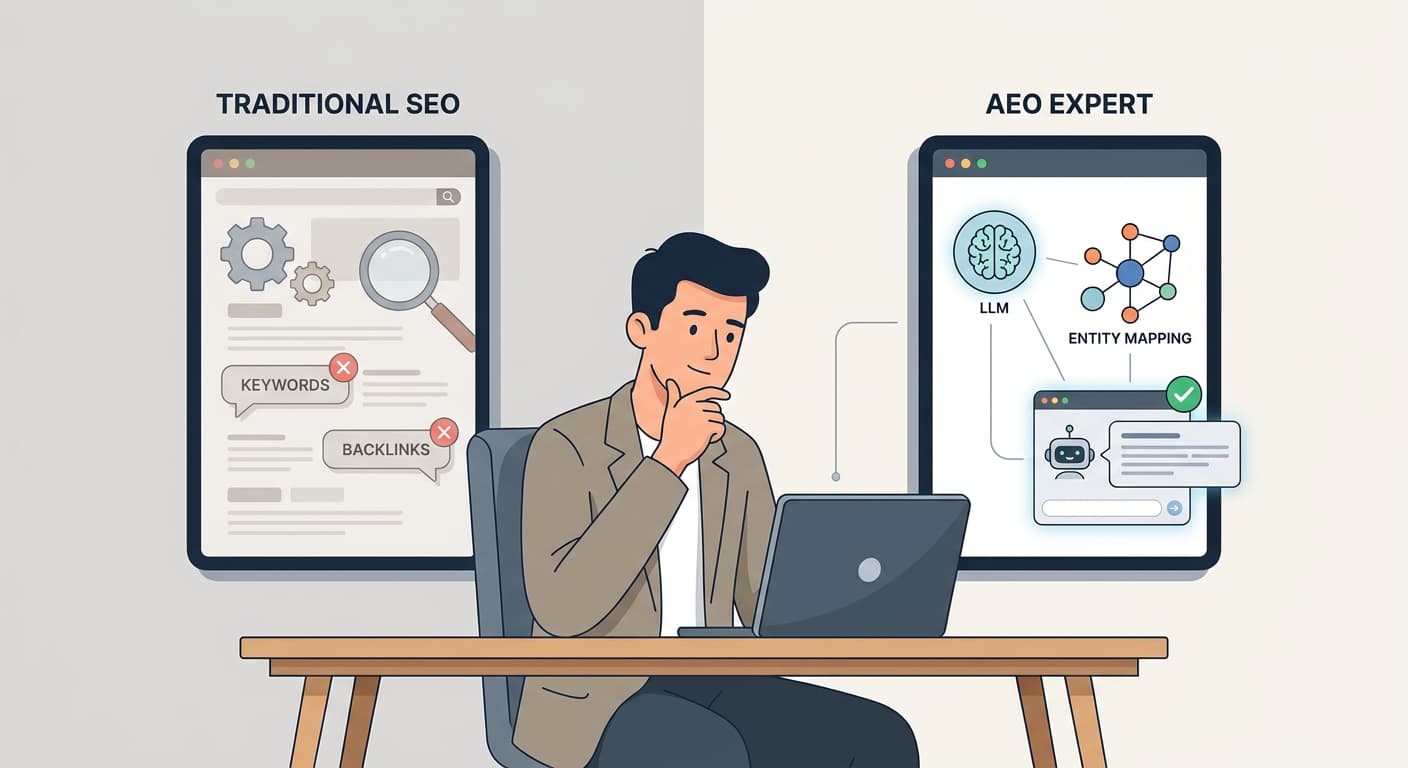
To get cited by these systems, your content must be formatted in a way that the AI can extract easily. A consultant who understands RAG will audit your heading structure. They will ensure your <h2> and <h3> tags contain direct questions or clear statements, and they will follow those headings immediately with concise, factual answers.
If you want to understand how this formatting actually looks in practice, I break down the exact structure in my guide on how to Get Cited in Perplexity and Claude Web Answers. A good consultant will restructure your long paragraphs into tight bullet points, clear tables, and short definitive sentences that an AI can confidently quote.
A Focus on Cross-Platform Verification
AI models check your claims against third-party directories before recommending you to a potential client. Your expert must audit your entire digital footprint, not just the pages on your domain. If your website claims you are a premier personal injury lawyer, but your state bar association profile is outdated and your directory page lists the wrong phone number, the AI drops its confidence in your business entirely.
A traditional search consultant usually focuses all their time on your own website. An AI visibility expert operates differently. They treat your website as the hub, but they spend equal time ensuring your external directory profiles match your site exactly.
| Focus Area | Traditional Search Consultant | AI Search Consultant |
|---|---|---|
| Primary Goal | Rank a specific page for a target keyword | Get the business cited in AI answers |
| Content Strategy | Write long articles to capture search traffic | Format facts clearly for immediate machine extraction |
| Technical Priority | Page speed and standard meta tags | Nested JSON-LD schema and entity mapping |
| Off-Site Strategy | Buying or earning backlinks | Ensuring data consistency across trusted directories |
When interviewing a candidate, ask them how they handle conflicting business information across the web. Their answer will tell you immediately if they understand how AI engines verify facts. They should outline a clear process for finding every mention of your firm online, correcting outdated phone numbers or addresses, and ensuring the name of your business is identical everywhere it appears.
Red Flags When Interviewing AEO Specialists
When you sit down to interview a marketing consultant or agency about AI search, you need to know how to spot traditional SEO dressed up as something new. Many providers simply add an AI label to their existing service packages without changing their methodology. Here is what to watch out for to ensure you are talking to someone who actually understands how systems like ChatGPT and Perplexity evaluate small service businesses.
Promising Mentions Based on Keyword Density
If an agency tells you they will get you into AI results by writing long articles stuffed with specific search phrases, end the interview. AI systems do not count keywords to decide who to recommend. They look for clear, structured facts that establish what your business does and who it serves.
An expert who still focuses heavily on keyword density is using an outdated playbook. Systems like ChatGPT use Retrieval-Augmented Generation (RAG). This means they read your site to extract specific facts, known as entities, rather than matching search terms string for string.
AI bots are not reading your site to learn about you. They are reading it to verify what other sources already say about you. If those sources and your site disagree, you lose.
In the data I reviewed across over 210,000 pages analyzed for AI visibility gaps, the pages that successfully generated AI citations were not the ones with the most words. They were the ones with the clearest factual structure. A true expert will talk to you about organizing your services clearly, not about hitting an arbitrary word count on your blog.
Selling AI Optimization Without Touching Your Schema
You cannot optimize a service business for AI search without discussing structured data. If a specialist plans to optimize your site but never mentions JSON-LD or schema markup, they are missing the most critical technical layer of AI visibility.
Schema is a type of code you place on your website to hand feed facts directly to bots. It lives inside a <script> tag in your site's code and is invisible to human readers. If your expert only wants to update your <h1> tags or meta descriptions, they are doing traditional SEO and ignoring the tools that answer engines rely on most.
Here is what a basic LocalBusiness schema looks like. A competent expert should be comfortable explaining how they will implement something like this for your specific practice:
{
  "@context": "https://schema.org",
  "@type": "LocalBusiness",
  "name": "Smith Consulting Partners",
  "telephone": "+1-555-0123",
  "address": {
    "@type": "PostalAddress",
    "streetAddress": "123 Main St",
    "addressLocality": "Springfield",
    "addressRegion": "IL",
    "postalCode": "62701"
  }
}
A real expert will want to audit your existing schema immediately to see if it accurately reflects your core services and location.
Ignoring the Cross-Reference Loop
An agency that focuses 100 percent of their effort on your website and ignores your external profiles does not understand how AI tools verify trust. AI models do not blindly trust what a business says about itself on its own domain. They cross-reference your claims against third-party directories, local chambers of commerce, and industry associations.
If your website says you specialize in commercial roofing, but your Better Business Bureau profile lists you as a general handyman, the AI detects a conflict. When AI systems detect conflicting information, they simply move on and recommend a competitor with a cleaner digital footprint.
A qualified specialist will ask for a list of everywhere your business is mentioned online. They will explain that fixing your website is only half the job. The other half is ensuring your name, address, phone number, and service categories match perfectly across the internet.
Guaranteeing Specific Placements in AI Answers
Run away from anyone who guarantees your business will show up every time someone asks ChatGPT for a service provider in your city. Because AI responses are generated dynamically based on conversational context, no one can promise a static ranking.
Traditional search engines give you a fixed page of results. Answer engines construct a custom response for every single prompt. A good expert will be honest about this uncertainty and set realistic expectations about what they can actually control.
| The Red Flag Promise | The Realistic Expert Promise |
|---|---|
| "We will rank you number one in ChatGPT." | "We will structure your site so AI tools can accurately read your services." |
| "This tactic guarantees AI tools will recommend you." | "We will remove the technical barriers preventing AI from seeing you." |
| "We just need to rewrite your blog posts." | "We need to align your site data with your external directory profiles." |
| "We know exactly how the Perplexity algorithm works." | "We know what machine-readable signals these platforms look for." |
Your goal is to hire someone who focuses on making your business as clear, factual, and machine-readable as possible. If they promise magic tricks or use fear to push a contract, they are not the right fit for your business.
How to Measure the ROI of Your AI Search Expert
Hiring an expert to optimize your digital presence for AI search tools is an investment. Like any marketing expense, you need a reliable way to know if that investment is producing a return. I analyzed crawler behavior across professional services sites on the platform. Between January and March 2026, average AI bot visits per site doubled - from 1,391 to 3,315. But more bot visits do not pay the bills. You need to measure actual clients.
Track Inbound Consultations Sourced to AI Search
The most accurate way to measure return on investment is counting the number of new consultations that originate directly from an AI platform recommendation. Service businesses survive on qualified leads, not website traffic. If your hired expert is doing their job, your law firm or accounting practice should see a shift in how new clients find you.
To capture this data, you must update your intake process. When a prospective client calls your office or fills out a form, ask exactly how they found you. Add specific platform names like ChatGPT and Perplexity as checkboxes on your digital intake forms alongside your traditional referral options.
Do not rely on web analytics alone to measure AI search success. Many prospects will read an AI recommendation for your firm and then call your office directly without ever clicking a link.
Calculate Your Cost Per AI Acquisition
You must divide the total amount paid to your expert by the number of signed clients who found you through AI search. This gives you a clear cost per acquisition (CPA). Knowing this number tells you whether the optimization work is financially viable for your specific business model.
For example, if you pay an expert $2,000 a month and they generate four new consultations that result in one signed client, your CPA is $2,000. You can then compare this number directly against your traditional marketing channels like local service ads or pay-per-click campaigns to decide where to allocate your budget next quarter.
Shift Focus From Rankings to Recommendation Scenarios
Your expert should measure success by whether you are cited as the best answer for a specific situation, not where you rank on a list of ten blue links. Traditional search engine optimization relies on tracking broad keywords like "personal injury lawyer." AI tools work differently because they generate specific answers for complex, conversational questions.
A qualified expert will track your visibility across these highly specific query types. For an accounting practice, they should test if an AI tool recommends your firm when a user asks about "tax resolution for real estate investors in Chicago" rather than just tracking a generic local keyword. You are paying them to build deep contextual relevance.
| Metric Type | Traditional SEO Focus | AI Search Focus |
|---|---|---|
| Visibility | Page one ranking for broad keywords | Direct citations in AI-generated answers |
| Traffic Source | Organic search clicks | Referral traffic from AI platforms |
| Content Goal | High word count and keyword density | Clear factual accuracy and structure |
| Measurement | Monthly search volume | Conversion rate of highly specific queries |
Watch for Spikes in Branded Search Volume
When your expert succeeds in getting AI tools to recommend your business, your traditional search metrics for branded terms will usually increase. Users often turn to these new platforms to build a shortlist of service providers. Once they see your firm recommended, they open a standard search engine and type your exact business name to read reviews or find your phone number.
You can monitor this by reviewing your performance data in Google Search Console. Look at the queries that include your firm name or the names of your specific partners. A steady rise in these branded searches often indicates that prospects are discovering you somewhere else first.
If the AI platform does provide a clickable link to your website, your expert should use tracking parameters to prove their work. They can append specific tags to the URLs listed in your directory profiles or citations.
https://yourlawfirm.com/?utm_source=chatgpt&utm_medium=referral&utm_campaign=ai_search
Demand the Right Type of Reporting
Your expert should provide monthly reports that show entity verification, schema markup health, and directory consistency, rather than just traffic numbers. An entity is simply a distinct, verified concept or business recognized by an AI. Schema markup is the hidden code that tells search engines exactly what your business does.
If an agency sends you a standard PDF showing keyword rankings, they are running an outdated playbook. An AI search expert will show you exactly how they are fixing your digital footprint so platforms trust your data. They should provide a clear summary of how they are structuring your pages to appear in ChatGPT results for your core practice areas.
To verify their technical work yourself, you can run your website through the official Schema.org validator. This free tool will show you exactly what machine-readable data your expert has implemented in the background, typically written in JSON-LD (the specific format used to write that hidden code). If you are paying for optimization and the validator shows no structured data, you need to have a serious conversation with your provider.