I hear this from IT support companies regularly: "If a business owner asks ChatGPT for a managed IT provider and my firm comes up, would I even know? Are we missing service contracts we have never seen?"
Watch: Is AI Sending Me Traffic? — free tool demo
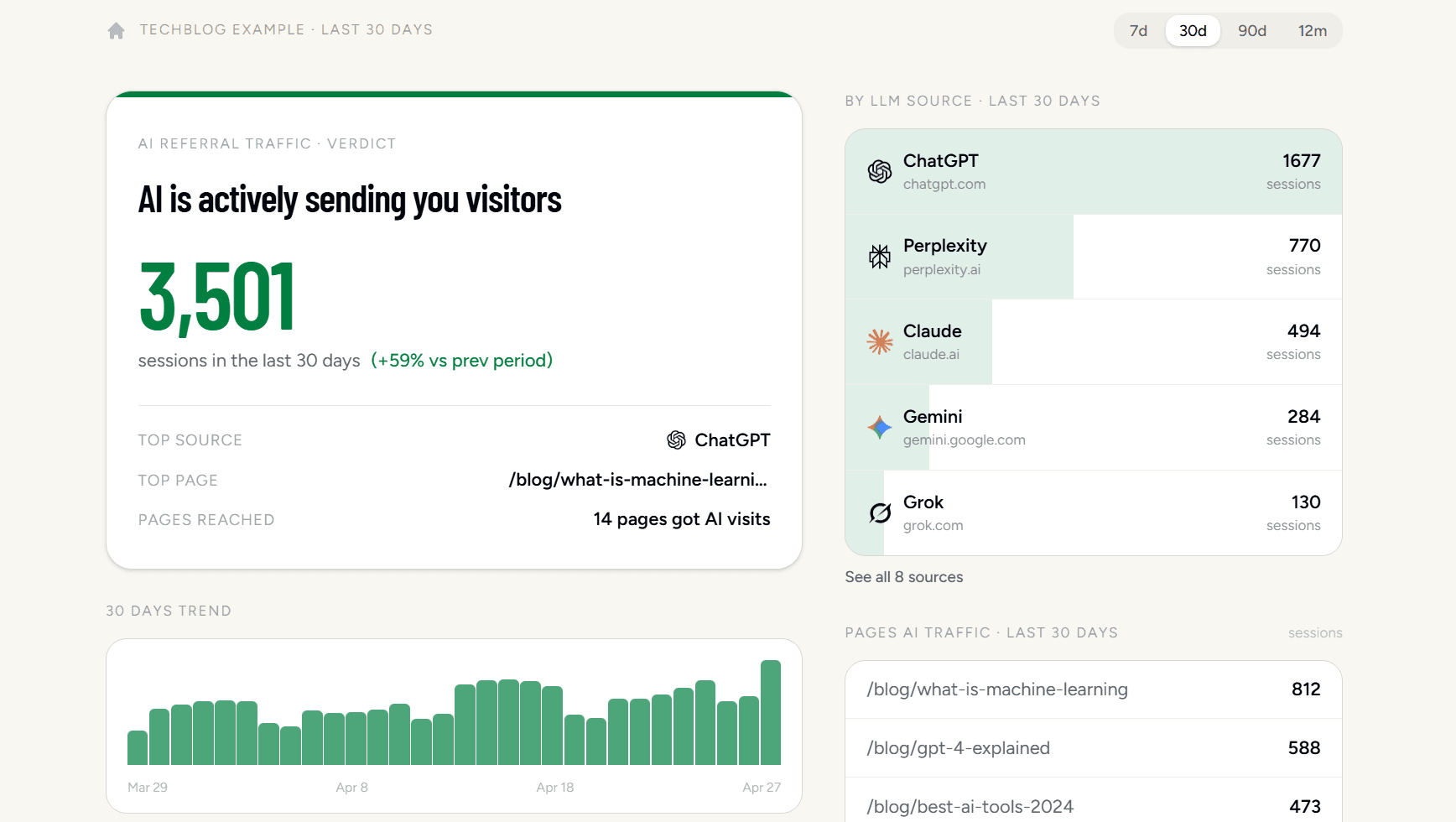
Is AI Sending Me Traffic? is a free tool that connects to your Google Analytics in 30 seconds and shows exactly which AI platforms — ChatGPT, Perplexity, Claude, Gemini, and more — are already sending you visitors. No manual digging in GA4 required.
Check if AI is already sending your firm new business leads
The first thing to do is open Google Analytics 4 and navigate to Reports > Acquisition > Traffic acquisition. Change the primary dimension to Session source / medium. Look for entries like chatgpt.com / referral, perplexity.ai / referral, or claude.ai / referral. If you see any of those, AI platforms are already citing your IT firm and driving potential clients to your site.
If these sources are missing, that does not mean AI platforms are ignoring you. It may mean the referral data is being stripped before it reaches your analytics. When a client clicks a link from a mobile AI app, the app often opens your site inside a built-in browser that removes the referral header. GA4 then files that visit under Direct traffic. Your actual AI-driven traffic is likely higher than your reports show.
| AI Platform | What appears in GA4 | Medium |
|---|---|---|
| ChatGPT (web) | chatgpt.com | referral |
| Perplexity | perplexity.ai | referral |
| Claude (web) | claude.ai | referral |
| Google Gemini | gemini.google.com | referral |
| Microsoft Copilot | copilot.microsoft.com | referral |
| ChatGPT (mobile app) | direct / (none) | direct |
Try this right now: open ChatGPT or Perplexity and prompt it to "Recommend a managed IT support provider in [your city]." If your firm does not appear, that is the gap you need to close.
Dark traffic signal: A sudden increase in Direct traffic landing on your specific service pages � not your homepage � is often the clearest sign that an AI platform is referencing your firm.
How can you tell if an AI referral actually turned into a quote request?
Seeing referral traffic from chatgpt.com is a start, but traffic alone does not win contracts. You need to connect those visits to an actual quote-requested event or contact form submission in GA4.
Build a conversion-linked Exploration
In GA4, open Explore > Blank exploration. Add Session source as a dimension and include both Sessions and your quote or contact conversion event as metrics. Filter the report to only show source values matching the regex chatgpt|perplexity|claude. Now you will see not just how many visits each AI platform sends, but how many of those visits resulted in a business owner reaching out for a quote.
Watch which pages AI sends leads to
Add Landing page as a secondary dimension. This reveals which specific service pages AI platforms are linking to most. If Perplexity keeps sending leads to your managed services page, that page has something AI finds credible � and you should replicate that structure across your other service pages.
Cross-reference with your intake process
Add a "How did you find us?" field to your contact or quote request form and include AI search assistants as one of the options. This manual check often catches AI-driven leads that never showed up in your analytics because the referral data was stripped by the mobile app.
Why your analytics is missing most of your AI traffic
GA4 was not built for the AI era. When a business owner clicks your firm's link from a mobile AI app, the built-in browser strips the referral header and the visit lands in your Direct bucket. This happens with roughly 39.1% of all AI-driven traffic, meaning your dashboard is underreporting your AI reach by default.
Three common reasons your AI traffic looks lower than it actually is:
- App-based referrals get stripped: ChatGPT on iOS and Android rarely passes referrer data through to GA4
- Incognito clicks lose context: Many business owners research IT providers privately, which breaks tracking chains
- AI answers without linking: When AI mentions your firm without a direct link, the prospect searches separately � and that visit arrives with zero referral signal
1. Check your Direct traffic for AI signals
Filter your GA4 traffic acquisition report to show only the Direct / (none) source. Then apply a secondary breakdown by Landing page. If specific service pages show unusually high direct traffic, an AI platform is likely the source. Pair this with your intake form data to confirm.
2. Improve your schema so AI platforms identify your IT firm clearly
Add LocalBusiness schema with your firm name, service area, and the specific IT services you provide. Include FAQPage schema on your managed services pages. AI platforms use this structured data to understand exactly what your firm does and whether to recommend you when a business owner asks for IT help.
3. Build your presence across directories AI platforms cross-reference
AI tools like Perplexity and ChatGPT verify IT firms against authoritative directories. A consistent presence on Google Business Profile, Clutch, Yelp, and Bark.com signals credibility. Make sure your firm name, address, phone, and services match exactly across all listings.
Not seeing AI traffic? Here is what to fix
If GA4 shows zero referrals from any AI platform and your direct traffic shows no unusual patterns after optimizing, start with these three checks.
1. Check if AI bots can reach your content
Open your robots.txt file and verify that GPTBot, ClaudeBot, and PerplexityBot are not blocked. Run a direct prompt test in ChatGPT: "What IT support services does [your firm name] offer?" If the AI cannot answer from your content, your key pages may not be properly indexed or the crawlers may be blocked.
2. Improve your entity clarity
AI platforms need to understand what your firm is and where it operates. Add LocalBusiness schema with your firm name, service city, and specific managed services. Replace vague copy like "comprehensive IT solutions" with literal statements like "Managed IT support for small businesses in [your city] � including helpdesk, network monitoring, and cybersecurity."
3. Build citations AI platforms use to verify you
Claim and complete your profile on Google Business Profile, Clutch, and Yelp. Get listed on Bark.com for local service discovery. Run a free GEO check on your site to identify which structured data signals are missing.
Conclusion
AI search platforms are already recommending IT support firms to business owners � and most firms have no idea it is happening. The traffic arrives quietly, often labeled as Direct, and converts without leaving a clean referral trail.
Start by checking your GA4 Traffic Acquisition report for chatgpt.com and perplexity.ai today. Run a prompt test to see if AI platforms can accurately describe your managed services. Then close the gaps: add LocalBusiness schema, complete your directory profiles, and add a "How did you find us?" question to your contact form. Once you connect the referral data to actual quote requests, you will know exactly which AI platforms are worth optimizing for.
For a complete guide to AI SEO strategies for IT Support GEO, check out our IT Support GEO page.