
A fractional CFO firm in Cleveland ran a quiet experiment earlier this year: they asked five popular AI tools to recommend accounting firms specializing in manufacturing audits in their city. They appeared in zero responses - despite being the only firm in the area with a publicly listed manufacturing specialty and a decade of client case studies on their site.
The culprit was not their reputation or content quality. It was their structured data, which described them as a generic "financial services business" with no indication of industry focus, service type, or practitioner credentials. The AI could not confirm what it needed to recommend them.
This mirrors what LovedByAI's platform consistently finds across the more than 900 professional services sites it has analyzed and the 63,000+ individual optimizations it has processed: the firms AI tools skip are not the worst websites. They are informationally opaque to machines. A 2024 Search Engine Land analysis of AI Overviews found that structured data was present on the cited source pages at a significantly higher rate than on non-cited pages in the same query set - which means the gap between cited and ignored is largely a technical one, not a quality one.
You do not need to rebuild your website. You need to close a small set of specific gaps. Here is the priority order.
Why do AI search engines ignore some accounting firms?
AI search engines bypass accounting firms when they cannot find concrete facts about what the practice does, who works there, and where they operate. If your website relies on vague marketing copy instead of clear details, AI tools cannot confidently recommend you.
How AI reads accounting sites differently than Google
Traditional search engines looked for keywords matching a query. AI platforms like ChatGPT and Gemini respond to Generative Engine Optimization (GEO) - the practice of structuring content so AI systems can extract and cite your facts rather than crawling for keywords. Without structured facts, AI search has no idea what services you offer or which city you operate in, meaning you are invisible to a local business owner asking an AI for a recommendation. The fix: read through your homepage and ensure your exact services, physical location, and ideal client profile are stated as direct, undeniable facts - not aspirational marketing copy.
For a broader look at what signals AI platforms use across different business types, see how AI citation engines decide what to recommend.
The expertise verification problem
Because accounting involves sensitive financial decisions, AI platforms prioritize verifiable expertise. They look for signals similar to Google's quality guidelines to confirm that credentialed professionals stand behind the business. If your site lacks author bios, a physical office address, or clear professional designations, the AI treats your firm as unverified and filters you from its answers. The fix is immediate: update your team pages with exact CPA license numbers, years of experience, and professional affiliations for every partner.
The generic messaging tax
Phrases like "comprehensive financial solutions" mean nothing to an AI trying to answer a question about "R&D tax credits for software startups." When your copy is vague, the AI moves on to a competitor with specific answers. The cost is invisible but real: you are losing high-value inbound leads to firms with plainer, less polished language that happens to be specific. Go through your service pages today. Replace broad statements with exact descriptions like "we handle payroll and state tax compliance for local restaurants."
What technical foundations matter most for accounting practices?
Priority matrix: what to fix first and why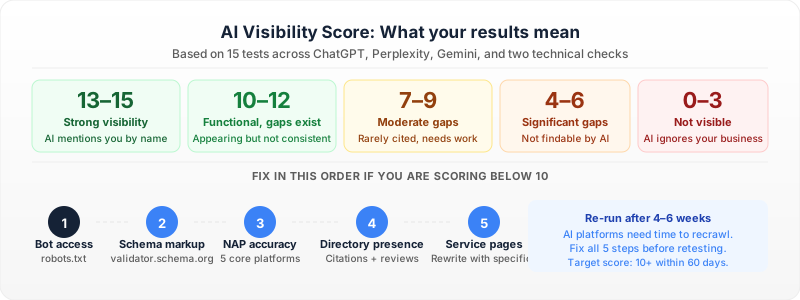
| Fix | Time to implement | Impact on AI visibility | Do this first? |
|---|---|---|---|
| Claim and align directory profiles (name, address, phone) | 1-2 hours | High - AI cross-references these to verify you are real | Yes |
| Add specific service descriptions to each page | 2-4 hours | High - vague copy makes you unrecognizable to AI | Yes |
| Update partner bios with CPA license numbers and credentials | 1 hour | High - AI filters out unverified professionals | Yes |
| Add AccountingService or FinancialService schema | 2-3 hours (manual) or automated | High - directly tells AI what your firm does | Yes |
| Create a dedicated page per service (payroll, audit, R&D credits) | Days | Medium-high - each page can rank for specific queries | After above |
| Add FAQ sections answering real client questions | Ongoing | Medium - helps AI match your page to conversational queries | After above |
The most important technical fix is transforming your website from plain text into structured facts that AI can instantly read. Here are the three technical layers that matter most.
Entity recognition: connecting names to credentials
Start with entity recognition - making sure AI systems recognize your practice as a real, verified authority. When an AI can connect a partner's name to a real CPA license number, it trusts the firm. List the full names, specific credentials, and professional affiliations for every partner on your team page, and link out to their public professional profiles. This is the fastest single change that improves AI confidence in your firm.
Schema markup: the AI's direct data feed
Schema is hidden code, usually written in a format called JSON-LD, that acts like a direct data feed for AI crawlers. If your LocalBusiness or FinancialService schema is missing or broken, the AI has to guess what you do - and usually guesses wrong. Add AccountingService or FinancialService schema to your key pages. You can write it manually and drop it into your <head> section, or use a plugin like Yoast SEO alongside LovedByAI's automated layer to generate and maintain it. Run Google's Rich Results Test on your homepage today to see if any schema is even present.
Site architecture: make services findable in one click
If your corporate tax preparation service is three clicks deep behind a vague menu, AI crawlers will miss it. Each core service - audit compliance, payroll, business valuations - needs its own dedicated page linked directly from your main navigation. When AI cannot find your specific service pages, you lose high-value inbound leads to firms with simpler navigation. Flatten your menu. If you want to verify whether your current structure is readable to AI crawlers, check your site here to see which pages are being found and which are being missed.
How should you adjust your firm's content for AI answers?
AI systems need plain facts to confidently match your practice with a business owner looking for financial help. Here are the three content changes that move the needle most.
Replace vague copy with direct service statements
When your website relies on vague language to sound sophisticated, AI search engines cannot verify what you do - and you become invisible to the clients looking for exactly your specialty. Open your homepage right now. Delete phrases like "comprehensive financial solutions for tomorrow" and replace them with direct, undeniable statements like "we manage bookkeeping and quarterly taxes for dental practices in Chicago." This is not just an AI optimization. It is a better pitch.
Build question-driven FAQ sections for each service page
Clients ask AI tools very specific, conversational questions: "how do I handle depreciation on heavy machinery for my construction business?" If your tax service page only contains a brief bulleted list of offerings, AI crawlers cannot connect your page to that specific problem. Add a dedicated FAQ section to the bottom of each core service page. Use H3 subheadings for the exact questions prospects ask you during initial consultations, and write a two-sentence factual answer directly below each one. For examples of how other professional service firms structure these pages for AI citations, see how to make your site AI-citation ready.
Make partner credentials machine-verifiable
Because accounting involves sensitive financial decisions, AI platforms actively look for verifiable proof of expertise before they will cite your firm. Generic partner bios filled with personality notes get filtered out. Update your partner bios with concrete, verifiable credentials: full legal names, state CPA license numbers, the specific year of certification, and specialized industry experience. You can list these in plain text, or use the official Schema.org vocabulary to mark up the credentials in your site's code so AI systems can instantly validate your team's authority.
How to Audit Your Accounting Firm's AI Visibility
Before you spend time changing your WordPress site, you need a baseline. An AI visibility audit tells you exactly where your accounting practice stands today and what technical gaps are keeping you out of answers from AI search platforms.
Step 1: Document high-intent queries Do not search for generic terms. Document the specific, high-intent queries your ideal clients actually use, such as "fractional CFO for manufacturing in Ohio" or "small business tax accountant near me."
Step 2: Open clean AI sessions Open fresh, logged-out sessions in platforms like ChatGPT, Gemini, and Perplexity. This prevents your past chat history from personalizing the results.
Step 3: Map the AI citations Enter your target queries and document exactly which competitor firms, directories, or aggregator sites the AI cites in its response.
Step 4: Validate competitor structured data Run the cited competitor URLs through the Schema Markup Validator to see how they are categorizing their services and authors. You will often find they use JSON-LD, a standardized code format that helps AI systems clearly understand page content, to highlight their expertise.
Step 5: Compare against your WordPress setup Compare those findings against your own website to identify missing schema, vague service descriptions, or technical gaps that need to be fixed first. Many accounting sites only use standard local business markup instead of the specific financial categories recommended by Google Search Central.
If you find your site is lacking, you can add the correct markup manually to your site's <head> section or via a tool from the WordPress plugin directory. Here is an example of what an optimized financial schema template looks like:
{
  "@context": "https://schema.org",
  "@type": "AccountingService",
  "name": "Ohio Manufacturing CFOs",
  "description": "Fractional CFO services for manufacturing businesses in Ohio.",
  "areaServed": "Ohio"
}
What to watch for: Do not blindly copy a competitor's schema. If your WordPress page content does not actively support the structured data you define, AI crawlers will ignore it. If you want a fast way to identify these technical gaps, you can check your site to see exactly what markup you are missing.
Conclusion
AI search visibility for your accounting firm does not require a complete overhaul of your existing marketing. It is simply about making sure your firm's core details, practice areas, and professional credentials are easy for both traditional search engines and AI models to interpret. Before you worry about complex tactics, start by verifying that your basic structured data is accurate and your service pages clearly state exactly who you help and where you operate. If you need a practical way to translate your practice areas into the format AI systems prefer, LovedByAI can automatically inject the proper schema and structure your pages without requiring a developer. Taking these foundational steps today ensures that when prospective clients ask an AI tool for a reliable accountant, your practice is positioned as the clear, trusted answer.