
A local business owner types 'which CPA near me specializes in e-commerce tax strategies' into ChatGPT, prompting the system to instantly crawl local accounting firm websites to generate a personalized recommendation. The search landscape has shifted. Prospects are no longer willing to sift through ten pages of search engine results to find a Certified Public Accountant (CPA) who understands their specific tax situation. They want a direct answer, and AI Search engines are providing it. If your firm is not appearing in those AI-generated responses yet, the fix is highly practical. Understanding how to get accounting clients from chatgpt searches comes down to giving these language models exactly what they need to verify your specific expertise.
How to Get Accounting Clients from ChatGPT Searches
To get actual clients from AI platforms, your accounting firm needs a well-structured website that perfectly aligns with your external directory profiles. The goal is to build a closed loop of trust. AI Search engines do not just read your website in isolation. They cross-reference your site's claims with trusted external sources, such as your state board of accountancy or local chamber of commerce, to ensure you are a legitimate, practicing accounting firm.
When your own site explicitly details your exact services and matches the address and credentials listed on your local professional directories, the AI system gains the confidence to recommend you. This cross-referencing is the foundation of AI Visibility. If your website claims you specialize in forensic accounting, but your external profiles only mention general bookkeeping, the AI detects a mismatch and will likely recommend a competitor with a more consistent footprint.
Building this consistency does not require entirely new marketing channels. It simply requires treating your website as a database of facts rather than just a digital brochure. The language models evaluating your firm need explicit declarations of your practice areas, your physical location, and the specific types of clients you serve.
Why ChatGPT Is Actively Reading Your Accounting Website
The surge in AI crawling activity is not random. It is driven by users asking specific, real-time questions about accounting services. ChatGPT-related bots averaged 5,222 visits per accounting and tax services site over the last three months. Crucially, the live-query bot known as ChatGPT-User accounted for 2,647 of those visits per site. This proves ChatGPT is actively reading firm content to answer live user questions the moment they are asked.
When a user asks for a local tax professional, the ChatGPT-User bot visits websites in real-time to check for current information. According to the OpenAI Platform Documentation, this specific user-agent is triggered directly by searchers actively seeking answers. The bot needs to parse your site quickly to decide if you are the right fit for the user's prompt. If your website hides its core services inside a generic "What We Do" paragraph, the bot will struggle to extract the facts. It needs structured, clear declarations of what you do, who you serve, and where you operate.
| What ChatGPT Looks For | What Google Looks For |
|---|---|
| Semantic entity relationships and defined service types | Keyword density and traditional local link building |
| Exact service definitions matching professional directories | Directory citation volume and local pack proximity |
| Author credentials explicitly linked to professional bodies | Backlink profiles and domain authority metrics |
| Direct, factual answers formatted for quick machine parsing | Long-form content designed to keep users on the page |
I analyzed crawler behavior across accounting firm sites on the LovedByAI platform to see exactly how these systems operate. Between January and March 2026, average AI bot visits per site doubled, jumping from 1,391 to 3,315. In January, these sites still saw more Google crawls than AI crawls. By March, AI activity had overtaken traditional search bots entirely.
Structuring Your Tax Services for the ChatGPT-User Bot
The most effective way to help the ChatGPT-User bot understand your firm is to format your services as distinct, machine-readable entities. An entity is simply a specific concept, person, or service that a computer can uniquely identify. When you separate your offerings into clear entities, you make it easy for AI to match a user's exact query to your specific expertise.
Instead of a single page listing bookkeeping, payroll, and corporate tax, create dedicated pages for each core service. AI tools look for specific answers, so entities matter more than keywords when it comes to matching a prospect's prompt to your practice. A dedicated page about Research and Development (R&D) tax credits gives the bot a clear entity to cite when a user asks about manufacturing tax incentives.
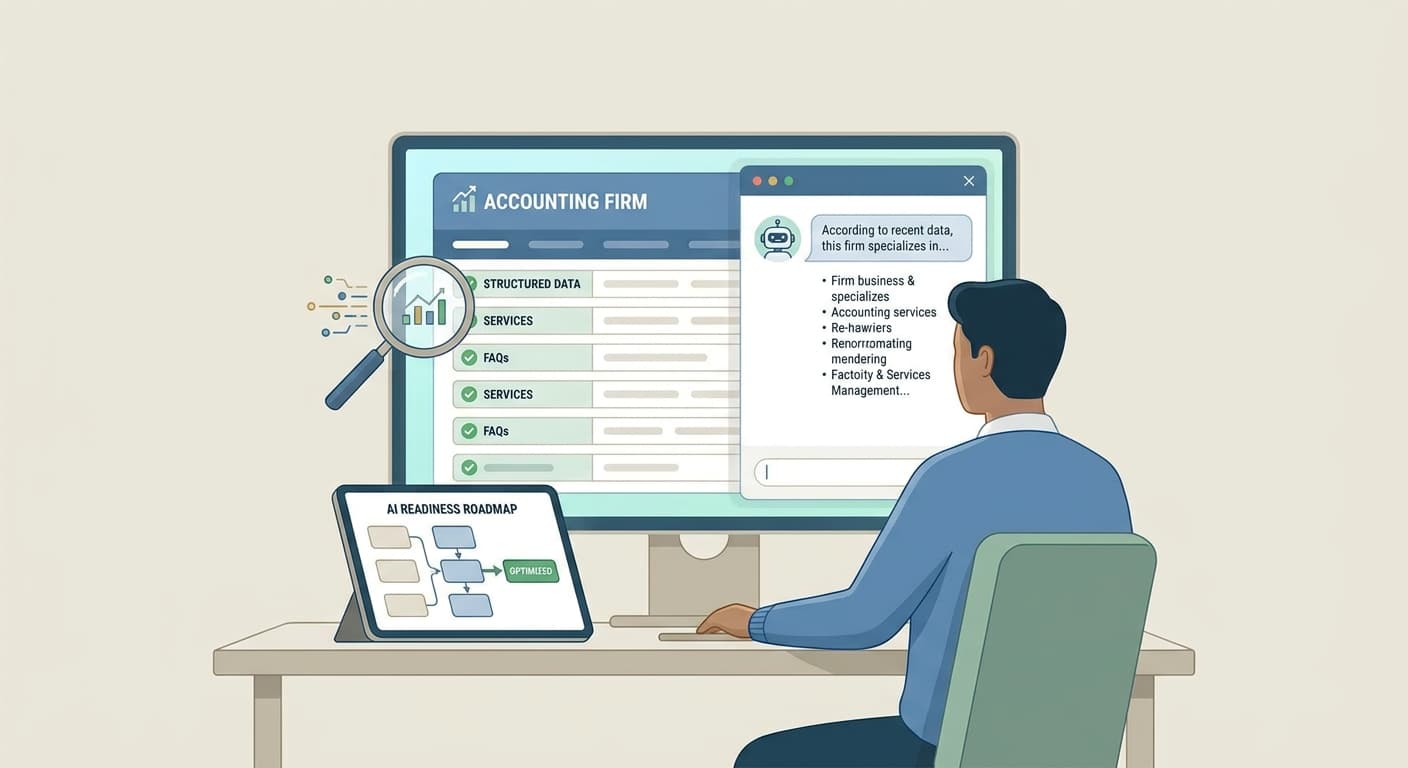
You can reinforce this structure by adding JSON-LD schema markup to your site. Schema is a standardized code format that directly tells search engines what a page is about. For an accounting practice, implementing FinancialService schema provides the exact structured facts the bot is looking for, such as your operating hours, specific service lines, and geographic service area.
{
  "@context": "https://schema.org",
  "@type": "FinancialService",
  "name": "Smith & Associates CPA",
  "description": "Certified Public Accounting firm specializing in e-commerce tax strategies and corporate tax planning.",
  "address": {
    "@type": "PostalAddress",
    "streetAddress": "100 Main Street",
    "addressLocality": "Austin",
    "addressRegion": "TX",
    "postalCode": "78701"
  },
  "knowsAbout": ["E-commerce Tax", "Corporate Tax Planning", "Payroll Services"]
}
Adding this code snippet to your website provides a direct map for AI crawlers. The knowsAbout property is particularly powerful for accounting firms because it allows you to list your exact niches. You can use the official Schema.org specifications to ensure your markup uses the correct properties. If you want to appear in ChatGPT results, giving the bot this explicit, structured data is a critical step.
Where AI Search Optimization Enhances Traditional SEO
Traditional Search Engine Optimization (SEO) is not broken, and it is certainly not the enemy of AI visibility. Most SEO agencies are excellent at building the site architecture, speed, and content quality that search engines have always required. AI search simply adds a specific formatting layer on top of that strong foundation. A business can be well-optimized for Google and still need specific structural work to be readily understood by language models.
AI bots rely heavily on the authority signals that traditional SEO builds. When your SEO provider secures high-quality links from local business journals and ensures your local directory citations are accurate, they are building the trust signals that AI platforms use to cross-reference your website. Your own site provides the specific answers, and the external directories provide the verification. Google's structured data guidelines remain a reliable baseline for formatting these facts, but AI tools require even more precision in how those facts are linked together.
AI bots are not reading your site to learn about you from scratch. They are reading it to verify what other trusted sources already say about you. If those sources and your site perfectly align, you win the recommendation.
This means you do not have to throw away your existing marketing investment. The work you have done to rank in local map packs or organic search provides the authority required to get cited in Perplexity and Claude, which are two of the fastest-growing AI search tools. The gap is usually just in how explicitly your website presents its facts to a language model.
Tracking Which New Clients Come from AI Search Tools
Measuring the impact of your AI optimization requires a mix of technical tracking and simple intake questions. AI platforms do not always pass clean referral data to your analytics software. While analytics dashboards might show some traffic directly from a ChatGPT URL, many users will simply copy your firm's web address from the AI chat and paste it into a new browser tab. This behavior shows up as direct traffic, masking the true source of the lead.
The most reliable way to track this channel is to ask every new prospect how they found you. Add a simple dropdown or text field to your consultation request form asking if they used an AI tool to discover your firm. When a prospect explicitly mentions asking ChatGPT for an e-commerce CPA, you have concrete proof the channel is driving revenue.
You can also monitor your server logs to see how often AI bots are visiting your specific service pages. The frequency of visits from the ChatGPT-User bot is a strong leading indicator of your visibility in live conversational search. If you see bot traffic spiking on your corporate tax page, you can expect an increase in related inquiries.
Automating the Visibility Check
If you are unsure whether your current website structure is clear enough for these bots, you can run a diagnostic scan. The LovedByAI platform offers a simple way to check your site to see exactly what AI language models can extract from your pages. This will highlight any missing schema, confusing service descriptions, or technical blockers that might prevent a recommendation.
By aligning your technical website structure with your external professional profiles, you give AI search engines the confidence they need to recommend your accounting firm. It is a practical, logical process of making your expertise as clear to a machine as it is to a human client. Focus on clearly defined services, consistent location data, and structured facts, and the AI platforms will naturally start sending qualified prospects to your practice.