
Imagine a Small Business owner typing 'find a tax accountant near me for a SaaS startup' into ChatGPT. Instead of relying on a traditional search index to surface a page of links, the tool triggers a real-time web fetch. It looks for firms with the clearest digital footprints, reading websites and directories instantly to formulate a direct answer.
How Does ChatGPT Choose Which Accountants to Recommend?
ChatGPT chooses accountants by cross-referencing the claims made on your website with mentions of your firm in trusted third-party directories. The system is looking for a closed verification loop. It wants to ensure the facts it presents to the user are accurate and corroborated across multiple sources across the web.
If your website states that you specialize in SaaS tax preparation, the AI tool checks if that entity data matches what the state CPA society or local chamber of commerce says about you. This is how the system builds trust before recommending your firm to a searcher. When the data matches perfectly, the AI feels confident generating an answer that features your business.
The foundation of this trust is your own website. A well-structured website combined with consistent directory profiles creates a cross-reference loop that AI tools rely on. The problem is rarely that an accounting firm lacks a website, but rather that the web presence is inconsistent or hard for a machine to read quickly.
| Evaluation Metric | What Google Looks For | What ChatGPT Looks For |
|---|---|---|
| Primary Signal | Backlinks and traditional local citations | Entity consistency and explicit structured facts |
| Content Format | Keyword-optimized paragraphs and headings | Direct, bottom-line-up-front (BLUF) answers |
| Discovery Method | Scheduled crawling and deep indexing | Real-time web fetching triggered by user prompts |
| Local Trust | Google Business Profile reviews | Cross-referenced mentions in authoritative directories |
The Role of the ChatGPT-User Bot in Real-Time Tax Queries
When a potential client asks a conversational question, ChatGPT sends out a live bot to read websites immediately. This bot is called ChatGPT-User, and its job is to fetch current, accurate answers for the person typing the prompt. It acts as an active researcher on behalf of the user, pulling the most relevant data it can find in milliseconds.
Understanding this bot's behavior is critical if you want to appear in ChatGPT results. It does not rely solely on old training data from years past. It actively crawls pages right now to verify details like your office location, current tax year services, and contact information.
I analyzed crawler behavior across the LovedByAI platform to see how active this process really is. In the data I reviewed, ChatGPT-related bots averaged 5,220 visits per accounting and tax services site over the last three months.
ChatGPT-User - the live query bot actively reading accounting and tax services content to answer real user questions right now - averaged 2,646 of those visits per site.
That means thousands of times per quarter, a machine is visiting tax firm websites specifically to pull answers for live user queries. If your site blocks these bots or presents information in a way they cannot parse, the bot simply moves on to a competitor with a clearer digital structure.
What AI Search Adds on Top of Traditional Local SEO
Traditional SEO is not broken, and AI Search does not replace it. Standard SEO builds the authority, backlinks, and local relevance that Google relies on, and those same signals help establish your firm's credibility for AI tools. The work you have done to rank well in search engines remains a vital part of your marketing foundation.
AI Search adds a specific new layer to this foundation. While Google's crawler parses links and keywords to index a page, AI search engines synthesize facts and look for clear, citable answers. A CPA firm can rank well according to the Google Local Pack guidelines but still be invisible to ChatGPT if its facts are buried in dense, hard-to-read paragraphs.
The shift in how traffic reaches your site is already happening. Looking at accounting firm sites in the platform, the average site received 1,391 AI bot visits in January 2026 versus 3,315 in March 2026 - a 2x increase per site.
The Shift in Bot Traffic
The most striking detail from that data is the crossover point. By January 2026, AI crawls (1,391 per site) had actually overtaken Google crawls (834 per site).
This means you need a strategy that handles both types of crawlers. You keep doing the SEO work that satisfies Google, but you add the structured data and formatting that AI models require to quickly extract your firm's details.
Structuring Your Accounting Firm's Data for Entity Recognition
You must organize your website so language models can instantly verify who you are, what you do, and where you operate. This is why entities matter more than keywords. An entity is a distinct, well-defined concept - like your firm's exact name, its physical address, or its core service offering.
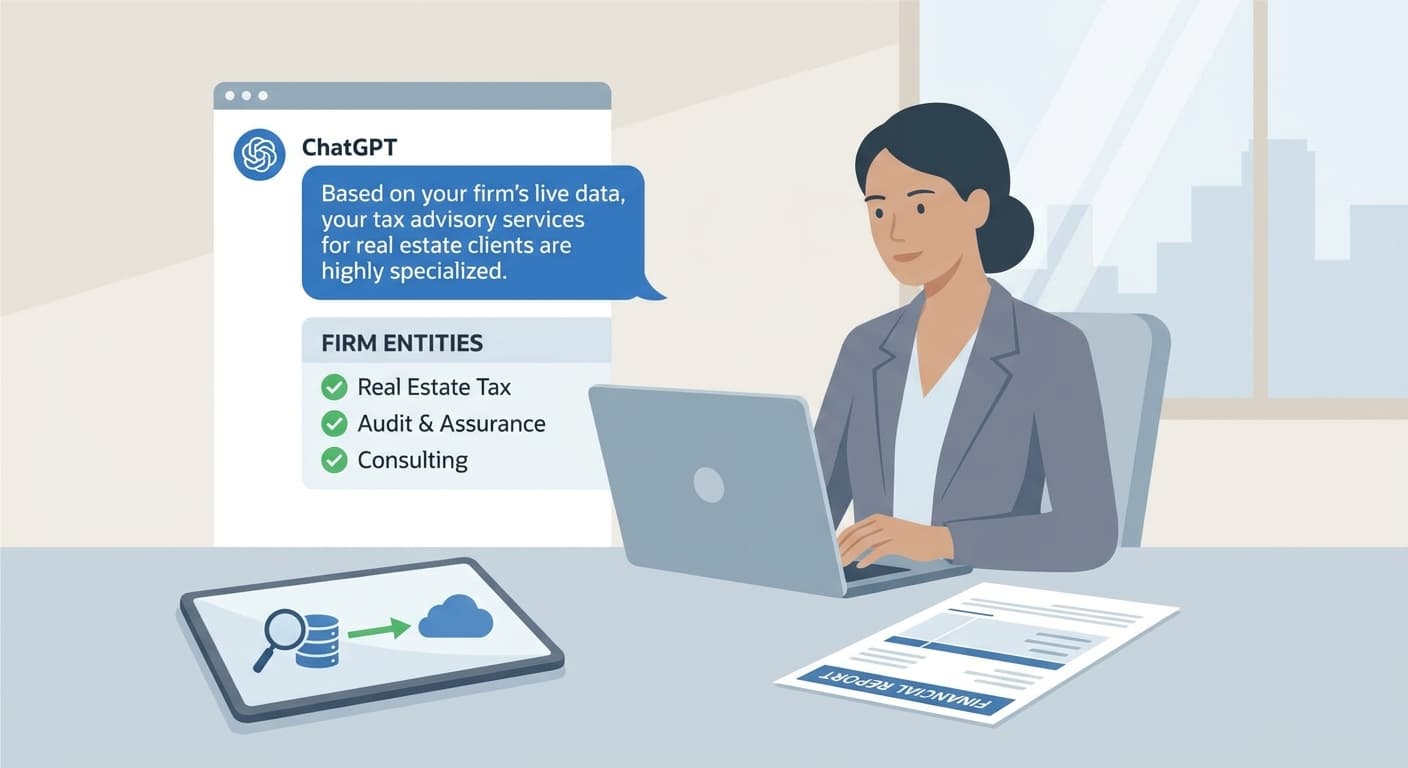
The most reliable way to establish these entities is by using structured data. Structured data is a standardized format for providing information about a page and classifying the page content. For accounting firms, this usually means adding a specific type of code called JSON-LD to the <head> section of your website.
Instead of a generic label, you should use the official AccountingService schema. This explicitly tells the AI bot that your business is an accounting practice, removing any ambiguity about what your firm does.
{
  "@context": "https://schema.org",
  "@type": "AccountingService",
  "name": "Smith & Associates CPA",
  "address": {
    "@type": "PostalAddress",
    "streetAddress": "100 Financial Way",
    "addressLocality": "Austin",
    "addressRegion": "TX",
    "postalCode": "78701"
  },
  "telephone": "+1-512-555-0198",
  "knowsAbout": ["SaaS Tax Preparation", "Corporate Restructuring", "R&D Tax Credits"]
}
This code acts like a digital business card that only machines can read. When the bot reads this code, it instantly knows your coordinates, your business type, and your specific areas of expertise without having to guess based on your paragraph text.
| ChatGPT Criteria | Why It Matters | How to Optimize |
|---|---|---|
| Clear Niche | AI tools match specific user prompts to specific firm capabilities. | List precise services in your knowsAbout schema array. |
| Unambiguous Location Data | ChatGPT-User filters real-time local queries by proximity. | Use strict PostalAddress markup on your contact page. |
| Consistent Third-Party Citations | Models require external proof that your firm is legitimate. | Audit your profiles on state CPA directories to match your site. |
| Clean Code Structure | Live bots have limited time to fetch answers. | Remove bloated JavaScript and ensure fast server response times. |
How to Monitor Your Firm's AI Search Visibility
To know how does chatgpt choose which accountants to recommend in your specific local market, you have to test the tool exactly like a client would. Open the application and type a highly specific prompt, such as asking for a CPA in your city who handles estate tax returns or startup accounting.
Watch which firms the AI suggests and pay attention to the footnotes. Those citations will tell you exactly where the AI found its information. Often, you will see it pulling from a mix of the firm's own website and major aggregator directories, proving the cross-reference loop in action.
Behind the scenes, you should also check your server logs to see if OpenAI's bots are successfully reaching your site. You can reference the official OpenAI crawler documentation to identify the exact user agents hitting your pages and see which specific services they are trying to read.
Taking the Next Step
If you notice that your firm is rarely cited in Perplexity and Claude or ChatGPT, the first thing to check is your technical foundation. Make sure your robots.txt file is not accidentally blocking AI bots from reading your site.
We built the free LovedByAI site checker so you can instantly scan your website for these exact gaps. It will tell you if your schema is missing, if your entities are unclear, and what you need to fix first to make your accounting firm visible to AI searchers.
