

Last fall, a solo estate planning attorney in Phoenix told me she had asked ChatGPT to recommend co-counsel in a neighboring city. Her own firm did not appear. Four competitors did - including one that had been in practice for less than two years. When she checked those four sites using Google's Rich Results Test, every single one had schema markup explicitly connecting each attorney to a specific practice area. Hers had none, despite being a well-designed, fast-loading site with real testimonials.
This is not an edge case. Across the more than 900 professional services websites tracked through LovedByAI's platform - which has processed over 63,000 individual optimizations - the pattern is consistent: AI tools skip firms not because they lack expertise, but because their websites feed the AI guesswork instead of structured, verifiable facts.
ChatGPT, Gemini, and Google's AI Overviews do not rank sites by keyword density. They look for machine-verifiable facts: which attorney handles which cases, in which city, confirmed by which third-party sources. According to a 2024 BrightEdge research report, AI-generated answers now appear in the majority of informational and navigational queries in professional services categories - meaning the contest to be cited is already underway, regardless of whether you have optimized for it.
Showing up does not require rebuilding your site. It requires making your firm's expertise machine-readable. Here is what these systems look for, why competitors appear ahead of you, and what you can change this week.
How do AI engines decide which law firms to recommend?
AI engines like ChatGPT and Gemini do not evaluate websites the way traditional search engines do. Instead of ranking links based on popularity and backlinks, they recommend law firms based on how easily they can verify facts about who you are, where you are, and what cases you handle. If an AI tool cannot immediately connect your firm's name to a specific legal service in a specific city, it simply will not suggest you.
Why AI bypasses keyword-heavy law firm pages
Traditional search looks for keyword density. AI looks for entities. An entity is a specific, machine-readable concept - like "family law attorney in Denver" - rather than a string of text on a page. When your site clearly defines these entities, AI systems trust the information enough to cite it. The fix: stop grouping all your legal services onto a single generic page. Create a dedicated page for each specific practice area so the AI can clearly identify exactly what you do.
Why directories dominate AI citations
AI answers frequently cite legal directories instead of individual firm websites. This happens because directories are built on structured databases that tie an attorney, a location, and a practice area together explicitly. Many law firm websites scatter this information - the attorney bio is on one page, the office address is buried in the <footer>, the services are on a different tab. The AI cannot assemble that picture reliably, so it reaches for the directory that already did the assembly. Fix this immediately by claiming your profiles on major legal directories and ensuring your firm's name, address, and practice areas match exactly.
How to replicate what directories do right on your own site
Bring that same organizational clarity to your own website using structured data. You can do this manually by writing explicit connections between attorneys and practice areas in plain text on each page. Or you can use a tool like LovedByAI to automatically inject the correct schema markup directly into your site's code. This links your firm to your practice areas in the background, giving AI systems the confirmation they need to cite you in an answer.
Why is your firm invisible to AI answers right now?
At a glance: what AI looks for vs. what most firms provide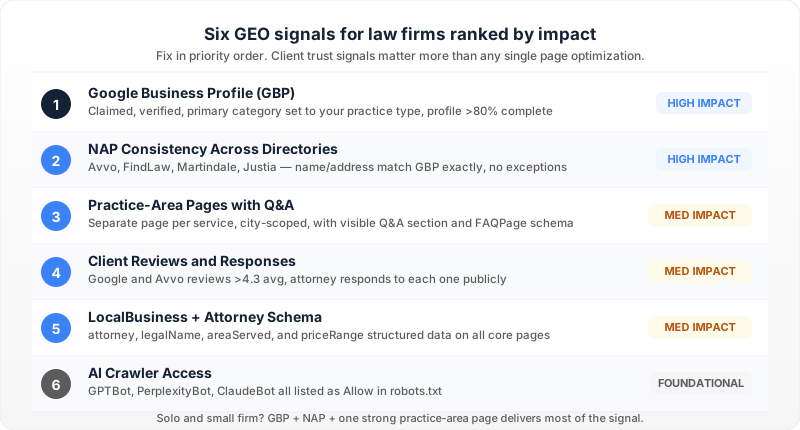
| Signal AI looks for | What most law firm websites do |
|---|---|
| Attorney tied to a specific practice area | All attorneys listed on one generic team page |
| Consistent name/address/phone across the web | Different details on old directory profiles |
| Dedicated page per practice area | One broad "Services" page covering everything |
| Schema markup declaring legal service type | No structured data beyond basic page metadata |
| Verifiable credentials linked to state bar profiles | Bio page with no external verification links |
| Recent, answered client questions | Static marketing copy unchanged for years |
If your firm is not showing up in AI recommendations, the system simply cannot confidently verify your location, your attorneys, and your exact legal specialties. Without this basic certainty, AI tools will not risk recommending your firm. Here are the three specific gaps that cause this.
Missing structured data: the silent citation blocker
The most common reason for AI invisibility is missing or broken structured data. Structured data is a layer of background code that hands AI systems the exact facts about your business, so they do not have to guess by reading your marketing copy. If an AI cannot instantly parse this code, it moves on to a competitor whose site is easier to understand. Fix this by adding LegalService markup to your key pages - you can paste it manually into the <head> section of your code, or use a schema plugin to generate it automatically.
Third-party verification gaps
AI engines also refuse to cite businesses that lack independent third-party validation. These systems cross-reference your website with the broader web to confirm you are a real, operational practice. If your site says you are a dedicated tax law firm but no external legal registries confirm this, the AI drops you from consideration. Audit your profiles on state bar websites, standard legal directories, and local business associations. Your firm's name, address, and phone number must match your website exactly - a single outdated directory listing can disqualify you.
Disconnected attorney-specialty signals
Your site likely suffers from weak connections between individual attorneys and their specific specialties. Many firms list all lawyers on a single team page with services on a separate menu, leaving the AI to guess who does what. If a prospect asks for a "commercial real estate lawyer," the AI needs to see a direct tie between a specific person and that exact service. Give every attorney their own biography page and link explicitly from that bio to the specific practice area pages they handle. You can see whether these connections are readable by AI right now by using the free site checker.
What should you fix first to improve your AI search visibility?
Three changes move the needle most: clean up your third-party footprint, add schema to your key pages, and rewrite service content to answer specific questions.
Start with your third-party directory footprint
AI engines rely on consensus across the web to verify facts. If your website says your office is in Austin, but an old FindLaw or Avvo profile still lists a former Dallas address, the AI will drop you from its answer to avoid giving a user bad information. You lose a potential consultation over a basic clerical error. Take an hour this week to claim your profiles on major legal directories, the state bar association, and local business registries. Ensure your firm name, address, and phone number match your website precisely across every source. For more context on how AI cross-references these signals, see how AI engines decide what to cite.
Hand your facts directly to AI using schema
Schema is a digital ID card hidden in your website's code that tells AI exactly who you are, what you do, and where you operate. Without it, AI search has no idea what services you offer or which city you serve. Add LocalBusiness schema for your office and Person schema for each attorney. You can write this code manually using Google's free Structured Data Markup Helper and paste it into your site's <head> section, or use a tool like LovedByAI to inject it automatically across your pages.
Rewrite service pages as direct answers
Potential clients do not ask AI tools for broad "family law services." They ask specific questions: "how is child custody decided in Ohio if I move out of the house?" If your website features only generic practice area descriptions, the AI will bypass you to cite a firm that answers the specific question. Talk to your intake team. Write down the exact questions new callers ask. Structure each service page around those questions - this is how you become the source an AI cites rather than the firm it scrolls past. For a deeper look at how these content signals work across multiple AI platforms, see how different AI platforms evaluate local service sites.
How to diagnose your law firm schema markup
The fastest way to see if AI tools can understand your law firm is to check your schema markup. Schema is a standardized code format, known as JSON-LD, that tells search engines and AI platforms exactly what your business does, who works there, and where you are located. If this code is missing, AI systems have to guess your firm's details - and they often guess wrong.
Step 1: Identify your core pages Do not test your entire site at once. Find the URL for your main homepage, your most important practice area page, and your lead attorney's biography page.
Step 2: Run the diagnostic test Go to the Google Rich Results Test. Paste your specific URL and hit test. This tool reveals exactly what structured data bots can read on your page.
Step 3: Check for legal-specific entity types
Review the detected structured data. You want to see LegalService or LocalBusiness for your firm's pages, and Person for attorney bios. You can verify the official properties for these entity types on Schema.org. If all you see is generic markup like "WebPage", your site is missing critical business context.
Here is what a healthy, basic legal schema snippet looks like behind the scenes:
{
  "@context": "https://schema.org",
  "@type": "LegalService",
  "name": "Smith & Associates Law",
  "address": {
    "@type": "PostalAddress",
    "streetAddress": "123 Legal Way",
    "addressLocality": "Chicago",
    "addressRegion": "IL"
  }
}
Step 4: Inject the missing JSON-LD If the correct schema is missing, you need to add it to your WordPress site. You can use an established plugin like Yoast SEO for foundational markup. If you want to skip manual configuration, LovedByAI automatically generates and injects the correct nested schema directly into your site's head section.
A warning on WordPress pitfalls: A common issue on WordPress is duplicate schema. If your active theme generates basic markup and you also install an SEO plugin, you might output conflicting information. Always re-run the testing tool after adding a new plugin to ensure only one clean set of data loads before the page renders.
Conclusion
It is frustrating to ask ChatGPT for local legal recommendations and see competing law firms listed while yours is nowhere to be found. But AI tools do not ignore your firm on purpose. They rely on clear, machine-readable signals to understand what legal services you provide. When competitors show up, it simply means their online footprint is easier for an AI to parse, verify, and cite.
The good news is that you do not need to guess how to fix this. By keeping your information consistent across legal directories and using proper structured data, you make it much easier for AI engines to confidently recommend your attorneys. Start by reviewing how clearly your specific practice areas are defined on your own website. If you want a structured way to improve how AI systems read your firm's pages, LovedByAI can help you build the technical foundation needed to turn quiet AI searches into real client consultations.
