
Picture a potential client asking a generative engine for 'the best personal injury lawyer near me' rather than typing it into a standard search bar. Recent data shows this exact shift is actively occurring across legal websites right now. As search habits change, many partners ask about seo vs GEO which is better for law firms to focus on this year.
The short answer is that they are not competing strategies. Generative Engine Optimization relies heavily on the foundation built by traditional Search Engine Optimization. If your firm has a well-optimized website, you are already halfway there. AI tools do not replace your website. They cross-reference your website with external directories to verify your firm is legitimate.
AI bots are not reading your site to learn about you from scratch. They are reading it to verify what other trusted directories already say about your firm. If those sources and your website agree, you win the recommendation.
SEO vs GEO Which Is Better for Law Firms? Why Both Are Essential
You need both systems working together to turn visibility into signed clients. Traditional SEO builds the domain authority and local relevance that Google respects. GEO structures that same information so AI tools like ChatGPT and Perplexity can extract precise answers instantly.
Many marketing agencies frame this as an either-or decision. This is a false choice. Research from search tools shows that the vast majority of pages cited by AI platforms already have strong Google visibility. The work you put into standard SEO provides the trust signals that AI models require before they will recommend your attorneys to a user.
A well-optimized website paired with consistent directory profiles creates a cross-reference loop. When an AI search tool evaluates your firm, it checks your site's structured data against your state bar listing and local business profiles. Completing this loop is what makes your firm citable.
| Feature Focus | Traditional SEO | Generative Engine Optimization (GEO) |
|---|---|---|
| Primary Goal | Ranking pages in search engine results | Providing direct answers and citations |
| Core Signals | Backlinks, keyword density, local proximity | Entity consistency, schema markup, factual accuracy |
| Trust Building | Domain authority and user engagement metrics | Cross-referencing data across multiple authoritative sources |
| User Intent | Browsing options to find the best fit | Seeking a definitive, immediate recommendation |
How AI Crawls Are Reshaping Legal Search Traffic
AI bots are visiting law firm websites at an unprecedented rate, shifting how firms acquire clients online. I analyzed data across the LovedByAI platform to see exactly how these crawlers behave on legal websites. The numbers show a massive transition away from traditional crawling patterns.
Average AI crawls per legal services and law firms site grew five times between January 2026 and April 2026. In January, we saw an average of 426 AI bot visits per site. By April, that number surged to 2,301 visits per site. Even more telling, by February 2026, AI bots had completely overtaken Google crawls across the legal sites I track.
This traffic is not just noise. According to the 2026 Clio Legal Trends Report, consumers increasingly start their search for representation by asking conversational questions rather than browsing lists of links. When AI bots crawl your site, they are actively gathering the facts needed to answer those conversational queries.
Why the bot type matters for your pipeline
Not every crawler is looking for immediate answers. Some bots are simply scraping data to train future models. If you want to see actual consultations from this activity, you have to optimize for the bots that fetch real-time data for active users.
Where Generative Engine Optimization Differs from Traditional SEO
Traditional SEO focuses on how search engine crawlers parse links and keyword frequency, while GEO focuses on structured facts and clear entities. An entity is a specific, unique concept, like a named attorney, a specific courthouse, or a distinct practice area.
If you are comparing SEO vs AEO: why entities matter more than keywords for your practice, the difference lies in machine readability. A human can read your biography page and understand you handle car accidents in Chicago. An AI tool needs that information explicitly defined in code to feel confident citing it.
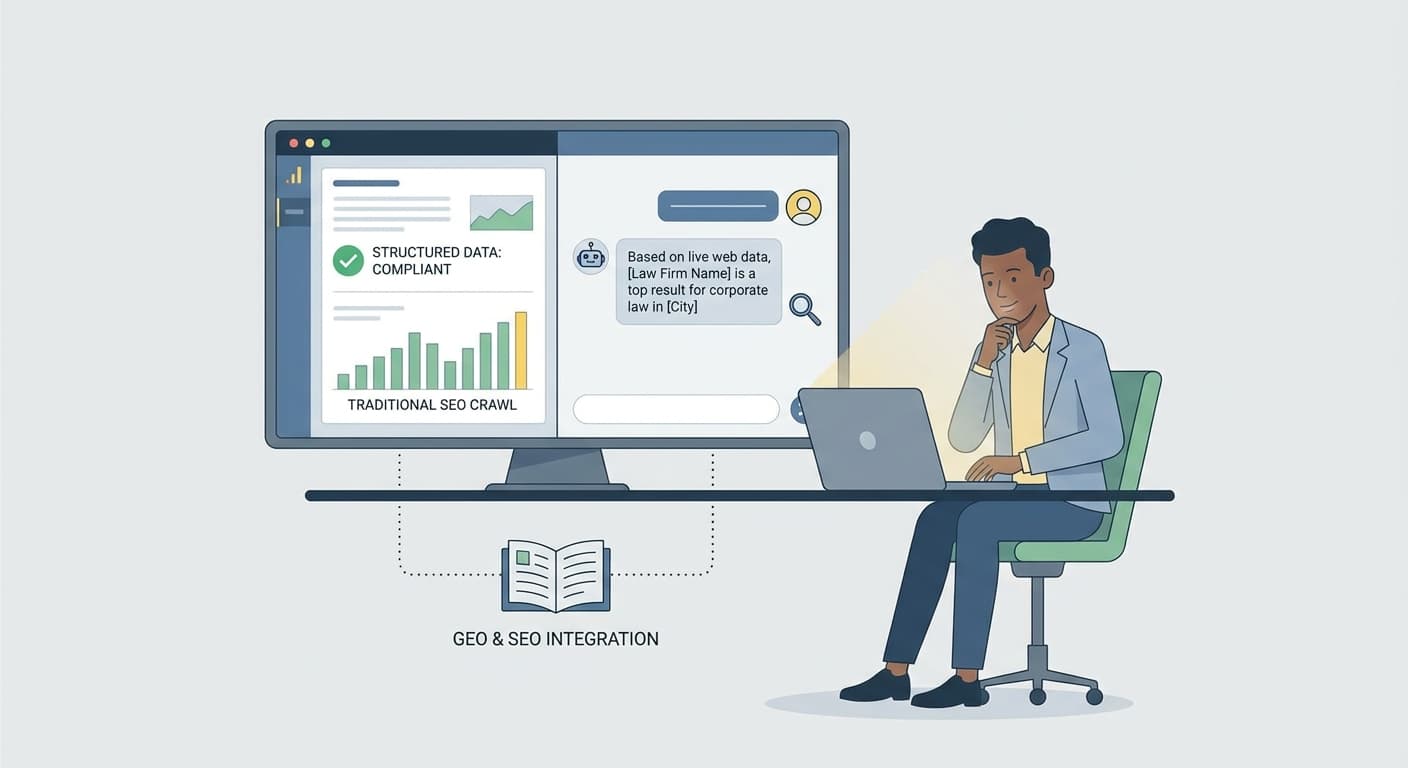
This is where structured data comes in. Adding JSON-LD schema to your website tells the AI exactly what it is looking at. Instead of guessing, the crawler reads a standardized format that defines your business name, phone number, and accepted case types.
{
  "@context": "https://schema.org",
  "@type": "LegalService",
  "name": "Smith & Associates Personal Injury Law",
  "address": {
    "@type": "PostalAddress",
    "streetAddress": "123 Legal Blvd",
    "addressLocality": "Chicago",
    "addressRegion": "IL",
    "postalCode": "60601"
  },
  "telephone": "+1-555-0198"
}
You can review the official requirements for this markup on the Schema.org LegalService documentation page. When your site structure matches the exact details found on your local directory listings, you build the entity trust required for AI visibility.
Why You Should Prioritize Live Query Bots like ChatGPT-User
Optimizing for live query bots is the most direct path to getting your firm in front of active searchers. When someone asks ChatGPT to find a local family lawyer, the system does not just rely on old training data. It deploys a specific live query bot to browse the web and fetch current information.
In the data I reviewed, ChatGPT-related bots averaged 2,550 visits per legal services and law firms site over the last three months. Out of that total, ChatGPT-User, which is the specific live query bot, averaged 1,293 of those visits per site. This means half of the ChatGPT traffic hitting these sites is driven by real-time user requests.
If you want to drive pipeline from AI search, focus entirely on how your site responds to live query bots. Training bots consume data, but live query bots serve actual prospective clients.
To understand the exact mechanics of these recommendations, you can read our guide on How to Appear in ChatGPT Results. The firms that win these citations provide the cleanest, fastest answers when the ChatGPT-User bot comes knocking.
| Bot Type | Primary Function | Value to Law Firms |
|---|---|---|
| Training Bots | Scrape content to build future AI models | Low immediate value, long-term brand presence |
| Live Query Bots | Fetch real-time data to answer active user prompts | High immediate value, drives qualified consultations |
| Traditional Crawlers | Index pages for standard search engine results | Foundational value, supports domain authority |
Next Steps to Prepare Your Firm for AI Overviews and SearchGPT
Start by evaluating the factual consistency across your entire web presence. AI tools like SearchGPT, the search mode built into ChatGPT, are incredibly sensitive to mismatched information. If your website lists one phone number but your Google Business Profile lists another, the AI loses confidence and will recommend a competitor instead.
You must ensure that your name, address, and phone number are identical across every platform. This manual cleanup is the prerequisite for any advanced optimization. Once your profiles match, you can focus on upgrading the technical structure of your website itself.
Implement structured data correctly
The next phase is adding clear, nested schema markup to your site. This involves placing code in the <head> section of your pages to define your attorneys, practice areas, and frequently asked questions. For a complete walkthrough of this process, consult our WordPress AI Search Optimization from scratch: what works tutorial.
Format content for direct answers
You also need to adjust how you write your practice area pages. AI crawlers prefer content that answers questions directly in the first few sentences. If you write a page about commercial litigation, define what you do and who you serve immediately, then use clear headings to break up the details.
You can test how well AI bots understand your current setup by running your site through the LovedByAI site checker. This tool scans your pages to identify missing schema and inconsistent entity signals, giving you a clear list of what to fix first. Following the Google Search Central guidelines for AI Overviews will also ensure your content is structured properly for major search engines.