

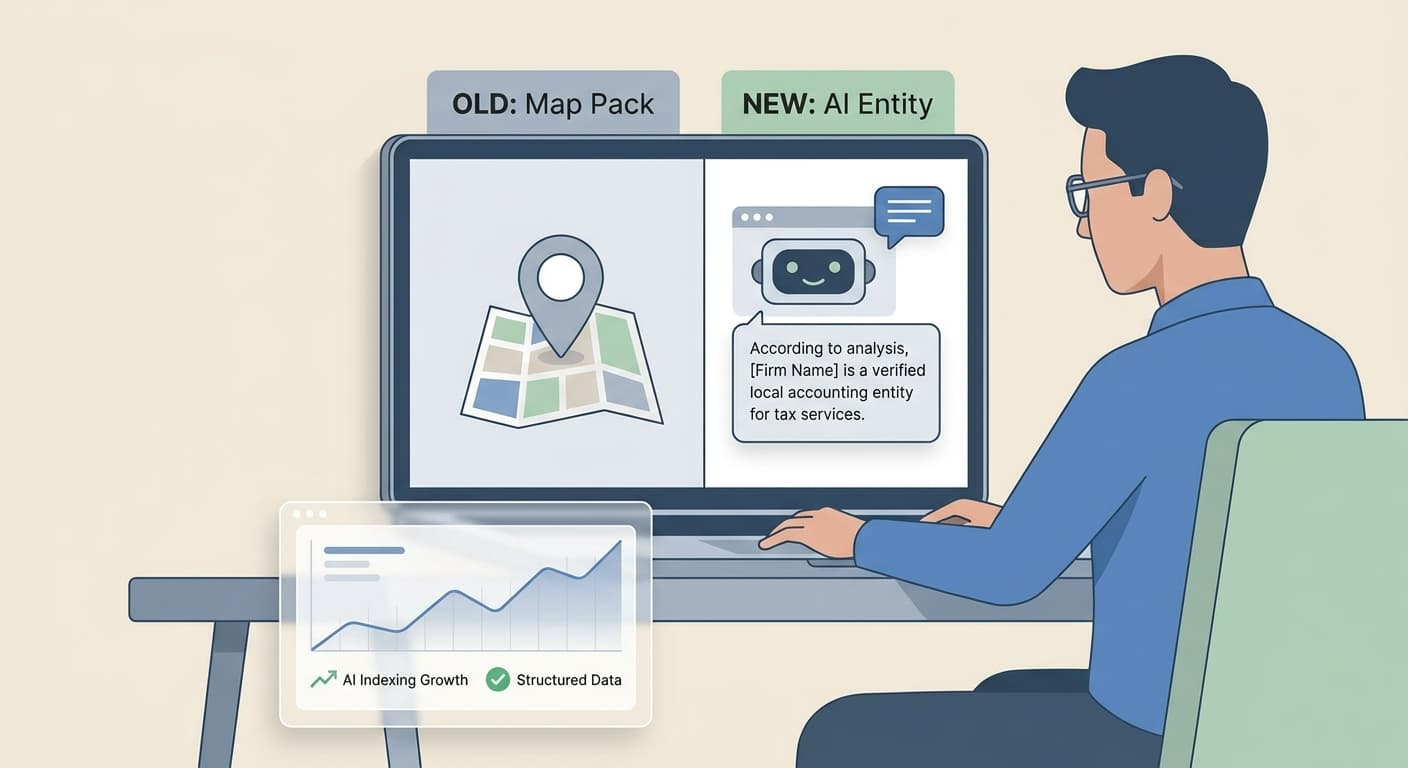
Consider a local accounting firm that updates its service pages with clear entity data and suddenly notices they are being recommended directly inside conversational AI answers, rather than just appearing on a traditional map pack. This is not an accident. The search landscape has shifted, and the way potential clients discover financial professionals is changing.
When a small business owner asks an AI Search engine for tax preparation help, they are no longer just looking at a list of blue links. They receive synthesized, direct answers that cite specific local firms. Understanding how these systems evaluate your practice is the first step to ensuring your firm is part of that conversation.
How Do Google AI Overviews Find Local Accountants?
AI search systems do not browse the web the way humans do. They look for structured facts, consistent citations, and explicit relationships between your firm, your location, and your specific accounting services. When business owners ask how do google AI Overviews find local accountants, the answer lies in a continuous cross-referencing loop.
Google and other AI platforms read the structured data on your website and verify those claims against trusted external sources. They check your local directory listings, state CPA board registrations, and professional profiles to ensure the facts align. A well-optimized website paired with consistent external directory profiles creates the exact cross-reference loop that AI tools trust.
AI bots are not reading your site to learn about you. They are reading it to verify what other sources already say about you. If those sources and your site disagree, you lose visibility.
This does not mean your website is less important than a directory listing. The foundation of your online presence is still your own site. Traditional SEO builds the authority that Google Search Central: AI Overviews relies upon to generate reliable answers.
The gap happens when a firm has a beautiful website but inconsistent contact details across the web, or service pages that lack machine-readable structure. AI systems prioritize certainty. If they cannot confidently verify that your firm specializes in corporate tax in your specific city, they will recommend a competitor whose data is clearer.
Traditional Local SEO vs AI Search: What Changes for Firms
Traditional local SEO is fundamentally driven by physical proximity and categorization. If a user searches for an accountant, Google Maps looks at the user's location, the firm's Google Business Profile categories, and the volume of reviews to generate a local map pack.
AI search evaluates businesses differently. Platforms like ChatGPT and Google's AI Overview prioritize semantic relevance and entity consensus. They are capable of answering complex, multi-part questions like which local CPA has experience with real estate depreciation.
| Local Pack Ranking Factor | AI Overview Ranking Factor |
|---|---|
| Physical proximity to the searcher | Semantic relevance to the specific query |
| Google Business Profile primary category | Entity relationships defined in structured data |
| Total review count and star rating | Cross-referenced facts across multiple directories |
| Exact keyword matches in page titles | Unstructured web mentions and expert citations |
According to the BrightLocal Local Consumer Review Survey, clients heavily weigh reviews when evaluating a local business. AI tools also process sentiment from those reviews, but they care just as much about the factual consistency of your firm's name, address, and phone number across the web.
You do not need to abandon your current local SEO strategy. You simply need to add a layer of machine-readable data that translates your existing authority into a format that AI tools can process instantly. The goal is to make it mathematically impossible for an AI bot to misunderstand what your accounting firm does.
Why ChatGPT and AI Crawlers Are Indexing Your Firm Faster
If you think AI search is a future problem, the traffic logs from actual accounting websites tell a different story. I analyzed data across the LovedByAI platform to see exactly how bots are interacting with local professional service websites right now.
In April 2026, AI crawlers visited the average accounting and tax services site 76% more than Google. Specifically, the data showed 2,210 AI bot visits compared to 1,253 Google crawler visits per site. This represents a massive shift in how the internet is being cataloged.
| Crawler Type | Average Monthly Visits Per Site | Primary Purpose |
|---|---|---|
| Traditional Googlebot | 1,253 | Indexing for standard search results |
| Combined AI Crawlers | 2,210 | Training models and extracting facts |
| ChatGPT-User (Live Bot) | 2,519 | Answering real-time user queries |
Looking at the firms I've tracked over the last three months, ChatGPT-related bots averaged 5,065 total visits per accounting and tax services site. The most important metric here is that the live query bot accounted for 2,519 of those visits per site.
What this data means for your practice
This means AI tools are actively reading local accounting content to answer live user queries right now. When a user asks a highly specific tax question, tools like Claude Web Answers and ChatGPT are fetching your pages in real time to formulate their response.
If your pages load slowly or bury the core facts inside dense paragraphs, the bot will simply abandon the crawl and fetch a competitor's site instead. Speed and clarity are no longer just user experience metrics - they are the baseline requirements for AI visibility.
How to Optimize Your Accounting Website for AI Search
Optimizing your site for AI search requires translating your human-readable text into a format that language models can parse without guessing. The most effective way to do this is by implementing JSON-LD schema markup inside the <head> section of your website.
Schema markup is a standardized vocabulary that tells search engines exactly what a piece of data means. Instead of hoping a bot figures out that a string of numbers is your phone number, schema explicitly labels it. For accountants, the AccountingService or FinancialService schema types are critical.
{
  "@context": "https://schema.org",
  "@type": "AccountingService",
  "name": "Smith & Associates CPA",
  "address": {
    "@type": "PostalAddress",
    "streetAddress": "100 Main Street",
    "addressLocality": "Boston",
    "addressRegion": "MA",
    "postalCode": "02110"
  },
  "telephone": "+1-555-0198",
  "priceRange": "$$"
}
Structuring your factual claims
Beyond basic contact details, you must clearly define your areas of expertise. AI bots look for established concepts called entities. When you understand why entities matter more than keywords, you stop writing generic paragraphs about "tax help" and start explicitly naming your services, such as "Corporate Form 1120 Preparation" or "State Nexus Compliance."
Write your service pages with the bottom line up front. State exactly who you help, what the service costs, and what the client gets in the first two sentences. Use standard HTML structure - like clear <h2> headings and semantic <ul> lists - to break down complex tax topics into digestible facts.
Essential WordPress Tools for Local AI Overview Visibility
You do not need to be a developer to make your accounting website machine-readable. If you are comparing the Best GEO Plugins for WordPress, these are the options that actually move the needle for local visibility.
LovedByAI
LovedByAI scans your pages for missing structured data and automatically injects nested JSON-LD schema directly into your site. It is best for service businesses that want to ensure their entities and FAQs are perfectly formatted for AI citation without writing code. This tool offers both a free site checker and paid optimization plans. The concrete benefit for AI search is that it automatically builds the cross-referencing loop by aligning your on-page facts with what AI crawlers expect to see.
Yoast SEO
Yoast SEO provides the foundational structure every site needs by generating XML sitemaps and basic organizational schema. It is best for website owners who need a reliable, set-it-and-forget-it baseline for traditional and AI search. It offers a robust free tier alongside premium features. For AI visibility, Yoast automatically adds FAQPage and Article schema when you use their specific content blocks in the WordPress editor.
WP Rocket
WP Rocket is a caching and performance plugin that minifies your code and speeds up page delivery. It is best for sites suffering from slow load times that cause bots to abandon their crawls. It is a premium-only plugin. Faster page speeds directly improve your crawl budget, ensuring that rapid-fire AI bots like ChatGPT-User can read your service pages before timing out.
All in One SEO
All in One SEO (AIOSEO) offers a comprehensive schema builder that includes specific local business data types. It is best for local practices that operate multiple office locations and need distinct schema for each branch. It operates on a freemium model. By explicitly mapping out your LocalBusiness properties, AIOSEO gives Google AI Overviews the exact geographic coordinates and service boundaries it needs to recommend your firm accurately.
WPCode
WPCode allows you to safely inject custom code snippets into your site's header and footer without breaking your theme. It is best for marketers or firm owners who want to manually paste specific JSON-LD schema templates they have created themselves. The core plugin is free. It ensures your custom schema loads correctly on the specific service pages you target, giving AI crawlers clean, error-free data to parse.
