
When a local business owner asks an AI engine for tax strategy advice, Perplexity isn't just relying on old training data; it is actively scanning live tax firm websites for up-to-date answers, opening a direct new channel to acquire clients. The search landscape has shifted, and prospective clients are now using AI tools to find specific, factual answers about tax codes, deadlines, and local practice specialties.
If you are figuring out how to get my tax preparation service on perplexity, the solution starts with understanding how these live bots read your site. They are not looking for keyword-stuffed paragraphs. They are looking for clear, structured facts that they can confidently cite to a user.
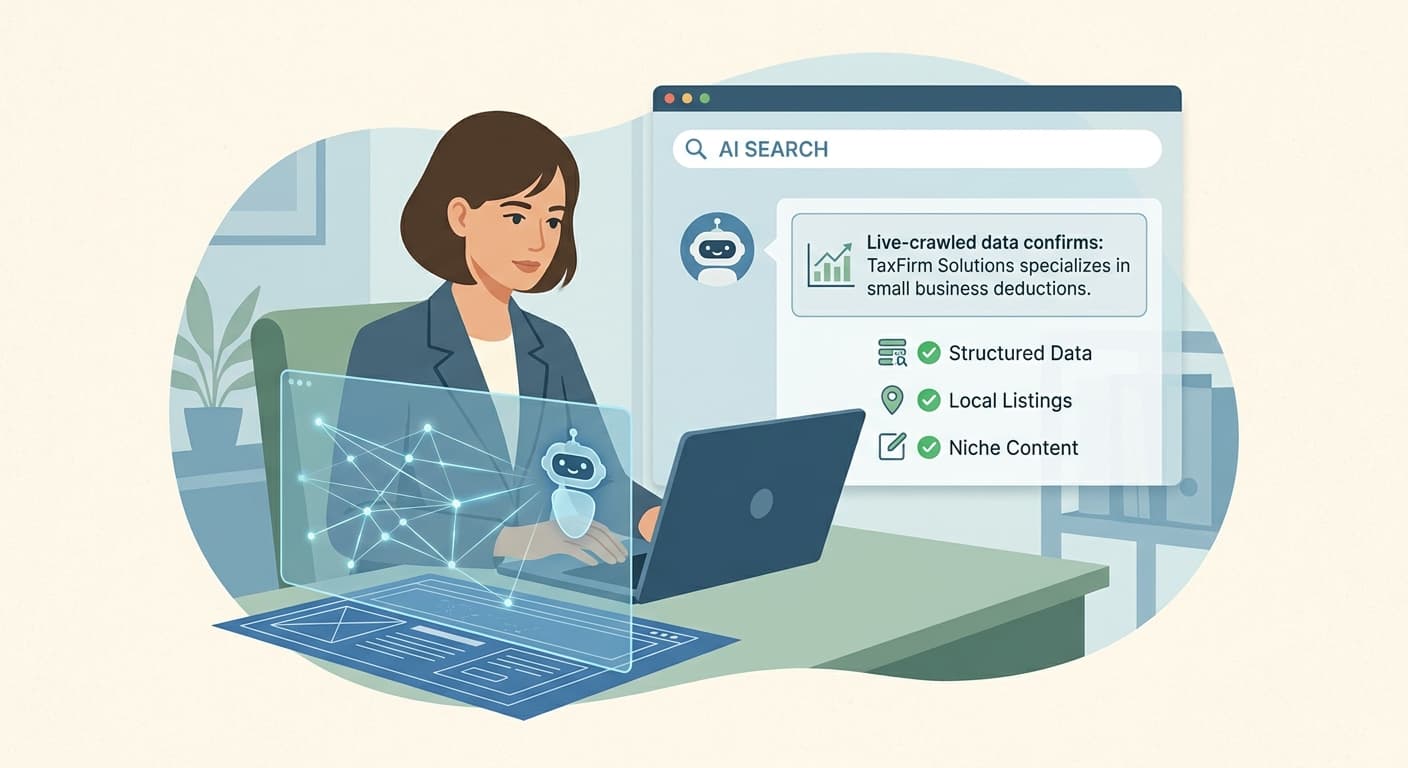
AI Search engines do not replace your website with directory listings. They look for a complete cross-reference loop between what trusted directories say and what your website proves.
Many firm owners assume their site is invisible because it lacks domain authority. In reality, the issue is often structural. By organizing your content so that AI bots can instantly verify your identity and expertise, you make your firm highly citable. You can check your site to see what these systems can currently read about your practice.
How to Get Your Tax Preparation Service on Perplexity Today
To appear in Perplexity answers right now, your website must provide direct, factual answers wrapped in structured data that perfectly matches your external directory profiles. Perplexity uses live crawling to verify that the information it pulls from a high-authority directory is accurately reflected on your actual website.
When your Google Business profile, your state CPA society listing, and your website all broadcast the exact same entity information, AI systems develop trust in your firm. The problem occurs when your website relies entirely on visual text rather than structured data, leaving the bots guessing about your core details.
Structuring Your Practice Details
The most effective way to communicate your firm's identity is through JSON-LD schema markup. This is a block of code placed in the <head> of your website that acts as a direct data feed for crawlers. For an accounting practice, you should use the FinancialService or AccountingService schema types defined by Schema.org.
{
  "@context": "https://schema.org",
  "@type": "AccountingService",
  "name": "Smith & Associates Tax Preparation",
  "address": {
    "@type": "PostalAddress",
    "streetAddress": "100 Main Street",
    "addressLocality": "Austin",
    "addressRegion": "TX",
    "postalCode": "78701"
  },
  "telephone": "+1-512-555-0199",
  "url": "https://www.smithtaxexample.com"
}
I analyzed data across the LovedByAI platform to see how aggressively these bots are seeking this data. Over the last three months, ChatGPT-related bots averaged 5,065 visits per accounting and tax services site. Crucially, the ChatGPT-User bot, which conducts live web searches for users, accounted for 2,519 of those visits per site. They are actively reading tax content to answer real user questions in real time.
Formatting Content for Live Crawlers
Once your firm's identity is structured, your content needs the same treatment. Perplexity favors pages that get straight to the point. If a user asks about the deadline for an S-Corp tax extension, the bot will pull from a site that states the date clearly in the first sentence, rather than one that buries it under four paragraphs of filler.
What Perplexity Looks for in Your Tax Accounting Content
Perplexity evaluates your site based on answer density, entity consistency, and factual clarity rather than traditional keyword repetition. It wants to extract a clear answer and provide a footnote link back to your page.
| What Perplexity Looks For | What Google Looks For |
|---|---|
| Concise, direct entity answers at the top of the page | Long-form comprehensive guides |
| Cited facts that cross-reference with known directories | High volume of inbound backlinks |
| Clear JSON-LD schema defining the business | Keyword usage in headings and body text |
| Fast time-to-fact (answers within the first 50 words) | Dwell time and overall page engagement |
The Value of Answer Density
Answer density refers to the ratio of factual statements to general prose. Tax preparation websites often fill their service pages with marketing language about peace of mind and personalized service. While that matters for human readers, AI bots need hard facts: which tax forms you file, which state regulations you handle, and what specific industries you serve.
If a bot has to parse through 500 words of marketing text to figure out if you handle multi-state corporate returns, it will abandon your site and cite a competitor instead.
To get cited in Perplexity and Claude web answers, you need to format your service pages with clear, descriptive subheadings followed immediately by the bottom-line answer. Use bulleted lists to outline the specific tax schedules you handle.
Verifying Your Entities
Every service you offer is an entity. When you mention "tax preparation," AI tools attempt to connect that concept to a known entity graph. You strengthen this connection by linking out to authoritative sources, such as the IRS or your state's department of revenue, when discussing specific tax codes. This signals to the AI that your content is grounded in established facts.
Why AI Search Optimization Complements Your Local Google SEO
Traditional SEO builds the authority that AI engines trust, while AI optimization provides the structure they need to read your facts quickly. They are complementary forces. You do not need to abandon your existing search strategy to become visible to Perplexity.
Researching SEO vs AEO: why entities matter more than keywords reveals that the sites performing best in AI search are already structurally sound. Traditional SEO handles the foundational work of site speed, mobile responsiveness, and building local citations. AI visibility work simply adds a layer of machine readability on top of that strong foundation.
Completing the Trust Loop
When Google crawls your site, it evaluates the entire page to determine where it should rank in a list of blue links. When Perplexity crawls your site, it is looking for a specific sentence to extract as an answer. This is why following the Google Search Central guidelines for structured data is so vital. It satisfies both the traditional crawler looking for context and the AI crawler looking for a fast fact.
If your firm is currently paying for SEO but you are not seeing AI visibility, the gap is likely in this structural layer. Many traditional campaigns focus heavily on generating monthly blog posts rather than solidifying the entity data on the core service pages.
LovedByAI helps bridge this gap by scanning your pages for missing schema markup and auto-injecting nested JSON-LD. This allows you to add the necessary machine-readable layer without needing to hire a developer or manually edit your theme files.
Tracking AI Crawlers on Your Accounting Firm Website
You can prove this channel is active right now by looking at your own server logs to see how often AI bots are visiting your tax pages. You do not have to guess whether Perplexity or ChatGPT cares about your local tax firm. The data shows they are already knocking on your door.
[PROPRIETARY] AI Crawlers vs Google Crawlers: Per-Site Visit Comparison for Accounting Firms (April 2026)
| Crawler Type | January 2026 Average Visits | April 2026 Average Visits | Growth |
|---|---|---|---|
| Googlebot | 754 | 1,253 | +66% |
| AI Bots (Perplexity, ChatGPT, etc.) | 1,103 | 2,210 | +100% |
I analyzed crawler behavior across the professional services firms tracked on our platform. In January 2026, the average accounting and tax services site received 1,103 AI bot visits compared to 754 Google crawler visits. By April 2026, that volume surged. The average site received 2,210 AI bot visits versus 1,253 Google crawler visits.
This means AI systems are actively indexing financial content at a faster rate than traditional search per site, visiting 76% more often than Google.
How to Check Your Own Logs
To see this activity on your own domain, you will need to access your server logs. If your firm uses WordPress, you can find this data through your hosting provider's control panel or by consulting the WordPress developer documentation for server access methods.
Look for user agents like PerplexityBot, ChatGPT-User, and ClaudeBot. When you see these agents hitting your tax service pages, you know your content is being evaluated for live answers.
Setting up WordPress AI search optimization from scratch: what works involves verifying these logs to ensure bots are not being blocked by outdated security plugins. Once you confirm the bots can access your pages, you can focus entirely on providing the clear, structured answers they need to recommend your firm.