

A small accounting practice owner recently told me a surprising story. During a consultation, a new prospect mentioned they did not use a traditional search engine to find a tax specialist. They simply asked an AI tool for a local CPA who handles multi-state returns for independent contractors. That interaction perfectly captures the silent shift in how clients are finding financial services today.
When firm owners ask me how to get my accounting firm found on chatgpt, I always point to this shift. If your firm is not appearing in those AI answers yet, it is not because your practice is invisible or lacking expertise. It usually means your web presence is missing a few specific signals that AI tools need to verify your credentials.
The good news is that optimizing your website for AI Search is highly practical. It comes down to connecting the dots between your site, your directory profiles, and the specific services you offer.
Step-by-Step: How to Get Your Accounting Firm Found on ChatGPT
To appear in AI answers, you need to structure your website data so that language models can instantly cross-reference your services with trusted external directories. AI models do not just read your website in a vacuum. They build trust by looking for Entity Consistency. This means your firm's name, address, and credentials must match perfectly across your site, CPA directories, and local business profiles.
Unify your core firm details
First, audit your physical address and partner names across the web. If your website says "Smith & Associates CPA" but your state board listing says "Smith and Associates LLC", the AI crawler sees two different entities. You must align these variations so the AI recognizes them as the exact same business.
Implement financial service schema
Schema is a standardized code vocabulary that labels parts of your website so search engines know exactly what they are reading. For accounting firms, using AccountingService or FinancialService schema in a format called JSON-LD is critical. It explicitly tells the AI that you are a qualified accounting practice, not just a financial blog.
{
  "@context": "https://schema.org",
  "@type": "AccountingService",
  "name": "Smith & Associates CPA",
  "address": {
    "@type": "PostalAddress",
    "streetAddress": "123 Financial Way",
    "addressLocality": "Chicago",
    "addressRegion": "IL",
    "postalCode": "60601"
  },
  "url": "https://www.examplecpa.com"
}
Connect your website to your profiles
Link directly from your website to your trusted profiles, like your state CPA society listing or your Better Business Bureau page, and ensure those profiles link back to your site. This creates the verification loop AI relies on. If you want a deeper look at this mechanism, you can read my analysis on How to Appear in ChatGPT Results.
Why ChatGPT Is Actively Reading Your Tax and Accounting Content
ChatGPT is actively crawling small accounting websites right now to answer live user queries about tax and financial services. Many firm owners assume AI tools only rely on old, static training data. That is no longer true, especially for queries requiring current tax season facts or local service availability.
I analyzed crawler behavior across accounting firm sites on the LovedByAI platform. Over the last three months, ChatGPT-related bots averaged 5,142 visits per accounting and tax services site.
AI bots are not reading your site to learn about you. They are reading it to verify what other sources already say about you. If those sources and your site disagree, you lose.
Crucially, ChatGPT-User, the live query bot actively reading accounting content to answer real user questions right now, averaged 2,593 of those visits per site. This bot visits your site specifically when a user asks a question that requires up-to-date, accurate local financial information.
The difference between training and answering
To understand why this matters, you have to separate how AI learns from how AI searches. According to official OpenAI Documentation: GPTBot and ChatGPT-User, these two bots serve completely different purposes for your firm.
| Bot Name | Primary Purpose | What It Means for Your Accounting Firm |
|---|---|---|
| GPTBot | General model training | Collects background knowledge about accounting principles |
| ChatGPT-User | Live search retrieval | Fetches your current service pages to answer a prospect's prompt |
When a user asks who the best small business CPA near them is, ChatGPT-User is the bot sent out to find the answer. If your site structure helps it parse your services instantly, you become a highly citable source.
How AI Search Complements Your Existing Google SEO Strategy
Optimizing for AI does not replace your traditional search engine optimization efforts; it builds directly on top of the authority you have already established. A well-optimized website combined with consistent directory profiles creates a cross-reference loop that AI tools trust.
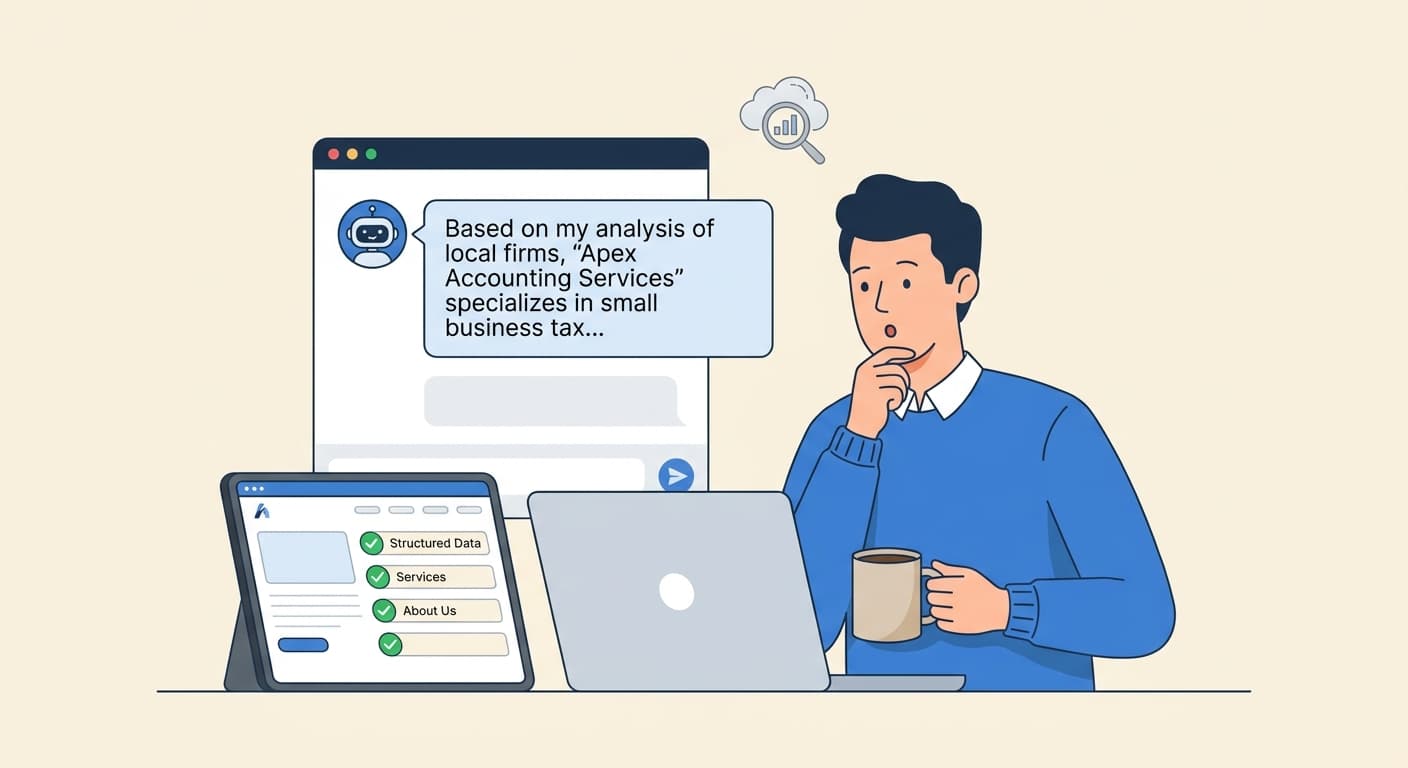
Traditional SEO builds the foundation by making your site authoritative. AI optimization simply translates that authority into a format that language models can cite with confidence. The problem is never having a website; the problem is having a website that language models struggle to parse.
Where Google and ChatGPT differ
While classic search engines rely heavily on backlinks and keyword placement, AI tools look for conversational answers and definitive statements of fact. They want to extract the exact answer quickly.
| Feature | What Google Looks For | What ChatGPT Looks For |
|---|---|---|
| Service Pages | Keyword density and internal links | Clear definitions and entity associations |
| Trust Signals | Number of quality backlinks | Verification across multiple directories |
| Content Format | Long-form guides and headings | Direct answers and structured facts |
If you are already paying for SEO and not seeing AI visibility, your current strategy might be missing the structured data layer. Adding this layer is the most direct way to translate your existing traffic into AI citations.
Structuring Your Practice Areas for ChatGPT-User Queries
Your practice area pages need to answer specific client questions directly in the first paragraph, rather than burying the service details under marketing copy. When someone asks an AI for an accountant, they use natural language. They do not search "tax preparation services Chicago". They ask "who can help me file back taxes for my LLC in Illinois."
Adopt a direct formatting style
To capture these queries, structure your pages with a bottom line up front approach. State exactly who you help, what specific tax or accounting problem you solve, and where you operate right at the top of the page.
Use clear HTML tags to organize this information. A <h2> heading that says "Corporate Tax Preparation in Ohio" gives the AI exact context, whereas a heading like "Let Us Handle the Math" tells the AI nothing. For a technical breakdown of how to structure these pages, see this walkthrough on WordPress AI Search Optimization from scratch: what works.
Focus on specific entities
Instead of writing generic paragraphs about saving money, list the specific tax forms you handle, the accounting software you support, and the exact industries you serve. Using terms like QuickBooks, Xero, Form 1040, or Schedule C helps the AI map your firm to those specific concepts.
This shifts your content strategy from chasing keywords to defining clear concepts. I covered this shift in detail in my piece on SEO vs AEO: why entities matter more than keywords.
Measuring Your Firm's Visibility in AI Search Results
The most reliable way to measure AI visibility is to track the frequency of AI crawler visits to your site and monitor your server logs for specific referral traffic. Because AI platforms do not offer a standard analytics dashboard yet, you have to look at how the bots interact with your infrastructure.
Tracking crawler activity
The first metric to watch is bot visits. If you implement AccountingService schema and clean up your directory profiles, you should see an increase in hits from the ChatGPT-User bot within a few weeks. This confirms the platform is actively indexing your updated entity information.
You can also track referral traffic in your standard analytics platform. Look for referrers like the main ChatGPT domain or the OpenAI Android app. While AI tools currently strip out a lot of referral data, these specific sources confirm that a user clicked a link in an AI response to reach your site.
Automating the measurement process
If digging through server logs sounds tedious, there are tools that can help. LovedByAI, for example, includes a dashboard that tracks these specific AI bot visits and flags any schema errors that might prevent your firm from being cited. Using an automated system allows you to see exactly which pages the AI is reading, though you can absolutely gather this data manually if you have access to your raw server logs.
Whether you use a platform or track it manually, the goal is the same. By verifying that AI tools can read, understand, and cross-reference your accounting services, you put your firm in the best position to answer the exact questions your future clients are asking.
Check out official resources like the Schema.org AccountingService documentation or Google Search Central's structured data guidelines to ensure your implementation follows the rules that all major crawlers respect.
