
When a local business owner opens ChatGPT to ask "What are the best tax saving strategies for an LLC?", the AI actively crawls live accounting sites to generate the answer. Positioning your firm as the source of that answer is the new frontier of client acquisition.
If your practice is not showing up in those AI responses yet, it is not because you lack authority. The search landscape has simply shifted. AI engines rely on specific structural signals to verify facts before they recommend a service provider to a user.
The good news is that traditional search optimization is not broken. Your existing website remains the foundation of your online presence. AI Search adds a specific layer on top, requiring your site and your directory profiles to match perfectly so bots can cross-reference your expertise.
How to Get Your CPA Firm Mentioned by AI Systems
To get mentioned by AI tools like ChatGPT, you must build a cross-reference loop between your firm's website and your public directory profiles.
AI systems do not read your website to learn about you from scratch. They read it to verify what other trusted sources already say about your accounting practice. If your site claims you specialize in forensic accounting, but your state CPA society listing says general tax preparation, the AI detects a conflict and moves on to the next firm.
The fastest path to AI Visibility is ensuring every mention of your firm across the web uses the exact same name, address, and practice area formatting as your own site.
Completing the verification loop
You can learn the mechanics of how to appear in ChatGPT results, but the core concept is consistency. A well-optimized website paired with consistent directory profiles creates the cross-reference loop that AI tools trust.
For accounting firms, this means your Google Business Profile, your AICPA directory listing, your local chamber of commerce profile, and your own website must align perfectly. If you abbreviate your address as "Ste 200" on one site and "Suite 200" on another, you introduce friction for the AI crawler.
When you establish absolute consistency, AI tools can confidently extract your firm as an entity. They stop treating your site as just a collection of text and start treating it as a verified business profile capable of handling complex tax queries.
Why AI Crawls Outpace Google for Accounting Sites
AI bots are now visiting accounting websites more frequently than traditional search engine crawlers because they are fetching live answers for users.
I analyzed data across the LovedByAI platform to understand how these systems interact with professional services websites. Looking at the accounting firms I've tracked, the average site received 1,289 AI bot visits in January 2026. By April 2026, that number surged to 2,210 AI bot visits per site, representing a massive acceleration in AI reading behavior.
During that same period, traditional search bot activity looked very different. In January 2026, AI had already overtaken Google, with 1,289 AI visits compared to 787 Google visits. By April 2026, the gap widened further, with 2,210 AI bot visits versus 1,253 Google crawler visits.
The rise of live query bots
This traffic is not just background indexing. In the data I reviewed, ChatGPT-related bots averaged 5,143 visits per accounting site over the last three months.
Crucially, the ChatGPT-User bot accounted for 2,594 of those visits. This specific bot triggers when a person asks a direct question and ChatGPT searches the live web for the answer. It proves that AI is actively reading tax and accounting content to answer real user questions right now.
When tax season approaches or new corporate filing requirements take effect, these user-triggered bots spike. If your content is structured clearly, your site becomes the source material for those answers.
What ChatGPT Looks for vs Traditional Google SEO
While Google relies heavily on backlinks and keyword density to rank pages, ChatGPT looks for entity consistency and structured data to extract direct answers.
Most digital marketing agencies are great at optimizing for how Google's crawler parses links and content. AI search requires a specific additional layer. It looks for clear facts formatted so a machine can parse them instantly without having to interpret marketing language.
If you want to understand SEO vs AEO: why entities matter more than keywords, you have to look at how these systems evaluate trust. The table below illustrates the core differences.
| Evaluation Area | Traditional Google SEO | AI Search (ChatGPT, Perplexity) |
|---|---|---|
| Primary Goal | Rank pages for specific search queries | Extract verified facts to answer questions |
| Crawl Volume (Apr 2026) | 1,253 crawls per accounting site | 2,210 crawls per accounting site |
| Content Preference | Long-form articles with keyword variations | Concise answers with structured formatting |
| Trust Signals | Backlinks from high-authority domains | Cross-referenced entity data across directories |
| Code Structure | Standard HTML tags like <h1> and <p> | Nested JSON-LD schema markup |
Merging both approaches
You do not have to abandon your traditional strategy. A strong Google presence actually provides the authority that AI tools rely on. The goal is to add the structured data and formatting that AI engines need without changing what already works for Google.
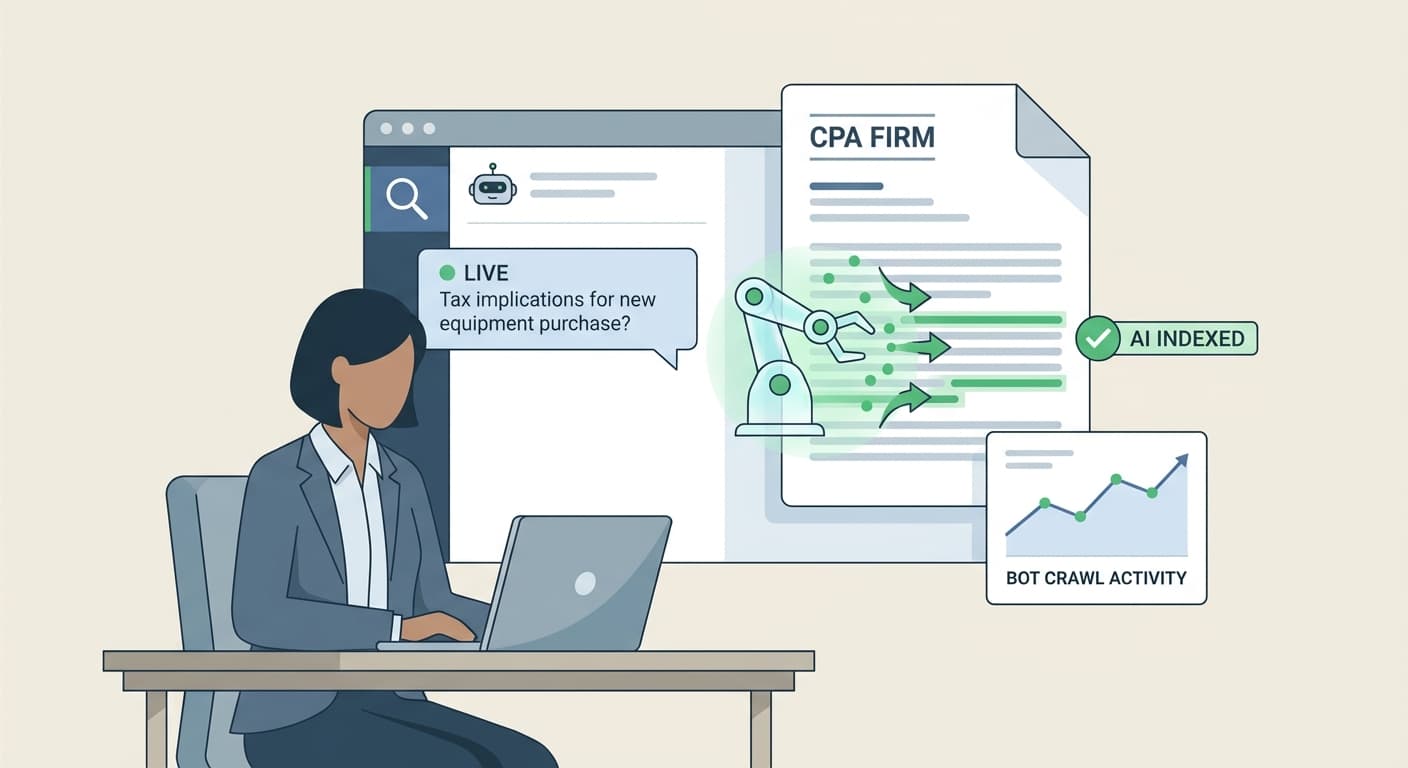
For example, your page about corporate tax preparation still needs a strong <h1> tag and comprehensive details for Google. For AI, you simply add a clear, two-sentence summary at the top and deploy the correct schema behind the scenes.
Structuring Your Tax and Accounting Content for AI
You must structure your pages with direct answers and proper schema markup so AI can extract the exact facts it needs without guessing.
When a user asks about the R&D tax credit, an AI tool wants a direct definition, the eligibility criteria, and the firm offering the service. If your page hides this information inside a long narrative paragraph, the AI will struggle to parse it and will likely cite a competitor instead.
You must format your content using the Bottom Line Up Front principle. Answer the core question in the first two sentences of a section, then provide the detailed explanation below it. Use clean bullet points for lists like "Required tax documents" rather than listing them in a flowing sentence.
Adding the machine-readable layer
Beyond text formatting, you need to provide data in a format designed specifically for machines. This is called JSON-LD schema markup. It lives inside a <script> tag in the <head> of your website and acts as a direct data feed for AI bots.
{
  "@context": "https://schema.org",
  "@type": "AccountingService",
  "name": "Smith & Associates CPA",
  "address": {
    "@type": "PostalAddress",
    "streetAddress": "100 Financial Way",
    "addressLocality": "Chicago",
    "addressRegion": "IL",
    "postalCode": "60601"
  },
  "knowsAbout": ["Corporate Tax", "LLC Formation", "Forensic Accounting"]
}
This code tells the bot exactly who you are, where you operate, and what specific accounting disciplines you master. You can read the official documentation on Schema.org to see all the available properties for accounting firms.
Implementing this properly helps you get cited in Perplexity and Claude web answers. If you use WordPress, you can add this manually or use a plugin to inject it safely. Google also provides a helpful guide on structured data basics in their Search Central documentation.
How to Track If ChatGPT and Perplexity Send You Clients
You can measure AI search success by monitoring your server logs for bot activity and configuring your analytics to catch AI referral traffic.
Unlike traditional search engines, AI tools do not always pass clean referral data when a user clicks a link to your site. A user might click a citation in ChatGPT, but your analytics platform might record it as direct traffic, leaving you unaware that the lead actually came from AI search.
To get an accurate picture, you need to monitor both ends of the process. First, track how often the bots are reading your site. Second, track the actual human clicks coming from AI platforms.
Setting up tracking mechanisms
You can capture AI referral traffic by adding UTM parameters to the links you control on external directories. For organic citations generated by the AI itself, you must rely on your web analytics platform. You can configure tools like Google Analytics to recognize known AI referrers. Google's analytics support documentation offers guidance on setting up custom channel groupings.
You cannot optimize what you do not measure. Identifying whether AI search is a real channel for your specific business requires looking at server logs, not just standard visitor metrics.
If digging through server logs sounds complicated, check your site using our free tool at LovedByAI. It scans your pages to see what AI crawlers can read and identifies the structural gaps you need to fix first. This gives you a clear baseline before you invest time in formatting changes.