

We are observing a fascinating shift in how prospective clients find financial help. Traditional search traffic remains a reliable baseline for accounting practices, but real-time AI tools are rapidly emerging as a powerful new avenue for answering complex tax and accounting questions. business owners and individuals are no longer just typing "CPA near me" into a search bar; they are asking AI platforms complex questions about tax liabilities, state-specific deductions, and entity structuring.
If you are a partner at a small or midsize accounting firm, you do not need to abandon your current marketing efforts to capture this new audience. Navigating seo vs AI Search for accounting firms is not an either-or decision. The firms that are getting recommended by AI are simply adding a specific layer of technical clarity on top of the traditional local search foundation they have already built.
SEO vs AI Search for Accounting Firms: How They Compare
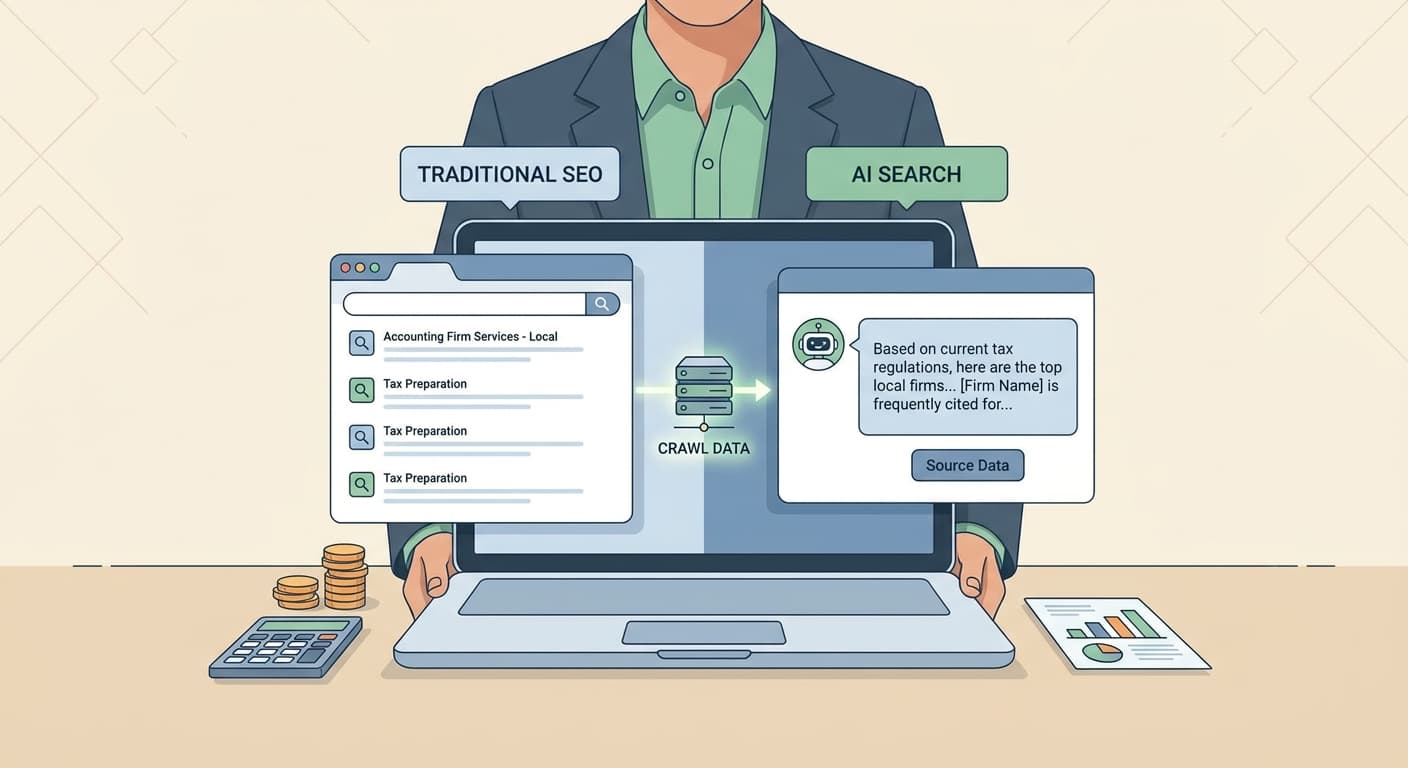
Traditional SEO builds the foundational authority and local relevance that gets your firm indexed, while AI search requires explicit structured data and cross-referenced facts to synthesize direct answers. When a prospective client uses Google, they are looking for a list of trustworthy websites to evaluate. When they use an AI search tool, they are asking the system to read those websites for them and return a single, definitive answer.
This fundamental difference changes how automated bots interact with your web pages. I analyzed crawler behavior across accounting firm sites on the platform. Between January 2026 and April 2026, average AI bot visits per accounting and tax services site grew 2x, rising from 1,359 to 2,210. This surge marks the exact moment AI officially overtook Google in crawl frequency for professional services.
| Metric | Google Indexing Bot | AI Search Bots (ChatGPT, Perplexity, Claude) |
|---|---|---|
| Primary Goal | Rank pages by relevance and authority | Extract specific facts and entities for answers |
| Average Monthly Visits (Apr 2026) | 1,253 | 2,210 |
| Content Preference | Service pages, localized keywords, long-form guides | Direct Q&A formats, BLUF structures, corroborated facts |
| Technical Priority | Fast load times, mobile responsiveness, backlinks | JSON-LD schema, consistent NAP, clean HTML structure |
The Data Behind the Shift
In the data I reviewed for April 2026, AI crawlers now visit the average accounting and tax services site 76% more than Google, with 2,210 AI visits versus 1,253 Google crawler visits per site. These AI systems are constantly checking your content to verify firm details, partner credentials, and specific service offerings.
This means your website is working harder than ever, even if your traditional search traffic has remained flat. The bots are pulling your insights into their own interfaces rather than sending the user to your homepage. Your goal is to ensure the bots extract accurate, verifiable information that positions your firm as the trusted local authority.
Why AI Search Is Complementary to Your Existing SEO Strategy
AI bots do not replace Google's crawlers. They rely heavily on the authority your traditional SEO strategy has already built. Research shows that the vast majority of pages cited by AI search tools already have strong visibility in standard search engines. SEO establishes your firm's credibility, and AI optimization translates that credibility into a format language models can parse.
AI bots are not reading your site to learn about your firm from scratch. They are reading it to verify what other trusted directories already say about you. If your site and those directories disagree, you lose the citation.
The real mechanism at play is a cross-reference loop. AI tools read your website, but they do not automatically trust it. They cross-reference the claims on your site with external data from local chambers of commerce, state CPA society directories, Yelp, and Google Business Profiles. A well-optimized website combined with consistent directory profiles creates a closed loop of trust.
Why the Website Still Matters
Many marketing agencies misunderstand this dynamic and assume that because AI tools pull from directories, the firm's website is less important. The opposite is true. The website is the central node that ties all your external profiles together. You can dive deeper into SEO vs AEO: why entities matter more than keywords to see exactly how this works behind the scenes.
When your website clearly states that your firm handles forensic accounting, and a local directory confirms that same service using the exact same firm name and address, the AI system registers a verified fact. If your website lacks technical structure or contradicts the directory, the AI simply skips your firm and recommends a competitor whose data matches perfectly.
How ChatGPT Looks at Your Firm vs How Google Looks at It
Google evaluates how popular and relevant your page is based on external links and localized keywords. ChatGPT evaluates how consistently your firm's facts are corroborated across the web and how directly your text answers the user's prompt. Google wants to provide options. ChatGPT wants to provide a synthesis.
This distinction is entirely visible in our crawler data. ChatGPT is actively reading accounting and tax services content to answer live user queries. Looking at the firms I have tracked over the last three months, ChatGPT-related bots averaged 5,197 visits per site, with the live-query bot (ChatGPT-User) accounting for 2,646 of those visits per site. The AI is fetching your tax advice the moment a user asks a related question.
| Feature Evaluated | What Google Looks For | What ChatGPT Looks For |
|---|---|---|
| Firm Address and Phone | Proximity to the searcher, Google Business Profile connection | Exact character match across all citations and website footer |
| Services Offered | Dedicated landing pages for each service (e.g., "Tax Preparation") | Explicit entity relationships in the page structure and schema |
| Expertise | Backlinks from financial publications, dwell time | Partner biographies, clear credentials, exact Q&A formatting |
| Code Structure | Proper <title> tags and heading hierarchy | FinancialService schema and Person markup for partners |
Structuring for the Synthesis
To satisfy ChatGPT, your content must be highly structured. When you write a blog post about the latest changes to state depreciation rules, you should not bury the answer in the fifth paragraph. You must state the rule change plainly in the first two sentences.
You can read more about How to Appear in ChatGPT Results to understand the exact mechanics, but the core principle is clarity. If a human skimming the page can find the bottom-line answer in three seconds, an AI bot can parse it efficiently. If the page relies on vague marketing copy, the bot will discard it.
Which AI Search Engines Matter Most for Tax and Accounting?
Not all AI tools serve the same purpose for your prospective clients. ChatGPT dominates direct, conversational questions where the user wants to understand a complex tax scenario. Google AI Overviews intercept users who still start their journey with a traditional search query. Perplexity acts as a research assistant, heavily favoring in-depth guides and highly cited articles.
For an accounting firm, ChatGPT and Google AI Overviews are the primary targets. When a small business owner types "how to switch from LLC to S-Corp in Texas" into Google, an AI Overview will often push traditional organic results below the fold. If your firm's content is structured correctly, your site can be cited directly inside that overview.
Optimizing for Google AI Overviews
Google's AI uses the exact same core index as its traditional search engine. It relies heavily on structured data. According to the official Google Search Central documentation, implementing precise local business markup allows Google to accurately extract your business details for rich results.
Optimizing for Direct AI Platforms
Platforms like ChatGPT and Perplexity operate independently of Google's index. They rely on their own web crawlers and partnerships with data aggregators. This is why having your firm listed accurately in industry-specific aggregators is non-negotiable. They use those aggregators as ground truth to verify the claims on your website.
What to Fix First if You Are Missing from AI Overviews
If your firm is currently absent from AI recommendations, the fix usually involves standardizing your firm's data footprint and translating your website content into a machine-readable format. The first step is an audit of your firm's Name, Address, and Phone number across every directory on the internet.
Any discrepancy between your state CPA listing, your Yelp profile, and your website footer creates confusion for AI crawlers. If one directory lists "Smith & Jones Accounting" and your website says "Smith and Jones CPAs," you have broken the cross-reference loop. Standardize your entity name exactly.
Implement FinancialService Schema
The most powerful technical fix is adding explicit structured data to your website's code. For accounting firms, this means utilizing specific vocabulary from the Schema.org specification for FinancialService. This code sits invisibly in the <head> of your website and feeds facts directly to AI bots.
{
  "@context": "https://schema.org",
  "@type": "AccountingService",
  "name": "Smith and Jones CPAs",
  "address": {
    "@type": "PostalAddress",
    "streetAddress": "100 Financial Way",
    "addressLocality": "Austin",
    "addressRegion": "TX",
    "postalCode": "78701"
  },
  "telephone": "+1-512-555-0198",
  "url": "https://www.smithjonescpas.com"
}
This JSON-LD format leaves no room for interpretation. If you use a content management system, you can implement this manually following the WordPress developer documentation to ensure the syntax remains stable when your pages load.
Verify Your Progress
Once your facts are aligned and your schema is in place, you need a way to measure the impact. You can use our platform to check your site and see exactly what AI crawlers extract when they visit your pages.
If you are handling the technical implementation yourself, follow a structured guide. Review WordPress AI Search Optimization from scratch: what works to ensure you are configuring your heading tags, FAQ layouts, and page speed correctly. The goal is to make your existing authority perfectly legible to the bots that are already knocking on your door thousands of times a month.
