
The question every business asks about GEO
Generative Engine Optimization sounds reasonable in theory. Add structured data, lead with the answer, cover your niche in depth, and AI engines are more likely to cite you. But does it actually change anything you can measure? Or is it just SEO advice with a new acronym?
We are in an unusual position to answer that, because we track the full journey from AI crawl to referral click across more than 1,100 WordPress sites. So we ran the numbers.
First, how AI traffic actually works
Before the result, it helps to know what "getting cited" is up against. AI bots hit your site constantly, but most of that traffic is training crawls: GPTBot, ClaudeBot, and others building their models. That is not the same as being used to answer a live question. Across our sites, AI bots logged 62.3 million training crawls, which narrowed to 6.2 million answer-time fetches (the moment a model actually pulls your page to respond to someone), which produced just 16,724 referral clicks. That is roughly one visitor for every 3,700 training crawls.
So being crawled is essentially free and nearly universal: 97% of the sites we track get crawled by an AI bot, but fewer than half ever earn a single referral visit. The whole game is moving a page out of the crawled-and-ignored majority and into the small set a model actually fetches and cites. That is the gap optimization is supposed to close, and it is exactly what we set out to measure.
The experiment: a natural A/B test hiding in the data
The cleanest way to test whether optimization works would be a randomized trial: take one site, optimize half its pages at random, and watch. We found something close to that occurring naturally.
Many sites optimize only some of their pages, usually because their plan covers a limited number. That leaves optimized and un-optimized pages living side by side on the same website. They share the same domain, the same brand reputation, the same niche, and the same author. The main thing that differs is whether the page was optimized. That makes the untouched pages a built-in control group.
We took every site that had both optimized and un-optimized pages (793 sites, roughly 355,000 pages) and measured a simple thing: what share of pages in each group earned at least one AI referral visit from ChatGPT, Gemini, Claude, or Perplexity.
The result: optimized pages get cited 4 to 7 times more often
Across all 793 sites, optimized pages earned an AI referral 2.48% of the time versus 0.41% for un-optimized pages. That is a 6x difference. In a world where getting cited at all is the hard part, a page being six times more likely to earn a citation is a large effect.
"But you optimize your best pages," so we controlled for it
The obvious objection: of course optimized pages do better, because people optimize their homepage and top service pages first, and those would attract citations anyway. If that were the whole story, the effect would vanish once you compared like with like.
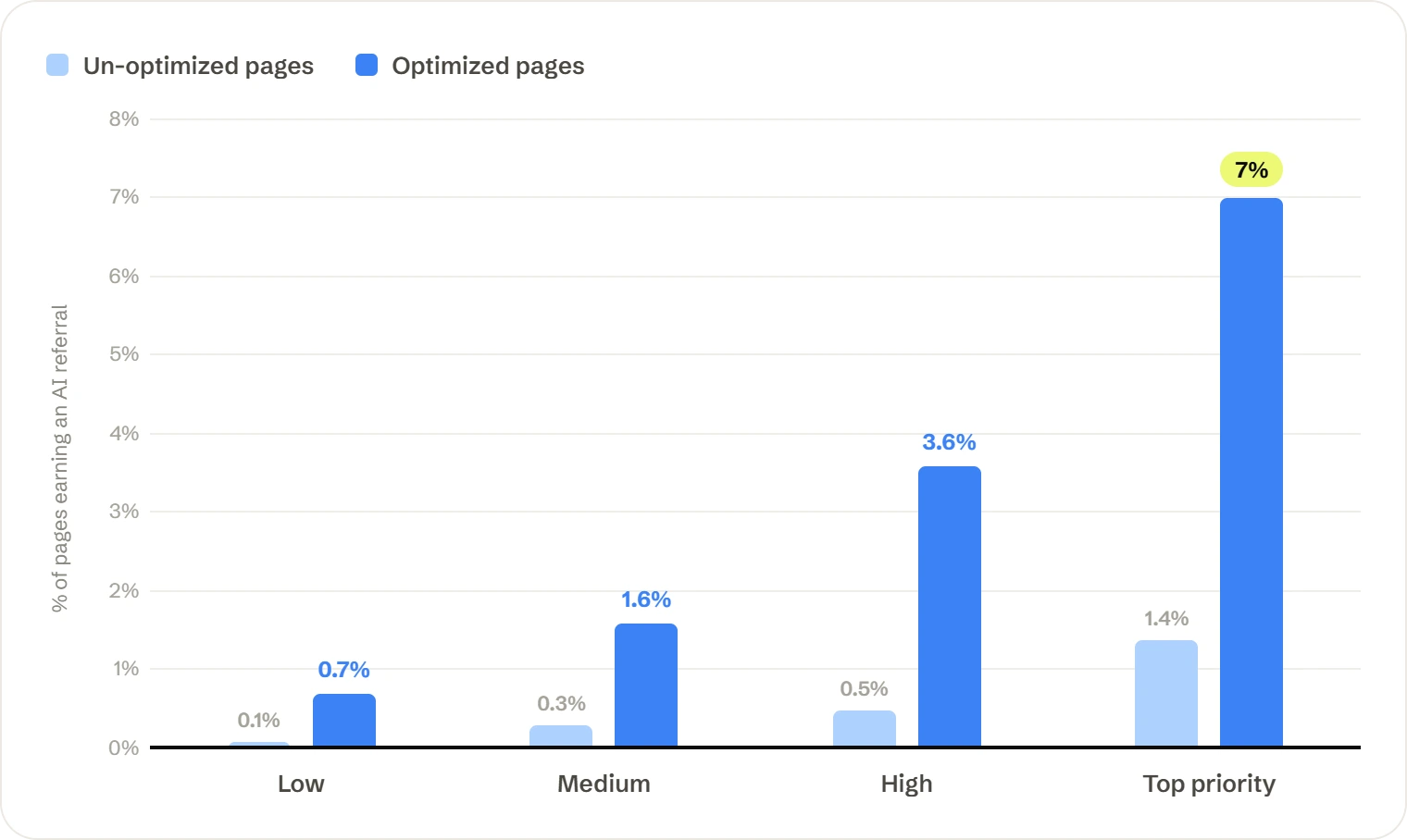
It does not. We grouped every page by an internal importance score and compared optimized against un-optimized pages within the same tier. The lift held at every level:
| Page priority | Un-optimized cited | Optimized cited | Lift |
|---|---|---|---|
| Low | 0.16% | 0.70% | ~4.4x |
| Medium | 0.33% | 1.66% | ~5.0x |
| High | 0.56% | 3.67% | ~6.6x |
| Top priority | 1.43% | 7.05% | ~4.9x |
A low-priority optimized page still out-cites a low-priority untouched page. A top-priority optimized page still out-cites a top-priority untouched page. The gap is not an artifact of which pages get chosen for optimization. Holding priority constant, optimization roughly multiplies a page's citation rate by five.
The honest caveats
This is real data, but it is observational, not a randomized controlled trial, so we will not overclaim:
- Selection still exists. People choose which pages to optimize. Controlling for our importance score removes the biggest confounder, but not every difference between pages.
- It is a rate, not a promise. Even among optimized top-priority pages, most do not get cited in a given window. Optimization improves your odds; it does not guarantee a citation.
- Content still has to be worth citing. Optimization makes good content legible to AI. It cannot make thin content authoritative. The content-depth pattern is just as strong in our data.
What would make this even stronger is a strict before-and-after on the same pages, which we are building next. But as a like-for-like comparison on the same sites, the signal is hard to explain away.
Why optimization moves the needle
The mechanism lines up with what separates cited sites from ignored ones. Optimized pages get complete, nested JSON-LD structured data so models can confirm what the page is about, they are restructured to lead with the answer, and they ship an llms.txt file that tells crawlers what the site is for. Each of those removes a reason for an AI to skip you in favor of a competitor whose page is easier to interpret. The best GEO and AEO plugins automate all three.
See where your pages stand
The pages that get cited are the ones AI engines can read cleanly and trust. The fastest way to see how yours look to a model right now is to run one through our free GEO checker: it scores your structured data, heading structure, and answer-first formatting, then tells you exactly what to fix first.
