For a long time, your Google rankings told you most of what you needed to know about how visible your business was online. They don't anymore. Gartner expects traditional search volume to fall by 25% by 2026 as more people move to AI assistants and conversational search. AI has also become a discovery channel of its own, and fast: Adobe has reported a 1,200% increase in traffic from generative AI sources to U.S. retail websites. People now ask ChatGPT, Gemini, Claude, Perplexity, and Google AI Overviews for recommendations, and a rank tracker can't tell you whether any of them mention you. AI search visibility tools measure that, and some of them help you improve it.
TL;DR: best AI search visibility tools
AI visibility platforms do different jobs. Some watch for brand mentions in ChatGPT and Google AI Overviews. Others are built for competitive intelligence, citation tracking, share of voice analysis, or AI search optimization. If you only want the short answer, the table below has our top pick for each business need.
Most of the tools here measure AI visibility. A smaller group also helps you improve it, through AI search optimization, GEO implementation, and content changes.
| Use Case | Best Tool |
|---|---|
| Best AI Search Optimization Platform | LovedByAI |
| Best for SEO Agencies | Profound |
| Best Enterprise Platform | Scrunch AI |
| Best for AI Share of Voice Tracking | Peec AI |
| Best Budget AI Visibility Tool | Otterly |
| Best for SEO Teams | Ahrefs Brand Radar |
| Best for Existing Semrush Users | Semrush AI Toolkit |
| Best for Ecommerce Brands | Yotpo |
| Best for Competitive Monitoring | Similarweb |
Key takeaway
For many businesses, showing up in AI answers now matters as much as ranking in traditional search. More people go to ChatGPT, Gemini, Claude, Perplexity, and Google AI Overviews to find products, services, and brands, and the businesses that keep appearing in those answers get a head start long before anyone opens a search results page.
A good AI search visibility platform tells you where you appear, how often you are cited, and which competitors get recommended instead. Some also help you act on that by improving your AI search optimization and visibility over time. If implementation is your priority, our companion guide to the best generative engine optimization (GEO) tools goes deeper on optimization-first platforms. And if you want a bigger presence in AI search engines without letting your traditional SEO slip, the right AI visibility platform is quickly moving from optional to necessary.
Quick list: best AI search visibility tools
The platforms below stood out on AI search coverage, citation tracking, competitive intelligence, reporting, ease of use, and overall value. Each one gets a full review further down the page.
- LovedByAI: AI search optimization platform that helps businesses improve visibility through automated GEO implementation, structured data, AI-readable content, and AI traffic tracking.
- Profound: A popular choice among agencies and enterprise teams focused on AI brand monitoring.
- Peec AI: Strong visibility analytics platform with detailed share of voice reporting.
- Scrunch AI: Built for larger organizations that need advanced AI search intelligence and reporting.
- AthenaHQ: Tracks how present a brand is in AI-generated answers and how it performs there.
- Similarweb AI Visibility: Excellent for competitive benchmarking and market intelligence.
- Ahrefs Brand Radar: Helps SEO teams understand how brands are being surfaced in AI search experiences.
- Semrush AI Toolkit: A natural extension for teams already using Semrush for SEO and marketing.
- Otterly AI: Affordable option for startups and small businesses entering AI visibility tracking.
- ZipTie: Tracks brand mentions, citations, and AI-generated recommendations.
- Yotpo Discover: Useful for ecommerce brands looking to increase visibility for products and reviews.
- Bluefish AI: Brand discovery and recommendation monitoring across AI platforms.
- Conductor: Enterprise search intelligence platform that keeps adding AI visibility features.
- Rankscale: Tracks brand performance across multiple AI search engines and answer platforms.
- AirOps: Connects AI search insights with content production and optimization workflows.
- Frase: Known for content optimization, with features that support AI search readiness.
- Writesonic: Content creation platform that also offers tools for improving AI search performance.
- SE Ranking AI Visibility: SEO-focused platform that includes AI search monitoring and reporting features.
Most of these platforms are monitoring tools. They report where you show up, how often you get cited, and who is being recommended in your place. AI search optimization platforms go a step further and work on the outcome itself, through content optimization, structured data, entity building, and other GEO practices.
Within those two groups, each product has its own emphasis. Some are mainly mention and citation trackers. Others lean toward competitive intelligence, share of voice measurement, AI search optimization, content optimization, or AI search analytics.
In practice, a visibility tool tells you where you're missing, and an optimization tool is what you use to fix it.
What is AI search visibility?
Online visibility used to mean search rankings. If your website sat near the top of Google, you were visible. Rankings still count, but they leave a lot out now.
Millions of people now use ChatGPT, Gemini, Claude, Perplexity, Google AI Overviews, and other AI-powered search experiences to find products, services, and brands. Instead of a list of links, these platforms give back a written answer and make recommendations directly.
So the question you need to ask changes.
Traditional SEO asks:
"Do I rank for this keyword?"
AI search visibility asks:
"Am I being mentioned, cited, or recommended when people ask AI platforms about my industry?"
The two don't always line up. A business can sit on the first page of Google for an important keyword and never come up in ChatGPT's recommendations, while a brand with fairly modest search rankings gets mentioned in AI-generated answers all the time.
AI search visibility is the measure of that presence across answer engines: how often you appear, which competitors get recommended instead, and where you have room to improve in AI-generated results.
AI visibility vs SEO vs GEO vs AEO
| Category | Full Form | Primary Goal | What It Focuses On | Key Success Metrics | Typical Tools | Example Question |
|---|---|---|---|---|---|---|
| SEO | Search Engine Optimization | Improve visibility in traditional search engines | Rankings, organic traffic, technical SEO, backlinks, keyword optimization | Rankings, clicks, impressions, organic traffic, conversions | Ahrefs, Semrush, Moz, SE Ranking | "Do I rank on Google for my target keywords?" |
| AEO | Answer Engine Optimization | Increase the likelihood of appearing in direct answers | Featured snippets, People Also Ask results, voice search, direct answers | Featured snippets won, answer box visibility, zero-click visibility | Semrush, Clearscope, Frase, LovedByAI, Schema tools | "Does Google use my content to answer questions directly?" |
| GEO | Generative Engine Optimization | Help AI systems understand, trust, and cite your content | Entity optimization, structured data, AI-readable content, citations, topical authority | AI citations, AI mentions, recommendation frequency, entity coverage | LovedByAI, AirOps, Frase, Writesonic | "Will ChatGPT or Gemini use my content when generating answers?" |
| AI Visibility | AI Search Visibility & Monitoring | Measure and improve brand presence across AI search platforms | Mentions, recommendations, citations, share of voice, competitive visibility | AI mentions, citation rate, recommendation rate, AI share of voice, sentiment | Profound, Peec AI, Scrunch AI, Similarweb | "How often do AI platforms recommend my business instead of my competitors?" |
In short, SEO is how people find you, GEO is how AI systems come to understand you, and AI visibility tracking tells you whether those systems actually recommend you.
The simplest way to think about it
SEO is about ranking in Google, and AEO is about showing up in direct answers. GEO helps AI systems understand, cite, recommend, and retrieve your content. AI visibility is the measuring side: it monitors and benchmarks how often AI platforms mention, cite, and recommend your brand.
How they work together
The four stack on top of each other rather than competing:
- SEO gets your content discovered.
- AEO helps that content become the answer.
- GEO makes it easier for AI systems to understand and cite.
- AI visibility tracking checks whether all of that is actually producing mentions, citations, and recommendations across ChatGPT, Gemini, Claude, Perplexity, Google AI Overviews, and other AI search platforms.
The businesses getting the best results right now run SEO, AEO, GEO, and AI visibility together, which gives them a stronger presence in traditional search engines and in AI-powered discovery platforms.
AI SEO tools vs AI visibility tools
People use these two labels interchangeably, and buying the wrong kind of tool is the most common mistake we see. They solve different problems.
AI SEO tools use AI to do traditional SEO work faster: generating briefs, clustering keywords, drafting meta descriptions, finding internal link opportunities. The output is still aimed at Google's ten blue links. Surfer, Clearscope, Frase, and the AI features inside Semrush and Ahrefs sit here.
AI visibility tools measure and improve whether AI systems mention you at all. The output is a citation, a recommendation, or a mention inside a generated answer. Profound, Peec AI, Scrunch AI, and LovedByAI sit here.
| AI SEO tools | AI visibility tools | |
|---|---|---|
| Optimises for | Google rankings | AI answers and citations |
| Core metric | Position, traffic, CTR | Mentions, citations, share of voice |
| Answers | "Will this page rank?" | "Will ChatGPT recommend us?" |
| Fails when | AI answers replace the click | You need classic rankings too |
Most teams need one of each. An AI SEO tool will not tell you that Perplexity has been recommending a competitor for six months, and an AI visibility platform will not write your content brief.
GEO tools, LLM visibility tools, and AI brand visibility: same thing?
Mostly, yes, and the naming hasn't settled yet. The labels differ because each vendor chose to emphasise something different, not because the software does anything very different underneath.
- GEO tools (generative engine optimization) emphasise the fixing: structured data, entity clarity, machine-readable output.
- LLM visibility tools emphasise the model layer: whether ChatGPT, Claude, and Gemini surface you, tracked prompt by prompt.
- AI brand visibility and AI visibility tracking emphasise the marketing metric: mentions, sentiment, and share of voice against named competitors.
- ChatGPT rank trackers are the narrowest of the group, watching position within a single assistant's answers.
When you compare vendors, ignore the label on the box and ask two questions instead. Does it measure across every assistant your buyers actually use, or only one? And when it finds a gap, does it hand you a report or does it change something on your site? The second question splits this category more than anything else, so this comparison is organised around it.
Why AI search visibility matters in 2026
| Statistic | Why It Matters |
|---|---|
| Traditional search volume could decline 25% by 2026 (Gartner) | More users are turning to AI assistants for discovery. |
| Generative AI traffic grew 1,200%+ year-over-year (Adobe) | AI is becoming a meaningful traffic source. |
| ChatGPT has 900M+ weekly active users (OpenAI) | Brands need visibility where consumers are searching. |
Businesses that invest in AI search optimization can see more AI-generated mentions and referral traffic within weeks rather than months, though results vary by industry and by where you start. Doing the GEO basics consistently (structured data, entity clarity, AI-readable content) usually matters more than any single tactic.
Discovery itself is moving. Plenty of people skip the ten blue links and ask an AI platform for a recommendation directly. Whether they want an accounting firm, a law firm, a software platform, an insurance provider, or a local service business, the AI answer has a growing say in which brands make the shortlist. If you start tracking and improving your AI search visibility now, you will be in a better spot as AI-powered discovery keeps growing.
How we evaluated these AI search visibility platforms
We evaluated each platform against the things that matter most to a business putting money into AI search visibility.
Our evaluation criteria
The first was AI engine coverage: support for ChatGPT, Gemini, Claude, Perplexity, Google AI Overviews, and other AI search platforms. Next came citation tracking, meaning the ability to monitor mentions, citations, and recommendations in AI-generated answers, and share of voice analysis, which shows how often your brand appears compared with competitors. We also looked at the quality and depth of each tool's AI visibility metrics (visibility, recommendation, and brand presence reporting) and at its competitive intelligence features for benchmarking competitors and spotting visibility gaps.
On the improvement side, we checked GEO capabilities, meaning tools that help raise AI discoverability and citation potential. Then we weighed ease of use (user experience, onboarding, and learning curve), pricing and value relative to features and target audience, and customer feedback drawn from independent reviews, ratings, and real-world user experiences.
We ranked for value to a particular kind of business (agencies, SaaS companies, ecommerce brands, local businesses, and WordPress websites) rather than for the longest feature list. If you are specifically weighing platforms that help you rank inside the AI answers themselves, our roundup of the best LLM SEO tools compares them head to head.
Comprehensive AI visibility platform comparison table
| Tool | Primary Category | AI Engines Covered | Citation Tracking | AI Mentions Tracking | Share of Voice Analysis | Competitor Tracking | AI Traffic Tracking | GEO Optimization Features | WordPress Native | Pricing (Starting) | Best For |
|---|---|---|---|---|---|---|---|---|---|---|---|
| LovedByAI | AI Search Optimization (GEO) | ChatGPT, Gemini, Claude, Perplexity, Google AI Overviews | ✅ | ✅ | Limited | Limited | ✅ | ✅ | ✅ | Free plan available, Pro $29/mo, Business $59/mo | WordPress businesses, agencies, SMBs |
| Profound | AI Visibility Monitoring | ChatGPT, Gemini, Claude, Perplexity, Google AI Overviews | ✅ | ✅ | ✅ | ✅ | ❌ | Limited | ❌ | From $99/mo | Enterprise brands and agencies |
| Peec AI | AI Visibility Monitoring | ChatGPT, Gemini, Claude, Perplexity | ✅ | ✅ | ✅ | ✅ | ❌ | ❌ | ❌ | From $95/mo | AI share of voice monitoring |
| Scrunch AI | AI Visibility Monitoring | ChatGPT, Gemini, Claude, Perplexity, Google AI Overviews | ✅ | ✅ | ✅ | ✅ | ❌ | Limited | ❌ | From $250/mo | Enterprise AI visibility programs |
| AthenaHQ | AI Visibility Monitoring | ChatGPT, Gemini, Claude, Perplexity | ✅ | ✅ | ✅ | ✅ | ❌ | Limited | ❌ | From $295/mo | Brand monitoring and reporting |
| Similarweb AI Visibility | Competitive Intelligence | ChatGPT, Gemini, Claude, Perplexity, Google AI Overviews | Limited | ✅ | ✅ | ✅ | ❌ | ❌ | ❌ | From $99/mo | Competitive intelligence |
| Ahrefs Brand Radar | Brand Monitoring | ChatGPT, Gemini, Perplexity, Google AI Overviews | Limited | ✅ | Limited | ✅ | ❌ | ❌ | ❌ | Brand Radar AI from $199/mo; Ahrefs plans from $129/mo track 5 AI prompts | SEO teams |
| Semrush AI Toolkit | AI Visibility Monitoring | ChatGPT, Gemini, Claude, Perplexity, Google AI Overviews | Limited | ✅ | Limited | ✅ | ❌ | ❌ | ❌ | From $99/mo per domain | Existing Semrush customers |
| Otterly AI | AI Visibility Monitoring | ChatGPT, Perplexity, Google AI Overviews, Copilot (Gemini, AI Mode, Claude extra) | ✅ | ✅ | Limited | Limited | ❌ | ❌ | ❌ | From $29/mo | Small businesses and startups |
| ZipTie | AI Visibility Monitoring | ChatGPT, Gemini, Claude, Perplexity | ✅ | ✅ | ✅ | ✅ | ❌ | ❌ | ❌ | From $69/mo | Brand monitoring |
| Yotpo Discover | Ecommerce Visibility | ChatGPT, Gemini, Perplexity | Limited | ✅ | Limited | Limited | ❌ | ❌ | ❌ | Yotpo plans from $89/mo | Ecommerce brands |
| Bluefish AI | Brand Visibility Monitoring | ChatGPT, Gemini, Claude, Perplexity | ✅ | ✅ | ✅ | ✅ | ❌ | Limited | ❌ | Custom pricing (industry estimates ~$99-$299+/mo entry level) | Brand recommendation tracking |
| Conductor | Enterprise Search Intelligence | ChatGPT, Gemini, Claude, Google AI Overviews | Limited | ✅ | Limited | ✅ | ❌ | Limited | ❌ | Custom enterprise pricing | Enterprise SEO teams |
| Rankscale | AI Visibility Monitoring | ChatGPT, Gemini, Claude, Perplexity | ✅ | ✅ | ✅ | ✅ | ❌ | ❌ | ❌ | From $99/mo | AI search performance monitoring |
| AirOps | AI Search Optimization (GEO) | ChatGPT, Gemini, Claude, Perplexity, Google AI Overviews | ❌ | Limited | ❌ | Limited | ❌ | ✅ | ❌ | Free plan available, paid plans from ~$49/mo | Content operations and GEO workflows |
| Frase | Content Optimization | Google AI Overviews, ChatGPT (content optimization workflows) | ❌ | ❌ | ❌ | ❌ | ❌ | ✅ | ❌ | From $39/mo | Content optimization |
| Writesonic | Content Optimization | ChatGPT, Gemini, Google AI Overviews | ❌ | ❌ | ❌ | ❌ | ❌ | ✅ | ❌ | From $79/mo | AI-assisted content creation |
| SE Ranking AI Visibility | AI Visibility Monitoring | ChatGPT, Gemini, Claude, Perplexity, Google AI Overviews | Limited | ✅ | Limited | ✅ | ❌ | Limited | ❌ | From $103.20/mo | SEO professionals and agencies |
The 18 best AI search visibility tools reviewed
1. Profound
Best for
Enterprise brands, large marketing teams, agencies managing multiple clients, and companies that need deep AI search monitoring across ChatGPT, Gemini, Claude, Perplexity, and Google AI experiences.
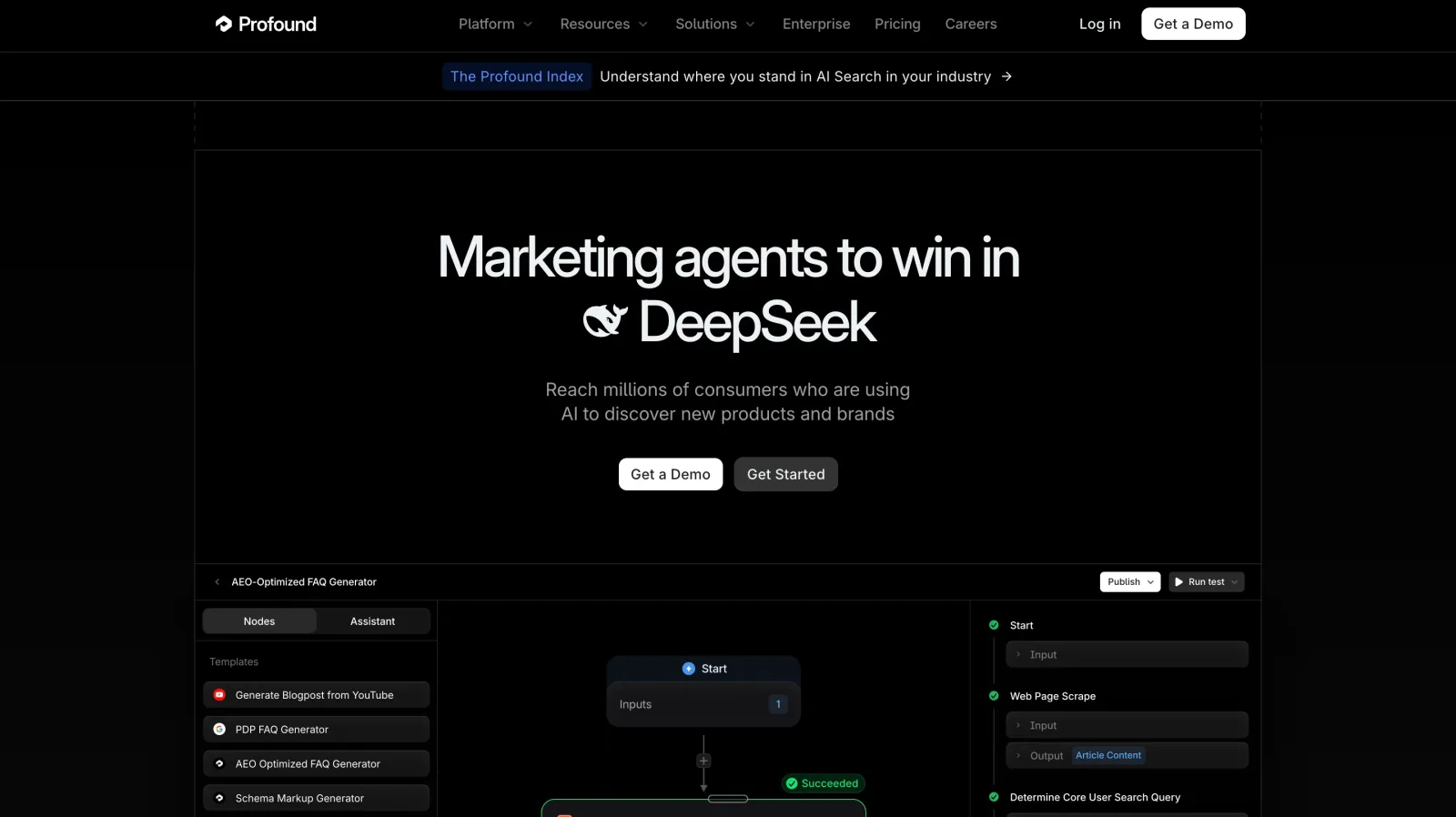
Profound is one of the most established AI visibility platforms on the market, and it has become a popular pick for enterprise brands and agencies that want to monitor how they show up in AI search engines. Website optimization takes a back seat. Profound concentrates on how often you appear inside AI-generated answers and how you compare with competitors there.
Many organizations use Profound as their central AI visibility dashboard, the place a team goes to see whether the major AI platforms are recommending them, citing them, or passing them over. If your company treats AI search as a new marketing channel, Profound's analytics are among the most mature you can buy.
Key features
- AI brand visibility tracking
- Prompt-level monitoring
- AI share of voice reporting
- Competitor benchmarking
- Brand mention analysis
- AI search performance dashboards
- Multi-engine monitoring
- Agency reporting capabilities
Pros
- Strong AI visibility analytics
- Detailed competitive intelligence
- Agency-friendly reporting
- Covers multiple AI platforms
- Established enterprise customer base
Cons
- Focuses primarily on monitoring rather than optimization
- Limited implementation capabilities
- Can become expensive as usage grows
- Better suited for larger organizations
Pricing
| Plan | Pricing |
|---|---|
| Starter | $99/month |
| Growth | $399/month |
| Enterprise | Custom |
As a tracker, Profound is one of the strongest available today. You get a clear picture of how AI engines talk about your products, your services, and your competitors.
Measurement and competitive intelligence are where Profound is strongest. Acting on the findings is another matter: GEO improvements and AI search optimization recommendations usually have to be carried out with separate workflows or tools. For an enterprise brand that mainly wants AI search analytics, Profound is still one of the best options.
Best for
- Enterprise brands
- Marketing agencies
- SaaS companies
- Competitive intelligence teams
- AI visibility monitoring programs
2. Peec AI
Best for
SEO teams, marketing departments, content marketers, and brands looking for affordable AI search visibility tracking.
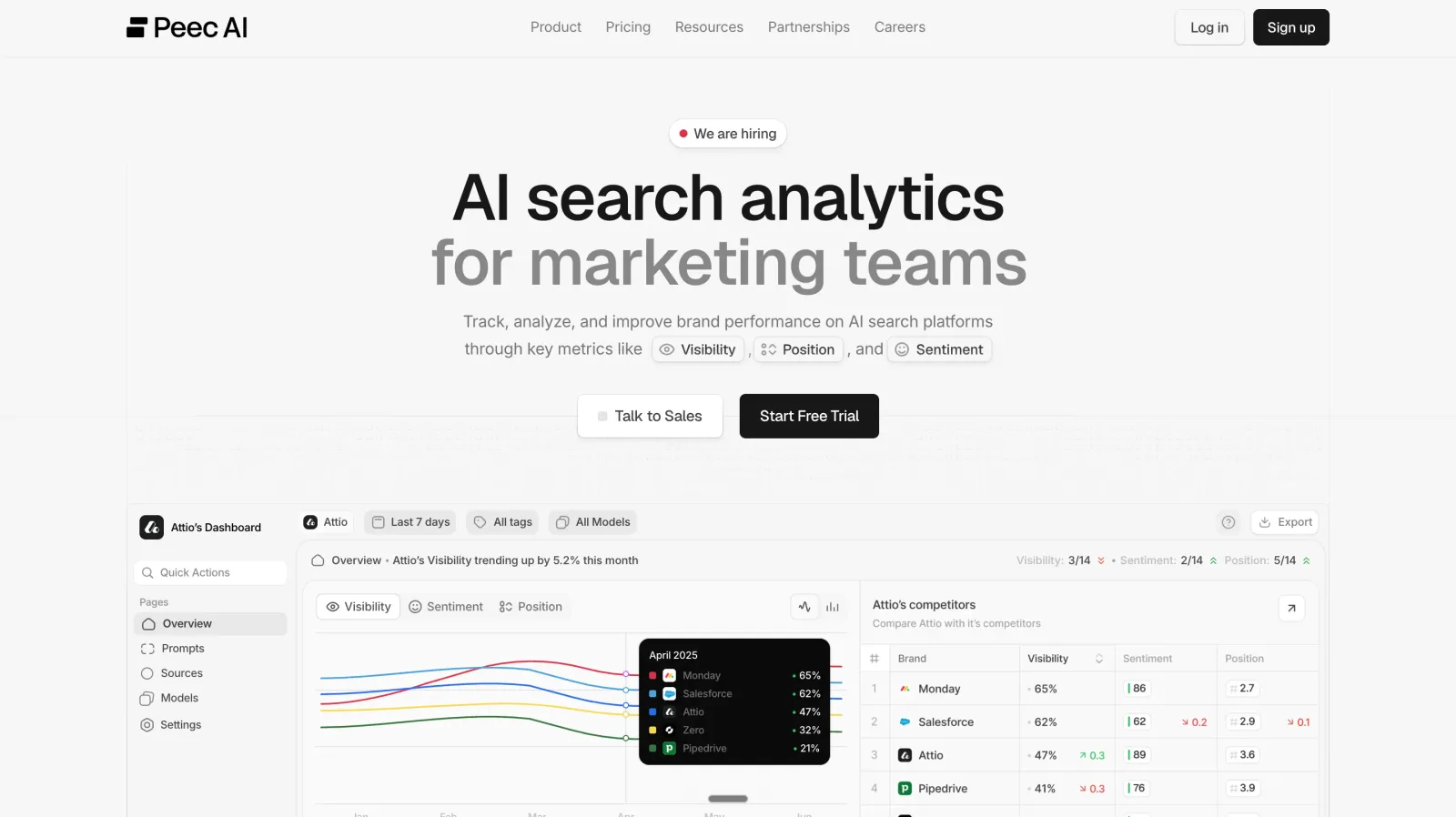
Peec AI caught on by making AI visibility tracking easier to get into than many enterprise-focused competitors. You can monitor mentions across ChatGPT, Gemini, Claude, and Perplexity, and the reporting dashboards are clear.
It often costs a good deal less than the enterprise alternatives, which makes it attractive to a growing business that wants AI search data without a large software commitment.
Peec AI sits between the lightweight monitoring tools and enterprise platforms like Profound. Most marketing teams will get enough visibility data out of it without the complexity getting in the way.
Key features
- AI search visibility monitoring
- AI mention tracking
- Share of voice reporting
- Prompt tracking
- Competitor analysis
- Multi-model monitoring
- Historical visibility reporting
Pros
- More affordable than many competitors
- Easy-to-use interface
- Strong reporting capabilities
- Good visibility tracking coverage
- Suitable for smaller teams
Cons
- Limited GEO implementation tools
- Primarily a monitoring platform
- Less enterprise functionality than Profound
- Advanced workflows require higher plans
Pricing
| Plan | Pricing |
|---|---|
| Starter | $95/month |
| Pro | $245/month |
| Advanced | $495/month |
| Enterprise | Custom |
Few tools here balance functionality and price as well as Peec AI does. You can start tracking AI visibility without committing to enterprise pricing on day one.
If what you mainly want is to measure AI presence, citations, and share of voice across several AI platforms, Peec AI is strong value, and you skip much of the cost and complexity that come with enterprise products.
Best for
- SEO teams
- Content marketers
- Mid-sized brands
- Marketing departments
- AI visibility reporting
3. Scrunch AI
Best for
Enterprise organizations, AI-first brands, and agencies managing large AI search programs.
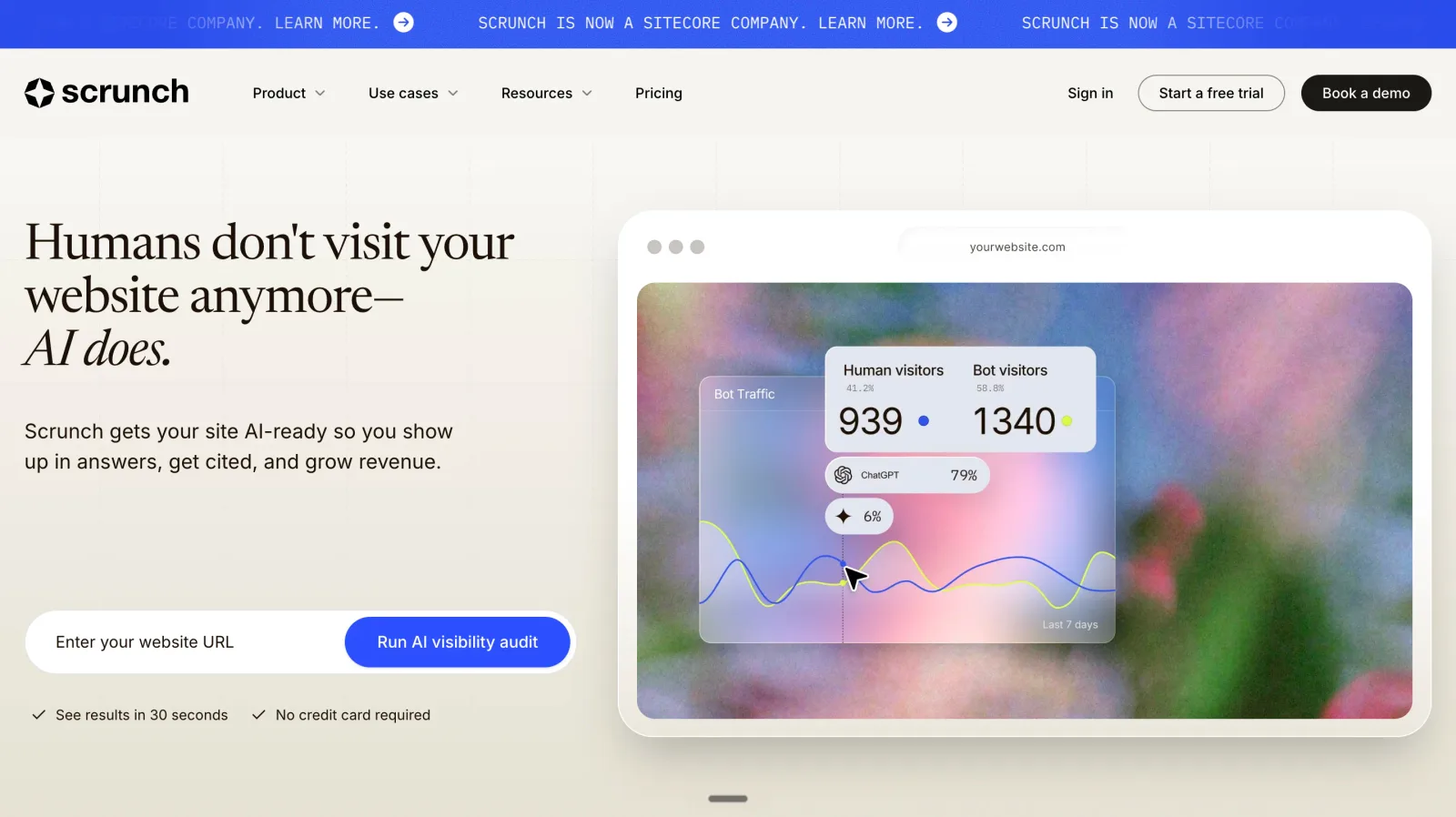
Scrunch AI pitches itself as a full AI visibility and AI search intelligence platform. Mention monitoring is only one part of it. The bigger focus is how AI systems perceive, summarize, and recommend your brand.
Scrunch covers a broad range of AI models, and its reporting shows how your brand comes up in AI-generated answers, in recommendations, and at the level of individual prompts.
Key features
- AI visibility tracking
- AI perception analysis
- Competitive monitoring
- AI share of voice
- Multi-model tracking
- Prompt intelligence
- Enterprise reporting
Pros
- Extensive AI model coverage
- Enterprise-grade reporting
- Strong competitor insights
- Built specifically for AI search
Cons
- Expensive for SMBs
- Enterprise-focused pricing
- Learning curve for new users
- Not focused on WordPress optimization
Pricing
| Plan | Pricing |
|---|---|
| Core | $250/month |
| Agency Core | $500/month |
| Enterprise | Custom |
Some of the most advanced AI visibility intelligence available today comes from Scrunch AI, and it is most useful at companies that treat AI search as a major acquisition channel.
The higher price makes it a better fit for enterprises than for small businesses.
Best for
- Enterprise brands
- Large agencies
- AI-first organizations
- Competitive monitoring teams
- Multi-brand companies
4. LovedByAI
Best for
- WordPress businesses
- Marketing agencies
- Local service businesses
- Law firms
- Accounting firms
- Insurance agencies
- Real estate agencies
- IT support companies
- Bloggers and publishers
- Agencies and freelancers
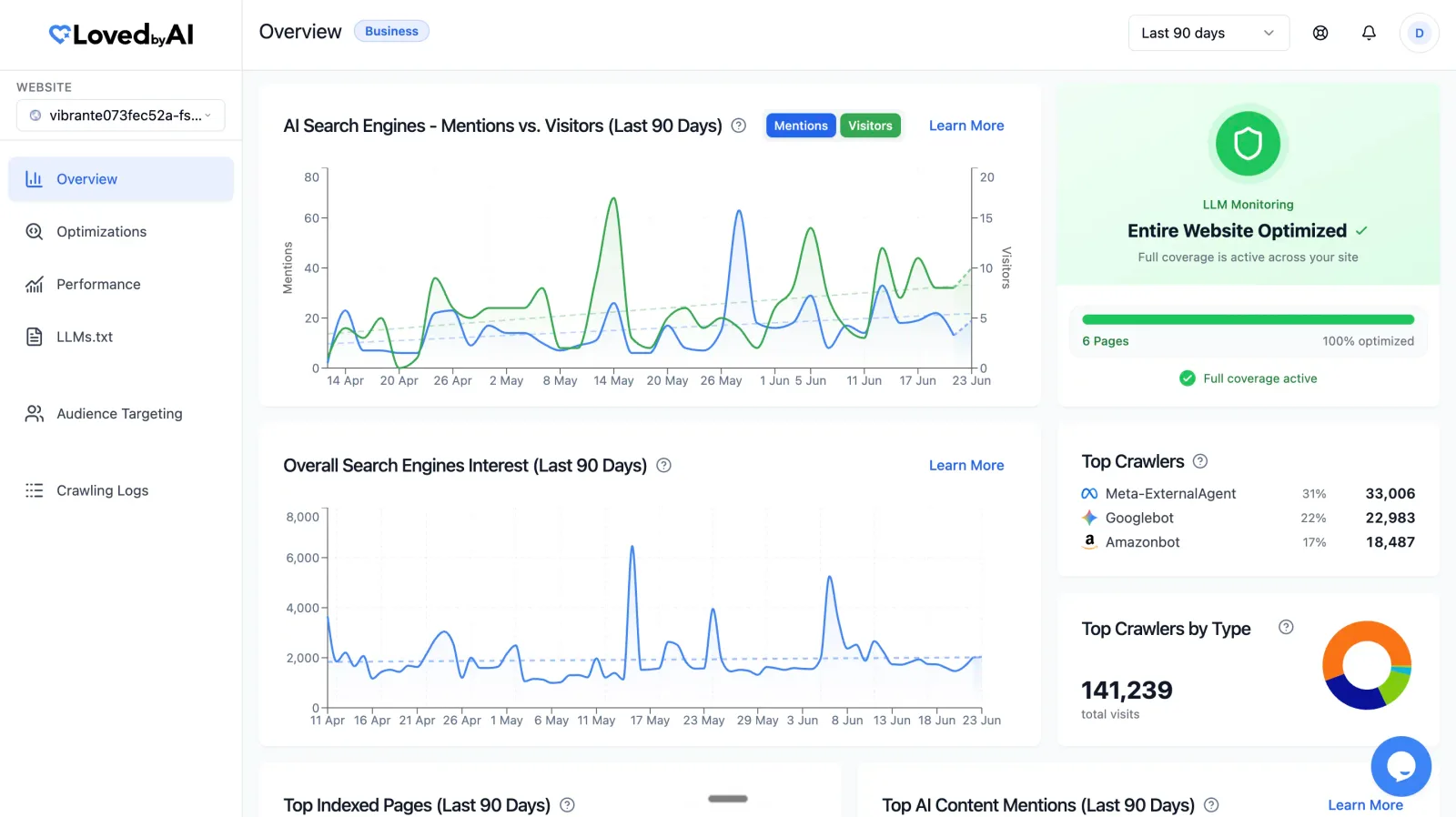
LovedByAI is one of the few platforms built specifically for WordPress websites that want more visibility in AI search engines such as ChatGPT, Gemini, Claude, Perplexity, and Google AI Overviews.
Many AI visibility platforms stop at monitoring mentions and citations. LovedByAI pairs that tracking with practical optimization features meant to make a business easier to find in AI-generated answers.
The emphasis is on Generative Engine Optimization (GEO), which is why it appeals to businesses that want more than a reporting dashboard. Besides telling you whether you appear in AI search results, LovedByAI gives you tools to improve the factors behind it: citation potential, entity recognition, structured data coverage, and AI readability.
The WordPress-first design is one of the biggest things that sets it apart. Installation takes only a few minutes, and most of the optimization runs automatically in the background, so you don't need technical expertise.
Key features
- AI visibility monitoring across major AI search platforms
- Automated JSON-LD schema generation
- AI-readable information layer
- Automatic FAQ generation and FAQPage schema
- llms.txt generation and maintenance
- AI content formatting for improved AI readability
- AI search readiness scoring
- AI traffic tracking and bot monitoring
- GEO optimization recommendations
- Agency and multi-site management capabilities
- Compatibility with Yoast SEO, Rank Math, Elementor, Jetpack, and other popular GEO WordPress plugins
Pros
- Built specifically for WordPress
- Easy setup with minimal technical requirements
- Combines optimization and visibility tracking
- Includes AI traffic analytics
- Automated structured data implementation
- Supports multiple AI search engines
- More affordable than many enterprise-focused alternatives
- Useful for both small businesses and agencies
- Free industry guides
Cons
- Limited to WordPress websites
- Not designed for large enterprise organizations with complex reporting requirements
- Smaller ecosystem compared to long-established SEO platforms
LovedByAI pricing
| Plan | Price |
|---|---|
| Free | $0/month |
| Pro | $29/month (annual billing) |
| Business | $59/month (annual billing) |
The Free plan covers a single webpage, which is enough to test AI visibility optimization. Pro goes up to 200 webpages and adds AI traffic tracking, AI mentions tracking, automated AI formatting, and llms.txt generation. Business raises the limit to 1,000 webpages and adds audience targeting and priority support.
A lot of AI visibility platforms sell to enterprise customers and quote custom prices. Next to those, LovedByAI is one of the more affordable ways for a WordPress business to improve its visibility across ChatGPT, Gemini, Claude, Perplexity, and Google AI Overviews.
What users like
Users frequently mention the simplicity, the quick setup, and the way the platform automates technical GEO tasks that would otherwise take a lot of manual work. Small business owners and agencies often describe it as a practical way into AI search optimization without the steep learning curve of enterprise software.
Many AI visibility platforms are almost entirely about monitoring. They tell you whether your brand appears in ChatGPT, Gemini, Claude, or Perplexity, and then the optimization work lands on your team. LovedByAI does that part as well.
Alongside AI visibility tracking, it handles automated schema generation, AI-readable content formatting, on-page GEO, FAQ creation, llms.txt generation (LLM SEO), and AI traffic tracking. Because monitoring and optimization live in the same product, it is one of the few platforms that takes you from AI visibility insight to actual implementation.
It is also easier to get into. Many AI visibility platforms target enterprise organizations, with custom pricing and dedicated implementation teams. LovedByAI is built for WordPress businesses that want better AI visibility without hiring consultants or developers.
The platform has been used on more than 1,500 websites, and customer case studies report increases in AI traffic, AI mentions, AI impressions, and AI-driven traffic after implementation.
If you run a WordPress site and would rather not manage schema, GEO implementation, structured data, and AI content formatting by hand, LovedByAI is one of the strongest mixes of automation, ease of use, and price available right now.
Verdict
For WordPress businesses that want to improve AI search visibility, and not only measure it, LovedByAI is our recommended choice. The automation-first approach, built-in GEO features, AI traffic tracking, and pricing make it a strong option for SMBs, agencies, publishers, and service businesses getting ready for the next generation of search.
5. AthenaHQ
Best for
Brands looking for a combination of AI visibility tracking, AI content optimization, and GEO workflows.
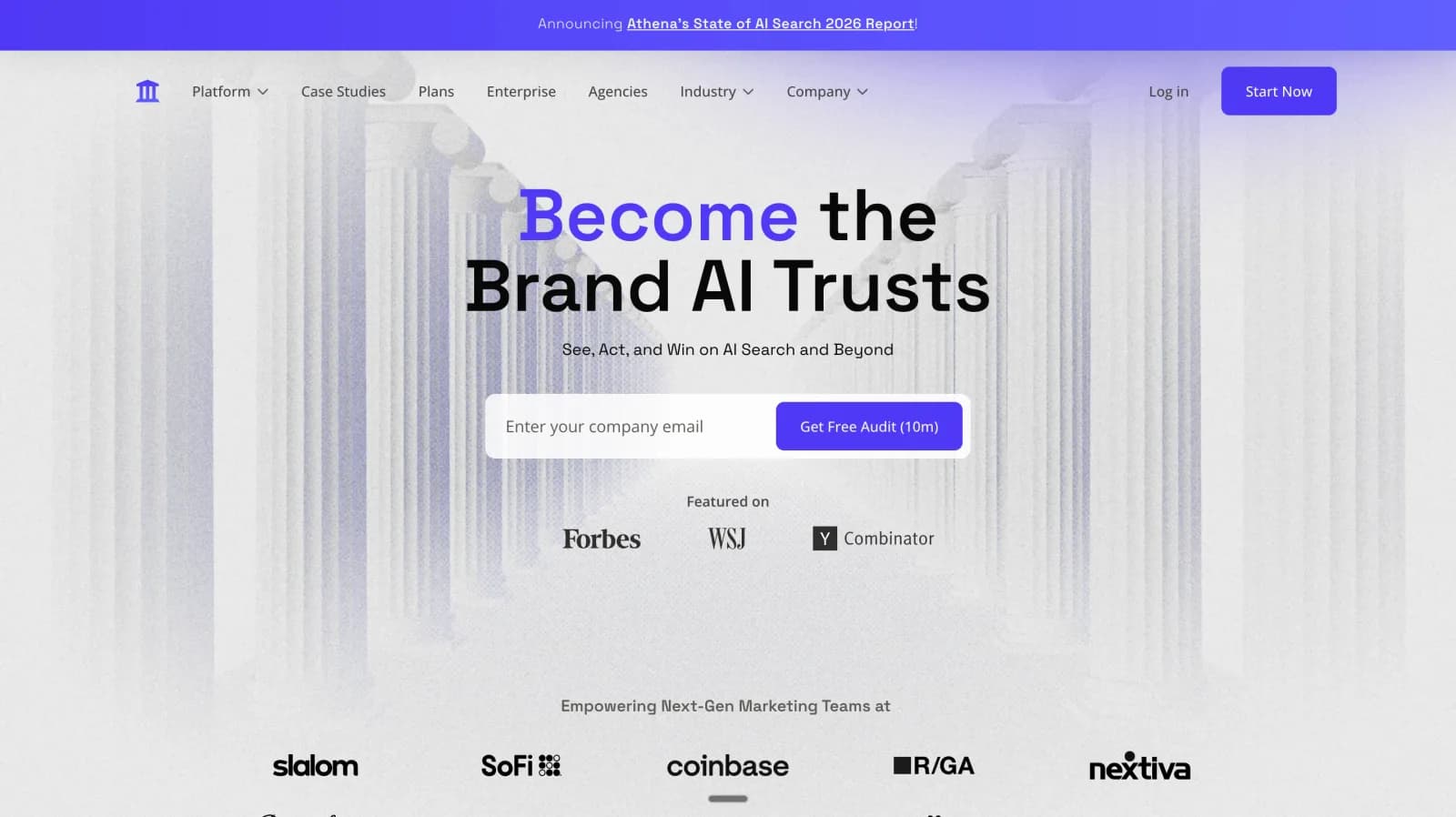
AthenaHQ combines visibility monitoring with AI search optimization features. It shows how AI engines perceive your content and points out where you could raise your visibility.
The product leans toward content, which suits brands already putting real effort into GEO.
Key features
- AI visibility monitoring
- Competitor tracking
- GEO recommendations
- AI content optimization
- Citation intelligence
- AI traffic analysis
- Prompt tracking
Pros
- Combines monitoring and optimization
- Strong GEO focus
- Useful content insights
- Covers multiple AI engines
Cons
- Higher entry pricing
- Better suited for experienced teams
- Requires active implementation
Pricing
| Plan | Pricing |
|---|---|
| Self-Serve | $295/month |
| Enterprise | Custom |
AthenaHQ connects visibility tracking to optimization. If you want GEO insights you can act on, and not only a dashboard, it is worth a look.
Best for
- Growth-stage brands
- GEO teams
- Marketing departments
- Content-led businesses
- AI search optimization programs
6. Similarweb AI Visibility
Best for
Large brands, enterprise SEO teams, and businesses that already use Similarweb for market intelligence.
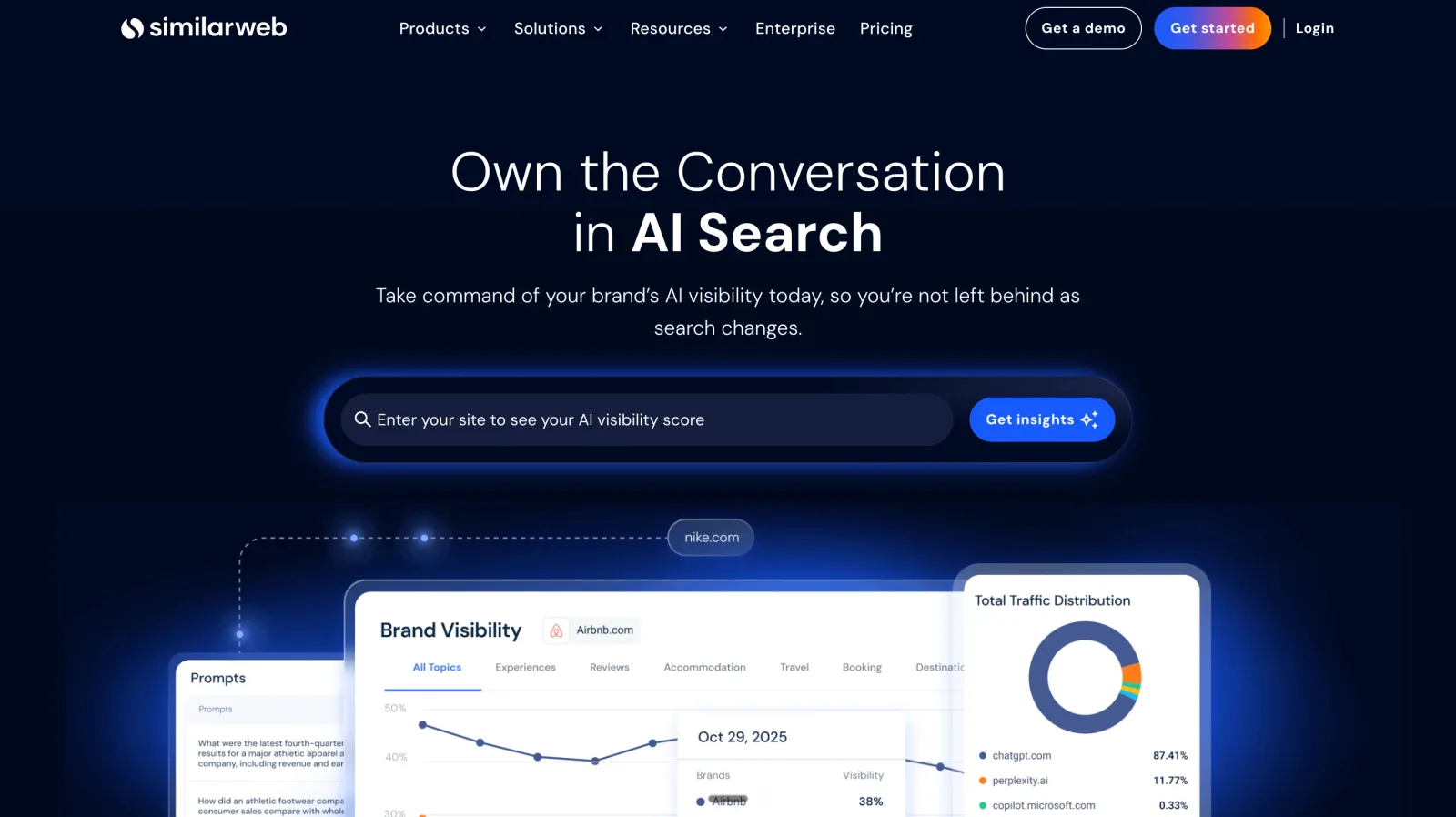
Similarweb has moved into AI visibility with reporting on AI-driven traffic, brand mentions, citation share, and generative search performance.
It runs on Similarweb's very large data infrastructure, so you see AI search performance in a broader context, right next to traditional search and traffic analytics.
Key features
- AI visibility analytics
- AI traffic measurement
- Brand visibility scoring
- Citation share analysis
- Competitive benchmarking
- Market intelligence
- Search trend reporting
Pros
- Large-scale data collection
- Strong market intelligence capabilities
- Excellent competitor insights
- Trusted enterprise platform
Cons
- GEO optimization features are limited
- More expensive than SMB-focused tools
- Some AI visibility features require higher plans
Pricing
| Plan | Pricing |
|---|---|
| AI Search Intelligence | $99/month |
| Web Intelligence | $199/month billed annually |
| Professional Web Intelligence | $399/month |
| Enterprise | Custom |
Few products give you a wider view of digital visibility today. In Similarweb you can analyze traditional search, AI search, market share, competitor performance, and traffic trends in one place.
Best for
- Enterprise brands
- Market intelligence teams
- Competitive analysis
- Digital marketing teams
- Large organizations
7. Ahrefs Brand Radar
Best for
SEO professionals, agencies, and Ahrefs users wanting AI visibility data alongside traditional SEO metrics.
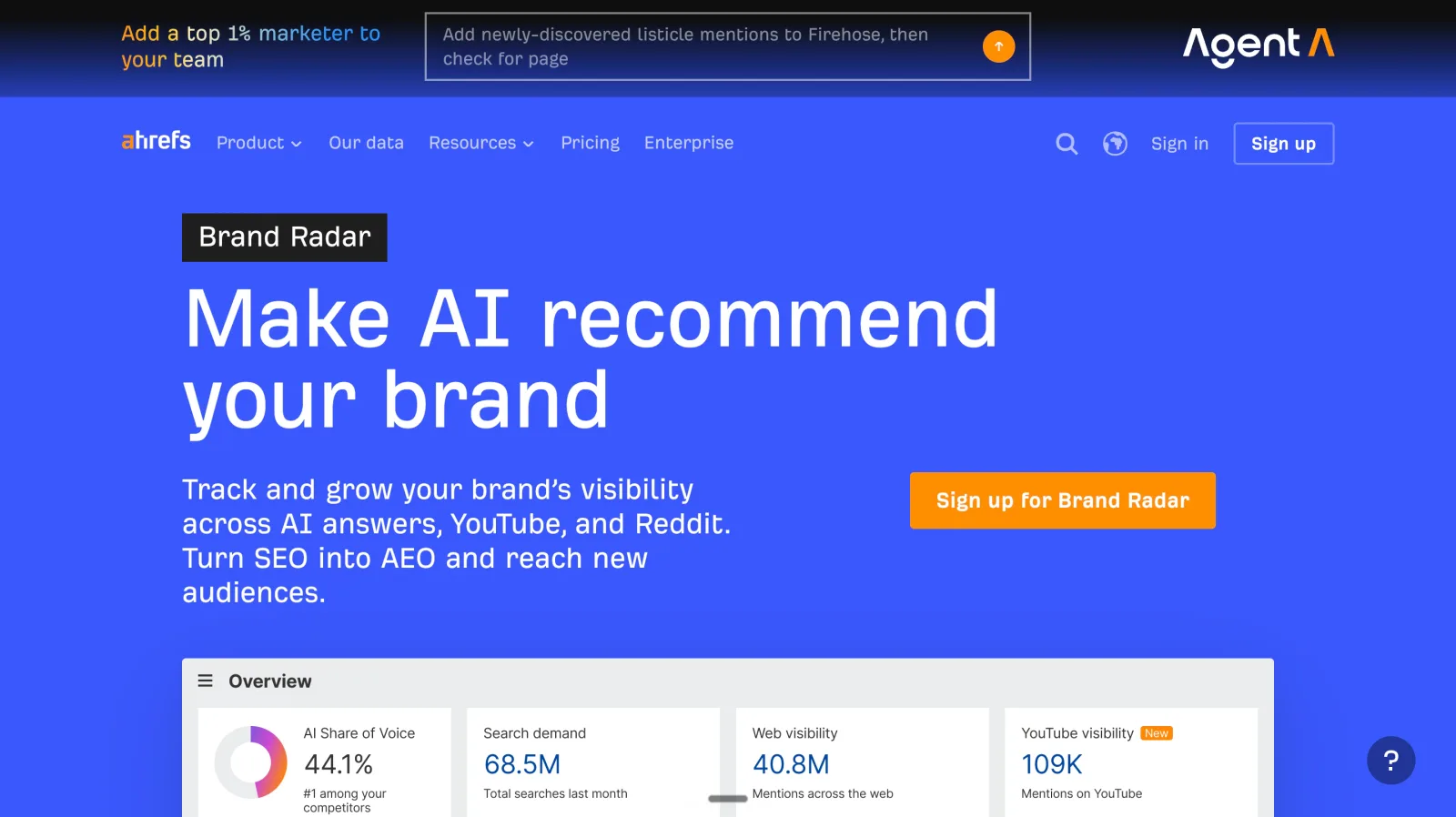
Brand Radar carries Ahrefs' data into AI search visibility. You can monitor how brands appear in AI-generated answers and compare your visibility with your competitors'.
If your team already works in Ahrefs, Brand Radar slots into the workflow you have.
Key features
- AI brand visibility tracking
- Brand mention monitoring
- Competitor comparisons
- Search visibility reporting
- Prompt tracking
- AI citation analysis
Pros
- Integrated with Ahrefs ecosystem
- Familiar workflow for SEO teams
- Strong competitive analysis
- Useful reporting capabilities
Cons
- The full Brand Radar AI index is a separate product, from $199/month
- Less specialized than dedicated AI visibility platforms
- Primarily focused on measurement
Pricing
| Plan | Pricing |
|---|---|
| Lite | $129/month, tracks 5 custom AI prompts |
| Standard | $249/month, tracks 10 custom AI prompts |
| Advanced | $449/month, tracks 20 custom AI prompts |
| Brand Radar AI | From $199/month, on its own or alongside a plan |
Ahrefs is still one of the most trusted SEO platforms in the industry, and Brand Radar lets existing customers monitor AI visibility without bringing in another piece of software.
Best for
- Ahrefs customers
- SEO agencies
- SEO consultants
- Marketing teams
- Competitive analysis
8. Semrush AI Toolkit
Best for
Existing Semrush customers, enterprise marketing teams, and businesses wanting AI visibility integrated into their SEO workflows.
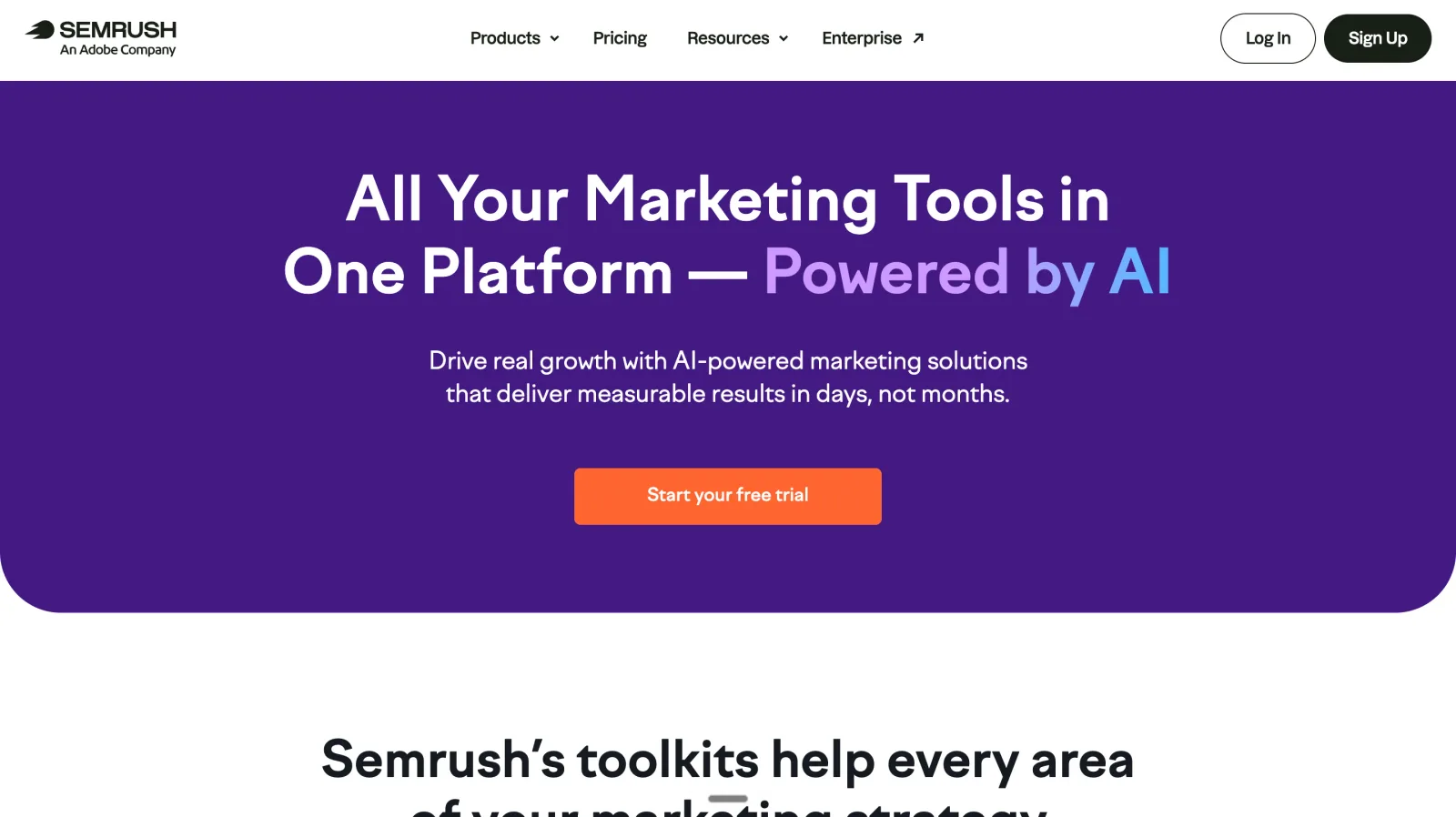
Semrush AI Toolkit shows brands how they appear in AI search platforms, including ChatGPT, Gemini, Google AI Overviews, and Perplexity.
The toolkit lives inside Semrush, so the AI visibility data connects to keyword research, content strategy, competitor analysis, and technical SEO in the same account.
Key features
- AI visibility reporting
- Prompt tracking
- AI competitor analysis
- AI mention monitoring
- Site AI readiness audits
- Brand performance tracking
- AI search analytics
Pros
- Integrated into Semrush ecosystem
- Strong reporting dashboards
- Useful competitor insights
- Familiar interface for existing users
Cons
- Primarily monitoring-focused
- Requires Semrush ecosystem investment
- Less optimization-focused than GEO-specific platforms
Pricing
| Plan | Pricing |
|---|---|
| AI Visibility Toolkit | $99/month per domain |
If you already pay for Semrush, the AI Toolkit is one of the easiest ways to start tracking AI search visibility. Your team gets useful AI search data without having to learn a whole new platform.
Best for
- Semrush users
- Marketing teams
- Enterprise SEO programs
- Brand monitoring
- Competitive intelligence teams
9. Otterly AI
Best for: Marketing teams, agencies, and brands that want affordable AI search visibility monitoring across the major answer engines.
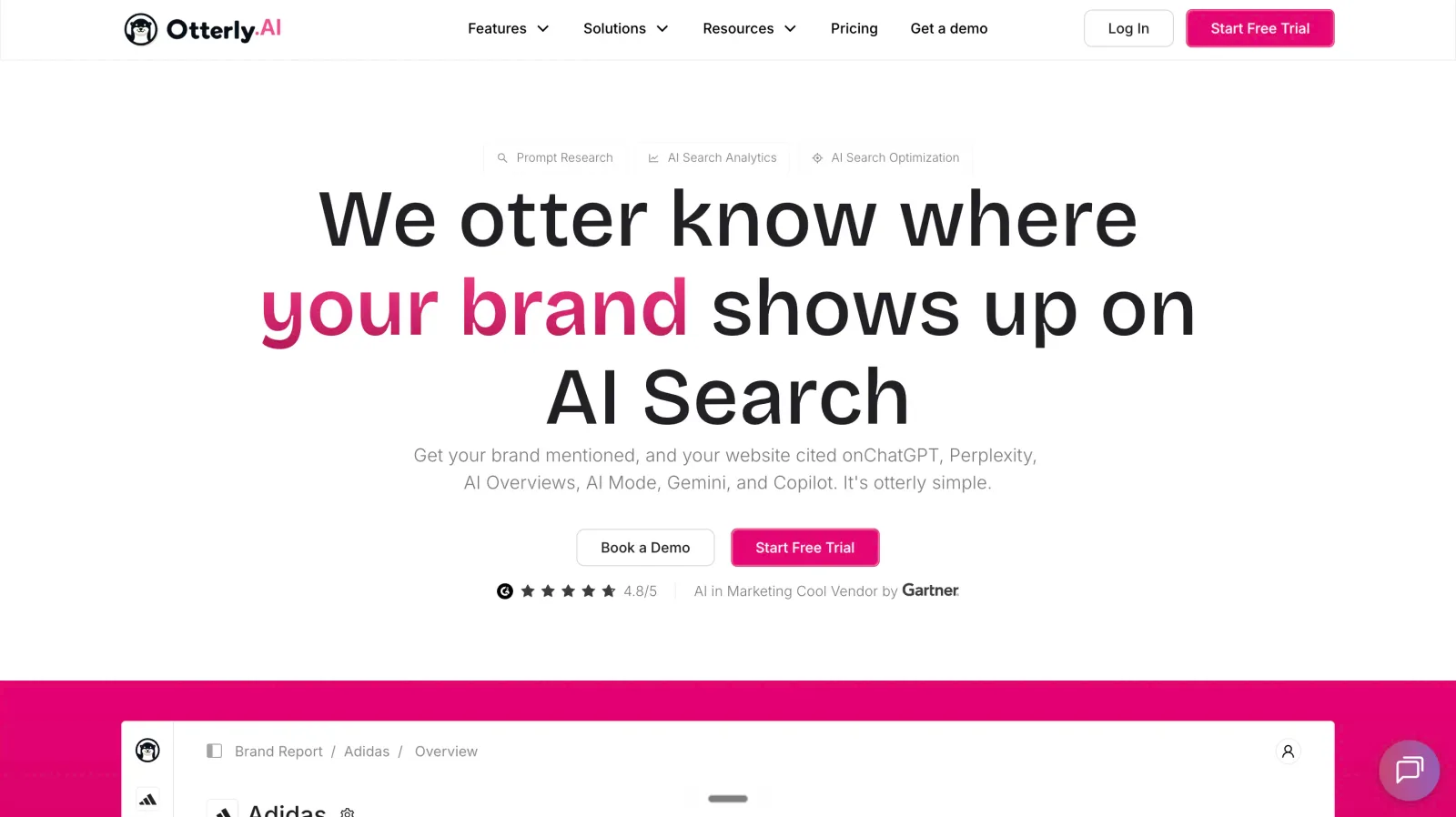
Otterly AI is one of the more established AI search monitoring platforms. It tracks brand visibility across ChatGPT, Google AI Overviews, Perplexity, and Microsoft Copilot, so marketers can see how often their brand turns up in AI-generated answers and where there is room to improve.
A lot of users pick Otterly AI for the price, which is easier to justify than many enterprise-focused alternatives. Visibility monitoring, GEO auditing, brand reporting, and recommendations all sit in one dashboard.
Key features
- AI search visibility tracking
- ChatGPT, Google AI Overviews, Perplexity, and Copilot monitoring
- Brand visibility reporting
- GEO audits
- Link citation analysis
- Competitor monitoring
- AI recommendation tracking
- API access on higher plans
Pros
- More affordable than many enterprise tools
- Supports multiple major AI platforms
- Daily tracking available
- Unlimited team members
- Agency-friendly features
Cons
- Advanced AI engines require add-ons
- Enterprise reporting can be less thorough than on larger platforms
- Smaller ecosystem than enterprise competitors
Pricing
| Plan | Price |
|---|---|
| Lite | $29/month |
| Standard | $189/month |
| Premium | $489/month |
| Enterprise | Custom |
On features for the money, Otterly AI stands out on this list. Your team can monitor visibility across several AI search platforms without signing an enterprise-level contract.
Best for
- Small and mid-sized businesses
- Marketing agencies
- GEO consultants
- SEO teams entering AI search
10. ZipTie
Best for: Small businesses and marketers who want simple AI visibility tracking and optimization.
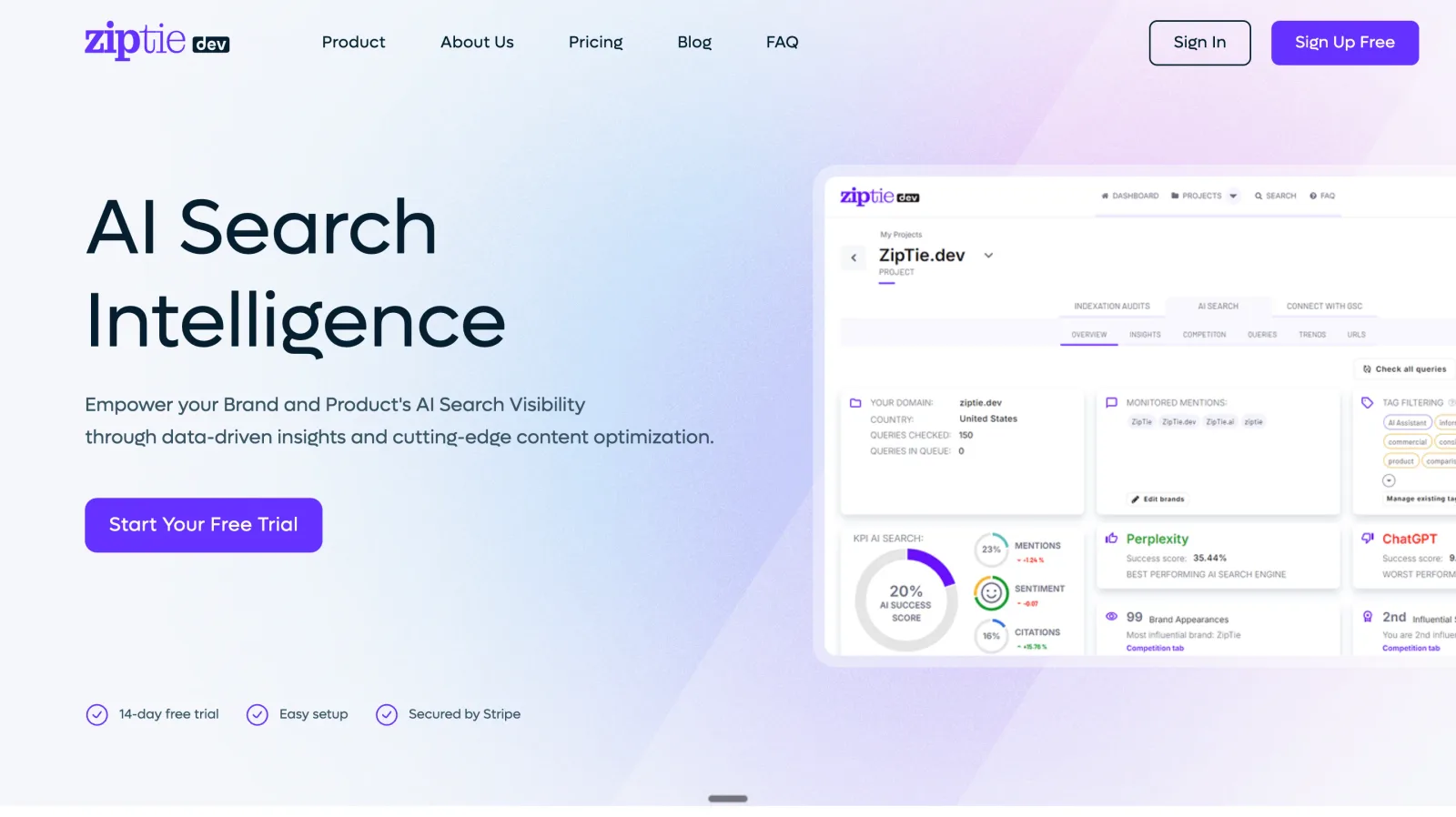
ZipTie is about understanding and improving how you appear in AI-generated search results. Visibility monitoring, AI search tracking, and optimization recommendations come in a fairly lightweight package.
Next to the enterprise-focused tools, ZipTie is simple and easy to pick up. That is the appeal for a business that wants AI visibility insights without a steep learning curve.
Key features
- AI search monitoring
- Google AI Overviews tracking
- ChatGPT visibility analysis
- Perplexity monitoring
- AI content optimization recommendations
- AI search summaries
- Multi-country tracking
Pros
- Easy to use
- Affordable entry pricing
- Useful optimization recommendations
- Good for small teams
- Includes AI content assistance
Cons
- Limited enterprise capabilities
- Fewer competitive intelligence features
- Smaller AI engine coverage than premium platforms
Pricing
| Plan | Price |
|---|---|
| Basic | $69/month |
| Standard | $99/month |
| Pro | $159/month |
| Free Trial | Available |
The interface is plain and quicker to learn than most competitors', which works for smaller businesses that want AI visibility insights and nothing extra to manage.
Best for
- Small businesses
- Solo marketers
- SEO freelancers
- Local businesses
11. Yotpo Discover
Best for: Ecommerce brands that want to use reviews and user-generated content to build AI visibility.
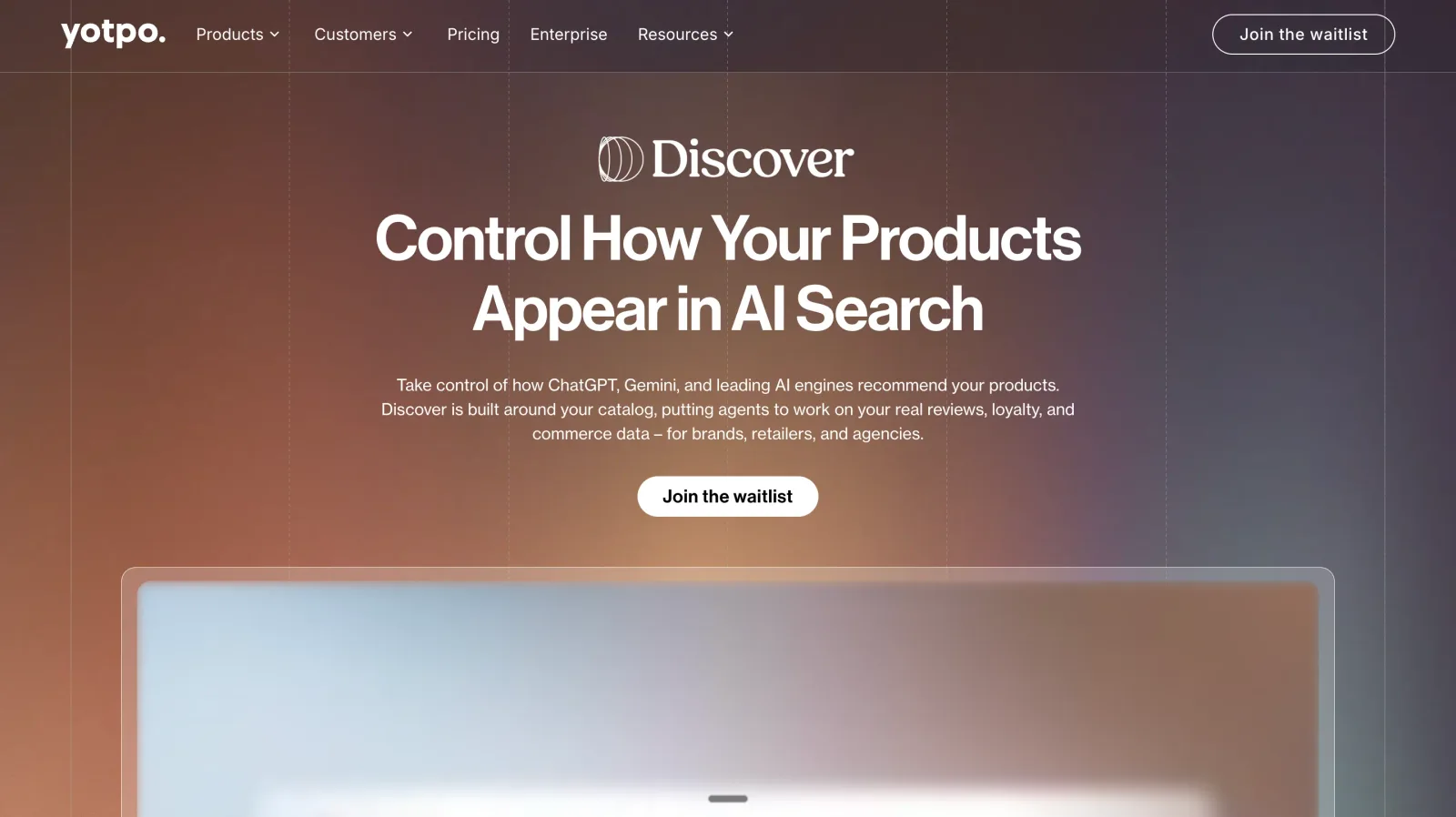
Yotpo Discover takes an unusual route to AI visibility. Instead of tracking AI answers the way a dedicated AI visibility platform does, it helps ecommerce brands get discovered through review content, customer feedback, and user-generated content, all of which has a growing influence on AI-generated answers.
If your ecommerce company already uses Yotpo, Discover is a useful add-on to wider GEO and AI visibility work.
Key features
- Review content optimization
- User-generated content management
- Brand discoverability insights
- Customer sentiment analysis
- Ecommerce integrations
- AI-powered review summaries
- Product visibility enhancement
Pros
- Strong ecommerce focus
- Excellent review ecosystem
- Large integration library
- Useful customer insight features
- Helps build authoritative content signals
Cons
- Not a dedicated AI visibility platform
- Limited AI citation tracking
- Best suited for ecommerce brands
Pricing
| Plan | Price |
|---|---|
| Starter | $89/month |
| Pro | $169/month |
| Premium | Custom |
| Enterprise | Custom |
Yotpo earns its place by turning customer reviews and user-generated content into stronger brand signals, which can influence traditional search and AI-powered search alike.
Best for
- Ecommerce brands
- DTC companies
- Retail businesses
- Review-driven marketing teams
12. Bluefish AI
Best for: Enterprise organizations that need custom AI visibility, monitoring, and audience intelligence work.
Bluefish AI is built for enterprises that want to understand, and influence, how their brands appear in generative AI systems. It combines AI visibility monitoring with audience intelligence, brand tracking, and advanced analytics.
Many tools in this category are self-service: you sign up and start. Bluefish AI mostly works through custom enterprise engagements instead, so it suits larger organizations with complex requirements.
Key features
- Enterprise AI visibility monitoring
- Audience intelligence
- AI mention tracking
- Brand performance analysis
- Competitive monitoring
- Enterprise integrations
- Custom reporting
Pros
- Enterprise-grade capabilities
- Strong analytics layer
- Custom implementation support
- Advanced audience insights
- Flexible enterprise deployments
Cons
- No transparent public pricing
- Less accessible for SMBs
- Requires sales engagement
Pricing
| Plan | Price |
|---|---|
| Entry-Level | Approximately $99-$299/month |
| Enterprise | Custom |
| Large Enterprise Contracts | Five to six figures annually |
For enterprise buyers, the draw is customization. Bluefish AI can shape its reporting and monitoring workflows around complicated organizational requirements.
Best for
- Enterprise brands
- Fortune 500 companies
- Large marketing teams
- Global organizations
13. Conductor
Best for: Enterprise SEO teams that want AI visibility built into a broader organic search platform.
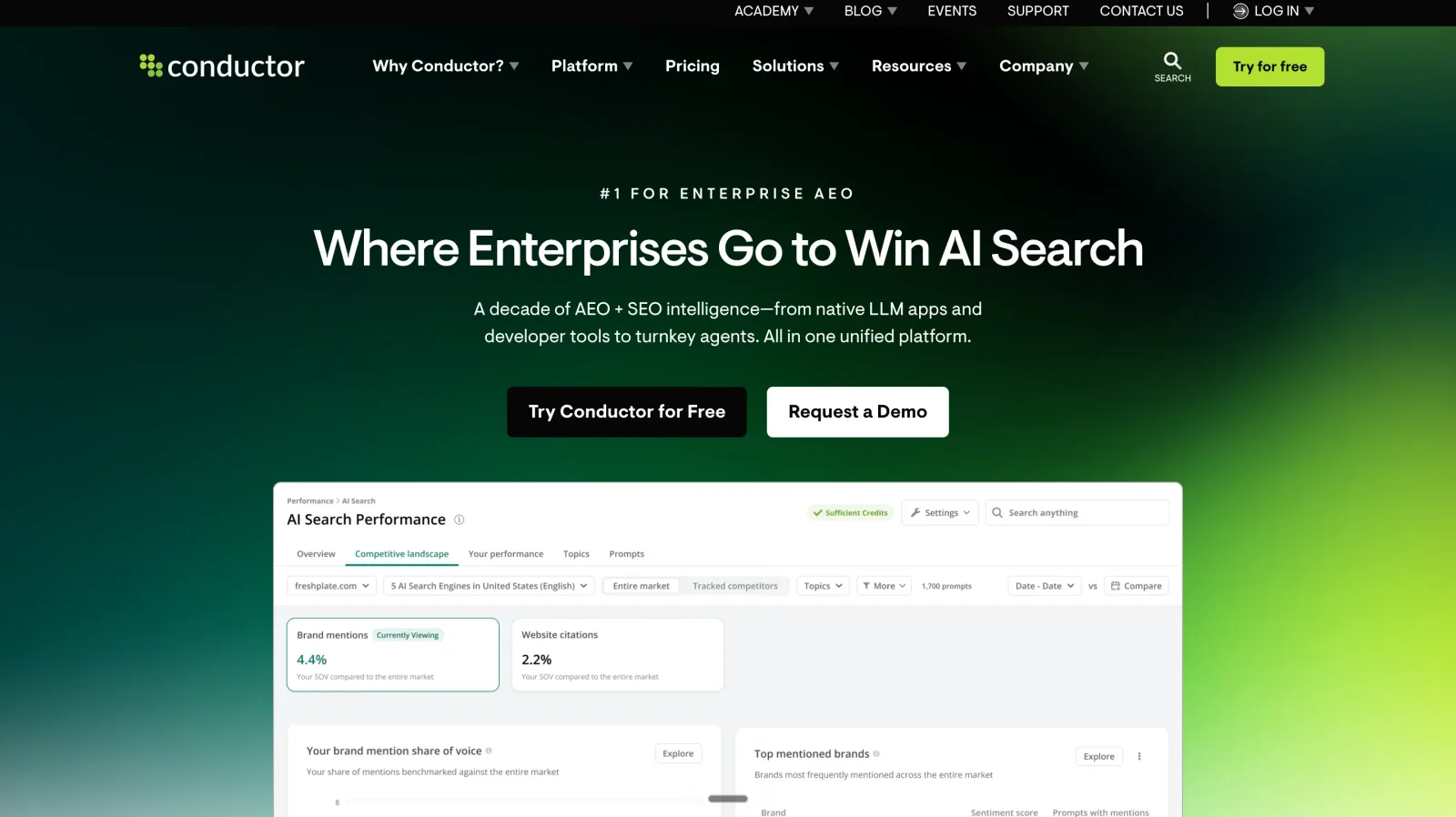
Conductor started in traditional SEO and has added AI search visibility, so organizations can track how they perform in the newer AI search environments. The AI search data lives inside Conductor's larger enterprise organic marketing platform instead of in a separate standalone tool.
That arrangement makes the most sense for organizations already invested in enterprise SEO workflows.
Key features
- AI search performance tracking
- Enterprise SEO platform
- Content intelligence
- Visibility reporting
- Competitive analysis
- Workflow automation
- Team collaboration tools
Pros
- Mature enterprise platform
- Strong SEO and AI integration
- Extensive reporting
- Large-scale data capabilities
- Enterprise support
Cons
- No public pricing
- Higher learning curve
- More expensive than standalone tools
Pricing
| Plan | Price |
|---|---|
| Enterprise | Custom Quote |
The payoff is that AI visibility data sits inside the SEO workflows you already run, and nobody has to manage a separate platform for it.
Best for
- Enterprise SEO teams
- Large publishers
- Global brands
- Enterprise marketing departments
14. Rankscale
Best for: Agencies and consultants focused on AI visibility reporting and client management.
Rankscale is an AI search visibility platform that monitors how brands perform in answer engines and generative search platforms. The toolkit covers AI visibility tracking, competitor benchmarking, citation analysis, and reporting.
Agencies are especially fond of it, mostly for the white-label options and the reporting.
Key features
- AI visibility tracking
- Citation analysis
- Competitor benchmarking
- White-label reporting
- Client dashboards
- API access
- Multi-region tracking
Pros
- Strong agency functionality
- White-label capabilities
- Competitive pricing
- Broad AI engine coverage
- Reporting flexibility
Cons
- Smaller market presence
- Less enterprise adoption
- Advanced features require higher plans
Pricing
| Plan | Price |
|---|---|
| Essentials | $20/month |
| Pro | $99/month |
| Growth | $385/month |
| Enterprise | $780/month |
An agency gets flexible reporting out of Rankscale and can pass AI visibility insights straight to its clients.
Best for
- Agencies
- Consultants
- Freelancers
- Multi-client SEO teams
15. AirOps
Best for: Content teams that want AI visibility optimization combined with AI content workflows.
AirOps is mainly an AI content operations platform. Over time it has added more features for AI search optimization and answer engine visibility, and teams use it to create, optimize, and scale content meant to do well in traditional search engines and in AI-powered search.
Key features
- AI content workflows
- AI search optimization
- Prompt management
- Content generation
- Workflow automation
- Team collaboration
- AI visibility insights
Pros
- Strong content workflow capabilities
- Useful automation features
- Good for scaling content production
- Integrates with existing processes
- Supports GEO initiatives
Cons
- Not a dedicated visibility platform
- Tracking capabilities are less extensive
- More content-focused than analytics-focused
Pricing
| Plan | Price |
|---|---|
| Starter | Free |
| Pro | From $49/month |
| Scale | Approximately $199-$299/month |
| Enterprise | Custom |
Users frequently praise AirOps for turning GEO and AI search optimization into something a content team can actually run at scale.
Best for
- Content teams
- SEO teams
- Agencies
- Marketing operations teams
16. Frase
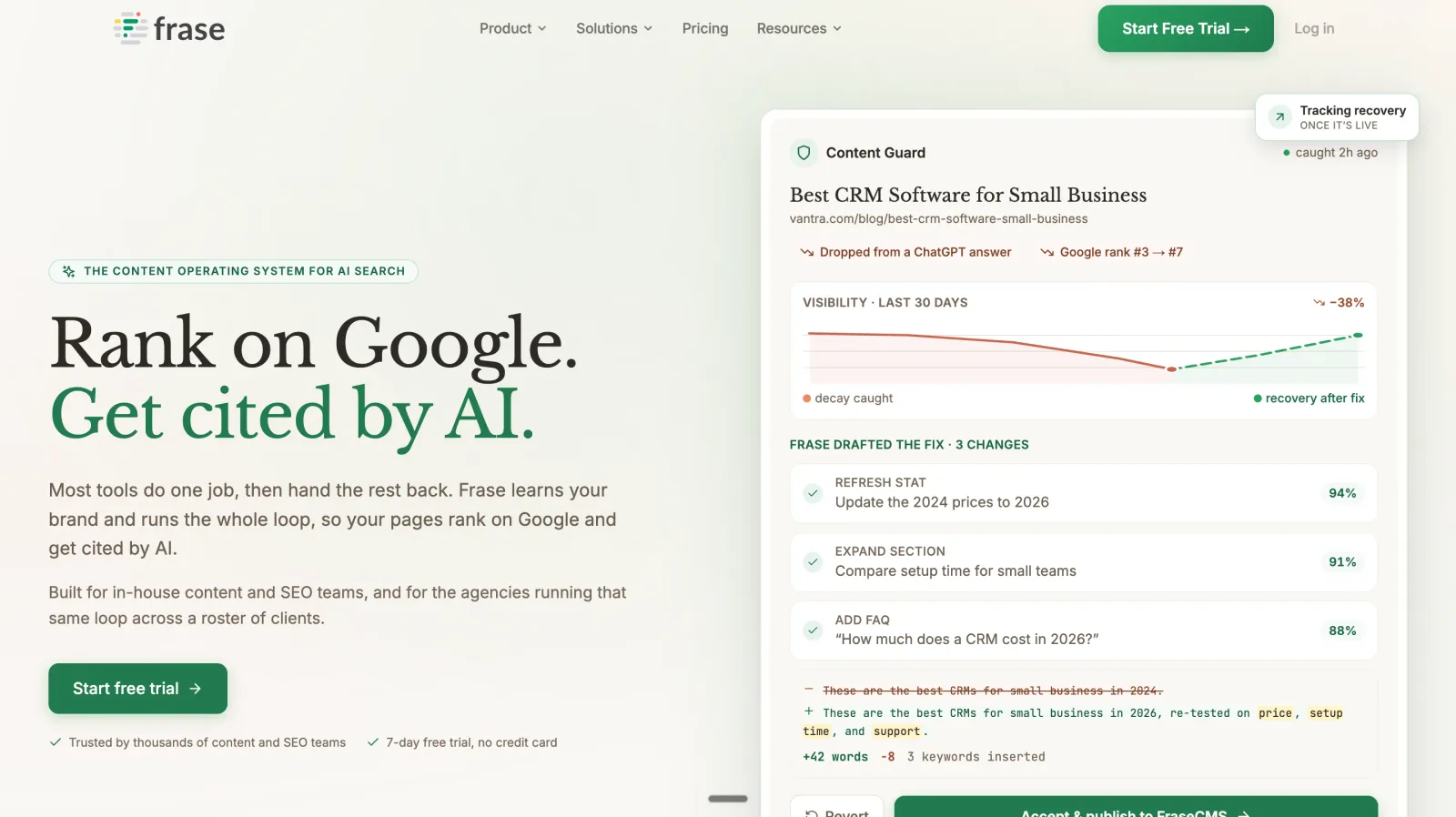
Best for: Content marketers who want AI visibility optimization built into content creation.
Most people know Frase as an AI content optimization platform. Its AI visibility features help marketers write content that fits better with how AI search engines and answer generation systems work.
Research, content creation, optimization, and AI search readiness all happen in one workflow.
Key features
- AI content optimization
- Content briefs
- SERP research
- GEO optimization workflows
- AI visibility monitoring
- Content scoring
- Internal linking recommendations
Pros
- Strong content optimization features
- Easy to use
- Good research capabilities
- Affordable pricing
- Useful for content teams
Cons
- Limited AI visibility tracking
- Less competitor intelligence
- Primarily content-focused
Pricing
| Plan | Price |
|---|---|
| Starter | $39/month |
| Professional | $103/month |
| Scale | $239/month |
| Enterprise | Custom |
What Frase does well is speed up content research and optimization, with AI search readiness handled in the same process.
Best for
- Content marketers
- Bloggers
- SEO specialists
- Small marketing teams
17. Writesonic
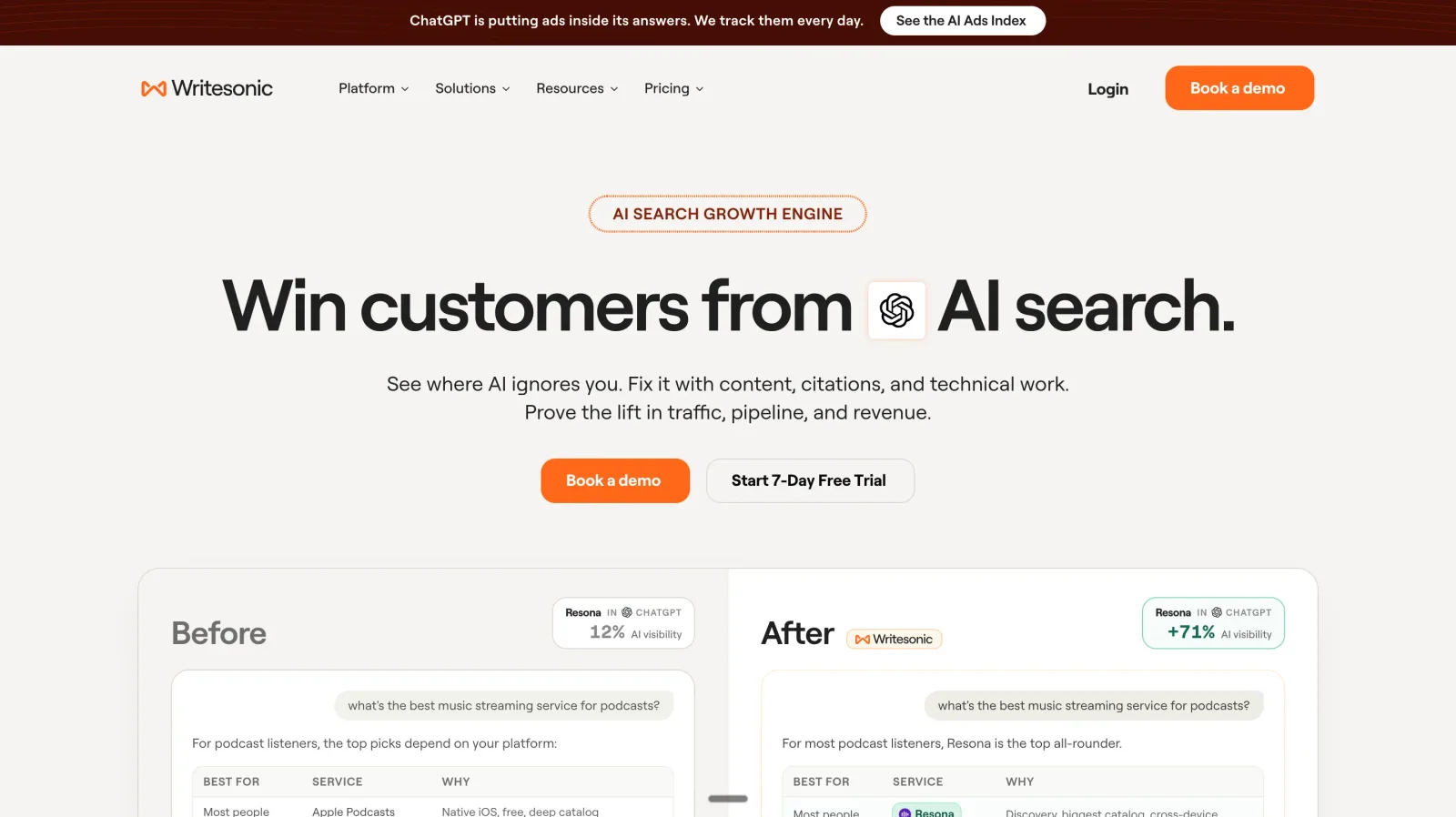
Best for: Teams that want AI visibility monitoring combined with AI content creation.
Writesonic grew out of content generation and has since added AI search visibility and GEO features. Its AI Search Visibility module shows brands how they appear in ChatGPT, Gemini, and Google AI Overviews, and it suggests content changes to improve those results.
Key features
- AI search visibility tracking
- ChatGPT monitoring
- Gemini monitoring
- Google AI Overview tracking
- Content generation
- GEO recommendations
- Competitor analysis
Pros
- Combines content and visibility tools
- Strong AI content capabilities
- Competitive pricing
- Multiple AI platform support
- Active product development
Cons
- Visibility tracking is newer than competitors
- Enterprise features require higher plans
- Some features still evolving
Pricing
| Plan | Price |
|---|---|
| Starter | $79/month |
| Basic | $199/month |
| Growth | $399/month |
| Enterprise | Custom |
Users often like having AI visibility tracking and AI content production in the same platform.
Best for
- Growth marketers
- Content teams
- Agencies
- AI-first marketing teams
18. SE Ranking AI Visibility
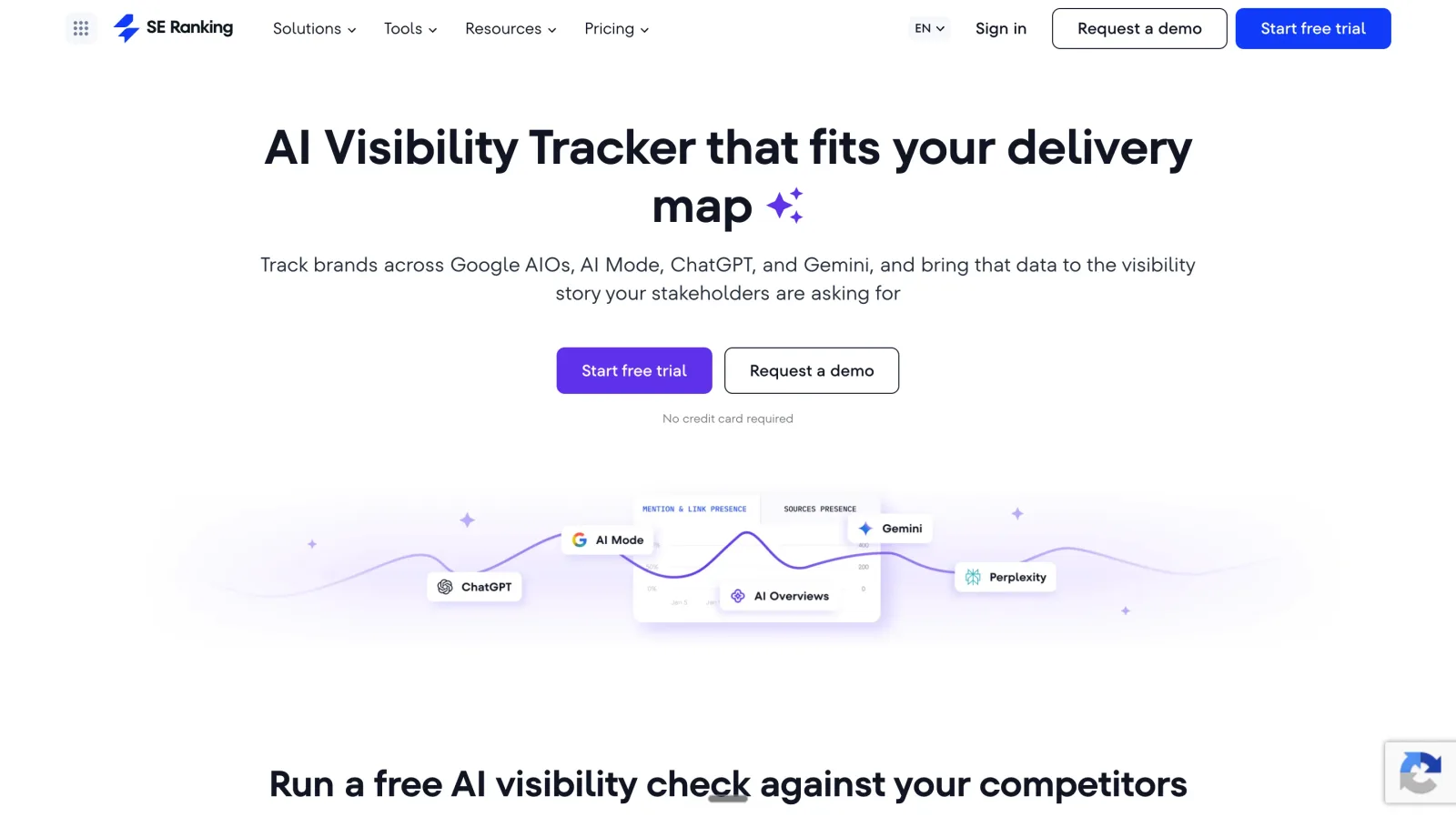
Best for: SEO teams looking for traditional SEO and GEO capabilities in one platform.
SE Ranking added AI visibility tracking to its broader SEO platform, so marketers can monitor search engines and AI-powered answer engines from the same place. Keyword tracking, site auditing, competitor research, and GEO features come in the same package.
If your organization already uses SEO software, SE Ranking is a practical way into AI visibility monitoring that doesn't mean adopting a separate tool.
Key features
- AI visibility monitoring
- GEO research
- Prompt tracking
- Competitor analysis
- Site auditing
- Keyword tracking
- API and reporting tools
Pros
- Strong value for money
- Combines SEO and GEO
- User-friendly interface
- Comprehensive toolkit
- Agency-friendly reporting
Cons
- AI visibility features are relatively new
- Less AI-specific depth than dedicated platforms
- Enterprise functionality is more limited
Pricing
| Plan | Price |
|---|---|
| Core | $103.20/month |
| Growth | $223.20/month |
| Enterprise | Custom |
You run traditional SEO and AI visibility work from one platform, and you pay for one subscription instead of several.
Best for
- SEO agencies
- Marketing teams
- SMBs
- Businesses transitioning from SEO to GEO and AI visibility tracking
Best AI search visibility tools by use case
Each of these platforms was built with a particular audience in mind. Some specialize in monitoring AI mentions and share of voice; others put their effort into improving visibility through GEO and AI search optimization. Our recommendations by business type and main use case are in the table, with more detail on each below it.
| Use Case | Recommended Tool | Why It Stands Out |
|---|---|---|
| WordPress Websites | LovedByAI | Native WordPress integration, AI traffic tracking, AI formatting, and GEO automation |
| Agencies | Profound | Multi-client monitoring, advanced reporting, and enterprise workflows |
| SaaS Companies | Scrunch AI | Strong competitive intelligence and AI share of voice tracking |
| Ecommerce Brands | Yotpo Discover | Review-driven visibility and AI-powered product discovery |
| Local Businesses | LovedByAI | Built for local SEO, service-area businesses, and AI search optimization |
| Law Firms | LovedByAI | Helps improve visibility for high-trust, authority-driven service businesses |
| Accountants | LovedByAI | Strong fit for local firms that rely on referrals and reputation |
| Real Estate Agencies | AthenaHQ | Combines visibility monitoring with content optimization and GEO insights |
| Insurance Agencies | LovedByAI | Well-suited for competitive local markets and service-area visibility |
| IT Support Companies | AirOps | Useful for businesses investing heavily in content-driven GEO strategies |
Best AI search visibility tool for WordPress sites
Winner: LovedByAIMost AI visibility platforms were built as standalone SaaS products. LovedByAI runs inside WordPress itself.
You can optimize content for AI search, generate LLMs.txt files, track AI mentions, monitor AI-driven traffic, and improve AI readiness without leaving your website dashboard.
It works best for businesses whose site already runs on WordPress and who want a simple way to show up more in ChatGPT, Gemini, Claude, Perplexity, and Google AI Overviews.
Ideal for:- Bloggers
- Small businesses
- Local companies
- Agencies managing WordPress sites
- Content publishers
Best AI search visibility tool for agencies
Winner: ProfoundProfound is one of the strongest agency-focused AI visibility platforms you can buy right now.
Multi-client workflows, competitive monitoring, prompt tracking, and advanced reporting make it a good fit for an agency running AI visibility campaigns for several brands at once.
It also handles the larger reporting setups many agencies need once enterprise clients are involved.
Ideal for:- SEO agencies
- GEO agencies
- Enterprise marketing agencies
- AI visibility consultants
Best AI search visibility tool for SaaS companies
Winner: Scrunch AISaaS markets tend to be crowded, and an AI recommendation can sway a buying decision a lot.
Scrunch AI gives SaaS companies strong AI visibility benchmarking, citation monitoring, competitive analysis, and share of voice tracking, so they can see where they stand in AI-generated recommendations.
B2B software brands get the most out of its enterprise-grade monitoring.
Ideal for:- B2B SaaS companies
- Technology startups
- Software vendors
- Product-led growth teams
Best AI search visibility tool for ecommerce brands
Winner: Yotpo DiscoverEcommerce visibility often comes down to reviews, user-generated content, product reputation, and customer trust signals.
Yotpo Discover helps brands build up those signals and makes their products easier to discover in current search experiences.
It is not a dedicated AI visibility platform. Even so, for an ecommerce company trying to get its products into AI-generated recommendations, it is one of the most valuable tools available.
Ideal for:- Shopify stores
- Ecommerce brands
- DTC businesses
- Consumer product companies
Best AI search visibility tool for local businesses
Winner: LovedByAILocal businesses have a different problem in AI search.
They need to be the provider AI recommends in one specific city, region, or service area, which is a narrower contest than competing globally.
LovedByAI fits this well because it applies local SEO principles to AI visibility optimization. That raises a business's chances of coming up when someone asks an AI assistant for a recommendation nearby.
Ideal for:- Home service companies
- Contractors
- Local healthcare providers
- Local professional services
Best AI search visibility tool for law firms
Winner: LovedByAIMore people researching attorneys and legal services are turning to AI-generated answers to do it.
Potential clients now ask questions like these:
- "Who is the best personal injury lawyer in Dallas?"
- "Which employment lawyer should I hire?"
- "Top estate planning attorneys near me"
LovedByAI helps law firms organize their content, authority signals, and website data so they are more visible across AI search platforms.
Ideal for:- Personal injury firms
- Family law firms
- Criminal defense attorneys
- Estate planning firms
Best AI search visibility tool for accountants
Winner: LovedByAIAccounting firms depend on trust, authority, and local visibility.
LovedByAI helps them show up when someone asks an AI assistant for a tax professional, a CPA, bookkeeping services, or a financial advisor.
Many accounting firms also benefit from the way it lifts service-page visibility without calling for major technical SEO expertise.
Ideal for:- CPA firms
- Bookkeepers
- Tax consultants
- Financial advisory firms
Best AI search visibility tool for real estate agencies
Winner: LovedByAIReal estate is one of the fastest-growing categories inside AI search. Our breakdown of GEO for real estate agencies shows what that means for a WordPress site.
More and more, people ask things like:
- "Best realtor in Miami"
- "Top real estate agency near me"
- "Who should help me sell my house?"
LovedByAI helps real estate businesses build stronger local authority signals and become easier to find in AI-powered recommendation systems.
Ideal for:- Real estate agencies
- Realtors
- Property management companies
- Commercial real estate firms
Best AI search visibility tool for insurance agencies
Winner: LovedByAIInsurance companies lean heavily on local visibility and trust signals, and our guide to AI search for insurance agencies goes through the specifics.
When a potential customer asks an AI assistant for an insurance recommendation in a particular location or coverage category, LovedByAI helps the agency come up in the answer.
It is most useful for agencies that generate their leads through local search.
Ideal for:- Health insurance agencies
- Auto insurance providers
- Home insurance agencies
- Independent insurance brokers
Best AI search visibility tool for IT support companies
Winner: LovedByAIWhen a business asks an AI assistant for managed IT services, a cybersecurity company, an MSP, or a technology consultant, IT support providers are increasingly competing to be in that answer. Our guide to GEO for IT support companies covers what an MSP site needs to make machine-readable.
LovedByAI makes these companies easier for AI to discover and builds up the authority signals AI systems often lean on when they recommend someone.
Ideal for:- Managed service providers (MSPs)
- Cybersecurity firms
- IT consultants
- Technology support companies
Quick takeaway
Enterprise brands should look at Scrunch AI, Profound, or AthenaHQ.
If monitoring AI visibility and share of voice is the main goal, Profound, Scrunch AI, Peec AI, and AthenaHQ are among the strongest options.
For an agency, Profound is usually the strongest fit.
Ecommerce businesses will often do best with Yotpo Discover.
For a WordPress business, local business, law firm, accountant, insurance agency, real estate company, or IT service provider, LovedByAI is the most specialized option on this list.
What makes a great AI visibility platform?
The depth of insight varies a lot from one AI visibility tool to the next. A good platform shows where you appear in AI-generated answers, why competitors get recommended, and what you can do to improve your visibility.
When you compare platforms, check that they cover the following:
- AI visibility tracking, with mentions monitored across ChatGPT, Gemini, Claude, Perplexity, and Google AI Overviews
- Citation monitoring that shows which sources AI engines cite and how often your brand is referenced
- Share of voice measurement, i.e. how frequently your brand appears compared with competitors
- Competitor benchmarking to find out which brands dominate AI-generated recommendations
- AI brand monitoring for mentions, sentiment, and recommendation trends
- GEO optimization features that give you recommendations to improve AI search performance
- AI traffic analytics that show how much of your website traffic comes from AI platforms
AI visibility metrics explained
Most AI visibility platforms report dozens of metrics. The ones below matter most.
| Metric | What It Measures |
|---|---|
| AI Share of Voice | Percentage of AI-generated answers that mention your brand. |
| AI Citation Rate | How often your website is cited as a source. |
| AI Recommendation Rate | Frequency at which AI engines recommend your business. |
| AI Brand Presence Score | Overall visibility across tracked AI platforms. |
| AI Sentiment Score | Whether AI mentions are positive, neutral, or negative. |
| AI Search Visibility Score | A combined score measuring overall AI discoverability. |
How to improve AI search visibility
Traditional SEO alone won't get you there. Businesses that show up in AI-generated answers again and again usually work on six areas:
- Build entity authority by strengthening your brand's presence and recognition online.
- Create content AI can cite: original, factual, and written from real expertise.
- Strengthen your structured data so AI systems understand your website better.
- Get your brand mentioned on trusted industry websites and in publications.
- Earn more references from authoritative sources.
- Monitor your AI visibility metrics and adjust your strategy over time.
Common AI visibility mistakes
Plenty of businesses put money into AI visibility and then hold back their own results with mistakes they could have avoided.
Tracking Google rankings only
Google rankings and AI search visibility have drifted apart. A page can rank well in Google and still rarely appear in AI-generated answers.
Ignoring AI citations
AI engines often draw on trusted sources and citations. If your content never gets referenced, you will struggle to become visible.
Not monitoring competitors
Finding out who AI engines recommend in your place is often the quickest way to spot opportunities.
Focusing only on content
Content matters. So do authority, citations, reviews, mentions, and brand signals, which all feed into AI recommendations.
Treating GEO like traditional SEO
Generative Engine Optimization (GEO) means optimizing for how AI generates answers, and search rankings are only part of that.
The future of AI search visibility
AI search is changing quickly, and visibility strategies will keep shifting as new search experiences arrive.
Trends to keep an eye on:
- SearchGPT and other conversational search experiences
- Google AI Mode and the expansion of AI-powered search results
- Agentic search, where AI agents do the research and make decisions on behalf of users
- AI recommendation engines that influence what people buy
- AI shopping results built straight into search and chatbot experiences
As these experiences take a bigger share of how customers find brands online, the businesses already tracking and optimizing their AI visibility will have less catching up to do.