
What is Profound?
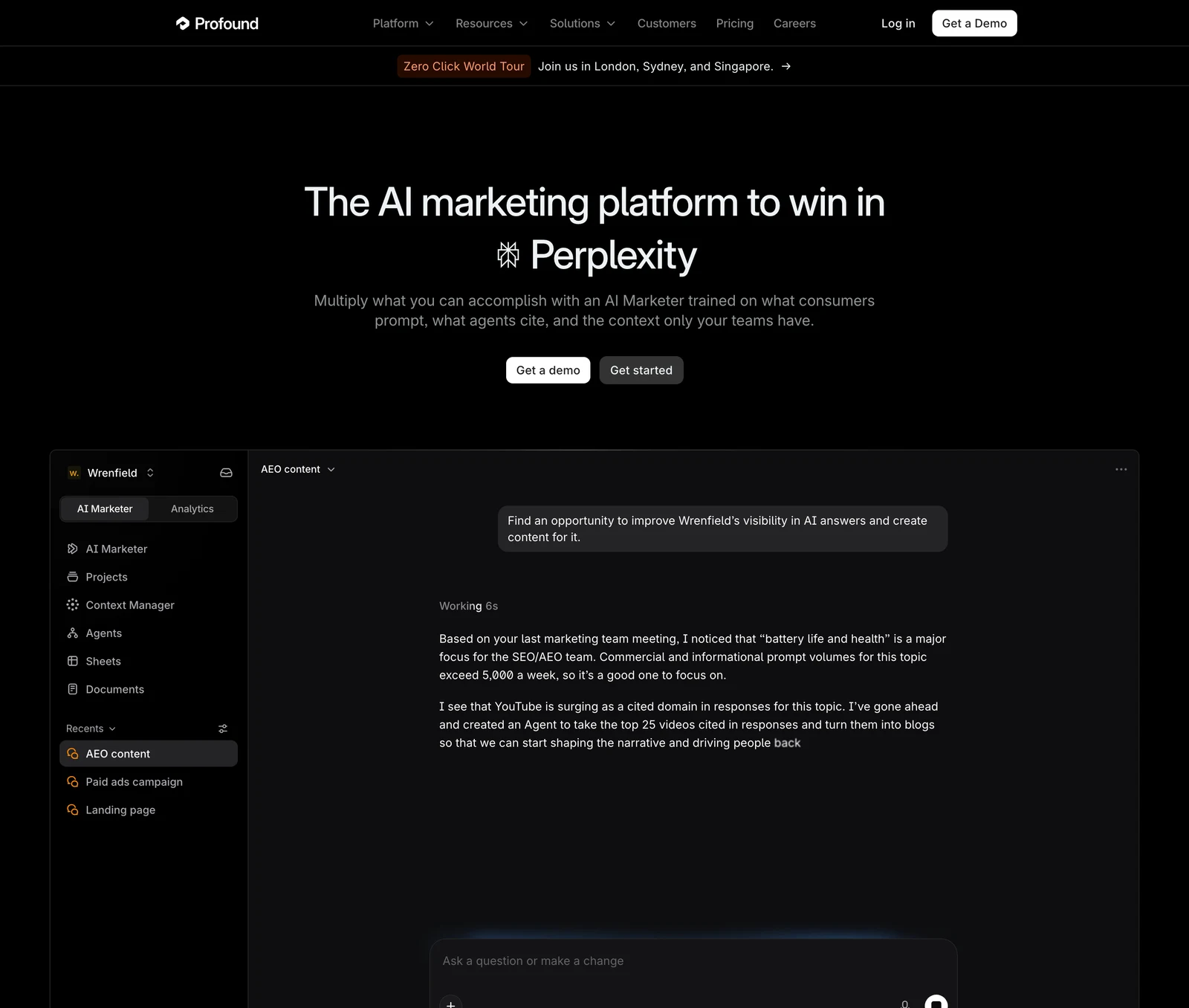
Ever wondered why ChatGPT recommends one brand over another? Or why your competitor keeps popping up in AI-generated answers while your brand is nowhere to be found?
That's exactly the kind of problem Profound wants to help businesses solve.
Profound is an AI marketing platform that helps brands understand how they show up across AI-powered search experiences like ChatGPT, Claude, Perplexity, Gemini, and Google's AI search features. It tracks brand visibility, analyzes the sources AI platforms cite, uncovers what people ask AI, and helps marketing teams decide what to do with all that information.
But here's where things get interesting.
Profound isn't stopping at dashboards and visibility reports. It's building toward an AI marketing workflow that turns insights into actual work.
Its Prompt Volumes feature helps marketers discover what people ask AI and which topics are worth targeting. Answer Engine Insights shows how brands appear in AI answers, while the AI Marketer (Aim) and Agents help teams research opportunities, create content, and automate marketing tasks. Its Context Manager gives those AI workflows access to brand information, so the work stays aligned with the company's positioning.
The platform is aimed at enterprise brands, agencies, and marketing teams that want AI search intelligence and execution in one place. The trade-off is that all these capabilities can be more than a small business needs, especially if the goal is simply to track AI mentions or make a website easier for AI to read.
In this review, we'll cover Profound's features, how sign-up works, what it costs today, what users say on G2, and how it compares with LovedByAI, a generative engine optimization platform for small businesses on WordPress.
Where is Profound based?
Profound is headquartered in New York City. Its careers page also lists roles in San Francisco, Boston, London, and Buenos Aires, and its September 2026 funding announcement says the company is expanding its applied AI lab in New York and San Francisco.
Who owns Profound?
Profound was founded in 2024 by James Cadwallader (CEO) and Dylan Babbs (CTO), who met at South Park Commons. The company's legal name is Cooper Square Technologies Inc., doing business as Profound, according to its privacy policy and subscription agreement.
Profound is venture-backed. On 15 September 2026 it announced a $180 million Series D at a $1.8 billion valuation, co-led by Sequoia Capital and Kleiner Perkins, with existing investors Lightspeed Venture Partners, Khosla Ventures, Saga Ventures, Evantic, and South Park Commons taking part. The same announcement says Profound serves over 1,000 enterprise brands and that its prompt dataset is built on more than 2 billion real user prompts.
Because Profound is privately held, the ownership split between founders, employees, and investors isn't public.
Profound features: what the platform does
Profound doesn't just tell you whether your brand appears in ChatGPT. It helps you investigate why, what people ask AI, which sources influence the answers, and what your marketing team can do about it.
It combines AI visibility tracking, prompt research, crawler analytics, shopping intelligence, and AI-powered marketing workflows. Here's the short version before we dig in.
Profound features at a glance
| Feature | What it does | Best for |
|---|---|---|
| Answer Engine Insights | Tracks brand visibility, citations, sentiment, and competitor performance in AI answers | Understanding how AI platforms represent your brand |
| FactCheck | Flags inaccurate AI-generated claims about your brand and the sources behind them | Brand, PR, and communications teams |
| Prompt Volumes | Estimates AI conversation demand, keyword relationships, and intent | Finding topics and questions worth targeting |
| AI Marketer (Aim) | Surfaces opportunities, writes execution briefs, hands work to Agents, and measures results | Turning AI search insights into marketing work |
| Agents | Automates research, content creation, content refreshes, and FAQ generation | Scaling content production and AEO execution |
| Context Manager | Connects brand knowledge, documents, and conversations to AI workflows | Keeping AI-generated work on brand |
| Agent Analytics | Monitors AI crawlers, page access, and AI-referred traffic | Understanding how AI systems use your website |
| Shopping | Tracks product visibility and descriptions in ChatGPT Shopping | Retailers and ecommerce brands |
1. Profound Answer Engine Insights
Ever searched for your brand in ChatGPT and wondered why a competitor gets recommended more often? Or why an AI assistant describes your product with outdated information?
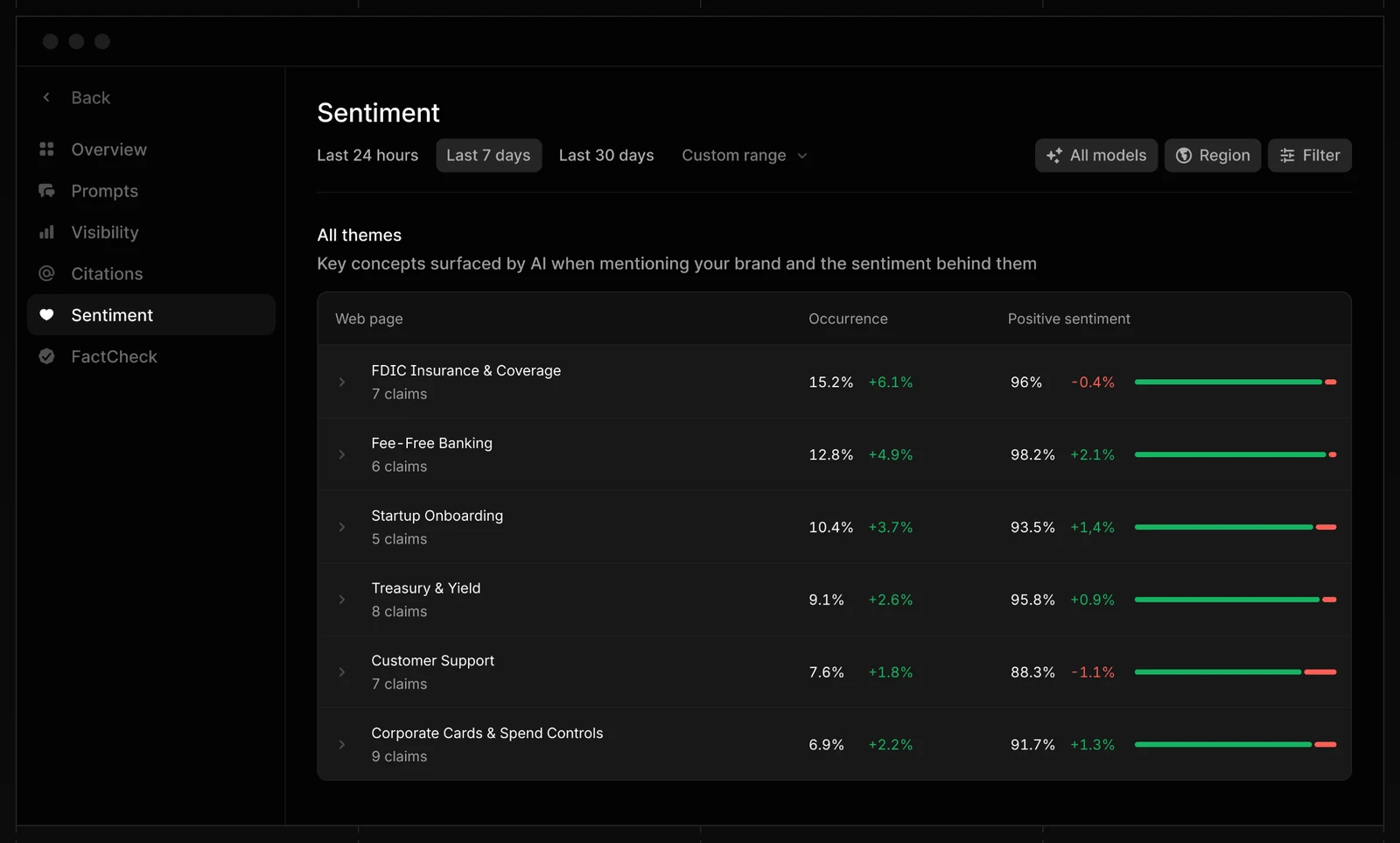
Answer Engine Insights is built to investigate exactly these questions. It tracks how often your brand appears in AI-generated answers, which competitors show up alongside you, and which websites influence those responses. You can also analyze sentiment, recurring themes, citations, and differences between AI platforms.
The most useful part is competitive benchmarking. Instead of only knowing that a visibility score moved, you can see where competitors earn citations and which topics your brand is missing from.
Profound says Answer Engine Insights captures responses from the consumer-facing versions of the AI platforms rather than relying only on API answers, and runs tracked prompts daily to account for the way AI answers vary.
2. Profound FactCheck
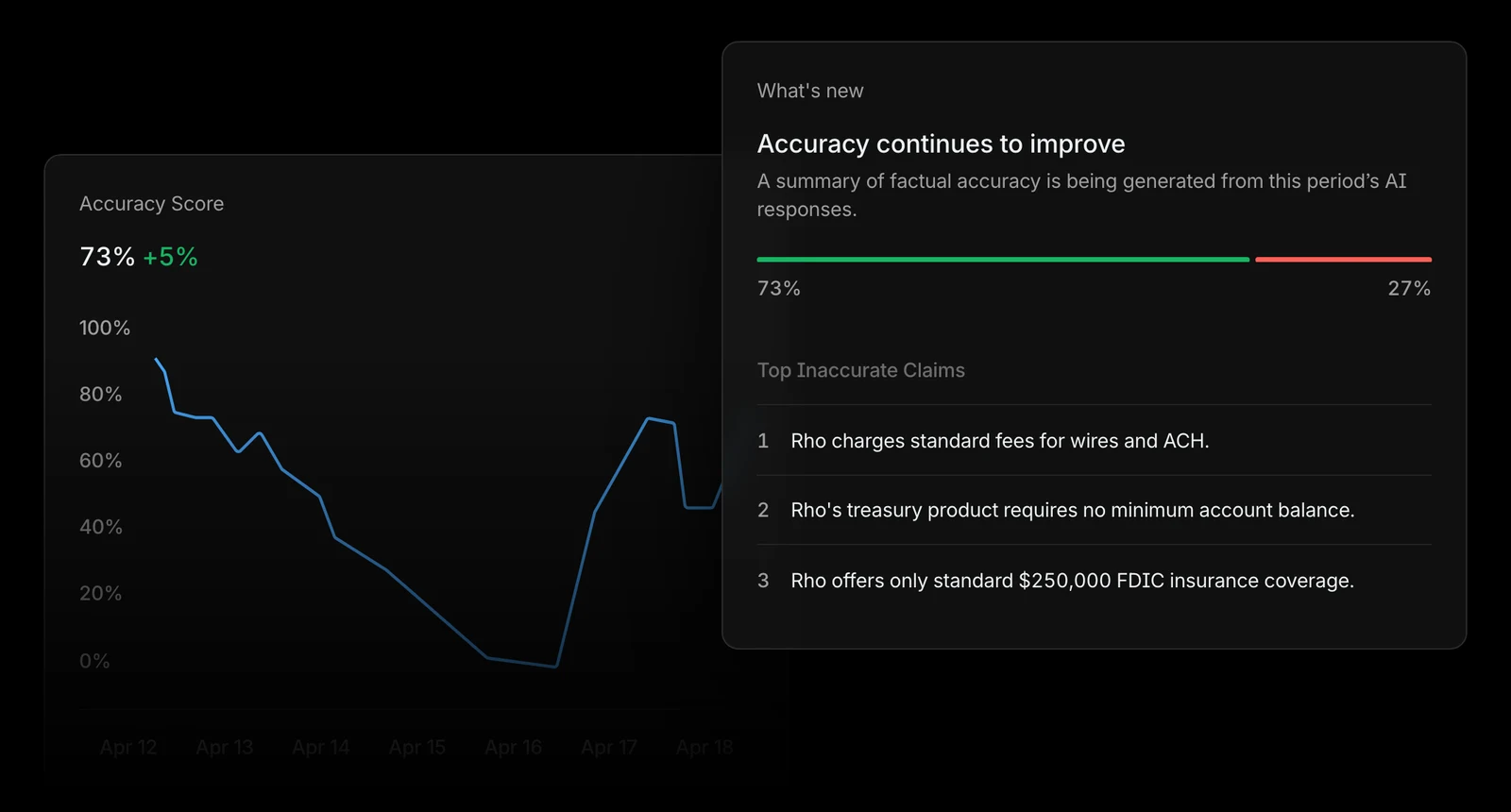
FactCheck sits inside Answer Engine Insights and handles a problem that mention counts miss: what happens when AI gets your brand wrong?
It checks AI-generated claims against a knowledge base of facts you supply, groups inaccurate claims by theme, and traces each one back to the source that caused it, whether that's your own page, a competitor's, or a publisher's. From there, Profound can launch an Agent to update content, create new content, or draft outreach to the publisher.
That's valuable for companies in categories where accuracy matters, such as finance, healthcare, and travel, where an outdated fee or policy in an AI answer can cost real customers.
3. Profound Prompt Volumes
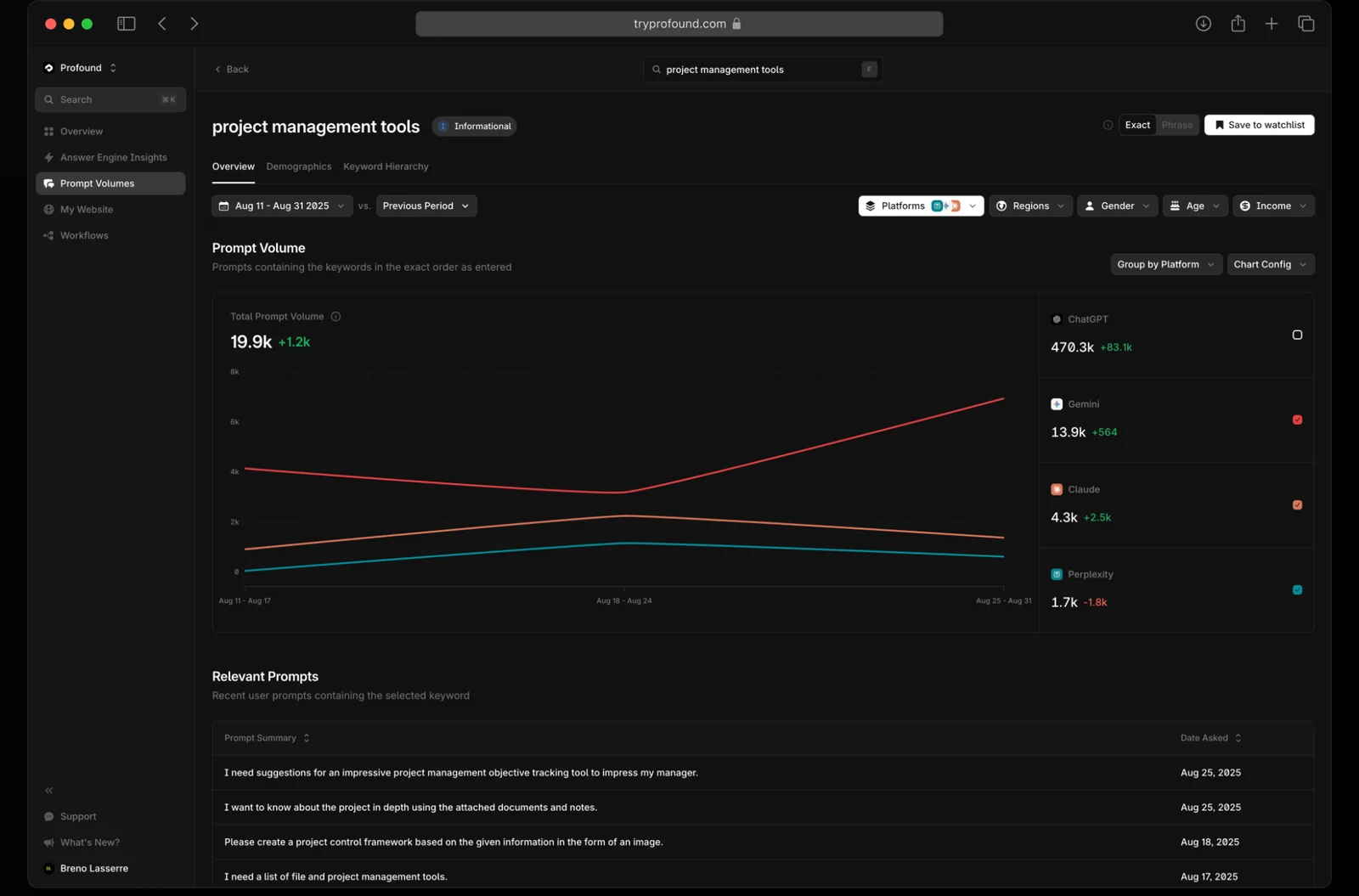
Traditional keyword research tells you what people type into search engines. But people ask AI assistants longer, more conversational questions.
Prompt Volumes is designed for that gap. Profound uses its own dataset of AI conversations to estimate which topics people discuss with AI, how much demand exists around them, and what intent sits behind each prompt.
Its main capabilities:
- Keyword and topic discovery: Explore related terms, subtopics, and long-tail prompt variations.
- Intent analysis: Classify prompts as informational, commercial, conversational, or generative.
- Audience segmentation: Break prompt demand down by AI platform, demographic group, and region.
- Competitive prompt research: Find prompts where competitors are cited but your brand isn't.
- Prompt Research Reports: Generate reports from Profound's dataset to decide which prompts to track.
For example, if you sell project management software, you could look beyond "project management software" and investigate questions like "Which project management tool is best for a remote team of 20 people?"
One important distinction: Prompt Volumes is not Google search volume. It's an estimate drawn from Profound's own conversation dataset, so the two numbers shouldn't be treated as interchangeable.
4. Profound AI Marketer (Aim)
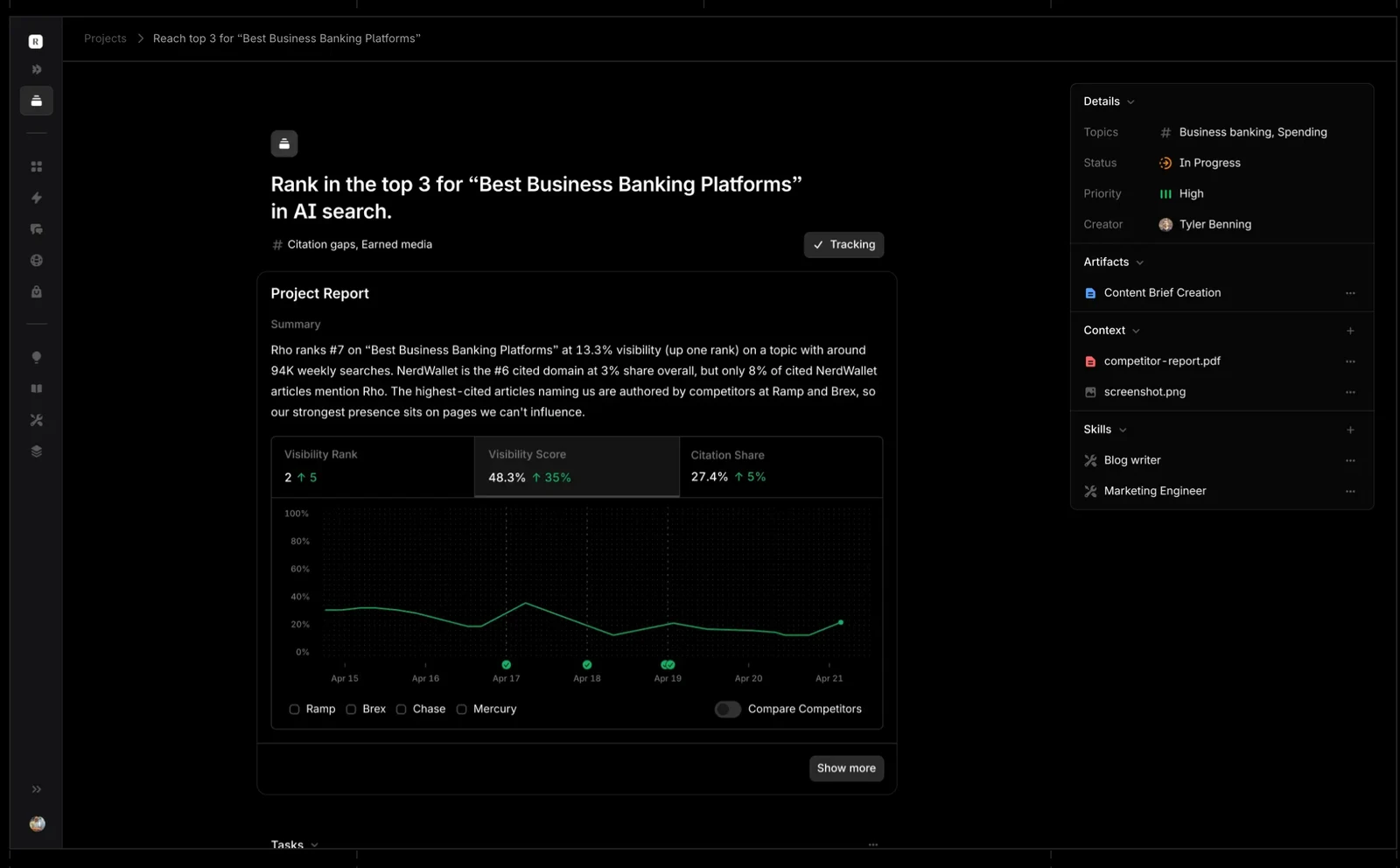
This is where Profound moves beyond conventional AI visibility software.
AI Marketer, or Aim, is designed to work like an AI teammate for your marketing team. Instead of leaving you with a dashboard of opportunities, it turns findings into projects, execution briefs, and workflows:
- Identify: Aim surfaces opportunities from your brand context, AI visibility data, and other marketing signals.
- Plan: It writes a brief with recommended tasks, such as refreshing a page, writing a comparison article, or pursuing third-party coverage.
- Execute: It hands the work to Profound Agents.
- Measure: It tracks project activity and visibility metrics so teams can see progress.
For instance, if competitors are being cited for a high-intent comparison topic, Aim can outline a plan with a new ranking page, competitor comparisons, and outreach targets. Your team reviews the plan and uses Agents to carry it out.
That's a real difference from a tool that only reports lost visibility. AI-generated plans and content still need human judgment, fact-checking, and approval before anything is published.
5. Profound Agents
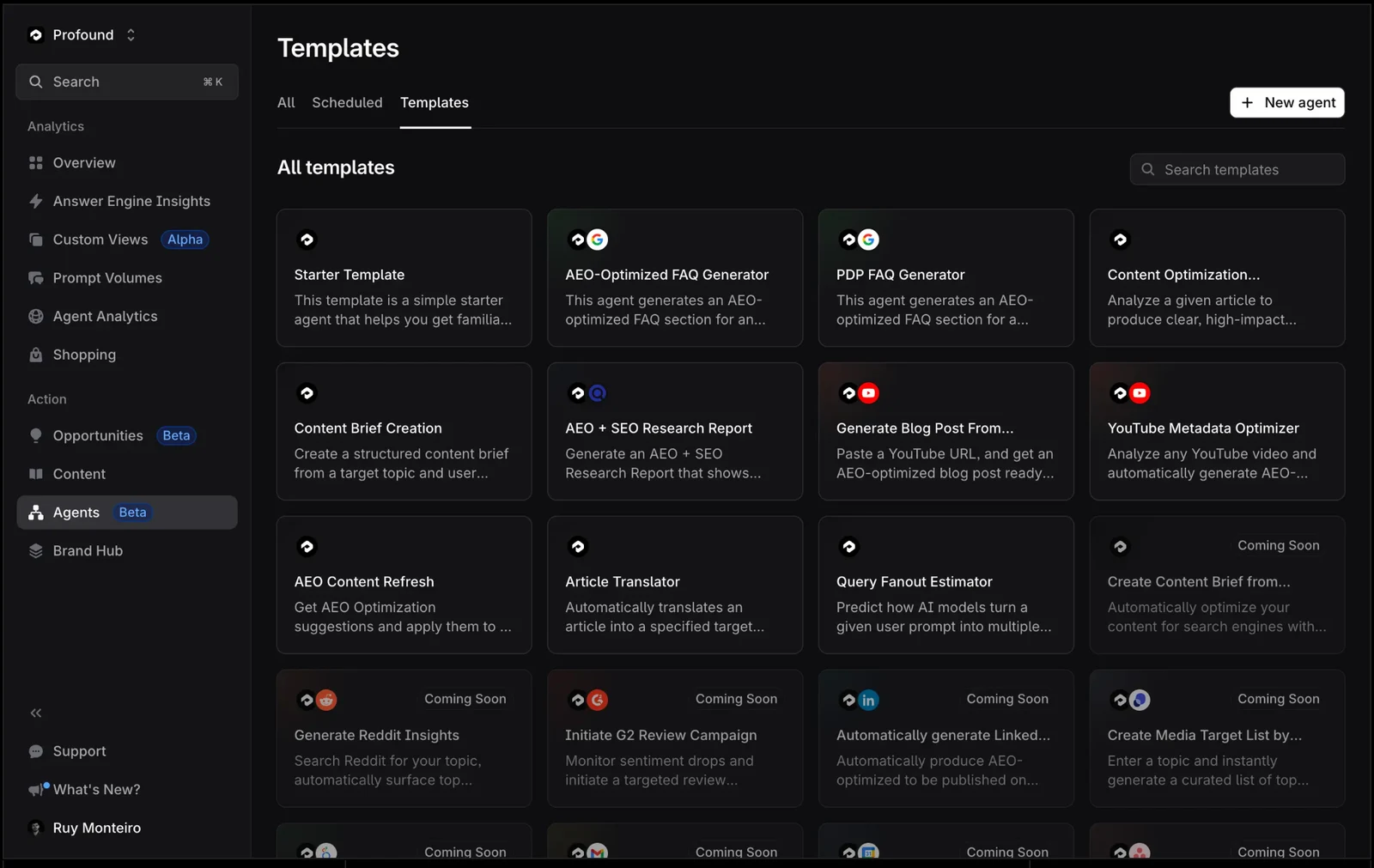
Agents are the execution layer behind Profound's automation. Teams can start from ready-made templates or build their own workflows with a drag-and-drop Agent Builder that combines research, web scraping, AI prompts, visibility data, and API calls.
| Agent workflow | What it helps you do |
|---|---|
| Content refresh | Find pages with declining AI citation rates and generate updated drafts |
| FAQ generation | Create structured FAQs in the formats answer engines favor for a topic |
| Competitive research | Analyze competitor citations and identify content gaps |
| New content creation | Generate articles from topic research and citation patterns |
| Custom workflows | Chain multiple steps and tools into repeatable marketing processes |
Agents can use your brand guidelines and knowledge base, and Profound presents the Agent Builder as a no-code tool for marketers. Teams can test outputs and add approval steps, and CMS integrations (Profound names WordPress, Sanity, and Contentful) cut down on copying and pasting.
The caveat: automation doesn't guarantee citations. The value depends on the quality of the research, how the workflow is set up, and whether the content is actually useful.
6. Profound Context Manager
AI tools can write content quickly. Getting them to understand your company's positioning, product details, and tone of voice is a different challenge.
Context Manager connects information scattered across brand kits, knowledge bases, documents, and workplace conversations so Aim and Agents work with relevant context:
- Brand Records: Structured information about your brand that updates as new information comes in.
- Knowledge connections: Pulls in information from sources such as Slack, email, and Gong.
- Personal Records: Learns individual users' preferences and roles.
- Knowledge gap detection: Spots missing information and asks you to fill it in with text, voice, or files.
For marketing teams, that means fewer repeated brand instructions and more consistent output across agents and projects.
7. Profound Agent Analytics
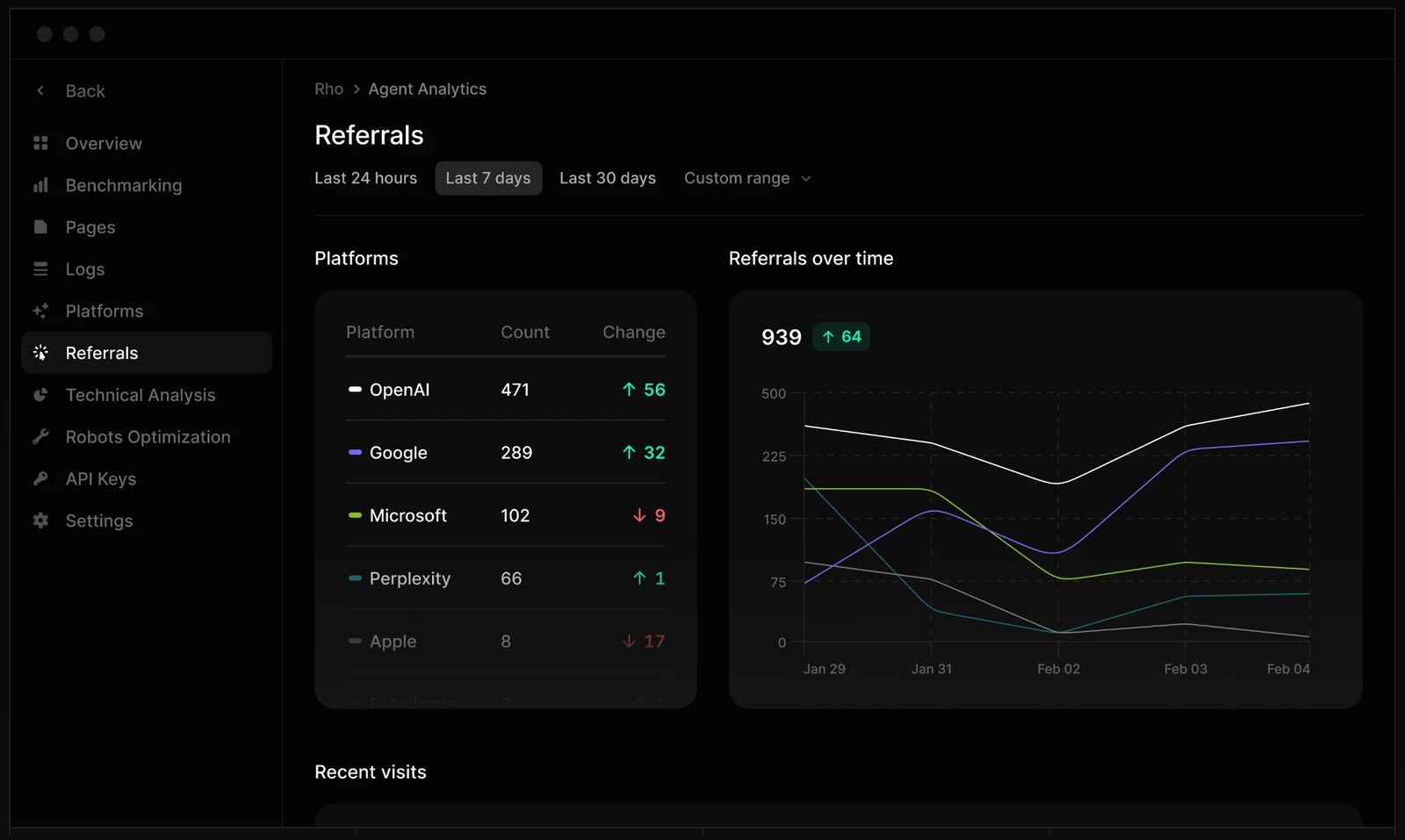
Here's something that often gets overlooked in AI search optimization: whether AI systems can actually reach and read your website.
Agent Analytics uses server-log data and integrations (Profound lists Cloudflare, Akamai, Fastly, AWS, Vercel, Netlify, Google Cloud, and WordPress) to monitor AI crawler activity and AI-referred traffic:
- AI crawler monitoring: See when AI bots visit and which pages they access.
- Content performance tracking: See which pages AI systems prefer.
- AI traffic attribution: Measure human visits arriving from AI platforms.
- Benchmarking: Compare your pages' citation performance against Profound's wider dataset.
- Crawler verification: Separate verified AI bots from crawlers impersonating them.
This is most useful for technical SEO and infrastructure teams. Just remember that crawling and citation are different signals: a bot visiting a page doesn't mean that page will be cited. For the wider picture, see our AI crawler statistics.
8. Profound Shopping
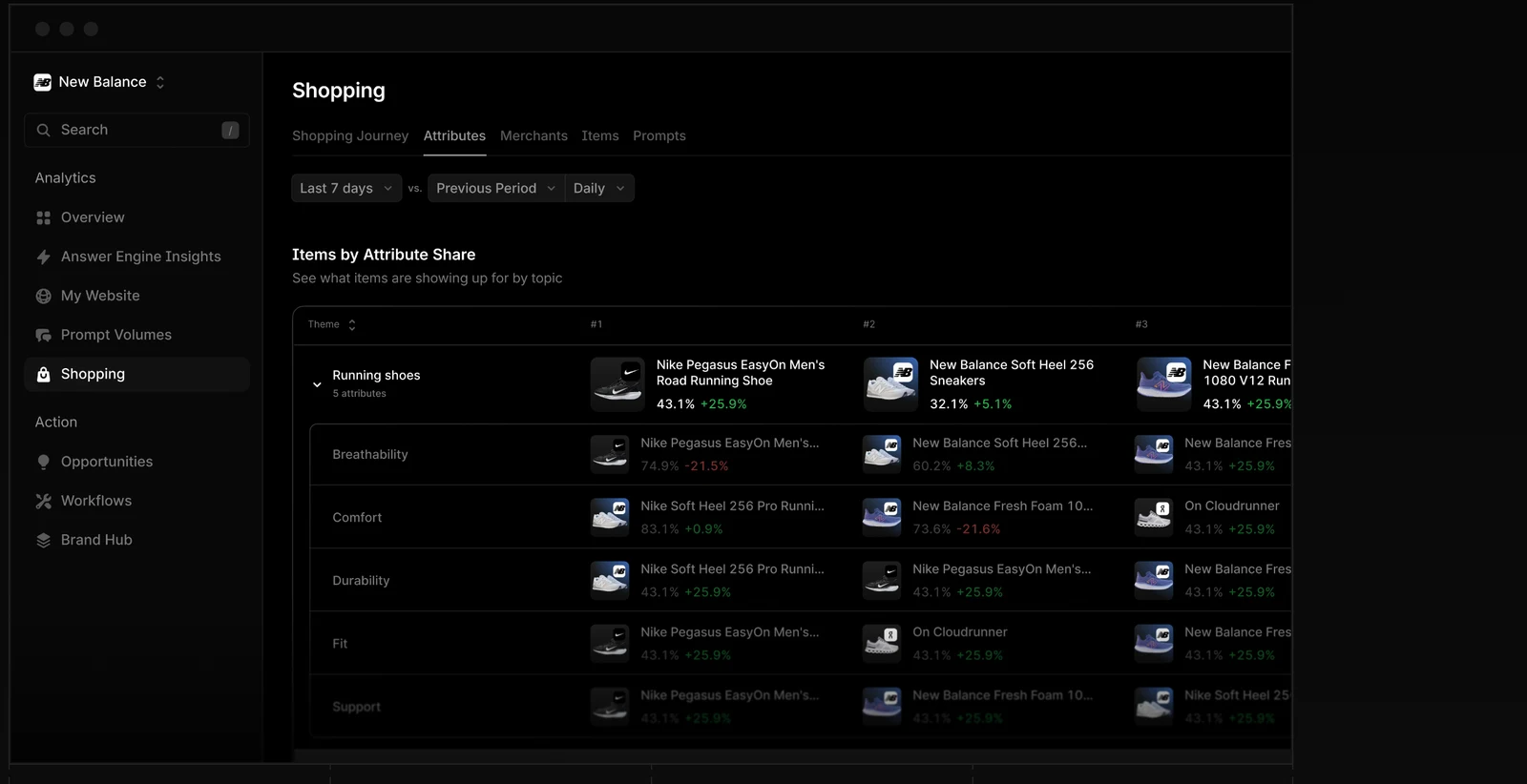
If you run an ecommerce business, AI visibility isn't only about your brand getting mentioned. It's about whether your products appear when shoppers ask for recommendations.
Profound's Shopping feature focuses on ChatGPT Shopping. It shows which queries trigger shopping results, where your products are placed, and how AI describes them:
- Shopping visibility: Track product placement in shopping-triggered answers.
- Attribute accuracy: Check how AI categorizes and describes your products.
- Shopper sentiment: See the impression AI-written product descriptions create.
- SKU-level analysis: Investigate individual products alongside their queries and citations.
- Merchant analysis: See which retailers or direct stores control the checkout.
If a competitor's products appear for a high-intent shopping query and yours don't, Profound helps you find that gap, so you can work on product feeds, structured data, and product pages.
Which Profound features matter most?
- Want to know how AI describes your brand? Start with Answer Engine Insights and FactCheck.
- Want to know what people ask AI? Look at Prompt Volumes.
- Want to automate content creation? Explore Agents.
- Want an AI teammate that connects research to execution? Look at Aim.
- Want to see AI crawlers and AI referral traffic? Choose Agent Analytics.
- Sell products online? Explore Shopping.
Profound's biggest strength is how these pieces fit together: AI search data, brand context, and marketing automation, rather than monitoring as the end goal. The trade-off is complexity. Teams get the most out of it when they have clear workflows, people to review outputs, and the budget for the broader platform.
Profound use cases: who the platform is for
| Team | How Profound helps | Most relevant features |
|---|---|---|
| AEO teams | Monitor visibility, increase citations, benchmark competitors | Answer Engine Insights, Prompt Volumes, Agents, Agent Analytics |
| Content teams | Find topics, create AI-informed content, refresh existing pages | Prompt Volumes, Agents, Aim |
| PR and brand teams | Track AI sentiment, fix inaccurate claims, find earned-media opportunities | Answer Engine Insights, FactCheck, Agents |
| Agencies | Pitch prospects with AI visibility audits and manage client workspaces | Answer Engine Insights, Prompt Volumes, Agents |
| Retail and ecommerce | Track product placement and AI product descriptions | Shopping, Prompt Volumes, Answer Engine Insights |
| Travel and hospitality | Research traveler prompts and correct outdated brand information | Prompt Volumes, FactCheck, Answer Engine Insights |
| Pharma | Understand patient questions and monitor AI-generated claims | Prompt Volumes, FactCheck, Answer Engine Insights |
How does Profound work? Signing up for Profound
Step 1: Go to Profound's website
Head to Profound's official website and click Get started or Log in in the top-right corner. Both take you to the same sign-in page.
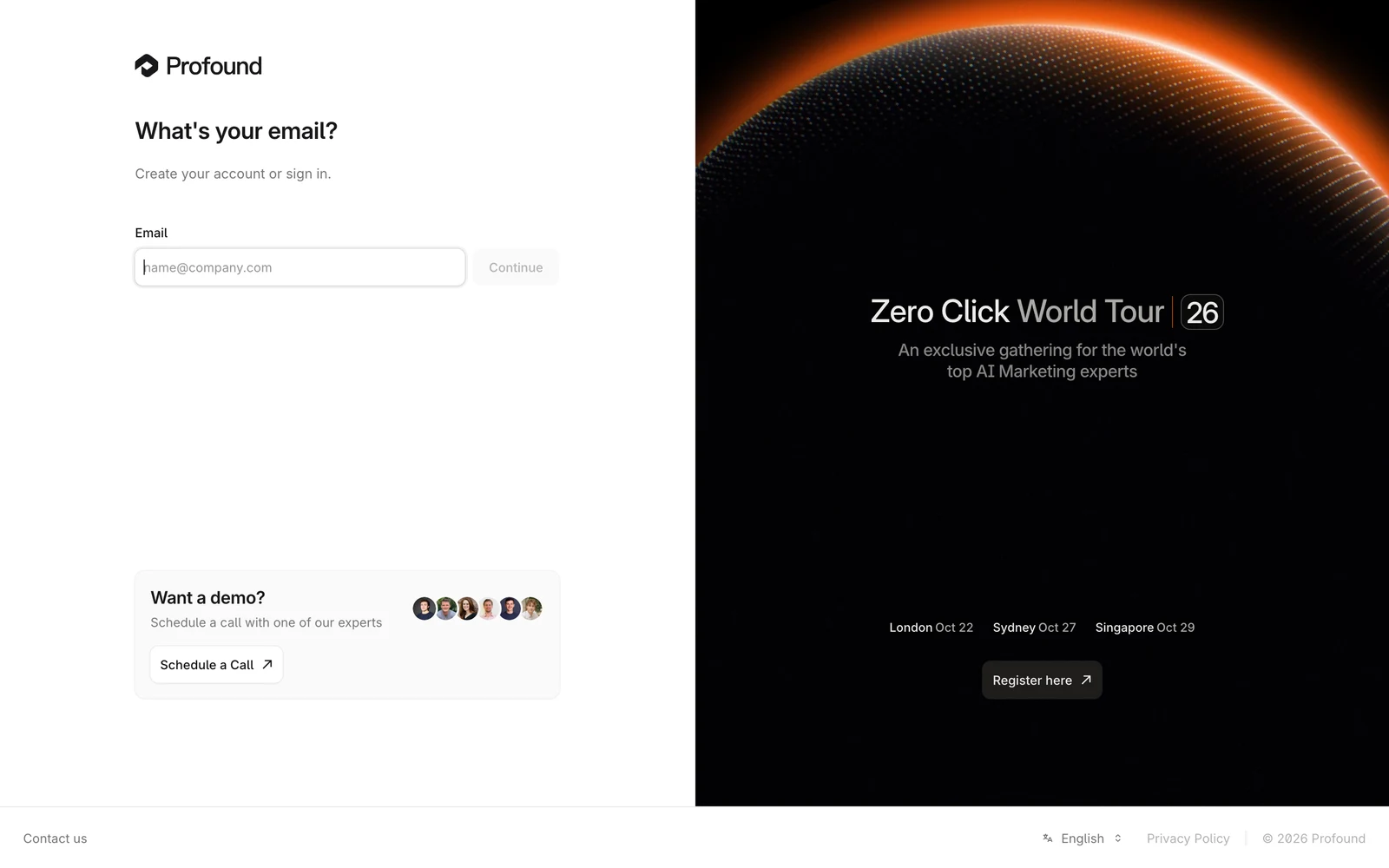
Step 2: Enter your email address
Profound uses one screen to create an account or sign in. Enter your work email and click Continue.
Step 3: Verify your email
Check your inbox for the verification email from Profound and follow the link.
Step 4: Add your company and website details
Fill in your company information, including team size, and say whether you're an agency. Then add your company website and any other details Profound asks for, review them, and continue.
Step 5: Let Profound analyze your website
Profound analyzes your website based on what you entered. Once the first analysis finishes, your Profound dashboard opens and you can start exploring. On the free Trial, that means 50 prompts run daily for seven days across ChatGPT, Gemini, and Google AI Overviews.
How much does Profound cost? Profound pricing in 2026
Profound's pricing has changed, and the plans you'll see quoted in most reviews are no longer on its own pricing page.
As of 20 October 2026, the For brands tab on Profound's pricing page lists only two options: a free Trial and a custom-priced Enterprise plan. The self-serve Starter ($99/month) and Growth ($399/month) plans still appear on Profound's G2 listing, but not on Profound's own site.
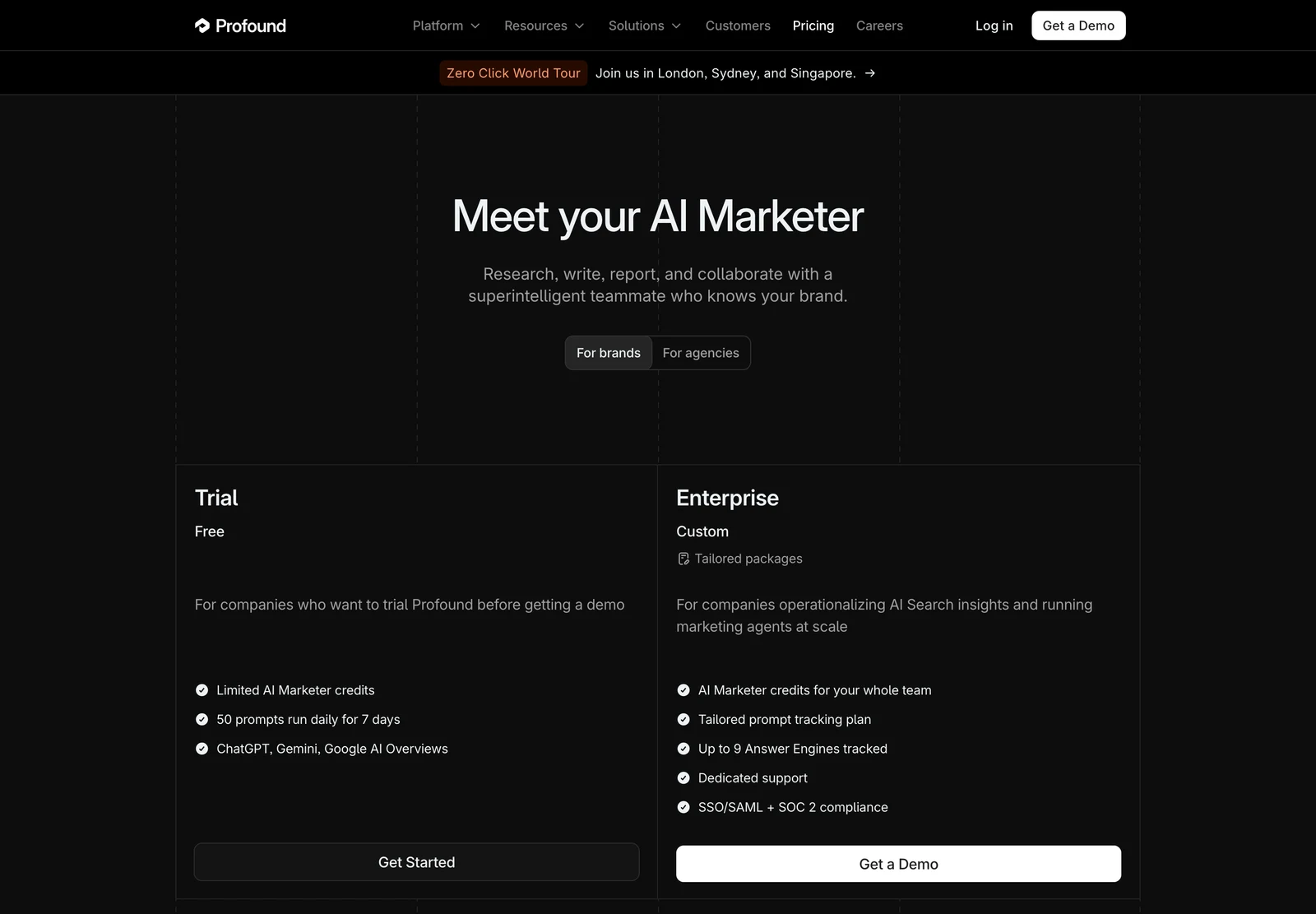
Profound pricing for brands
| Trial | Enterprise | |
|---|---|---|
| Price | Free | Custom |
| Prompts tracked | 50 unique prompts | Custom |
| Prompt frequency | Daily for 7 days | Daily |
| Answer engines | ChatGPT, Gemini, Google AI Overviews | Up to 9, including ChatGPT, Perplexity, Google AI Mode, Gemini, Microsoft Copilot, DeepSeek, Claude, Google AI Overviews, and Exa Search |
| AI Marketer credits | Limited | For your whole team |
| Prompt Volumes searches | 5 | Custom |
| ChatGPT Shopping | No | Yes |
| Data history, exports, API | None | All-time history, CSV and JSON exports, API |
| Seats | Unlimited | Unlimited |
| Support | None | Email, dedicated Slack, or a dedicated specialist with a 24-hour SLA |
| SSO | No | Yes, SSO/SAML |
Profound pricing for agencies
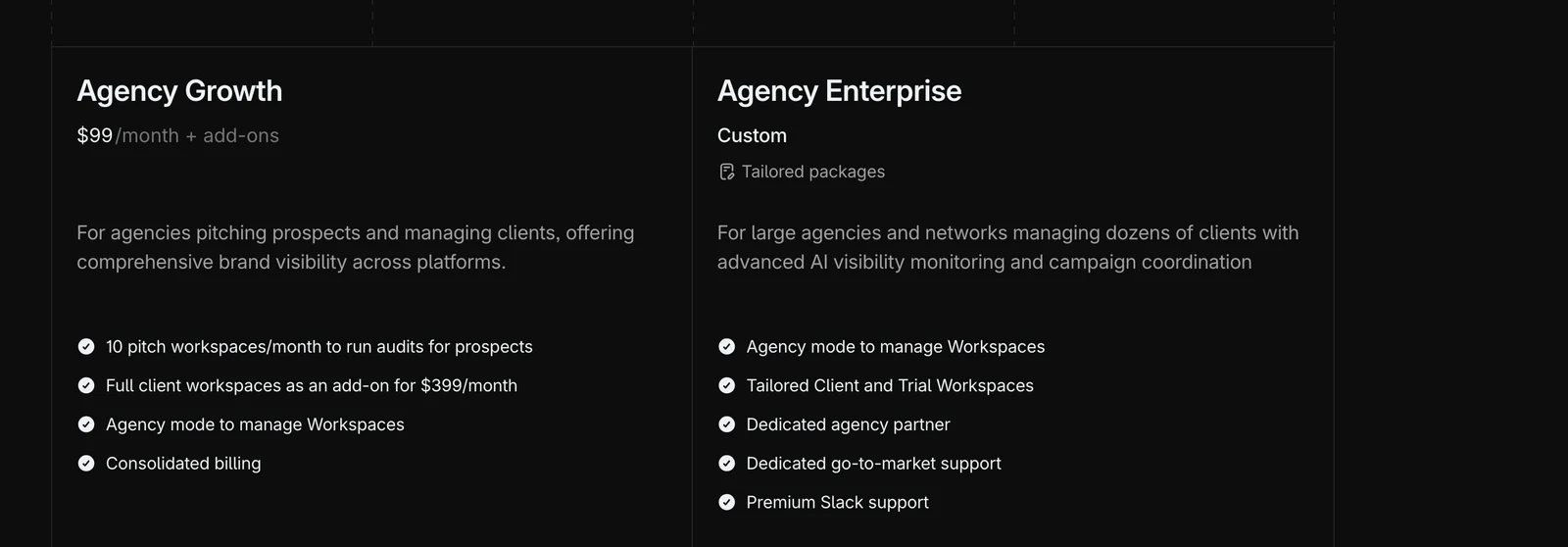
The For agencies tab is the only place Profound still shows a self-serve price:
- Agency Growth: $99/month plus add-ons. It includes 10 pitch workspaces a month for running AI visibility audits on prospects (25 prompts each, run for 7 days across ChatGPT, Perplexity, and Google AI Overviews), agency mode, and consolidated billing. A full client workspace costs $399/month as an add-on, and 5 more trial workspaces cost $199/month. Each client workspace comes with 400 Agent credits a month.
- Agency Enterprise: custom pricing, with tailored client and trial workspaces, a dedicated agency partner, and premium Slack support.
So for an agency, the real cost scales with clients: one client workspace on Agency Growth is $99 plus $399, or $498 a month.
Source: Profound's official pricing page, checked 20 October 2026.
Is there a Profound free trial?
Yes. Profound's Trial plan is free and needs no demo. It runs 50 prompts daily for seven days across ChatGPT, Gemini, and Google AI Overviews, with limited AI Marketer credits and 5 Prompt Volumes searches.
It's a preview, not the full platform. There's no data history, export, API, or support on the Trial, and after seven days the next step is an Enterprise conversation.
Is Profound worth the price?
That depends on how much of the platform you'll use.
For brands, there's no longer a published self-serve plan between the free Trial and custom Enterprise pricing, so most teams that want to keep using Profound will be talking to sales. That suits companies running AEO as a program, with people to review Agent output and act on the insights. It's a harder fit for a small business that only wants to check whether ChatGPT mentions it.
Our take: evaluate Profound as an AI marketing platform, not a visibility tracker. Before committing, ask about prompt limits, Agent credits, supported answer engines, and data history in your proposed package. Those details tell you more about its value than any headline price.
Profound pros and cons
| Pros | Cons |
|---|---|
| Tracks brand visibility across up to 9 answer engines, including ChatGPT, Perplexity, Gemini, and Google AI Overviews | No published self-serve plan for brands: past the free Trial, pricing is custom |
| Citation analysis, sentiment tracking, FactCheck, and competitor benchmarking in one place | The free Trial lasts only 7 days, with no data history, exports, or support |
| Prompt Volumes estimates what people ask AI platforms | Some G2 reviewers find setup complex and the learning curve steep |
| Aim and Agents turn insights into briefs, drafts, and refreshes | Some reviewers find it hard to turn visibility data into concrete next steps |
| Agent Analytics covers AI crawlers and AI referral traffic from server logs | Agencies pay $399/month per full client workspace on top of the $99 base |
| API access, data exports, SSO, and dedicated support on Enterprise | Far more platform than a business needs if it only wants basic AI visibility |
Profound reviews: what users say on G2

Profound has a 4.5 out of 5 rating on G2 from 1,136 reviews, when we checked on 20 October 2026. (Source) The distribution leans heavily positive: 837 five-star and 279 four-star reviews, against 16 three-star, 3 two-star, and 1 one-star review.
What users like about Profound
AI visibility tracking and competitor analysis. Reviewers value seeing how their brand appears in AI-generated answers, which competitors appear alongside it, and which sources AI platforms rely on.
Monitoring and research depth. Prompt tracking and Prompt Volumes come up often as ways to understand what people ask AI and where a brand is missing.
Automation and product pace. Several reviewers praise Profound's integrations, its API, and how quickly new features ship.
What users don't like about Profound
Pricing. Cost is the clearest theme in the critical reviews, including the claim that cheaper tools offer similar insights.
Setup and learning curve. Some reviewers describe setup as complex, especially when defining the brands and competitors in their market.
Insights that don't turn into action. Some want clearer recommendations, not just visibility data.
Product and support issues. A few low-rated reviews describe features that didn't work or slow support responses. These are individual experiences, not proof of a widespread problem.
Profound G2 reviews worth highlighting
1. A positive review of Profound's AI visibility data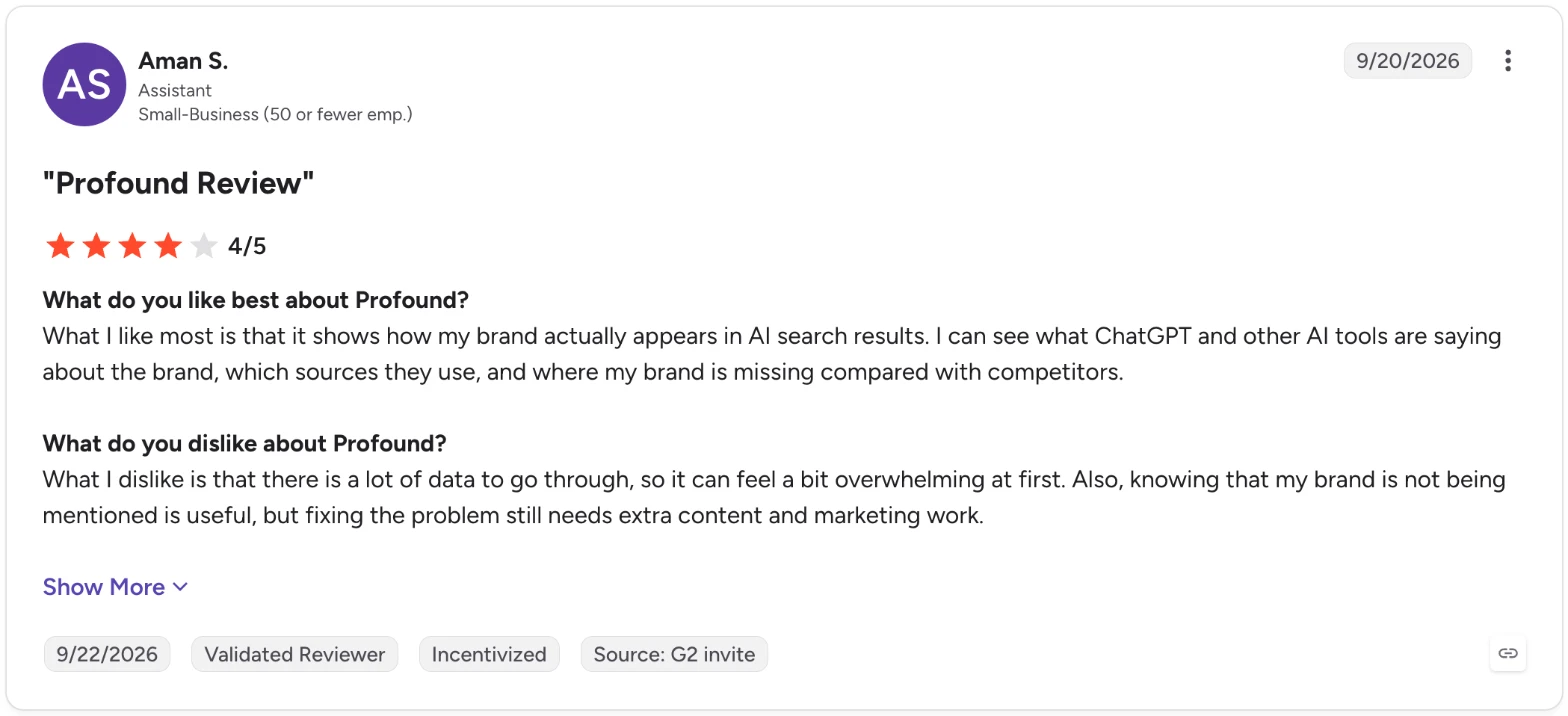
Aman S., reviewing in September 2026, gave Profound 4/5 and said what they like most is seeing how their brand actually appears in AI search results: what ChatGPT and other AI tools say about the brand and which sources they use.
Why it matters: this is Profound's core value proposition, visibility into AI answers without manual checking.
2. A positive review of its API and development pace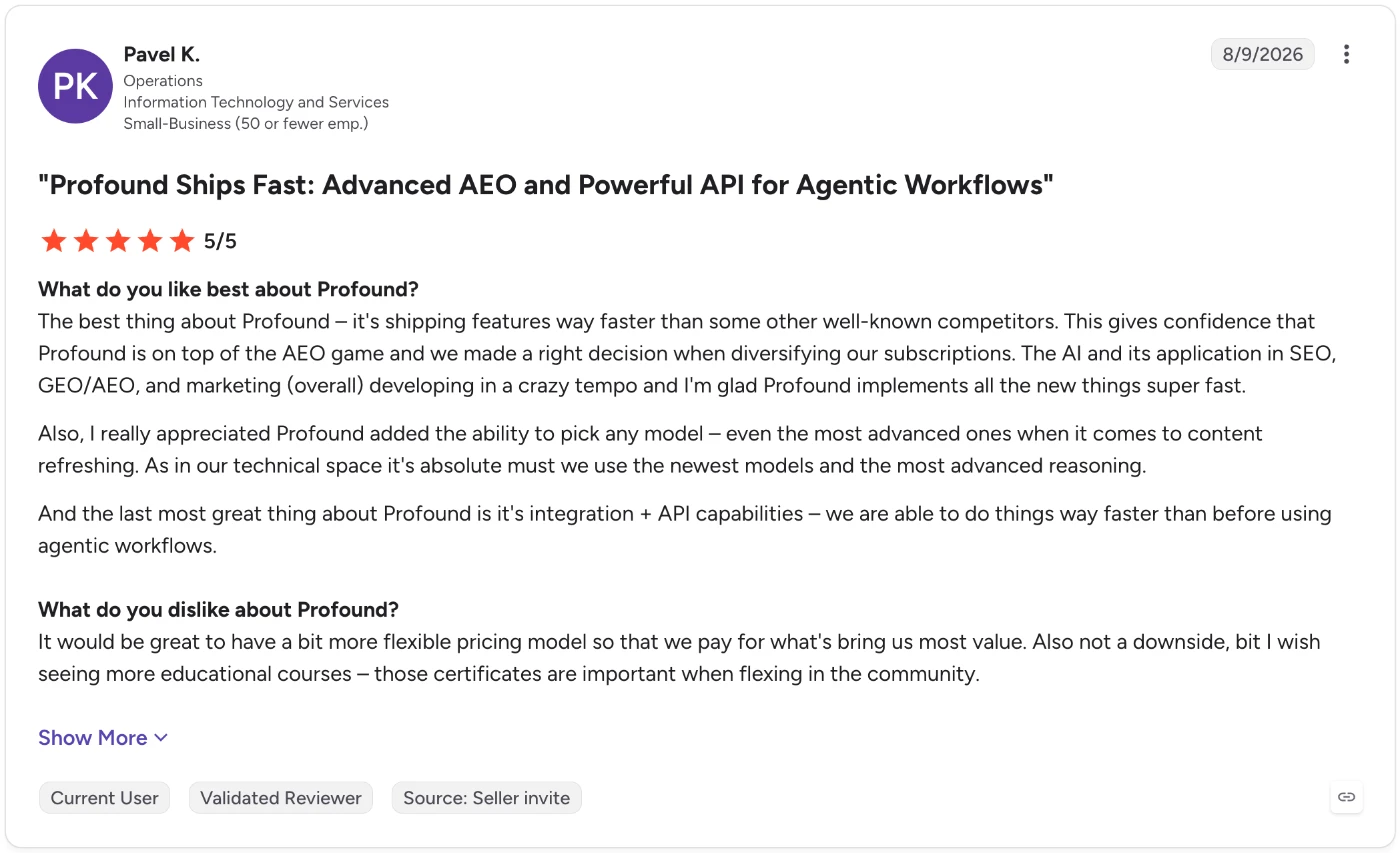
Pavel K., reviewing in August 2026 under the title "Profound Ships Fast: Advanced AEO and Powerful API for Agentic Workflows," gave Profound 5/5, praising how fast it ships features and its API for agent workflows, while wishing for a more flexible pricing model and more educational courses.
Why it matters: Profound's appeal goes beyond monitoring for teams building AI search into existing marketing workflows.
3. A negative review questioning its value for money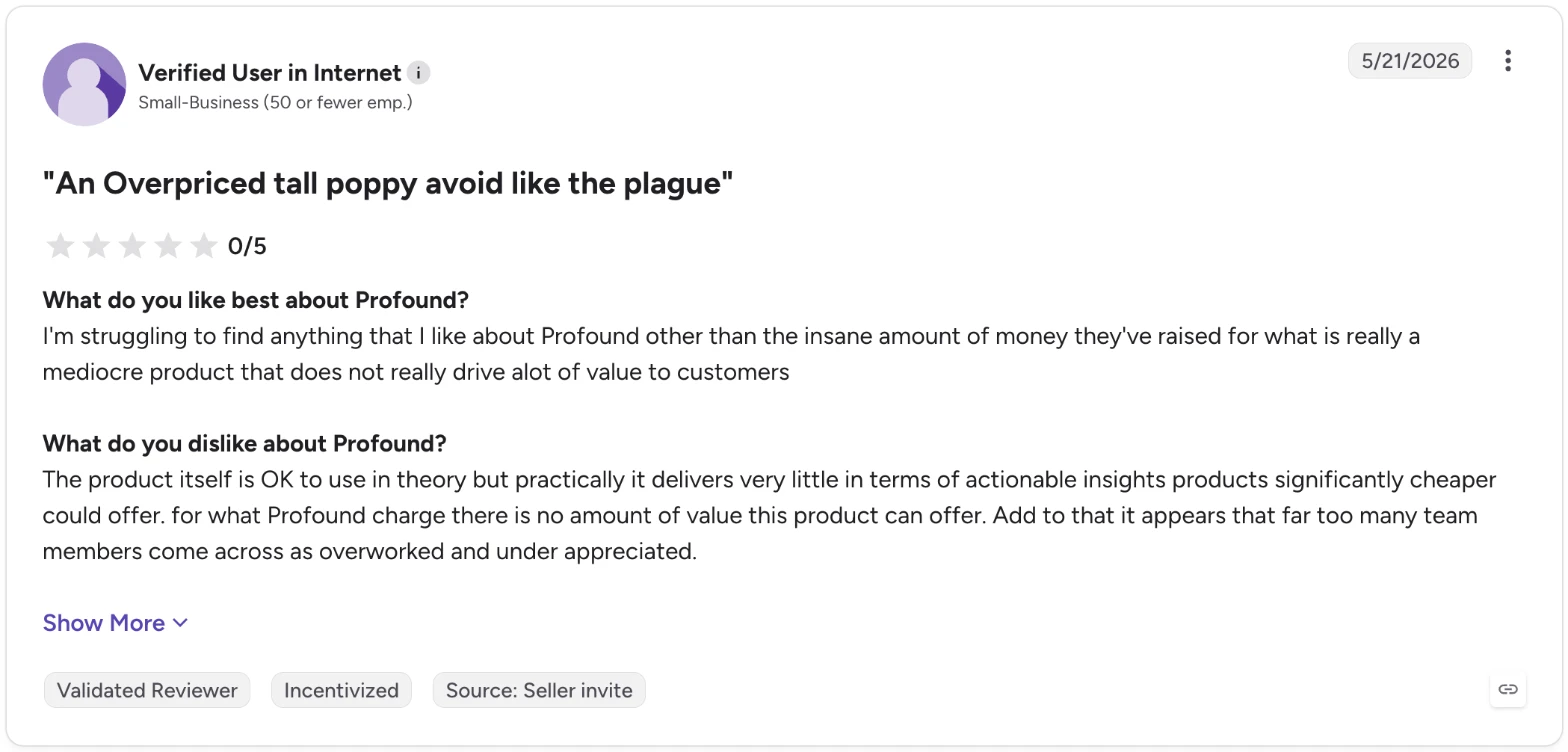
A verified reviewer in the internet industry gave Profound 0/5 in May 2026, writing that the product "delivers very little in terms of actionable insights products significantly cheaper could offer."
Why it matters: it's a direct challenge to Profound's price-to-value proposition. It's one opinion among more than a thousand, but the question it raises is the right one for buyers.
4. A negative review describing a broken trial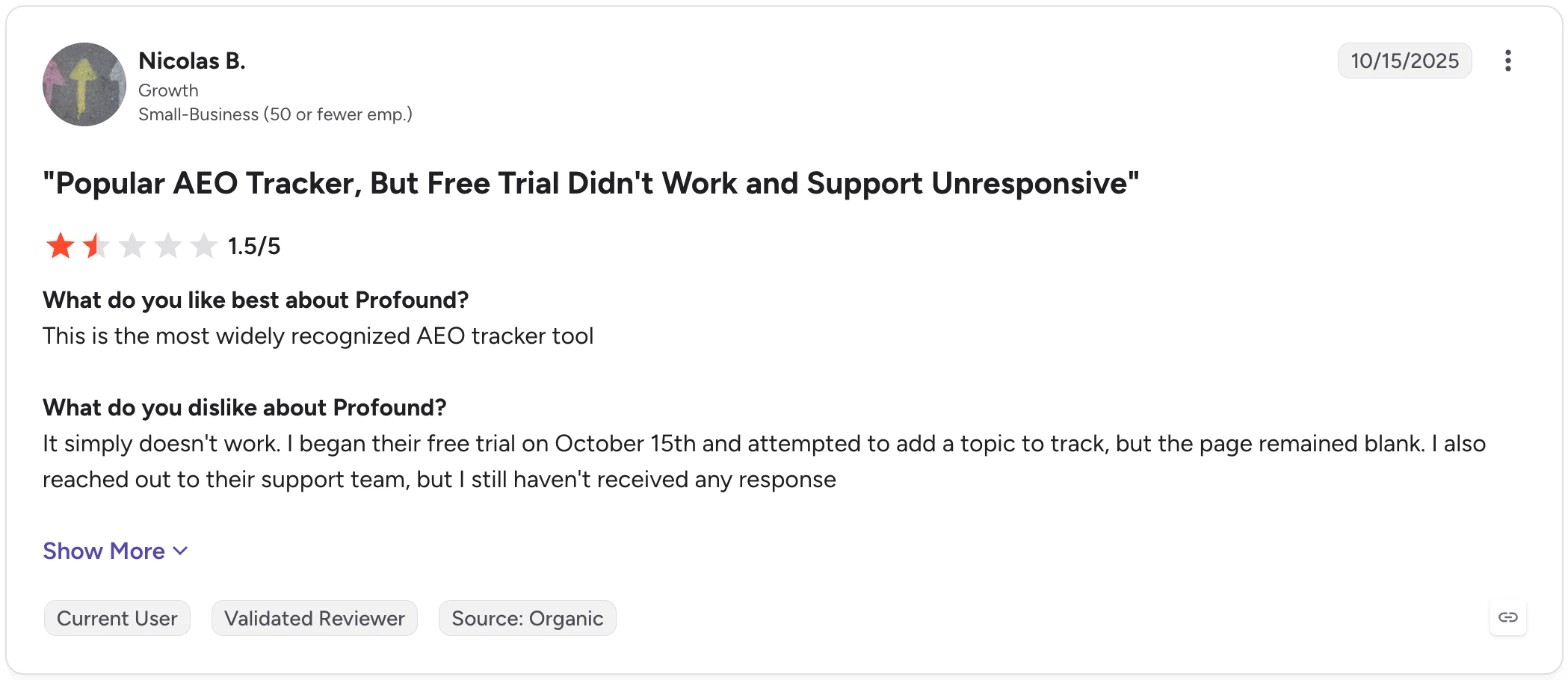
Nicolas B. gave Profound 1.5/5 in October 2025, reporting that the page stayed blank when they tried to add a topic during the free trial and that support hadn't replied when they wrote the review.
Why it matters: it's a concrete example of a frustrating first experience. It's also a year old and a single report, so it isn't evidence the issue persists.
5. A negative review about setup complexity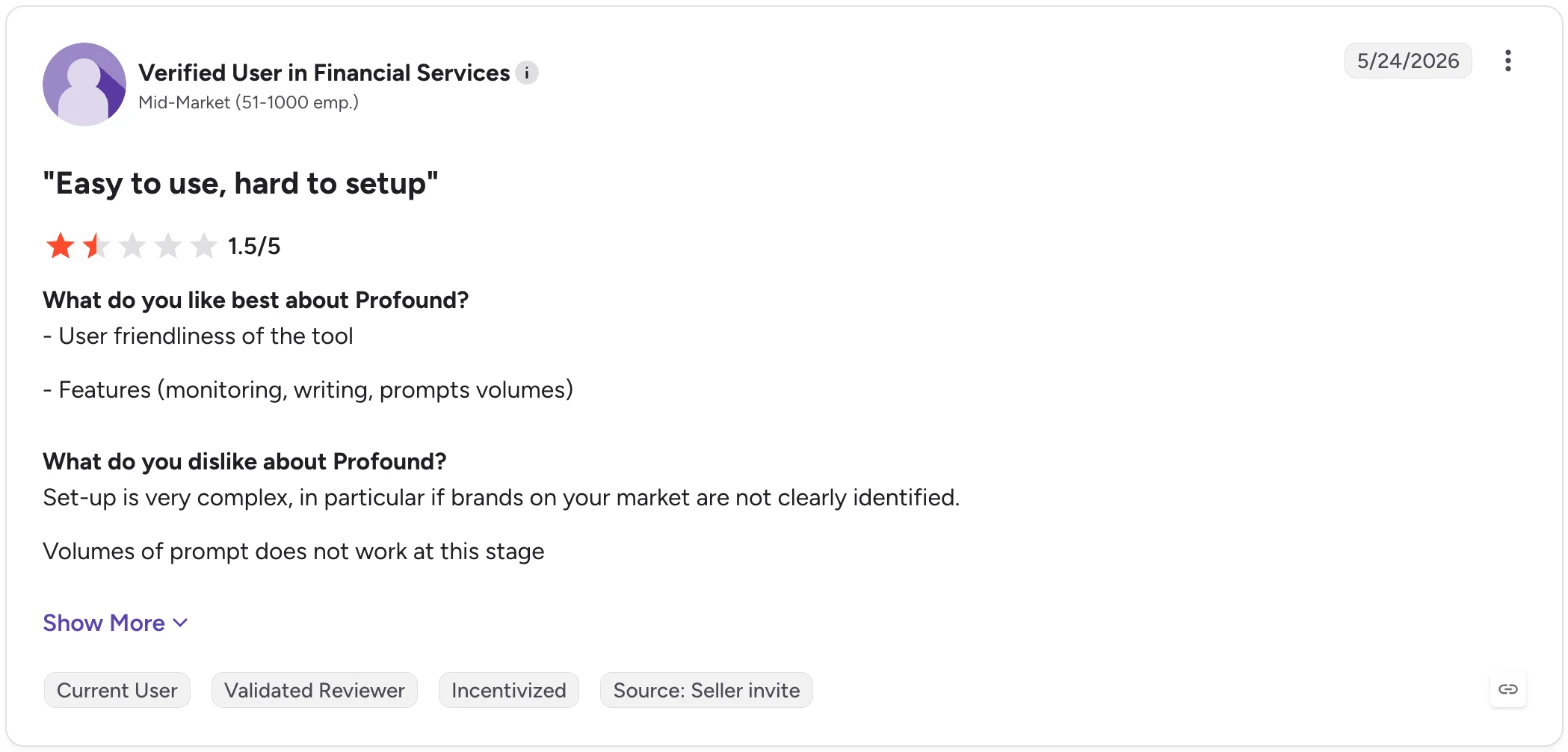
A verified user in financial services gave Profound 1.5/5 in May 2026. They liked the interface and features but described setup as "very complex," particularly when the brands in their market weren't clearly identified, and said prompt volumes weren't working at the time.
Why it matters: extensive capabilities are less useful if a team struggles to configure them.
Is Profound worth it?
Profound can be worth it, depending on what you need from an AI search tool.
If you're an enterprise brand, a large marketing team, or an agency that pitches AI visibility audits, Profound offers a lot: AI visibility tracking, competitor analysis, FactCheck, prompt research, AI crawler analytics, and agents that connect research with content work. A G2 rating of 4.5 from more than 1,100 reviews suggests most of its users are happy with what they get.
The bigger question is whether you need all of it. For brands, Profound now goes straight from a seven-day free Trial to custom Enterprise pricing, and the critical reviews on G2 keep returning to cost, setup, and the work of turning reports into improvements.
For small businesses and lean teams, an enterprise AI marketing platform may be the wrong tool if what you need is a website AI systems can read, plus a way to see whether AI is sending you visitors.
Profound vs LovedByAI: which one should you choose?
Profound and LovedByAI both help businesses get found in AI search, but they approach the problem from opposite ends.
Profound focuses on AI search intelligence and marketing workflows: tracking how AI platforms describe your brand, researching prompts, and running agents that plan and draft content.
LovedByAI is a generative engine optimization platform for small businesses, built around WordPress. It automates the on-page optimization work, making your pages easier for AI systems to read and cite, and reports AI mentions and AI referral traffic back.
Profound vs LovedByAI: side-by-side comparison
| Profound | LovedByAI | |
|---|---|---|
| Best for | Enterprise brands, agencies, and large marketing teams | Small businesses on WordPress and lean teams |
| Primary focus | AI visibility monitoring, prompt research, and AI marketing workflows | Making website content easier for AI systems to read, understand, and cite |
| How it works | Dashboards, Aim, and Agents your team configures and reviews | A WordPress plugin that generates an AI-readable version of your pages |
| AI visibility tracking | Brand mentions, citations, sentiment, and competitors across up to 9 answer engines | AI mentions and AI referral traffic |
| Prompt research | Yes, Prompt Volumes | Not the focus |
| Optimization | Agents draft and refresh content for your team to approve | Automates structure, schema, FAQs, and AI-readable formatting |
| AI crawler analytics | Agent Analytics, from server logs and CDN integrations | Bot Activity reports on AI crawler visits |
| Pricing | Free 7-day Trial; Enterprise custom; agencies from $99/month plus $399 per client workspace | Free homepage scan and optimization; Pro from $29/month billed annually |
| Learning curve | Broad platform; some reviewers find setup complex | Works automatically after setup, no developer needed |
When should you choose Profound?
Choose Profound if you need detailed AI search intelligence across many answer engines, want to benchmark against competitors, and have a team to act on Aim's briefs and Agent output. It's built for enterprise marketing teams, PR teams, and agencies running AI visibility as a program, with the budget for custom pricing.
When should you choose LovedByAI?
Choose LovedByAI if you're a small business or lean team on WordPress and want your site to be easier for AI to read without managing an enterprise platform. It does the optimization work automatically and shows you whether AI is mentioning you and sending visitors.
Profound vs LovedByAI: our verdict
Profound helps you understand your AI search performance in depth and gives a marketing team agents to act on it. LovedByAI fixes how AI reads your website and measures what that changes. They aren't direct substitutes, so choose based on your team's size, budget, and the work you want the tool to do.
Related: Profound vs LovedByAI