What is Goodie AI?
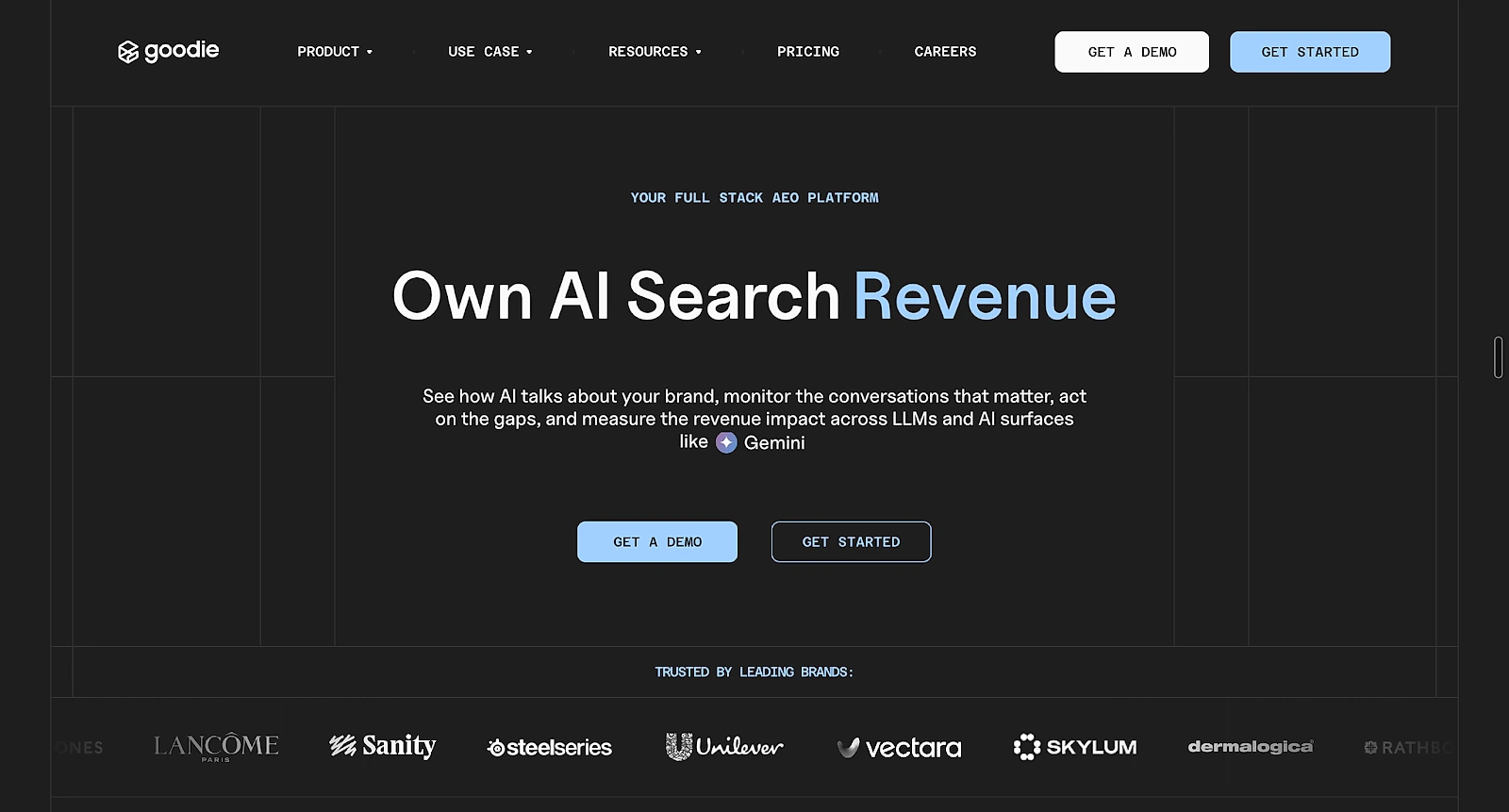
Goodie AI is an Answer Engine Optimization (AEO) platform built for businesses that want to get noticed in AI search. Think of it as more than just another AI visibility tracker.
It helps brands understand how AI search platforms like ChatGPT, Claude, Perplexity, Gemini, Copilot, Grok, and Meta AI talk about them, when they get mentioned, and which sources these AI models cite in their answers.
But here's where things get interesting.
Goodie doesn't just show you the numbers and leave you to figure everything out yourself. It also helps you spot visibility gaps, identify optimization opportunities, and take action to improve how your brand shows up in AI-generated answers.
And for enterprise teams, there's another big piece: revenue attribution. Goodie helps businesses connect AI search visibility and AI-referred traffic to business outcomes, making it easier to understand whether AI search is actually contributing to leads, conversions, and revenue.
So the idea is to bring the whole process under one roof: research what people ask LLMs, monitor how your brand appears, optimize where you're missing out, and measure the impact.
In this review, we'll look at Goodie AI's features, onboarding, pricing, pros and cons, and what users say on G2. We'll also compare it with LovedByAI, a generative engine optimization platform for small businesses on WordPress, to help you decide which tool fits your needs.
Goodie AI features: what the platform does
1. Goodie AI Prompt Research
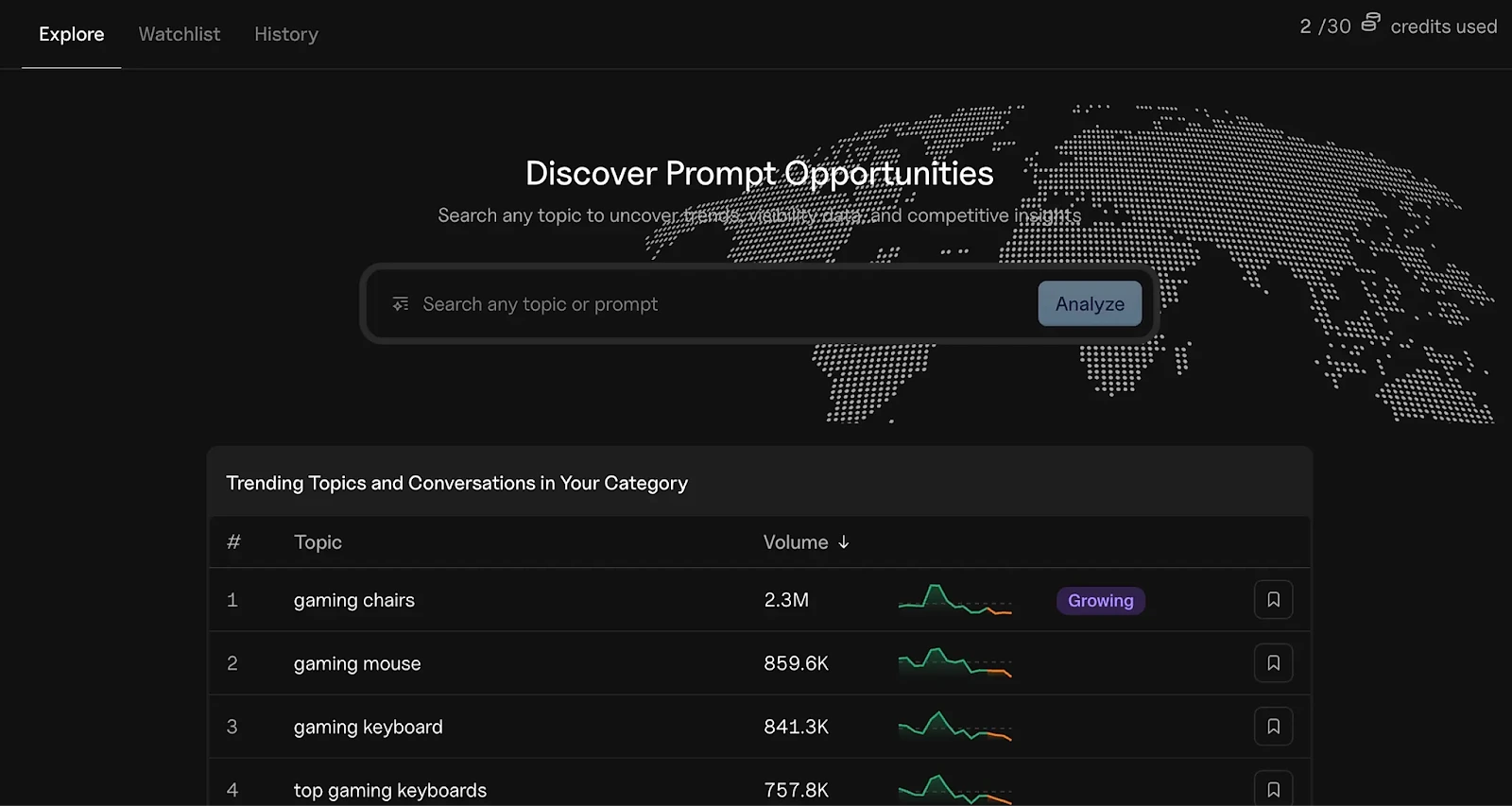
Goodie's Prompt Research feature helps businesses understand what potential customers actually ask AI assistants, rather than relying only on traditional keyword research.
The platform analyzes conversational queries across AI platforms, identifies related prompts, and groups them into topic clusters. It also looks at conversation volume, search intent, seasonality, and competitive opportunities to help teams decide which topics deserve attention first.
For example, a CRM company might want to track questions like "What's the best CRM for a small sales team?" or "HubSpot alternatives for startups?" Goodie's approach is to uncover these conversational opportunities and identify prompts where competitors appear but the brand is missing.
Goodie says Prompt Research covers 12 LLMs, multiple languages, and geographic markets. Its FAQ states that prompt data is collected and updated monthly.
2. Goodie AI visibility monitoring
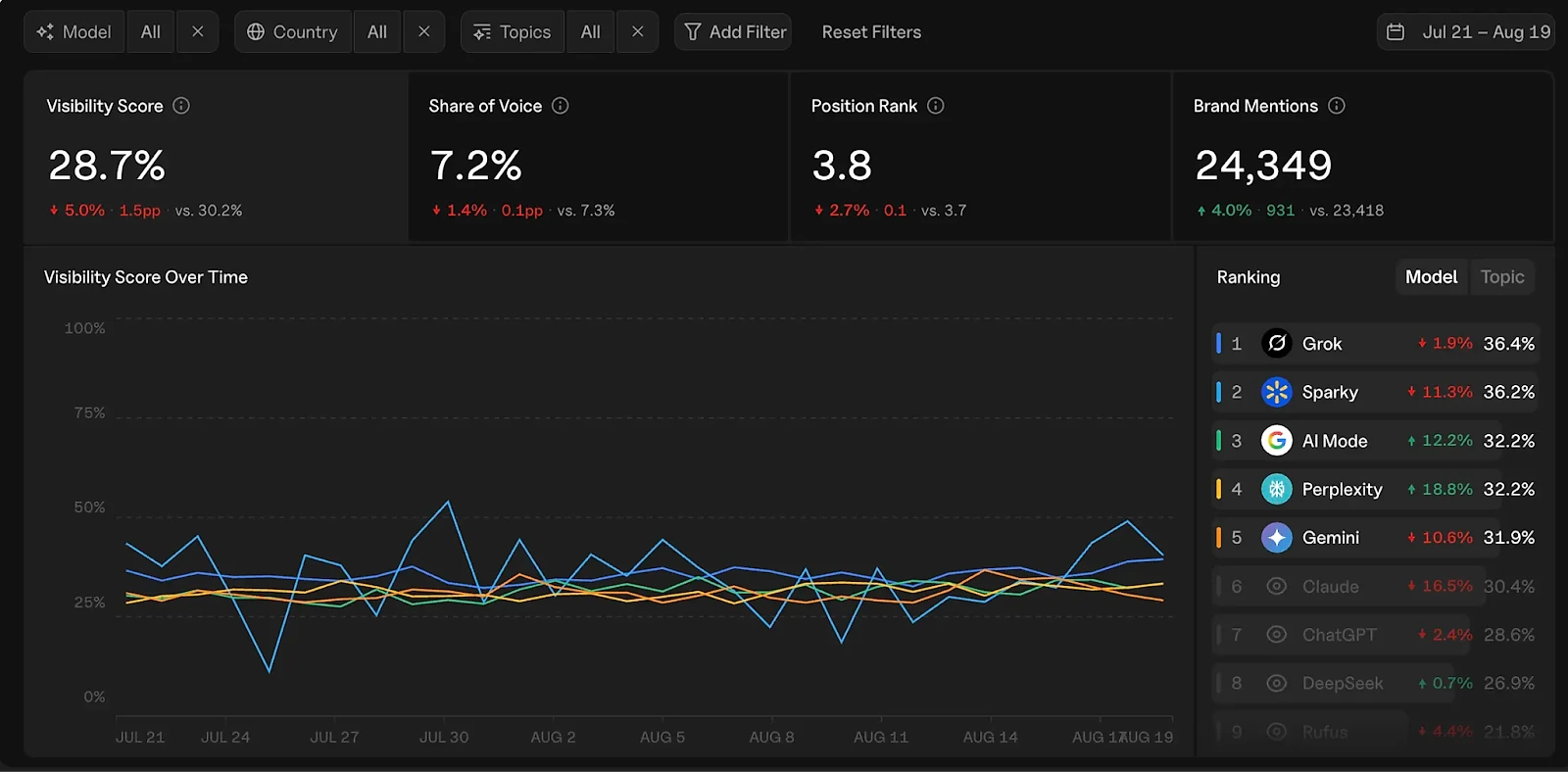
This is the feature that helps you understand how AI platforms actually talk about your brand.
Goodie's AI visibility monitoring tracks brand mentions, ranking positions, sentiment, citations, and competitive share of voice across supported AI platforms. It also shows which domains AI systems cite and how your brand compares with direct and indirect competitors.
You can segment results by geography, language, persona, model, and topic category. That makes it easier to understand whether your brand performs well in one market but struggles in another.
The platform also tracks historical trends and changes in visibility. So, instead of checking a dashboard once and forgetting about it, your team can investigate sudden drops in mentions, changes in sentiment, or competitors gaining ground. Goodie says visibility data is tracked daily, on every plan.
3. Goodie AI Optimization Actions
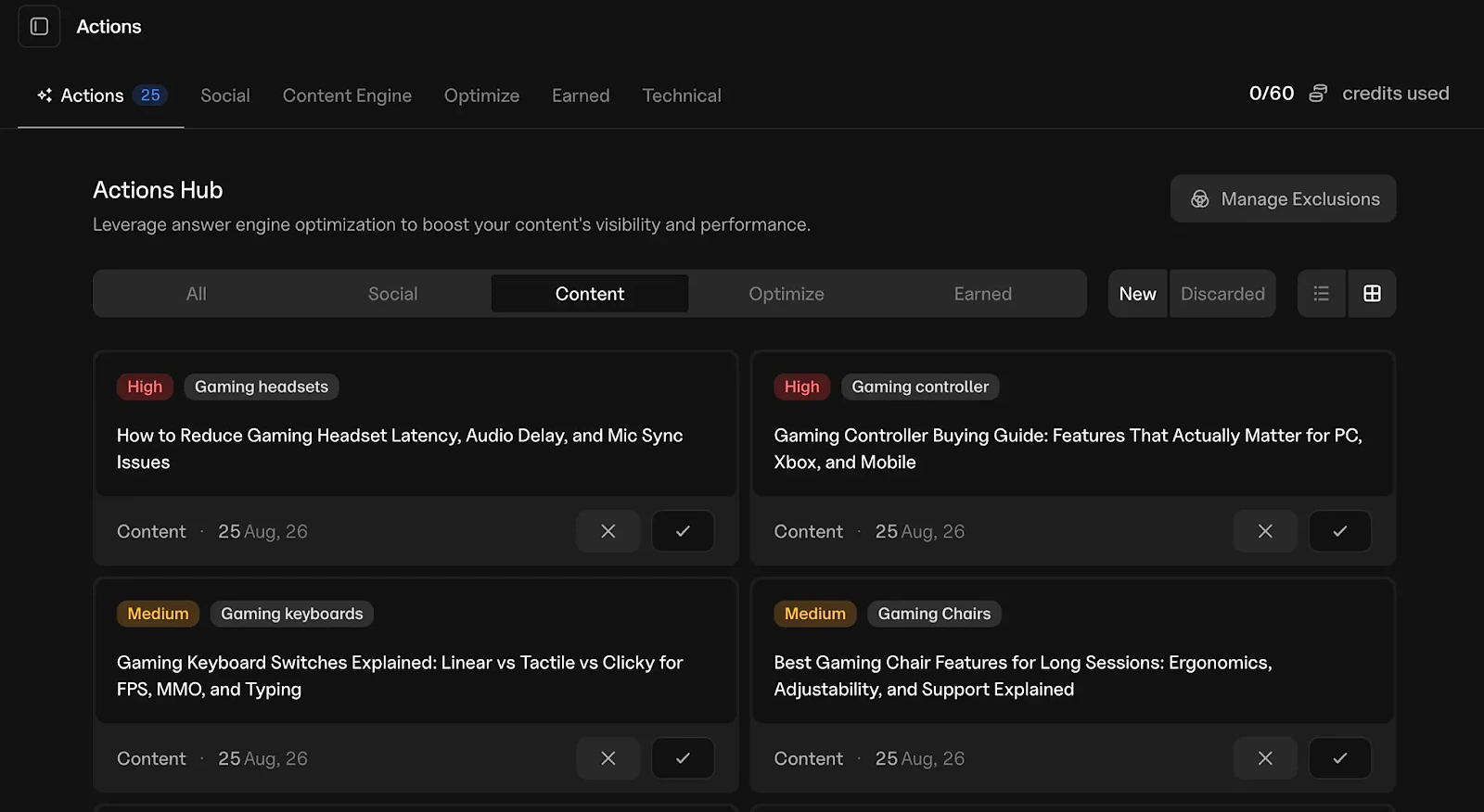
Here's where Goodie moves beyond showing you charts and reports.
Its Optimization Actions feature turns AI visibility gaps into a prioritized list of recommendations. It compares your owned content with the sources LLM platforms cite, then identifies missing topic coverage, weak authority signals, unclear entity definitions, missing schema markup, and technical problems.
The recommendations cover several areas:
- Content optimization: Improve topic coverage, strengthen author credentials, clarify entities, and add relevant source citations.
- Technical SEO: Address crawl errors, page speed, structured data, and robots.txt issues.
- Earned media: Identify relevant publications and journalists for outreach opportunities.
- Social optimization: Improve profile completeness, entity clarity, and credential signals.
Each recommendation includes information such as difficulty, estimated implementation time, and projected visibility impact. Goodie also lets teams filter actions by type, effort, impact, and affected prompt clusters. Owned-content changes can be implemented through the platform, while external outreach requires additional work.
4. Goodie AI Content Studio
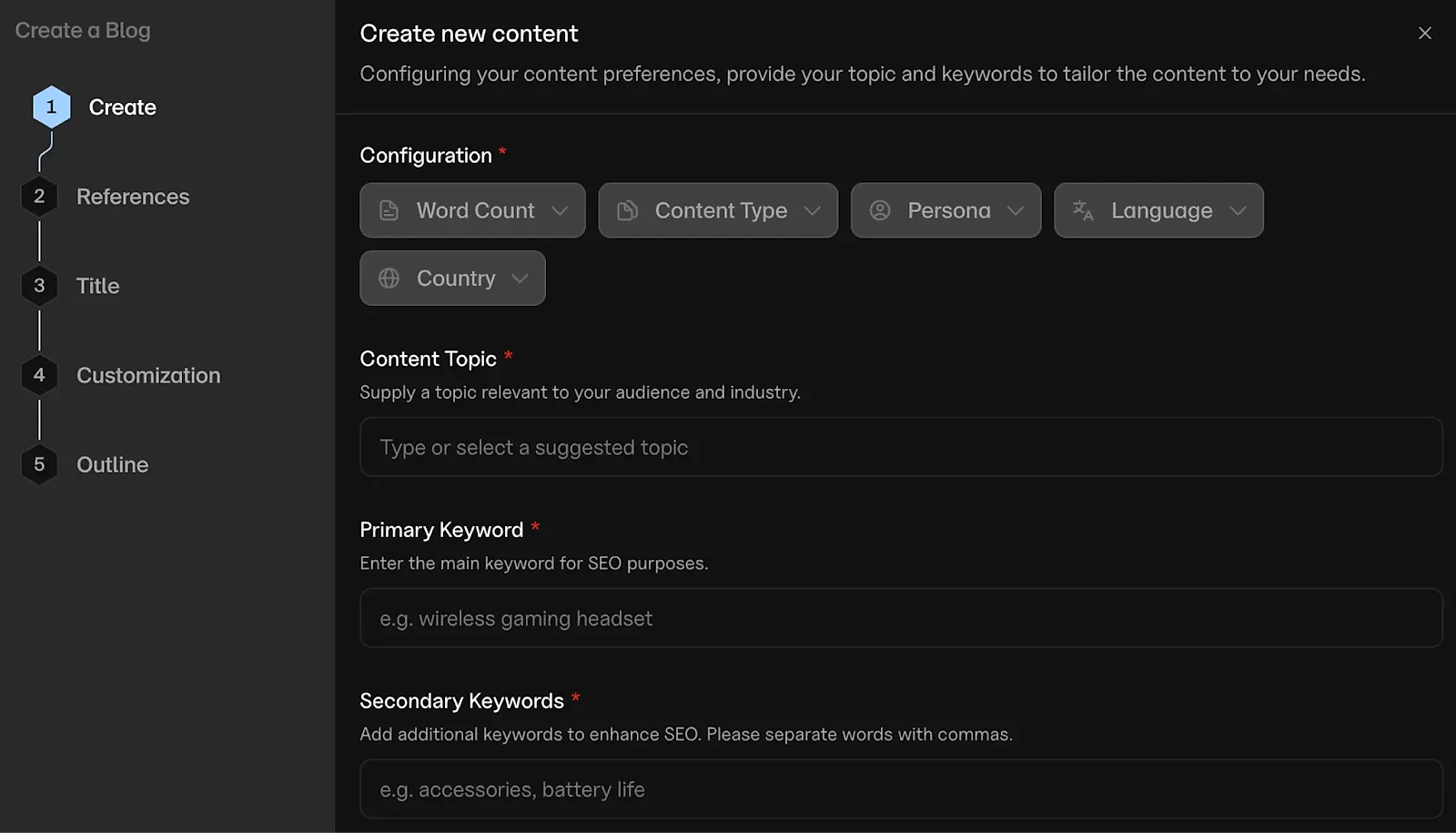
Goodie's Content Studio is built to help businesses create content that people find useful and AI systems can more easily understand and cite.
Instead of generating generic articles from a prompt alone, the platform analyzes your existing content, brand positioning, editorial tone, and competitive gaps. It then helps create structured, question-driven content with clear entity definitions, source citations, author credentials, and recommendations for schema markup.
You can adjust tone, technical depth, target audience, and editorial guidelines to keep the content aligned with your brand. Once a draft is ready, you can review and refine it inside Goodie, then publish directly or export it for your CMS workflow.
This can be useful for enterprise content teams that need to cover multiple topics at scale without losing consistency. As always, generated content should be checked for factual accuracy, originality, and editorial quality before publication.
5. Goodie AI Brand Command
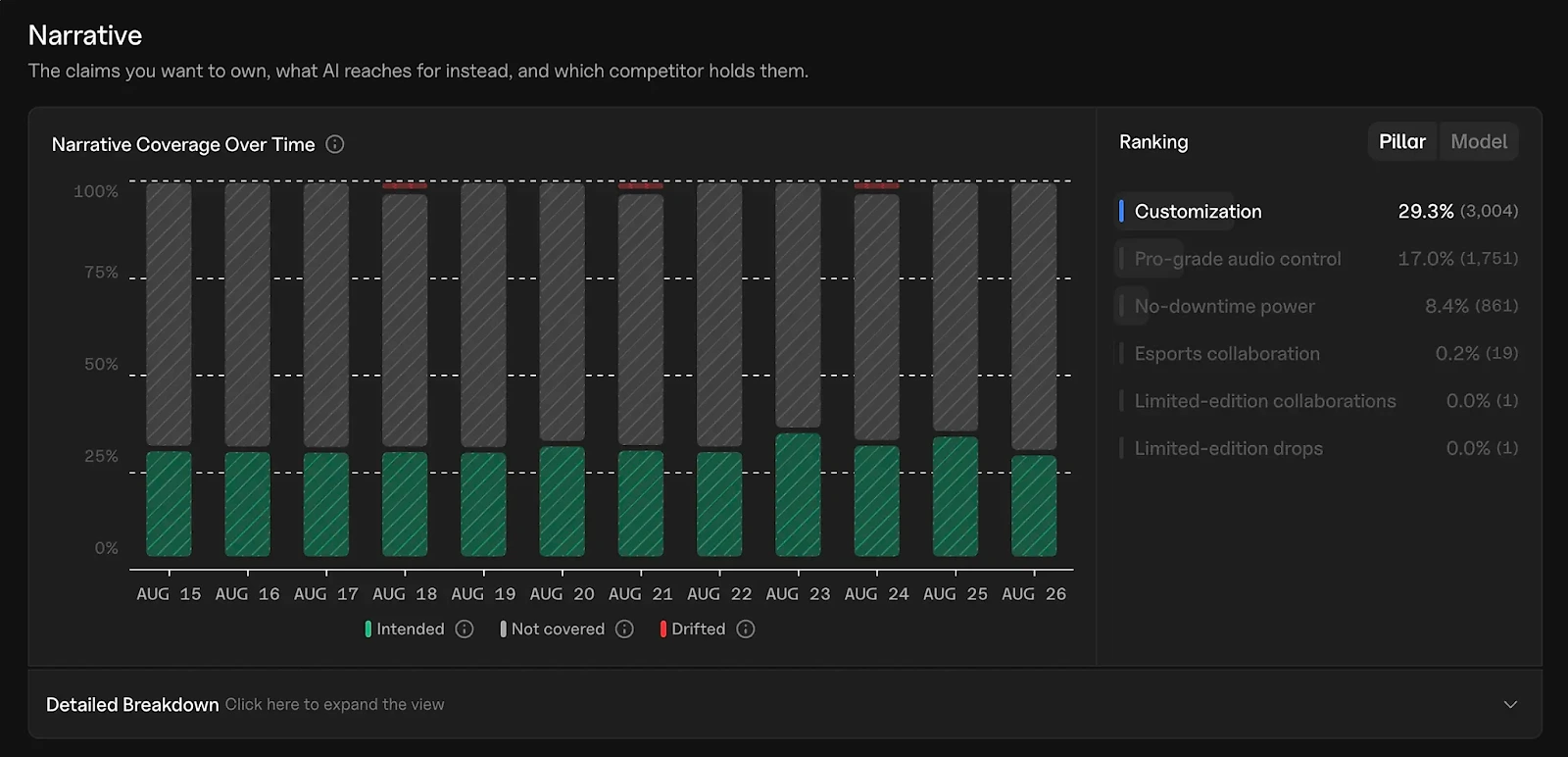
Brand Command focuses on a problem that basic AI visibility tracking may miss: what happens when AI gets your brand wrong?
A brand might appear in an AI answer but be described inaccurately, associated with outdated information, or overlooked in favor of a competitor. Counting mentions alone doesn't tell you whether AI systems are representing your business correctly.
Goodie lets teams establish an approved brand narrative using their website and other documents. It then compares AI-generated claims against those approved facts, flags inaccuracies, and identifies instances where another brand receives the recommendation instead. Findings are ranked by priority and can be routed into Optimization Actions for follow-up.
For businesses in industries where accuracy and trust matter, this provides an additional layer of AI brand reputation management. It helps teams understand not only whether AI mentions them, but also whether it communicates the right information.
6. Goodie AI Agentic Commerce Suite
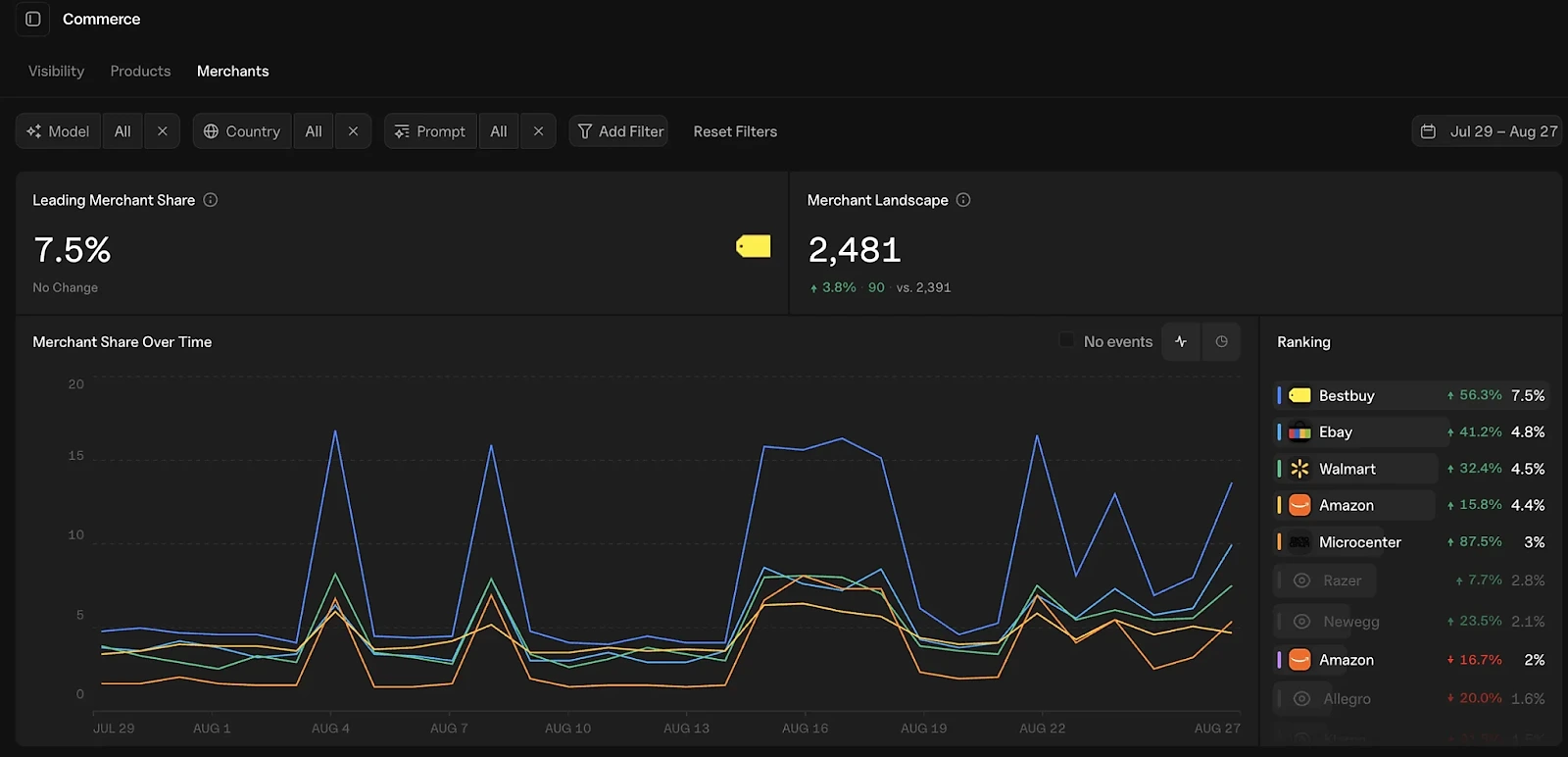
If you're running an ecommerce business, this is one of Goodie's more specialized features.
The Agentic Commerce Suite tracks how individual products appear across AI shopping experiences, including ChatGPT Shopping, Amazon Rufus, Perplexity Shopping, and Google AI Mode Shopping. Instead of monitoring only overall brand mentions, it provides product-level visibility at the SKU level.
You can examine which products get mentioned, where they appear in product comparisons, which competing products are recommended alongside yours, and whether AI-generated answers accurately represent your prices.
Goodie also offers product optimization workflows, including feed remediation, product copy and FAQ generation, schema injection, and image optimization. Its analytics can connect AI shopping impressions and referrals with assisted carts, checkouts, and product-level revenue reporting.
This makes the feature particularly relevant for retailers that want to understand whether AI shopping assistants are recommending their products and where product information needs improvement.
7. Goodie AI Agent Analytics
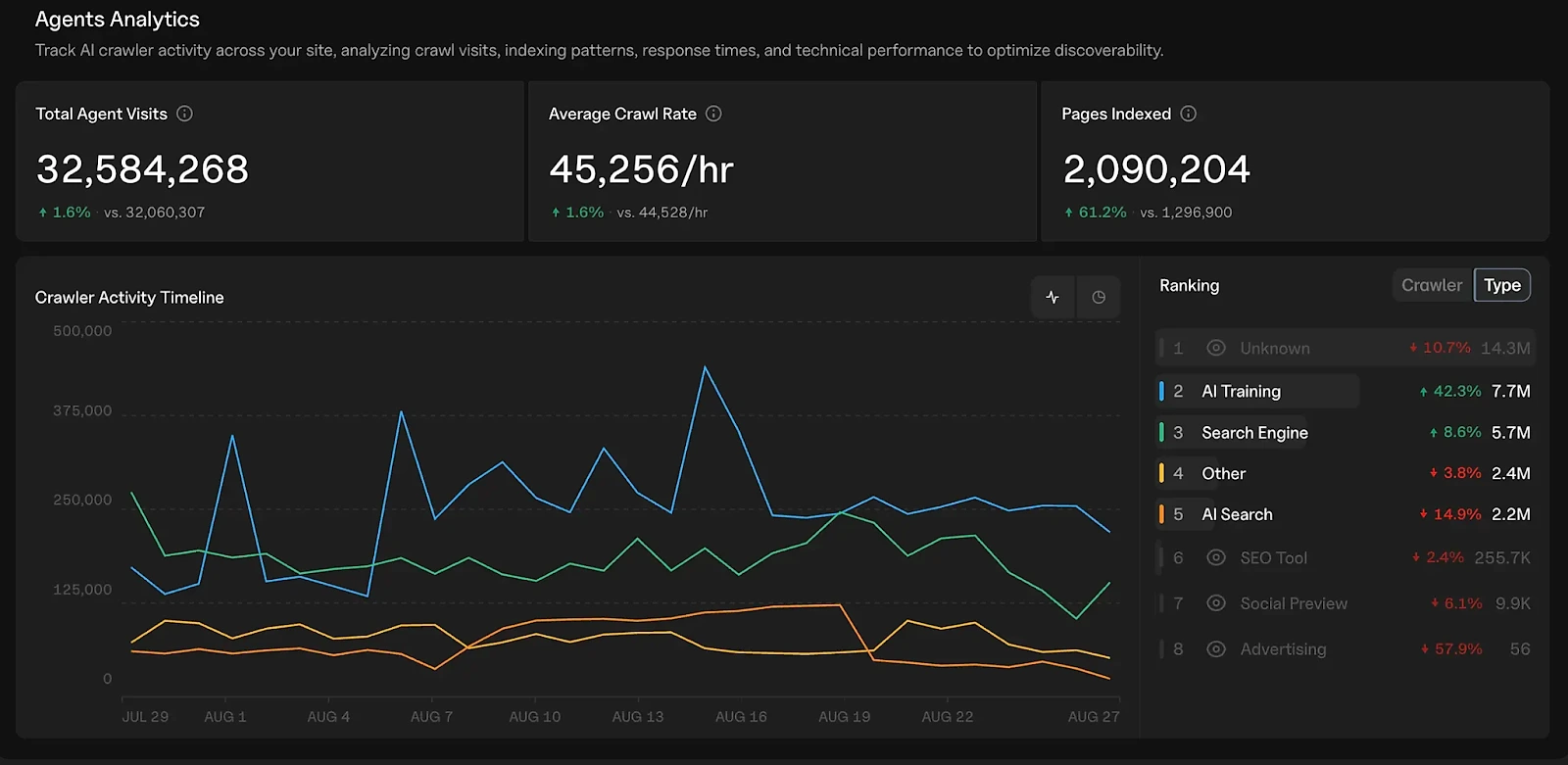
Getting mentioned by AI is one thing. Making sure AI crawlers can access and interpret your website is another.
Goodie's AI Agent Analytics monitors AI crawler activity and helps identify technical barriers that may prevent AI systems from accessing or parsing website content. Its coverage includes crawlers such as GPTBot, ClaudeBot, Google-Extended, Perplexity's crawlers, and Meta AI's crawlers.
The platform examines areas such as:
- Crawler access and robots.txt rules
- Server configuration and access logs
- Schema markup and structured data
- Page speed and mobile rendering
- Content structure and crawlability
It then recommends technical improvements, which can include schema additions, crawler access adjustments, llms.txt generation, and rendering fixes. Teams can monitor crawler behavior afterward to check whether the changes had the intended effect.
One important distinction: allowing a crawler to access your content does not guarantee that an AI system will cite or recommend your brand. The feature helps address technical accessibility, which is one part of a broader AEO strategy. For the wider picture, see our AI crawler statistics.
8. Goodie AI analytics and revenue attribution
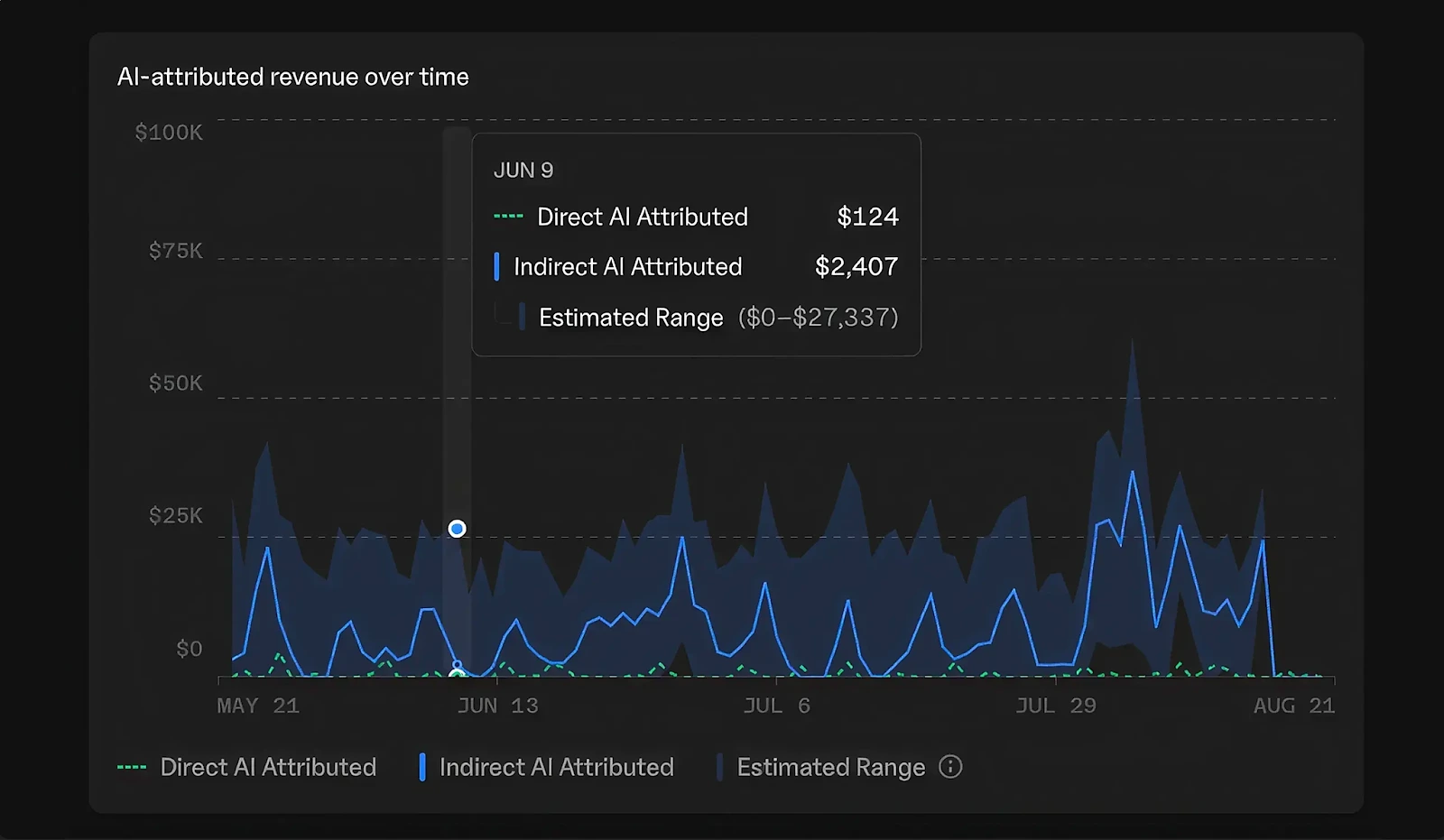
One of Goodie's central selling points is its focus on measuring the business impact of AI search, not just visibility metrics.
Analytics & Attribution connects AI-referred traffic from platforms such as ChatGPT, Claude, and Gemini with conversion and revenue data. It helps teams investigate which AI platforms, content categories, and customer segments generate valuable visits and conversions.
Goodie describes two distinct types of measurement:
- Attributed revenue: Revenue associated with identifiable AI-referred traffic and its subsequent conversion journey.
- Influenced revenue: Estimated business impact from AI search discovery that may not generate a directly measurable referral click.
The platform also helps teams compare performance before and after optimization work, segment results by geography and content theme, and investigate which changes appear to have the strongest impact.
There is an important caveat here. Directly observed referral conversions and estimated zero-click influence are not the same thing. Influenced revenue depends on the methodology and assumptions used, so businesses should understand how it is calculated before using it to justify marketing spend.
9. Goodie MCP
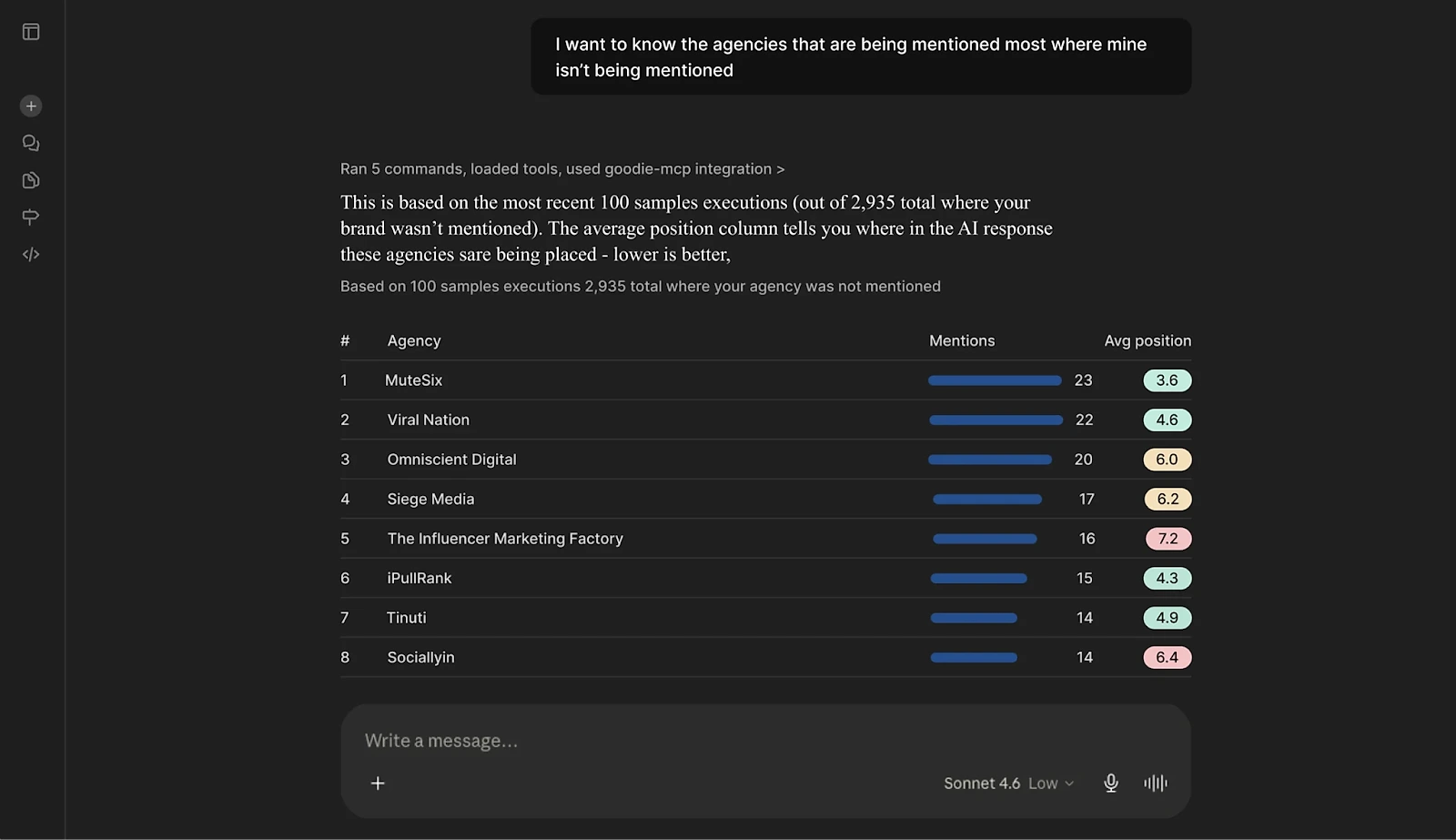
Last but not least, Goodie offers MCP integration, which connects its data with compatible AI assistants and development tools.
MCP stands for Model Context Protocol. In practical terms, it lets users query Goodie's data through supported tools such as Claude, ChatGPT, and Cursor rather than constantly switching between dashboards or exporting reports.
For example, a team member could ask:
- Which competitors are receiving more citations for our target prompts?
- How has our AI visibility changed this week?
- Which optimization actions should we prioritize?
- Which AI platforms are sending us referral traffic?
Goodie MCP can provide access to visibility data, prompt research, crawler insights, optimization actions, and attribution through a single connection. Goodie says setup takes under five minutes, and every connection uses OAuth. The MCP integration is designed for data lookup and reporting, while recommended changes are implemented within Goodie itself.
My take on Goodie AI's features
Goodie's biggest differentiator is how its features connect. Prompt Research identifies opportunities, visibility monitoring measures performance, Optimization Actions turns gaps into tasks, Content Studio supports content creation, and Analytics & Attribution helps teams assess business outcomes.
Brand Command adds a layer for brand accuracy, Agentic Commerce Suite extends the workflow to individual products, and AI Agent Analytics covers technical accessibility. Goodie MCP makes its data available through compatible AI tools.
That's a broader proposition than simply tracking AI mentions. The main question for buyers is whether they need this entire workflow, including enterprise reporting and optimization support, or whether a more focused and affordable AI search optimization tool would be enough.
Goodie AI use cases by industry
Goodie AI serves businesses across several industries, from enterprise marketing teams to ecommerce brands, SaaS companies, and regulated industries. Its use cases focus on helping organizations improve AI search visibility, strengthen brand authority, identify optimization opportunities, and understand how AI-driven discovery affects their business.
Here's a quick breakdown of Goodie's main use cases.
| Use case | What Goodie AI helps with | Best for |
|---|---|---|
| Enterprise | Scales AI visibility monitoring and optimization across thousands of pages, multiple brands, markets, and languages, with security controls and revenue reporting. | Large organizations and global brands |
| Media & Publishers | Tracks AI citations of editorial content, identifies citation gaps, protects publisher authority, and measures AI-driven traffic and attribution. | News publishers, media companies, and digital publications |
| Agencies | Manages multiple client accounts, supports branded reporting, and streamlines optimization workflows. | Agencies running AEO for clients |
| Commerce & Retail | Tracks product visibility across AI shopping platforms, monitors competitor recommendations and pricing accuracy, and identifies SKU-level optimization opportunities. | Ecommerce businesses, retailers, and product brands |
| Healthcare | Monitors how AI describes providers, facilities, and treatments, identifies visibility gaps, and helps improve the accuracy of public-facing information. | Hospitals, healthcare networks, and healthcare brands |
| Pharma | Monitors AI-generated claims about drugs, indications, safety profiles, and clinical data, helping teams identify inaccuracies and competitive gaps. | Pharmaceutical companies and medical affairs teams |
| Travel & Hospitality | Tracks how AI recommends hotels, destinations, and travel experiences, with property-level visibility, competitive monitoring, and booking attribution. | Hotel groups, travel brands, and hospitality businesses |
| Fintech | Monitors AI-generated descriptions of financial products and identifies opportunities to strengthen accurate, credible financial information. | Fintech companies and financial services brands |
| SaaS | Tracks how AI compares software vendors, identifies high-intent buyer prompts, improves documentation visibility, and connects AI search to demos, trials, and pipeline. | B2B SaaS companies and software vendors |
Goodie's industry-specific offerings combine AI visibility monitoring, prompt research, and optimization workflows, with additional capabilities depending on the use case. Commerce focuses heavily on product discovery, while regulated industries place greater emphasis on accurate information and brand representation.
How does Goodie AI work? The Goodie AI onboarding process
First, head over to Goodie's official website and sign up to get started.
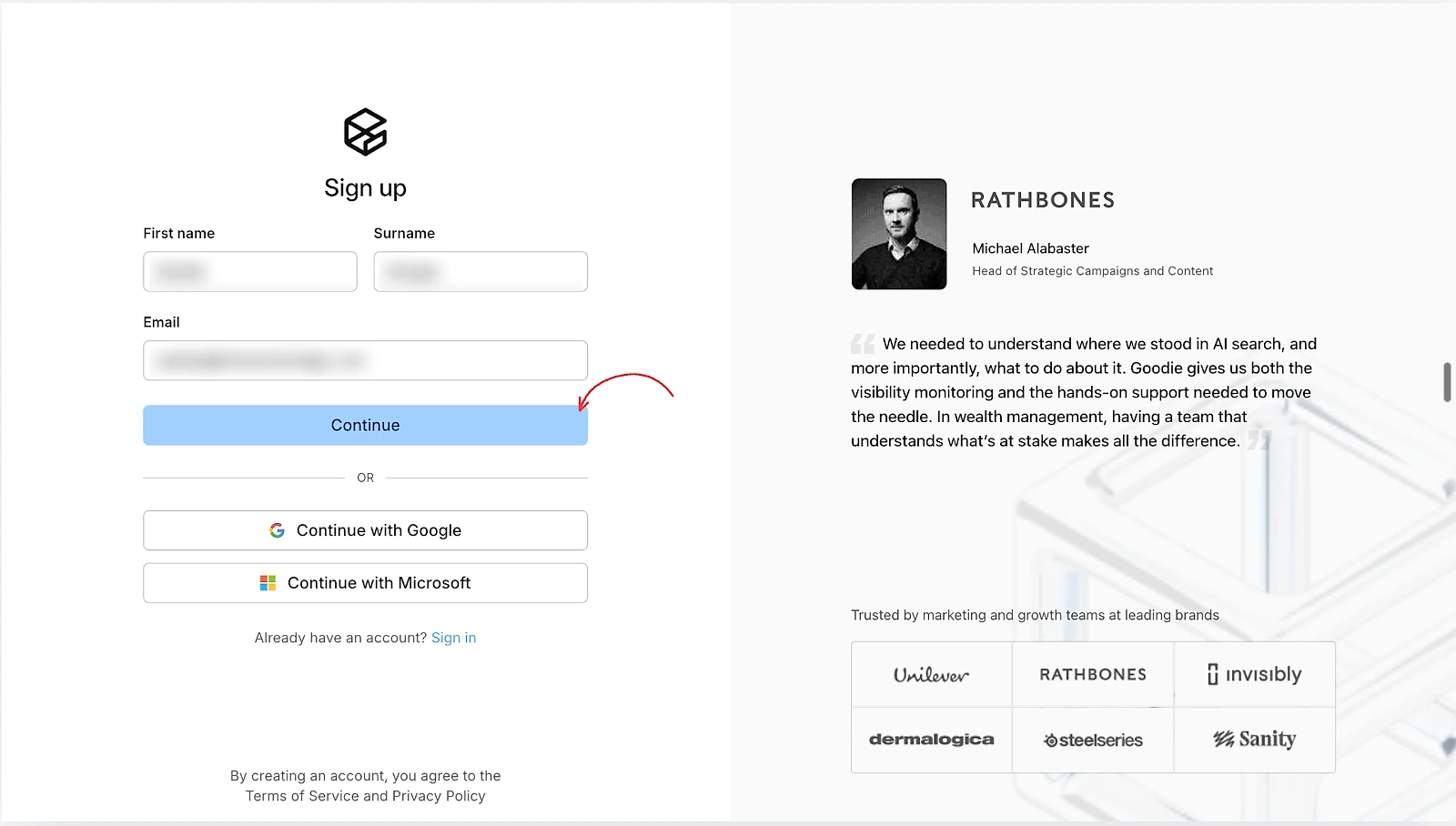
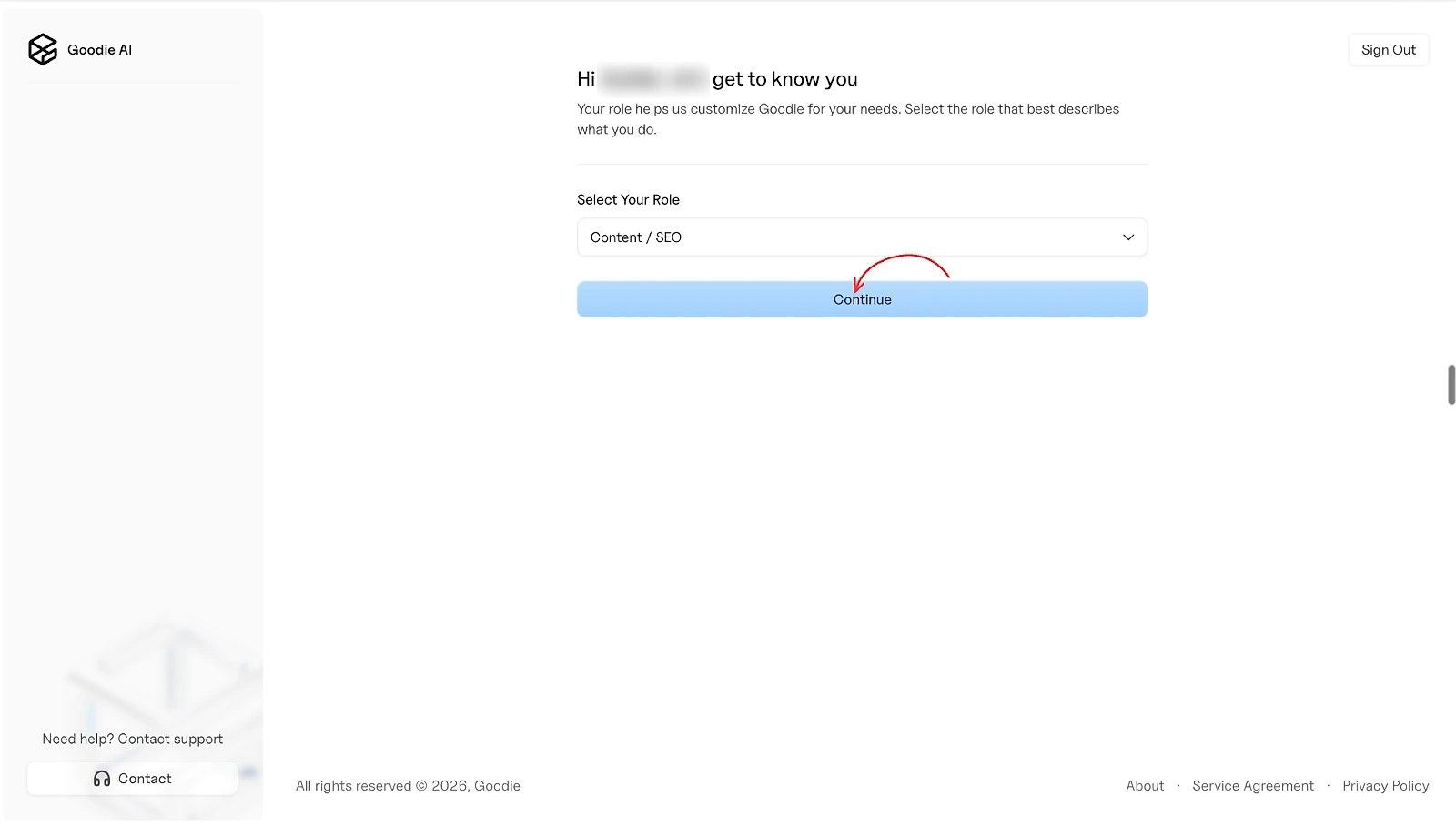
Step 1: Select your role
Once you sign up, Goodie asks you to select your role. Choose the option that best describes your work and hit Continue.
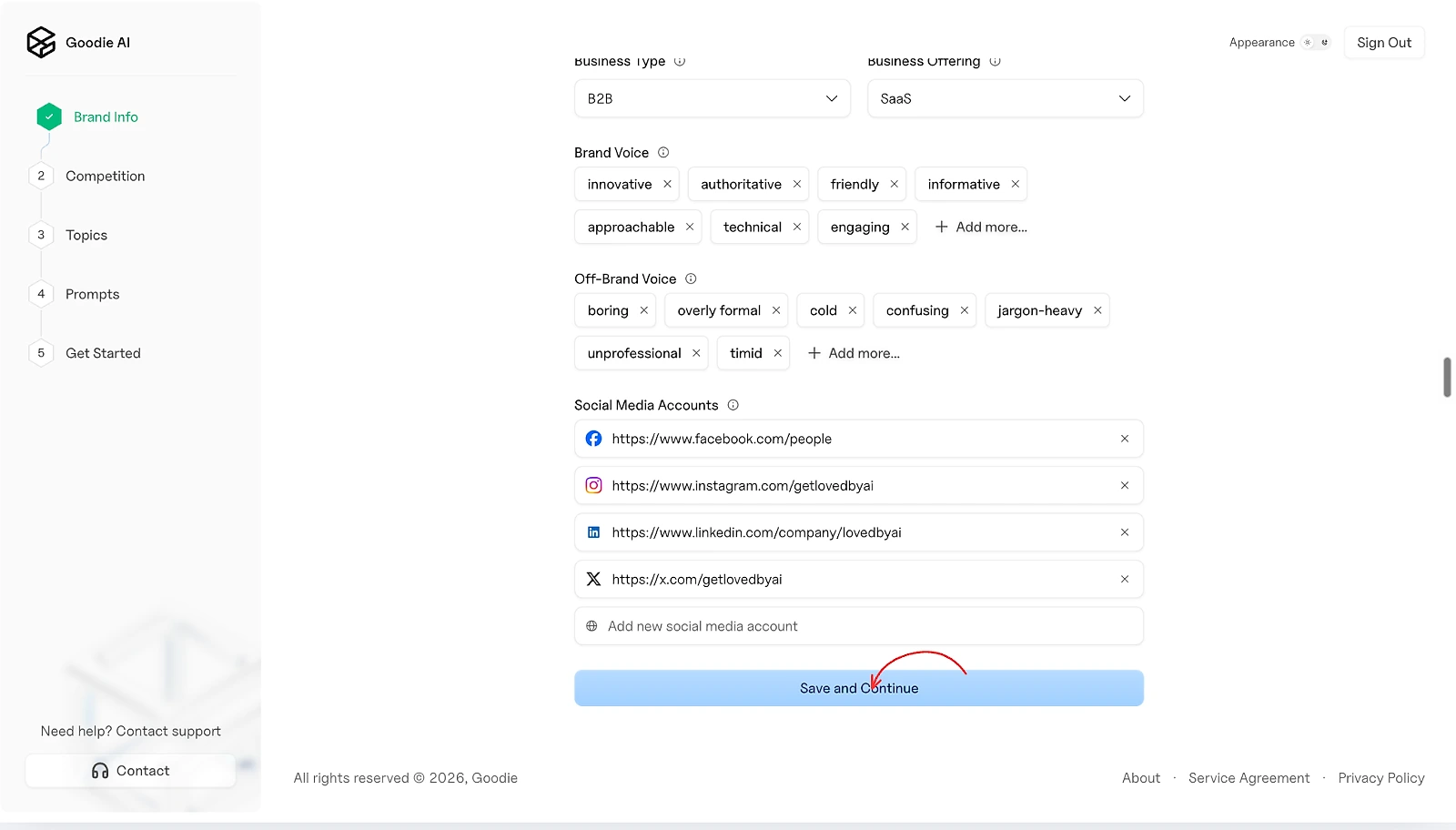
Step 2: Add your brand information
Next, Goodie takes you to the brand information step, where some details are already populated automatically, such as business type, brand voice, and social media accounts. Review the information and edit anything that needs changing so it accurately represents your business.
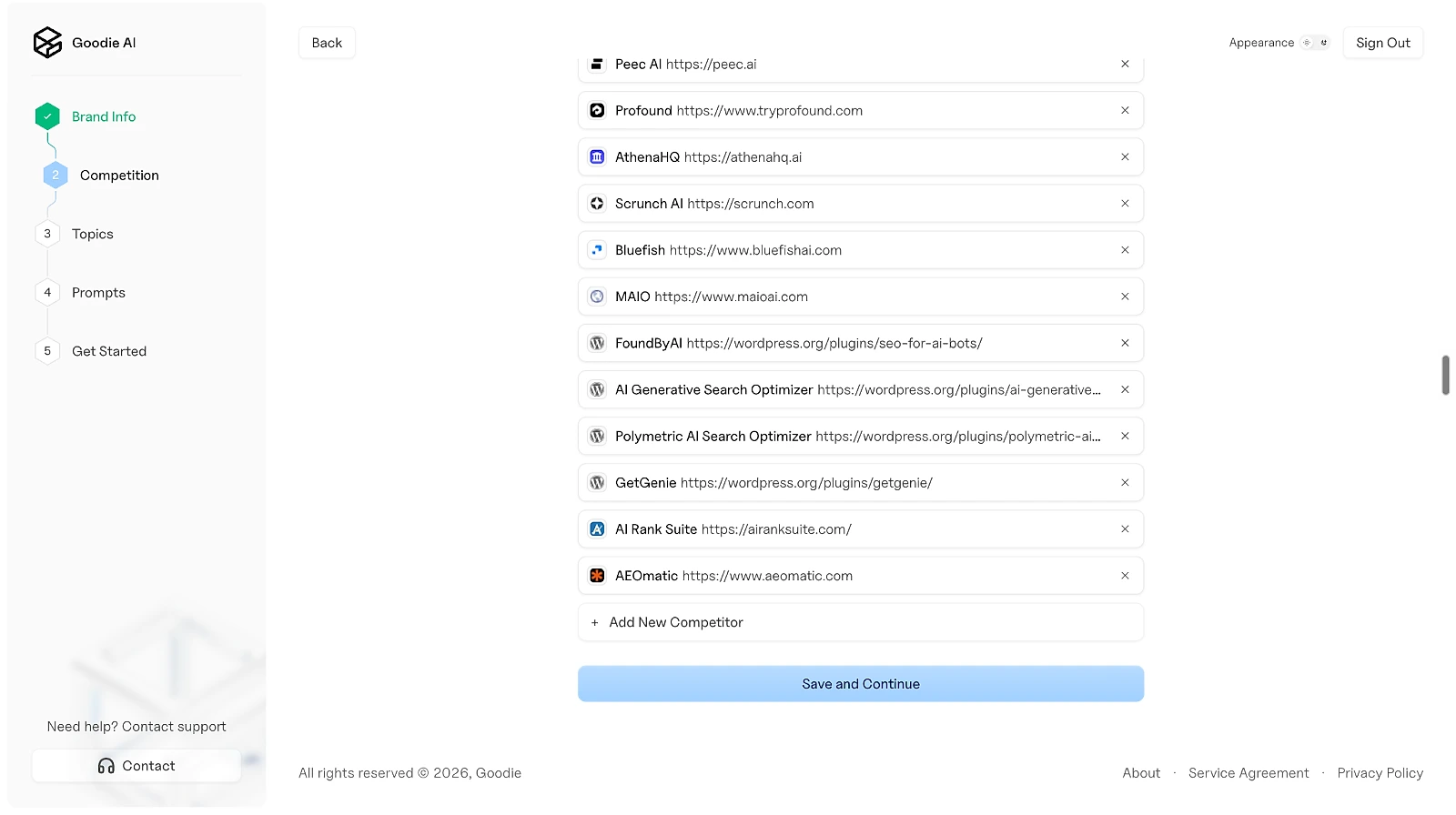
Step 3: Add your competitors
Now, add the competitors you want to track. This helps Goodie understand your competitive landscape and compare how your brand appears across AI search results.
Review the suggested competitors, make any necessary changes, and continue.
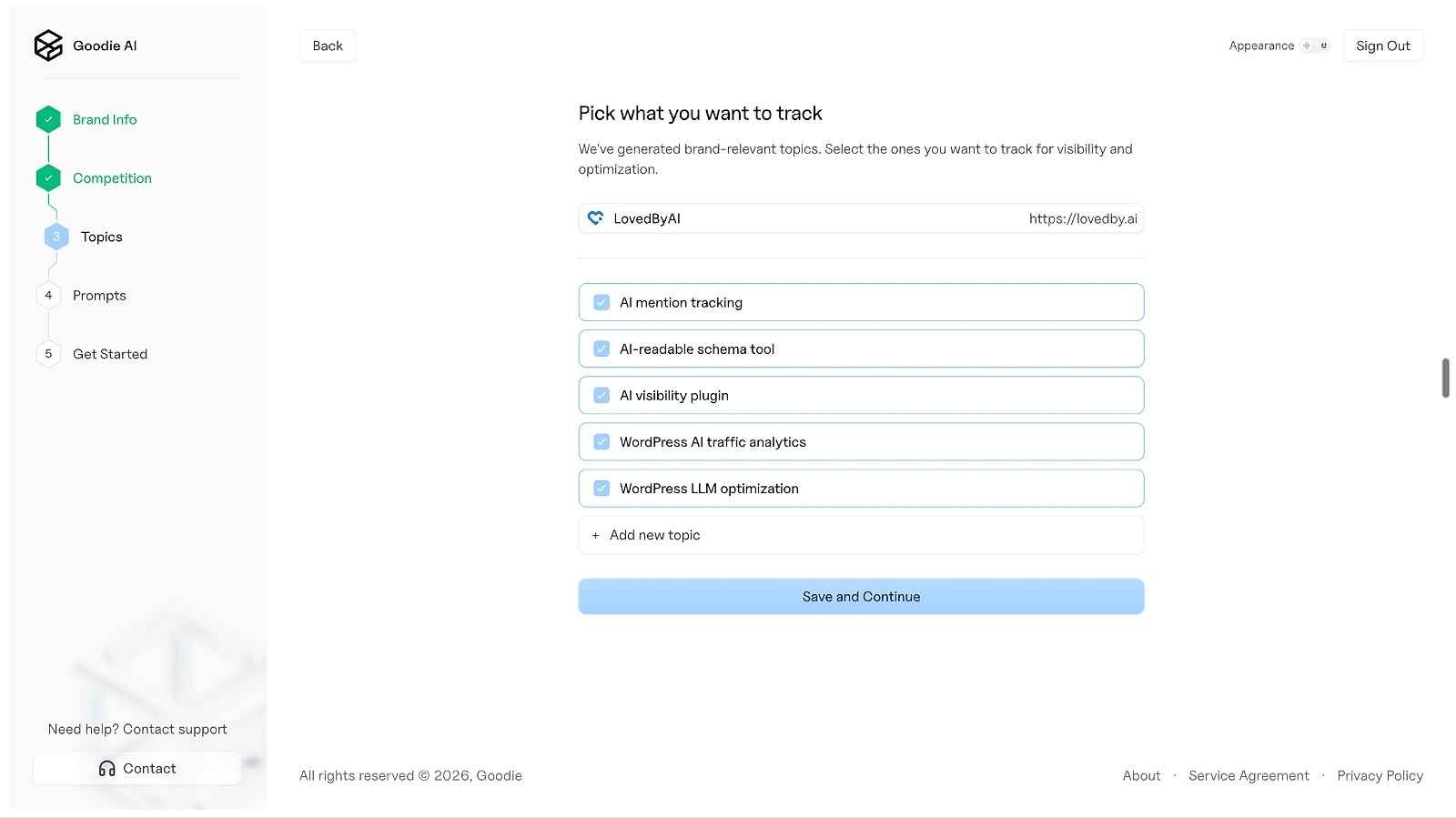
Step 4: Select your topics
Next up, choose the topics that matter most to your business. These help Goodie identify the subject areas and search conversations relevant to your brand.
Try to focus on topics that align with your products, services, and target audience.
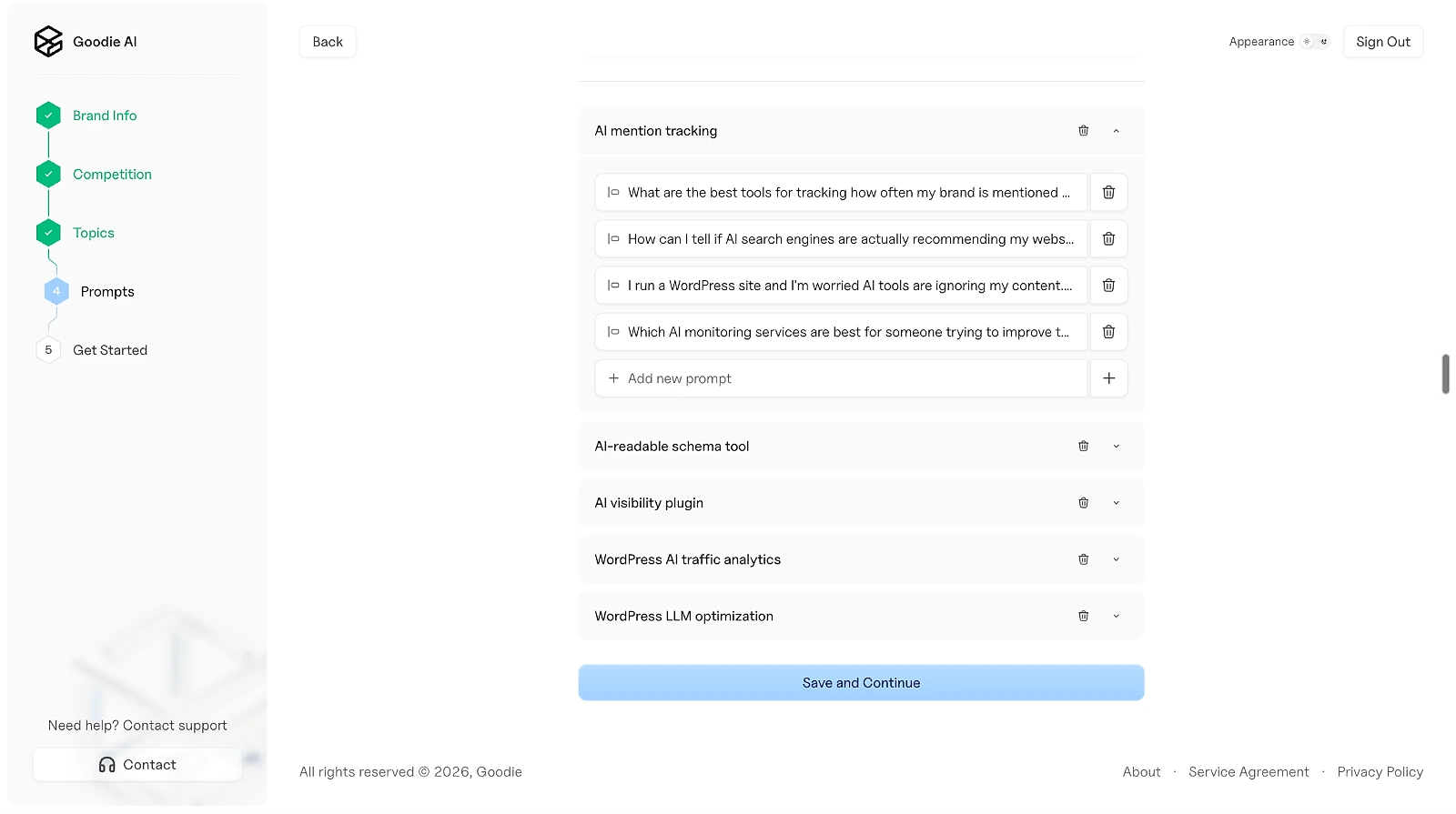
Step 5: Generate your AI search prompts
Once you've selected your topics, Goodie starts generating prompts related to your business. These are the questions and queries you can use to monitor how AI platforms mention your brand and recommend your products or services.
You can also add more prompts manually if you want to track specific questions that matter to your business.
Step 6: Choose a Goodie AI pricing plan
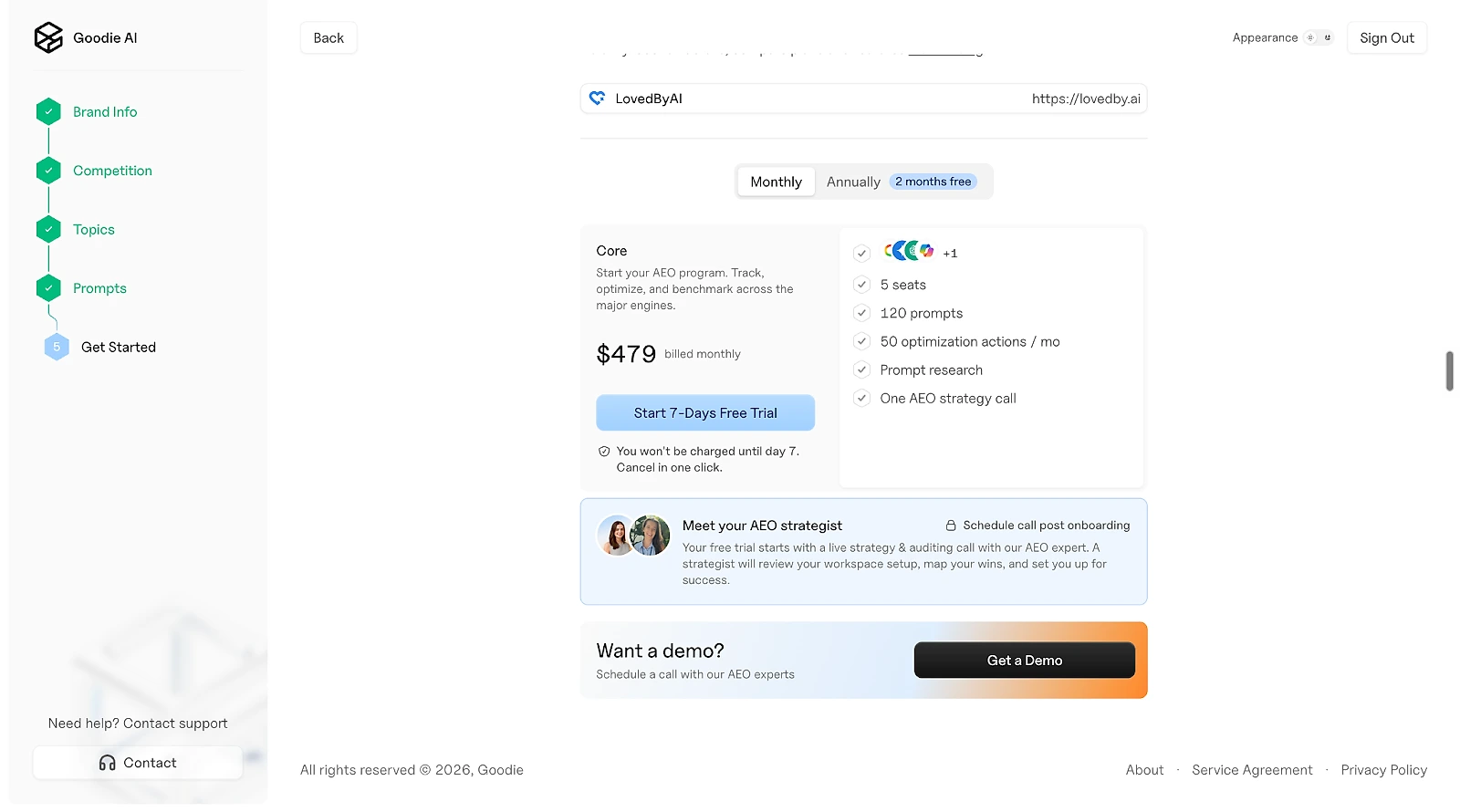
Once you've completed the initial setup, you'll need to choose a subscription plan to continue. Goodie offers monthly and annual billing options, with different limits for tracked models, prompts, optimization actions, and other features.
Choose the plan that fits your team's requirements and budget before proceeding.
How much does Goodie AI cost? Goodie AI pricing in 2026
Goodie AI offers three plans, priced by how many AI models you track, how many prompts you need, and the scale of your optimization workflow. Annual billing gives two months free, which is why the prices you'll see most often ($399 and $999) are the annual rates.
| Feature | Core | Pro | Enterprise |
|---|---|---|---|
| Price, billed annually | $399/month | $999/month | Custom |
| Price, billed monthly | $478.80/month | $1,198.80/month | Custom |
| AI models tracked | 5 | 8 | Up to 13 |
| AI platforms | ChatGPT, Google AI Overviews, Perplexity, Google AI Mode, Microsoft Copilot | Core's five plus Gemini, Alexa and Sparky (Walmart's assistant) | Adds Claude, Meta AI, DeepSeek and Grok |
| Prompts tracked | 120 | 250 | 500+ |
| Countries | 2 | 5 | 8+ |
| Languages | 2 | 5 | 8+ |
| Optimization actions/month | 50 | 100 | 100+ |
| Prompt research/month | 30 | 80 | 80+ |
| Seats | 5 | Unlimited | Unlimited |
| Revenue attribution | Included | Included | Included |
| Commerce visibility | Limited | SKU-level | SKU-level |
| Support | Email, plus a 30-minute strategist onboarding call | Email and AEO strategist support | Email, Slack, and a dedicated AEO strategist |
| Best for | Teams starting with AEO | Growing teams scaling AI search visibility | Enterprises running larger, multi-brand AEO programs |
Source: Goodie AI's official pricing page, checked 12 October 2026. Exact model availability may vary by plan.
The main difference between the plans isn't just the number of models. Higher tiers also add prompts, countries, languages, optimization actions, and team capabilities. Goodie also lists separate agency pricing for teams that manage client workspaces.
Is there a Goodie AI free trial?
Goodie AI offers a 7-day free trial on its Core plan. The trial screen says you won't be charged until day 7, so expect to add a payment method when you start it.
The trial gives you a chance to explore Goodie's AI visibility tracking, prompt research, and optimization workflows before committing to a paid subscription.
Goodie AI pros and cons
| Pros | Cons |
|---|---|
| Full-stack AEO platform: Combines prompt research, AI visibility tracking, content optimization, and performance measurement in one place. | Expensive starting price: Core costs $399/month billed annually, or $478.80 billed monthly, which may be too much for freelancers and small businesses. |
| Tracks multiple AI platforms: Monitors brand visibility across ChatGPT, Perplexity, Google AI Overviews, Microsoft Copilot and more, depending on the plan. | Limited usage on Core: 120 prompts, 50 optimization actions per month, and 5 AI models. |
| Built-in optimization workflows: Helps teams identify visibility gaps and take action instead of relying on monitoring dashboards alone. | Payment details for the trial: The 7-day trial bills on day 7 unless you cancel. |
| Revenue attribution: Helps businesses connect AI search activity with traffic, conversions, and revenue. | More than smaller teams need: Its enterprise-focused feature set may be excessive for businesses that want basic AI visibility tracking. |
| Advanced enterprise features: Multi-brand reporting, API access, and dedicated support on Enterprise. | Higher tiers cost significantly more: Pro is $999/month billed annually, and Enterprise pricing is custom. |
| Commerce-focused visibility: Pro and Enterprise track product visibility across AI shopping experiences. | Features vary by plan: Models, prompt volumes, integrations, and optimization capabilities depend on the tier. |
Goodie AI reviews: what users say on G2
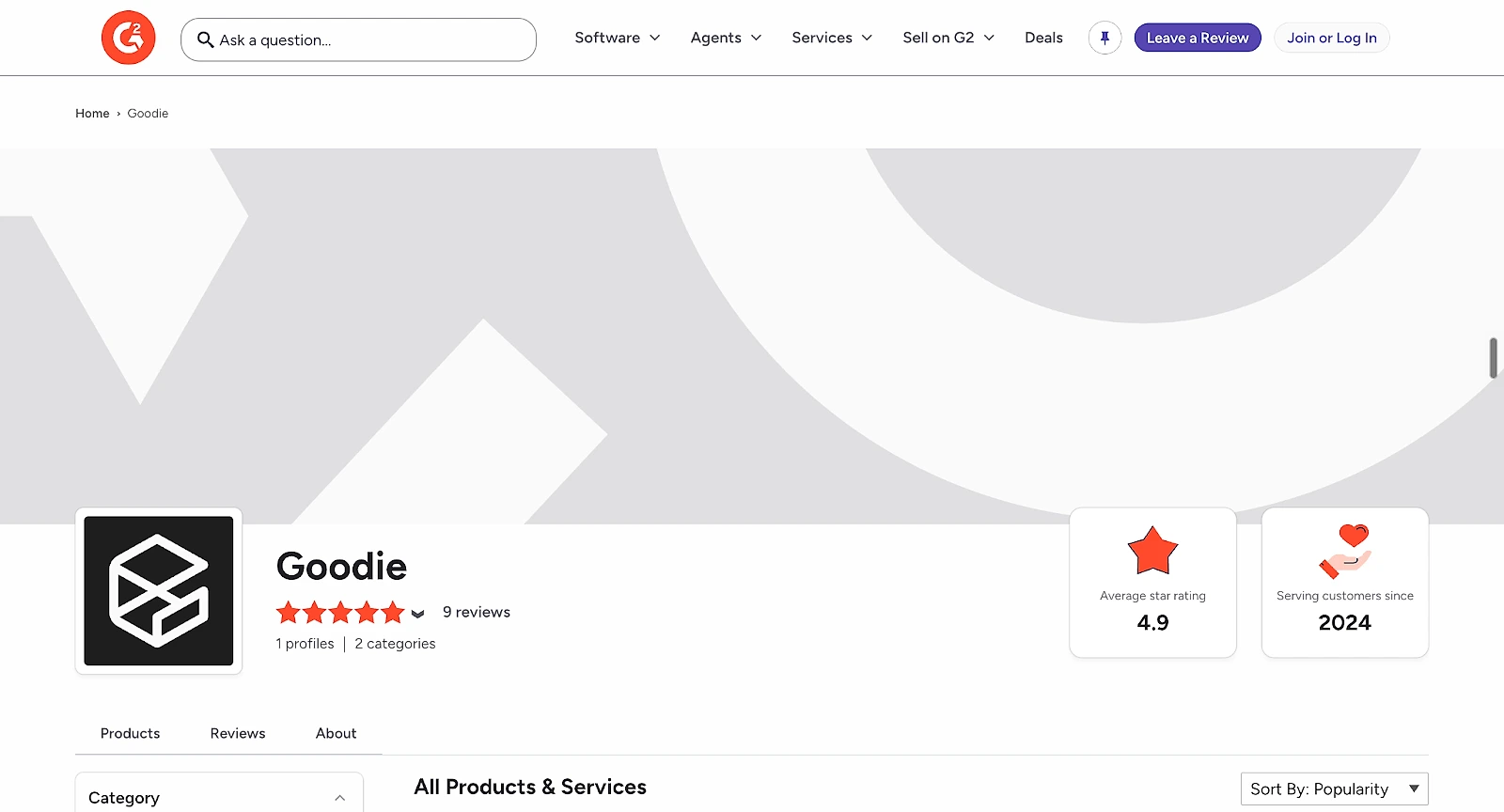
Goodie AI has a 4.9 out of 5 rating on G2, based on 9 reviews when we checked on 12 October 2026. (Source)
Users praise the platform for its in-depth data, AI visibility insights, agentic optimization features, and customer onboarding. One reviewer highlighted how Goodie combines analytics with actionable recommendations to improve AI search visibility. Another appreciated its ability to work with complex data sources.
The main drawback mentioned is pricing, which one reviewer noted is high compared with some competitors.
Overall, early G2 feedback is positive, particularly for businesses looking for a comprehensive AEO platform with hands-on support. With only 9 reviews, though, the rating reflects a small sample of customer experiences.
Is Goodie AI worth it?
Goodie AI is worth considering if you're a growing brand or enterprise that needs more than basic AI visibility tracking. Its combination of prompt research, competitor benchmarking, optimization workflows, and revenue attribution makes it a comprehensive AEO platform.
However, with plans starting at $399/month billed annually, it may be overkill for small businesses with limited budgets. If you need enterprise-level insights, Goodie is worth exploring. If affordability and simple, automated optimization matter more, a lighter tool may be a better fit.
Goodie AI vs LovedByAI: which one should you choose?
Goodie AI and LovedByAI both help businesses improve their visibility in AI search, but they approach the problem differently.
Goodie AI focuses on AI visibility monitoring, research, and optimization workflows, giving marketing teams a central place to track brand mentions, benchmark competitors, and identify opportunities across AI platforms.
LovedByAI focuses on making websites easier for AI systems to read and understand, while also tracking AI mentions and AI referral traffic. It's built for small businesses on WordPress and budget-conscious teams, rather than requiring a large AEO budget or a dedicated team to manage complex dashboards.
Here's how the two tools compare.
| Feature | Goodie AI | LovedByAI |
|---|---|---|
| Best for | Marketing teams, growing brands, and enterprises | Small businesses on WordPress and budget-conscious teams |
| Primary focus | AI visibility monitoring, insights, and optimization workflows | Making website content easier for AI systems to read, understand, and cite |
| How it works | Dashboards, competitor benchmarking, prompt research, and optimization actions | A WordPress plugin that generates an AI-readable version of your pages and tracks AI mentions and referral traffic |
| AI visibility tracking | Brand mentions, citations, sentiment, and competitors across supported AI platforms | AI mentions and AI visitors |
| Optimization | Optimization agents and workflows for content, technical SEO, and other activities | Automates structure, schema, FAQs, and AI-readable content formatting |
| Implementation | Teams use recommendations and platform workflows to make improvements | Works automatically after setup, with no developer needed for routine optimization |
| Revenue measurement | Revenue attribution on every plan, with capabilities varying by tier | AI mention and AI referral traffic reporting |
| Pricing | Core $399/month billed annually; Pro $999/month | Free homepage scan and optimization; Pro from $29/month billed annually |
| Free access | 7-day free trial on Core | Free homepage optimization, no credit card required |
| Best reason to choose it | You need a comprehensive AEO platform with enterprise reporting, benchmarking, and revenue attribution | You want an affordable, hands-off way to improve AI discoverability without managing a complex AEO dashboard |
Goodie AI vs LovedByAI: what's the main difference?
The biggest difference comes down to what you want the tool to do for you.
Goodie AI is a strong option if you have a marketing team that needs to monitor AI search performance, research prompts, benchmark competitors, and connect optimization efforts to revenue. It's built for businesses that want a broader AEO workflow in one platform.
LovedByAI takes a more hands-off, budget-friendly approach. Instead of making you spend time interpreting dashboards and implementing recommendations, it improves how AI systems read your website, then helps you track mentions and referral traffic. That makes it particularly appealing to small businesses that want to get started with AI search optimization without a large software budget.
And the price difference is substantial. LovedByAI has a free option and paid plans starting at $29 per month billed annually, while Goodie's Core plan starts at $399 per month billed annually.
Choose Goodie AI if you need enterprise-level monitoring, competitive intelligence, and a broader research-to-revenue AEO platform.
Choose LovedByAI if affordability, automated website optimization, and tracking AI-driven traffic are your priorities.
Related: Goodie AI vs LovedByAI