I’d keep SEO and add AI-focused updates - not replace one with the other. Start with 1 WordPress service page: keep it accessible, put the main answer first, and check your business details.
The difference? SEO helps people find your page in search results. AI search optimization helps your content become a source for generated answers. Neither guarantees visibility. Still, in LovedByAI’s study of 108,834 pages, optimized pages earned 11 times the AI referral visits per page of untouched pages on the same sites.
Quick Comparison| What changes | SEO | AI search optimization |
|---|---|---|
| Discovery | Crawling, indexing, and ranking | Retrieving sources to build an answer |
| Presentation | Listings with page links | Answers that may mention or cite your business |
| Content | Clear titles and content that matches the search | The same basics, plus direct answers and current facts |
| Goal | Rankings and clicks | Mentions and citations |
| User actions | Visit your website | Read an answer or follow a citation |
| Measurement | Impressions, rankings, clicks, CTR, and conversions | Mentions, citations, referrals, and assisted conversions |
| Limits | Indexing doesn’t guarantee rankings | Retrieval doesn’t guarantee citations |
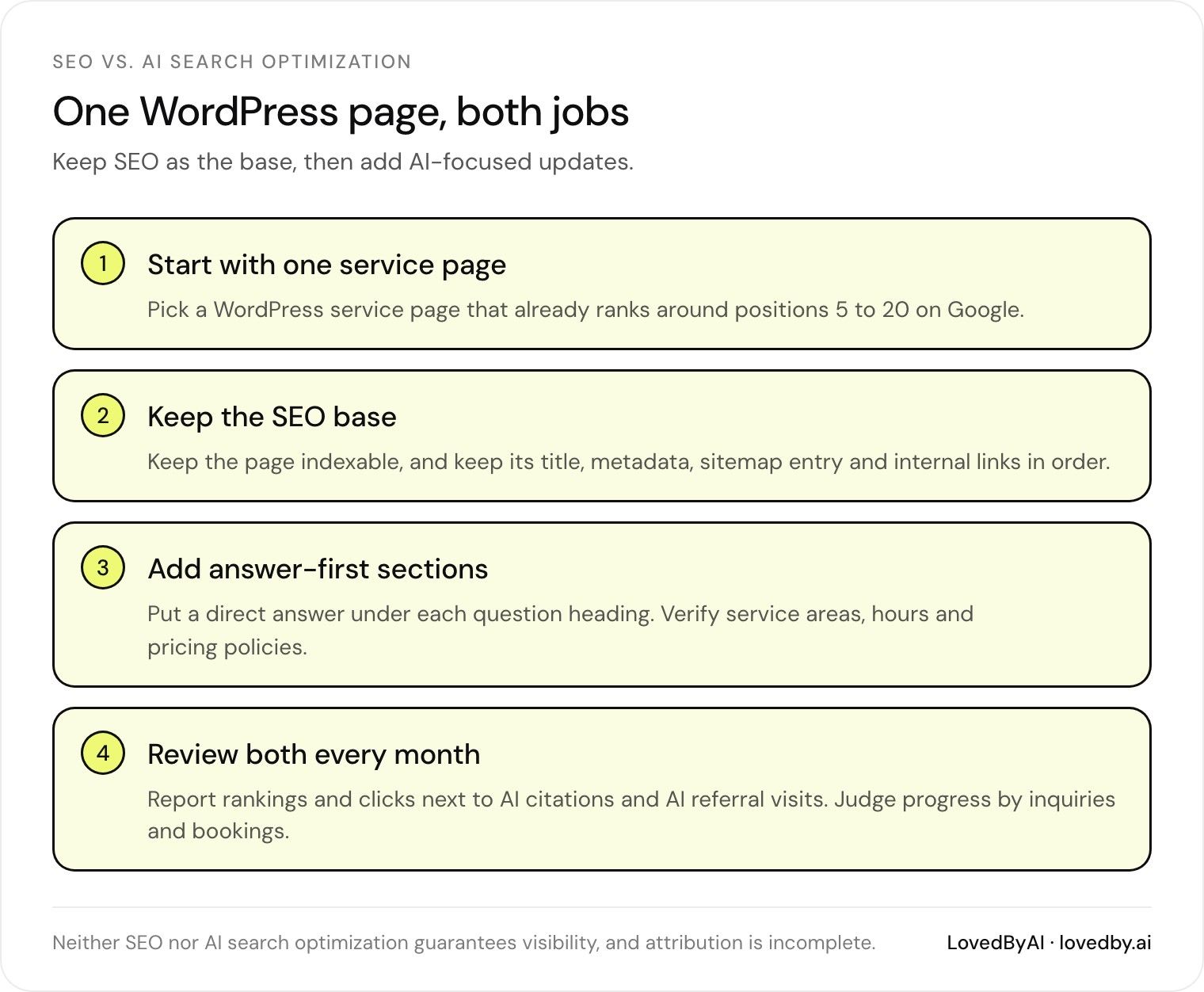
I’d begin with pages ranking around positions 5–20, check service areas, hours, and pricing, and make sure structured data matches the page. Then I’d review search results and AI results monthly, with separate reporting.
Tools are checks - not promises. LovedByAI can help flag gaps and draft changes, but I’d verify every detail before publishing and judge progress by inquiries and bookings - not scores alone.
What is GEO, and how does it differ from SEO?
Optimize your WordPress site for AI search
Find out what ChatGPT, Gemini, and Perplexity can and can't read on your site, and exactly what to fix.
SEO vs. AI Search Optimization: Key Differences
How Search Engines and AI Systems Find Content
The difference starts with how each system finds and uses a page. SEO depends on crawlability and indexing. AI systems retrieve multiple sources, then combine information from them into one answer.
What Content Needs for Search and AI Answers
Your page needs to support both search rankings and AI answers. For SEO, use a descriptive title and match search intent. For AI, make each section stand on its own by including the service, location, limits, and proof.
Clear answers make facts easier to extract and potentially cite. Consistent business details help AI systems link those facts to the right business and use them accurately. Update outdated information whenever pricing or availability changes.
Service schema structured data must match what visitors can read on the page. It can't replace missing business details or support claims that lack proof. No tactic guarantees inclusion in an AI answer.
How to Track Rankings, Citations, and Conversions
Track SEO through organic impressions, rankings, clicks, CTR, and conversions. For AI visibility, monitor mention rate, citation frequency, referral traffic, and assisted conversions.
Keep AI visibility reporting separate from organic search. Attribution is incomplete, so these metrics won't show every interaction. Keyword pages and answer-first pages also need different reporting to measure how people find and use them.
WordPress Example: A Phoenix Plumbing Page
This hypothetical Phoenix plumbing page shows how one WordPress service page can support both SEO and AI search. It can attract search clicks and earn AI citations without splitting into two pages.
| Aspect | SEO-focused treatment | Answer-first treatment |
|---|---|---|
| Page focus | Target “emergency plumber in Phoenix” | Become a cited source for plumbing answers |
| Structure | Keyword-rich title, service headings, internal links, and a contact button | Question-led headings, a direct answer at the top, then supporting details |
| Business context | Services and service area the business offers | Verified neighborhoods, hours, response-time expectations, and pricing policies |
| Measurement | Rankings and clicks | Citations and AI referrals |
SEO Focus: Emergency Plumber in Phoenix
Use “Emergency Plumber in Phoenix” as the page’s descriptive title. In the WordPress editor, add headings for the emergency services the business provides. Link to relevant repair pages and the contact page. Make the call or booking action easy to find.
In Google Search Console, filter performance data to this page. Review relevant queries, impressions, average position, and clicks. Use site analytics and booking records to connect organic visits to bookings. A phone-button click counts as a lead - not proof of a booking.
AI Focus: Answer Emergency Plumbing Questions
Lead with direct answers, not keyword repetition, as outlined in our LLM SEO guide.[3] Explain which plumbing problems need emergency attention using a proven content formula for AI citations. Include Arcadia, Biltmore, or Ahwatukee only if the business has verified service there.[1] State verified response-time expectations, hours, and pricing policies.
Keep the business name, address, phone number, and service area consistent with its Google Business Profile and local directories.[1][5] Track whether AI answers cite the page and whether identifiable AI referral traffic leads to inquiries or bookings.[2]
These tasks add AI visibility while keeping the page’s SEO basics intact. The next section shows how to combine SEO basics and AI search tasks on the same WordPress site.
Keep SEO Basics and Add AI Search Tasks
Improve existing service pages before adding more content. Start with pages already ranking around positions 5–20.[3] This keeps SEO as the base while you work on AI visibility.
Keep Pages Accessible and Business Details Accurate
Keep pages indexable, and maintain their metadata, sitemaps, readability, and crawlability.[4][5] Your business name, address, and phone number should match across your website, Google Business Profile, and directories.[1][6]
Add Direct Answers and Monthly Reporting
Place the useful answer near the start of each section, and replace vague claims with documented facts. Each month, review AI citations, referrals, and conversions alongside organic results.[5]
Track answer-generation retrieval separately from routine crawling. Only retrieval during answer generation can lead to citations and traffic.[3] Use your monthly results to choose which pages need AI-specific updates next.
Use LovedByAI Alongside WordPress SEO
Follow the same workflow for AI-specific fixes, with tools to help. Use LovedByAI’s readiness scan to spot unclear headings and structured-data gaps. Its answer-first rewrites and JSON-LD can help fix those issues, but check generated details before publishing.[3][6]
Measure results with its AI mention and AI referral traffic analytics. Keep page facts consistent with what visitors see; these tools do not guarantee retrieval or citations.
Conclusion: Improve AI Visibility Without Replacing SEO
The goal isn’t to replace SEO. It’s to build on it. SEO earns rankings and clicks; AI search optimization helps your content get cited in generated answers.[2] Both depend on accessible pages, accurate facts, and direct answers.[3]
Start with one high-priority WordPress service page. Keep its SEO base intact, then refine its answer-first sections for AI search optimization.[3][6]
Track search and AI visibility side by side. Review rankings, AI citations, referral traffic, and conversions together.[2]
Use AI visibility tools for scans and scores as diagnostic signals - not proof of traffic growth or a guarantee that AI answers will include your content.[3]
FAQs
Why might AI answers overlook my high-ranking page?
SEO and AI search optimization focus on different signals. Your page may rank well thanks to keywords and backlinks, but AI models favor information density, clear writing, and a structure machines can read.
Long paragraphs, a missing direct answer at the top, or complex HTML can make your content harder to extract. Missing schema markup or inconsistent entity data can also make AI less confident about citing your page as a reliable source.
Which WordPress page should I optimize first?
Start with the service page that already ranks around positions 5 to 20 and brings in leads.
Swap vague headings for buyers’ questions, then give direct, factual answers immediately below them. Add structured data, such as FAQPage or LocalBusiness, and keep your HTML lightweight and semantic. Not sure where your audience searches? Test priority queries to see where your brand gets cited.
How can I measure AI visibility without referral clicks?
Track brand mentions and AI engine activity directly. Each month, enter your customers’ top 10 questions into AI assistants like ChatGPT, Perplexity, and Gemini. Note whether your brand appears, along with the sentiment or context of each mention.
Check your server logs, too. Visits from bots like ChatGPT-User or PerplexityBot can indicate that AI engines are accessing your site content for possible citations.