
Their SEO conversations had stalled. AI visibility restarted them.
A full-service digital agency in the US Midwest sells SEO to twenty client sites. The work was solid and the retainers kept renewing, but the conversations had gone quiet: nothing new to report, nothing new to sell, and a client base that had stopped asking questions. AI visibility gave them a reason to call every one of them back.
Verified LovedByAI reseller, anonymised at their request.
Setup time per site
5 min
No conflicts, no rebuilds
Gross margin on resale
82%
$29–59 cost → $150–350 price
Clients who took it
20 of 32
Offered to the whole pilot group
- Partner
- Full-service SEO agency, US Midwest (five offices)
- In business
- Founder-led, 15+ years in digital marketing
- Clients
- Government & municipal, nonprofits, manufacturing, professional services, eCommerce
- Model
- Resale · buys at standard list pricing, sets its own client rate
- Live since
- January 2026 · 20 client sites, a pilot subset of the book
- Total time invested
- ≈15 hours, all in
The retainer was fine. The conversation wasn't.
This is the ordinary shape of a mature SEO book. Rankings hold, reports go out, invoices clear. What stops is the reason to talk: after a few years there is no new problem to raise and no new thing to sell, and a quiet client is a client who eventually wonders what they are paying for.
The trigger was a client asking the question directly — why doesn't ChatGPT know about us? — and the founder realising two things at once. The honest answer was that nothing in the SEO retainer was addressing it. And it was the first question a client had brought to them unprompted in a long time.
So they took it to a pilot group of 32 clients and 20 of them said yes. Not a campaign, not a price rise: a call, a short explanation, and a new line on the next invoice. The agency expects to buy more licences shortly and take it to the rest of the book.
Doing it by hand wasn't an option. Generative Engine Optimization done manually is schema markup written per page, content restructured per template, an llms.txt maintained by whoever remembers to maintain it. That's consulting: billed by the hour, different every time, impossible to put on a rate card. An agency can sell it to three clients. It cannot sell it to twenty.
The hesitation was the obvious one
“It was a new plugin. That's always the question — do I want to put something unproven on twenty client sites?”
This is the real objection for anyone with client sites under management, and it deserves a straight answer rather than reassurance. The rollout covered twenty WordPress installs running the usual mix of page builders, WooCommerce and incumbent SEO plugins. Nothing broke. No conflicts, no rollbacks, no emergency calls.
What visitors see
What assistants read
<script type="application/ld+json">
"@type": "Organization", "name": …
"@type": "FAQPage", "mainEntity": […]
</script>
# llms.txt
What this business does, in one line.
Which pages answer which question.
## Answer-first summary
The point of the page, in the first sentence.
llms.txt, generated and kept current.Here's the part worth reading twice
This agency isn't on wholesale pricing at all. It pays standard list, $29–59 per site per month depending on page count, and sells into its own retainers at $150–350.
Unit economics per site, per month
What the software costs this agency against what it charges a client for the service wrapped around it. Both tiers at standard list pricing, with no partner discount applied.
- Software cost
- Agency gross profit
View as table
| Tier | Cost | Client price | Gross profit | Margin |
|---|---|---|---|---|
| Pro site | $29 | $150 | $121 | 81% |
| Business site | $59 | $350 | $291 | 83% |
The actual book is 14 sites on Business and 6 on Pro. So: $1,000 a month in software, $5,800 a month billed to clients, $4,800 a month in gross profit — or $57,600 a year. None of that comes from a partner discount. It's the gap between what software costs and what a service is worth to a client, which is the gap agencies have always sold into. Wholesale tiers begin at 50 sites and would widen it further, but nothing here depends on reaching them.
The number worth pausing on isn't the margin, though. It's the fifteen hours. This is a line of business generating five figures annually that consumed a little over a working day of labour to stand up. The margin only means something because the workload behind it is close to zero, and that is what resellers are actually trying to find out.
“There's a WhatsApp group with their team. Really responsive.”
Twenty sites, seven months, no support burden that registered as one. For an agency working out whether a new product line becomes a new ticket queue, that is the load-bearing detail.
One client of the twenty has cancelled, and not over the product: they moved off WordPress onto Next.js, so the plugin had nothing to sit on. That licence went straight onto another client's site rather than being lost. Nineteen of twenty still on it after seven months is the number that decides whether this is a line of business or a one-off sale.
One caveat worth being straight about, because agencies think about it and rarely say it out loud: charging $350 for software that costs $59 and installs in five minutes only holds up if you're selling more than the install. What the client is paying for is somebody who understands what AI visibility is, reads the monthly numbers, explains what moved and why, and stays accountable for it. The software is the delivery mechanism. The retainer is still the retainer.
The clearest way to see it is the month the rollout finished.
Across the whole of Q1, AI-referred traffic to these sites ran at 12 visits. Since April it's 379, more than thirty times the rate, and it kept climbing after the rollout rather than spiking and fading.
Visits referred from an AI assistant
Twenty client sites, January to July 2026. People arriving from ChatGPT, Perplexity, Claude or You.com rather than a search results page.
View as table
| Month | AI-referred visits |
|---|---|
| Jan 2026 | 3 |
| Feb 2026 | 5 |
| Mar 2026 | 4 |
| Apr 2026 | 76 |
| May 2026 | 94 |
| Jun 2026 | 81 |
| Jul 2026 | 128 |
Underneath the referrals, the assistants themselves are reading far more often. Mentions went from about 12 per site per day before the rollout to around 44 after, and kept climbing every month rather than settling back.
AI mentions per site, per day
Averaged per site so the April rollout doesn't inflate the figure. Counts requests from AI search and on-demand assistants; bulk AI training crawlers are excluded, and they are roughly 12× larger in volume.
View as table
| Month | AI mentions / site / day |
|---|---|
| Jan 2026 | 14 |
| Feb 2026 | 10 |
| Mar 2026 | 12 |
| Apr 2026 | 29 |
| May 2026 | 44 |
| Jun 2026 | 38 |
| Jul 2026 | 63 |
LovedByAI
This partner's account · mentions against visits
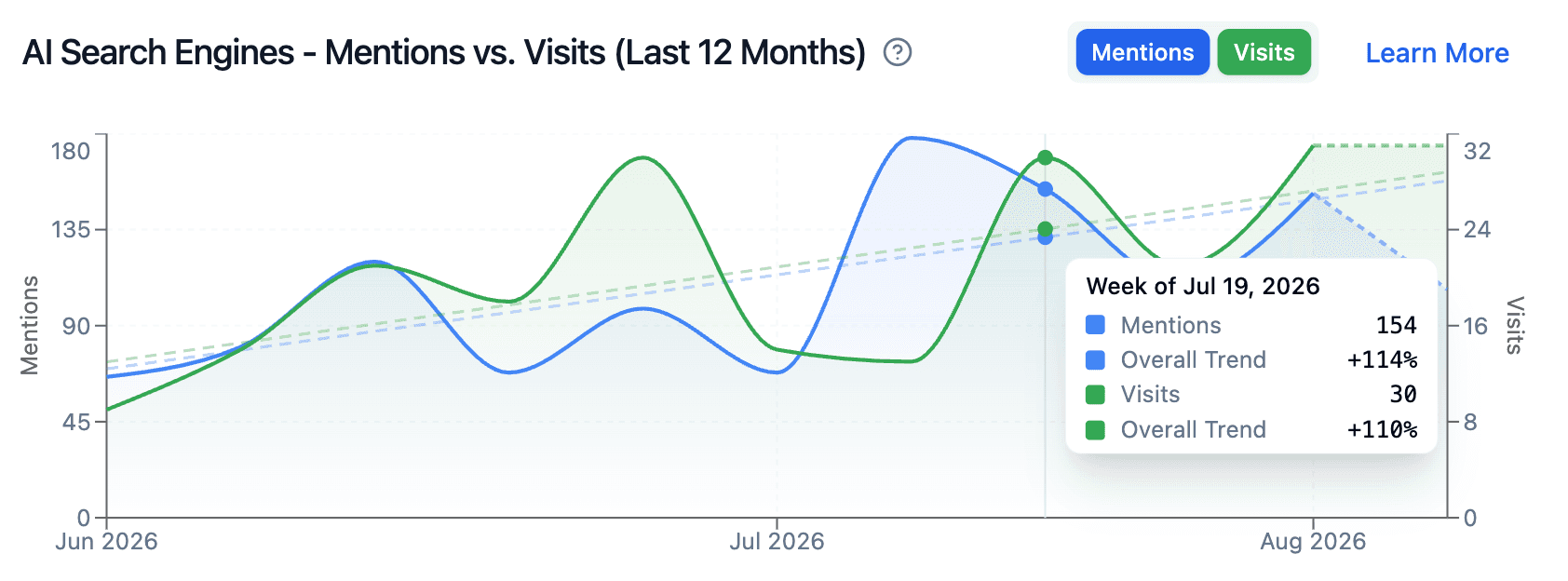
The agency's own dashboard across all twenty sites. Mentions on the left axis, visits on the right, both trending up through the summer.
Why the SEO retainer wasn't already covering this.
Every agency asks the same thing first: we already do SEO for these clients, so surely we've got this covered. One number settles it.
URLs ranking in Google's top ten for a query
URLs cited by AI assistants for that same query
12% are in both. The rest are cited without ranking there at all.
Almost nine in ten pages an assistant quotes are not the pages you got to the top of Google. Ranking work and AI visibility are different surfaces read by different machines, and the second one is mostly unclaimed.
For an agency, that is the whole pitch, and it is a pitch to a client who already believes in the category. They are paying for search visibility. This is search visibility on a surface their current retainer does not reach, which is why it opens a conversation instead of relitigating an old one.
That is the part the margin doesn't capture. Twenty of thirty-two clients took a call about something new, and several of those calls turned into the first proper review of their search strategy in years. An agency that had nothing new to say for two years now has a monthly number that moves and a reason to pick up the phone about it.
Worth keeping honest about scale, though. 379 referred visits across twenty sites over four months is about 5 a site a month. That is real, it's compounding, and it is not yet replacing anybody's organic traffic. The case for moving now is that it costs almost nothing and the sites that are legible today are the ones being quoted while everyone else waits.
The questions other agencies ask them.
Answered with what actually happened across twenty client sites and seven months.
Do I need to be an SEO specialist to sell this?
Wholesale or revenue share: which one am I?
Will it conflict with page builders, WooCommerce or my existing SEO plugin?
How much of my time does each site actually take?
What happens if a client cancels?
What if AI search turns out to be a phase?
See the wholesale tiers.
The agency in this case study built an 82% margin on list pricing. Wholesale tiers start at 50 sites and widen it; below that, revenue share pays recurring commission for the life of the customer with nothing upfront.
About this case study. The partner is a real LovedByAI reseller. Their name, location and client details have been anonymised at their request; the figures have not been changed.
How this was measured. Mention and referral figures come from LovedByAI's own telemetry for the twenty sites in this partner's account, covering 1 January to 31 July 2026. An “AI mention” is one request for a page from an AI search or on-demand assistant agent (OAI-SearchBot, ChatGPT-User, PerplexityBot, Perplexity-User, Claude-Web, Claude-User, YouBot). Bulk AI training crawlers are excluded: they are far larger in volume and not indicative of an assistant answering a live question. Per-site-per-day figures are averaged over active site-days so that adding sites does not inflate the rate. Commercial figures are as reported by the partner.
On earnings. Revenue and margin figures describe one partner's results and are not a projection. What you earn depends on your pricing, your client base and your own sales effort.