Prospects are increasingly shifting their discovery habits: instead of browsing traditional search engines for a 'freelance graphic designer,' they are asking ChatGPT to recommend specific professionals with exact niche experience and proven results. A client does not want a list of ten website links anymore. They want a direct answer about who has built Shopify stores for outdoor apparel brands.
If you are a freelancer relying on a traditional portfolio, this shift presents a unique challenge. Freelance portfolios are traditionally heavily visual and designed purely for human buyers. A beautiful grid of project mockups works perfectly when a human is clicking through your site. However, AI language models struggle to extract the actual facts about your skills, past clients, and niches unless that information is structured specifically for AI retrieval.
If you find yourself asking why is my freelance portfolio not showing in chatgpt, the answer is rarely about the quality of your work. The issue is usually a missing text layer and a lack of structured data. I have worked with many independent professionals who have stunning websites but remain completely invisible to AI search tools.
To fix this, you do not need to abandon your visual portfolio. You need to translate your visual proof into machine-readable facts and build a clear verification loop across the web.
Why Your Freelance Portfolio Is Not Showing in ChatGPT
Your portfolio is likely built for human eyes, meaning the concrete facts about your business are trapped inside images, PDFs, or clever creative copy. An AI crawler cannot watch your motion graphics reel or appreciate the whitespace in your brand identity project. It looks for text-based entities that connect your name to specific skills and outcomes.
When a large language model parses your website, it strips away the design and looks at the raw HTML. If your case study consists of a brief introductory paragraph followed by ten high-resolution images, the AI simply sees a very thin page. It cannot confidently determine what software you used, what industry the client belonged to, or what the measurable result was.
Without those clear text signals, the AI will not risk recommending you to a user. It will instead recommend a competitor whose site explicitly states their capabilities in plain text.
The Cross-Reference Loop
AI Search tools do not blindly trust what you say on your own website. They form trust through a cross-reference loop. They look at the claims on your site and verify them against external sources.
If your website says you are an expert WordPress developer, the AI expects to find a matching profile on GitHub, a consistent professional history on LinkedIn, or verified client reviews on platforms tracked by the Upwork Research Institute.
A strong, well-optimized website is the foundation of this loop. Your site acts as the central source of truth. The problem is not that your website is secondary to directory listings. The problem is that having inconsistent messaging across your site and your external profiles breaks the verification loop. When the facts align everywhere, AI tools feel confident recommending you.
How ChatGPT Reads Professional Services Sites Compared to Google
Google crawls your website to index pages for keyword matching, while AI bots crawl your site to extract concrete facts and relationships. Google wants to know if your page is the best destination to send a searcher. ChatGPT wants to extract the answer directly so the user never has to leave the chat interface.
I analyzed crawler behavior across the professional services and consulting sites tracked on the LovedByAI platform. The data shows a massive shift in how these sites are being evaluated. Between January and April 2026, average AI bot visits per freelancers site surged from 999 to 3,402. This is a threefold increase in just a few months.
More importantly, this AI activity has officially overtaken traditional Google crawls, which stood at 1,981 visits per site in January 2026. Bots are reading your portfolio differently now, and they are visiting more frequently than ever before.
What the Bots Are Looking For
| Feature | What Google Looked For (Traditional SEO) | What ChatGPT Looks For (AI Search) |
|---|---|---|
| Project Pages | Broad keyword usage, image alt text, and time-on-page metrics | Clear entity relationships connecting your name, the client, and the skill |
| Service Lists | Separate landing pages for every minor service variation | A structured, text-based list of skills with clear definitions |
| Proof of Work | Visual case studies and portfolio grids | Markdown-structured results, specific metrics, and plain-language summaries |
| Trust Signals | Backlinks from high-authority domains | Consistency between your website and third-party professional directories |
AI bots are not reading your portfolio to admire your aesthetic choices. They are reading it to extract verifiable facts about what you do and who you do it for.
The ChatGPT Crawl Surge
Looking closer at the recent data, ChatGPT-related bots alone averaged 958 visits per freelancers site over the last three months. This indicates that ChatGPT is actively reading professional services and consulting content to answer live user queries.
If your site is not structured to hand those bots the exact facts they need, those 958 visits are wasted. The crawler leaves without understanding your actual value, and your portfolio remains absent from AI recommendations.
Structuring Your Skills and Past Projects as Entities
To make your portfolio visible to AI, you need to understand how bots process information. AI systems do not think in keywords; they think in entities. An entity is a distinct, defined concept. It could be a specific programming language, a design methodology, a past client, or an industry niche.
When you optimize a traditional site, you might sprinkle the phrase "freelance copywriter" across your headings. When you optimize for AI, you must build relationships between entities. You want the bot to understand that [Your Name] is a [Freelance Copywriter] who uses [SEO Strategy] to help [B2B SaaS Companies] achieve [Increased Lead Generation].
If you want to understand the technical difference behind this shift, reading about why entities matter more than keywords is a great place to start. The goal is to make every project in your portfolio a web of connected entities.
Translating Visuals to Text
You do not have to delete your images. You just need to add a descriptive text layer alongside them. For every visual case study in your portfolio, add a summary section that clearly defines the project parameters.
Use standard HTML lists (<ul> or <ol>) to break down the tools you used, the timeline, the industry, and the final deliverable. This gives the AI crawler exactly what it needs without ruining the visual experience for human visitors.
Using JSON-LD to Hand Data to Bots
The most direct way to establish entities is through schema markup. Schema is a vocabulary of tags that you add to your site's code to tell search engines exactly what your content means. You can read the official documentation at Schema.org for the full technical specifications.
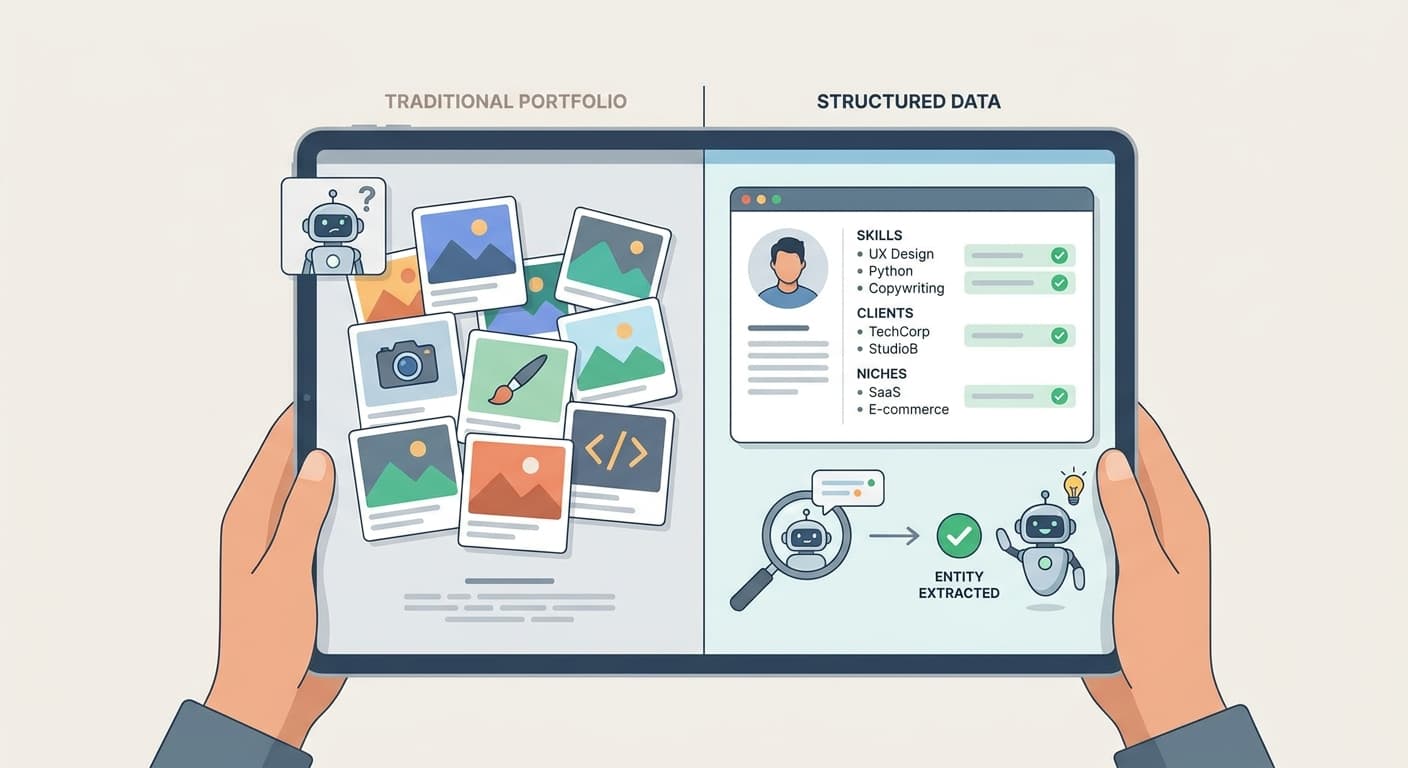
Instead of hoping the bot understands your text, you can use JSON-LD schema to explicitly define your past projects. Here is an example of what that looks like for a freelance project:
{
  "@context": "https://schema.org",
  "@type": "CreativeWork",
  "name": "B2B SaaS Website Redesign",
  "author": {
    "@type": "Person",
    "name": "Alex Freelancer"
  },
  "about": "UI/UX Design for tech startups",
  "keywords": "Figma, Wireframing, User Research",
  "client": {
    "@type": "Organization",
    "name": "TechFlow Software"
  }
}
When you place this code in the <head> section of your project page, the AI crawler does not have to guess what the page is about. It reads the code and instantly maps the relationships between your name, the skills used, and the client.
Where AI Search Optimization Differs from Google SEO for Freelancers
Traditional SEO is not broken, and it is not your enemy. It is the foundation that AI optimization builds upon. According to Google Search Central guidelines, creating helpful, reliable, people-first content remains the core of good search performance.
Most SEO advice for freelancers focuses on optimizing your own site for human consumption and Google rankings. This involves writing long blog posts, optimizing title tags, and trying to rank for broad terms like "freelance web designer Chicago." That work still matters for traditional discovery.
AI search optimization requires a different lens. It focuses on making your facts machine-readable and verifying them across the web. You are optimizing for extraction rather than just destination ranking.
The Shift from Clicks to Citations
When a client uses Google, they are looking for a list of options to browse. When they use an AI tool, they are looking for a definitive answer. If you want to appear in ChatGPT results, you have to format your content so it serves as a reliable citation.
This means using a Bottom Line Up Front (BLUF) writing style. Instead of burying your unique value proposition at the bottom of an "About Me" page, state it clearly in the first sentence.
If a client asks an AI tool for a recommendation, the tool will prioritize freelancers whose websites offer clear, structured answers over those with vague, creative prose.
Combining Both Approaches
You do not have to choose between traditional SEO and AI visibility. The fastest path to getting clients is to handle both together.
Your traditional SEO efforts build the domain authority and structure that AI tools rely on. By adding entity-rich text, schema markup, and clear formatting, you open an additional lane for AI bots to understand and recommend your business.
Steps to Make Your Freelance Business Visible to AI
Fixing your portfolio for AI search does not require a complete redesign. You can keep your visual aesthetic while upgrading the underlying text and structure. The goal is to close the gap between what humans see and what machines read.
If you are ready to update your site, here are the practical steps to take first.
Step 1: Text-Ify Your Case Studies
Review every project page on your website. If the page is just a title and a gallery of images, you need to add context. Write a clear, factual summary for every project.
Use simple heading tags (<h2> and <h3>) to organize the content. Include a bulleted list detailing the specific skills, software, and strategies you applied. State the client's industry explicitly. If you want to see how these formatting choices influence different AI platforms, you can review how sites get cited in Perplexity and Claude based on their text structure.
Step 2: Implement Schema Markup
Add structured data to your website. At a minimum, your homepage should include Person or LocalBusiness schema that clearly defines what you do, where you are located, and how to contact you. Your individual project pages should use CreativeWork schema to detail your past successes.
You can write this JSON-LD code manually and inject it into your website using a free snippet plugin. If writing code is outside your comfort zone, the LovedByAI platform includes a schema injection tool that automatically scans your pages and adds the correct JSON-LD markup without requiring any technical development. Both paths work; choose the one that fits your technical comfort level.
Step 3: Complete the Cross-Reference Loop
AI tools need to verify your claims. Make a list of every third-party platform where you have a professional presence. This includes LinkedIn, Upwork, Dribbble, GitHub, or specialized industry directories.
Ensure that your name, your core services, and your target industry are described consistently across all of them. If your website says you specialize in "E-commerce SEO" but your LinkedIn headline says "Digital Marketing Enthusiast," you are creating conflicting entities. Align your messaging everywhere so the AI crawlers receive the same factual signals no matter where they look.