
I recently spoke with an independent supply chain consultant who landed a $15,000 contract without a single Google Search involved. The client had simply asked ChatGPT to find a freelance specialist with experience in cold-storage logistics and a specific inventory software. Because the consultant had clearly structured her website and aligned it with her professional profiles, the AI cited her as the exact answer. Search is no longer just about generating a list of blue links. It is about connecting a highly specific client problem directly with the specialized talent that can solve it.
If you are a freelancer relying on online visibility, you might be wondering if AI tools are worth your attention. The short answer is yes, but the mechanics are different. AI platforms are not reading your site to figure out what keywords you stuffed into the footer. They are reading your site to verify the facts about your expertise, your services, and your professional footprint. The goal is to create a tight, consistent loop of information between your website and your other professional listings. When that loop is clear, AI tools confidently recommend you.
How to Rank a Freelance Website on ChatGPT Search
To get recommended by AI, your website must serve as a verifiable factual hub rather than just a digital brochure. The core task is making your expertise, pricing, and service area entirely unambiguous to a machine reader. You do this by combining plain-language answers on your site with structured data that confirms your identity.
When a potential client asks an AI tool for a freelance web developer or a fractional CFO, the AI evaluates candidates differently than a traditional search engine does. It looks for consensus. If your website says you specialize in forensic accounting, but your external directory profiles and LinkedIn page say you do general bookkeeping, the AI sees a contradiction and skips you.
AI bots do not guess. If your external profiles and your own website disagree on what exactly you do, the AI system simply recommends someone else whose details match perfectly.
To fix this, you must treat your own domain as the central source of truth. Your website must state exactly who you are, what specific problems you solve, and ideally, how you structure your engagements. Then, every other place you exist online must point back to these exact same facts. This cross-reference loop is what builds trust with a large language model.
| Evaluation Area | What ChatGPT Looks For | What Traditional Google SEO Looks For |
|---|---|---|
| Content Focus | Direct answers to specific user prompts | Long-form blog content and keyword density |
| Trust Signals | Personal entity authority and profile consistency | Backlinks from high-authority external domains |
| Service Details | Clear pricing structures and specific capabilities | Broad service pages optimized for search volume |
| Code Layer | Structured service data and JSON-LD markup | Meta descriptions and title tag formatting |
The Cross-Reference Loop in Practice
Start by auditing your professional footprint. Open your website, your main professional network profile, and any industry-specific directories where you are listed. Look at the exact name you use, the specific titles you claim, and the contact information you provide. Make them identical.
Once the text matches, use your website to host the definitive version of your professional biography. State your specific niche plainly in the first paragraph of your homepage. If you offer specialized freelance services, do not bury them in a dense paragraph. Use a bulleted list or a clear <ul> tag structure so an AI crawler can extract the exact services without parsing marketing language.
Why ChatGPT Is Crawling Freelance Portfolios in 2026
ChatGPT and similar tools are actively crawling independent professional websites because they need verified facts to answer live user queries. I analyzed crawler behavior across professional services and consulting sites on the LovedByAI platform to understand exactly how much attention these sites are getting. Between January and April 2026, average AI bot visits per site surged from 999 to 3,402.
That is a three-fold increase in just one quarter. Even more telling is the shift in dominance. In January 2026, the average freelance or consulting site still saw more Google crawls (1,981) than AI crawls. By April, AI activity had completely overtaken traditional search bots.
The ChatGPT Specifics
Looking closer at the data I reviewed, ChatGPT-related bots are leading this charge. Over the last three months, these specific crawlers averaged 955 visits per freelancer site in the professional services category. They are not just scraping data for training purposes. They are fetching real-time information to synthesize direct answers for users looking for help right now.
This means if a potential client uses the ChatGPT search function to find a freelance graphic designer who specializes in accessible packaging, the bot is actively scanning professional sites to find those exact matches. If your site blocks these bots or presents information in a confusing way, you simply will not be in the output.
You can check how bots interact with your site by reviewing your server logs or using a tool like the Google Search Central documentation to understand standard crawler behavior, which AI bots increasingly mimic. The key is ensuring your robots.txt file permits access to bots that fetch live search answers.
Shifting from Keyword Services to Recognised Freelance Entities
The biggest mindset shift for a freelancer is moving away from optimizing for isolated keywords and instead establishing yourself as a recognized entity. An entity is simply a distinct, defined concept that a machine understands, such as a specific person, a specific business, or a specific service. You want the AI to understand that your name is not just a string of text, but a verified professional who provides a specific category of help.
You achieve this by using schema markup. Schema is a standardized vocabulary of code, detailed in full on Schema.org, that you add behind the scenes to your website. It tells search engines and AI tools exactly what they are reading. For a freelancer, the most critical step is implementing JSON-LD schema that defines your professional identity.
If you only do one technical task this year, add proper schema markup to your homepage. It is the fastest way to translate your human-readable expertise into machine-readable facts.
Implementing Proper Professional Schema
Instead of relying on a generic webpage, you can inject a specific code block into the <head> section of your site. This acts as a digital business card for AI crawlers. You do not need to be a developer to do this. Many website platforms allow you to paste this directly, or you can use a free schema generator tool online.
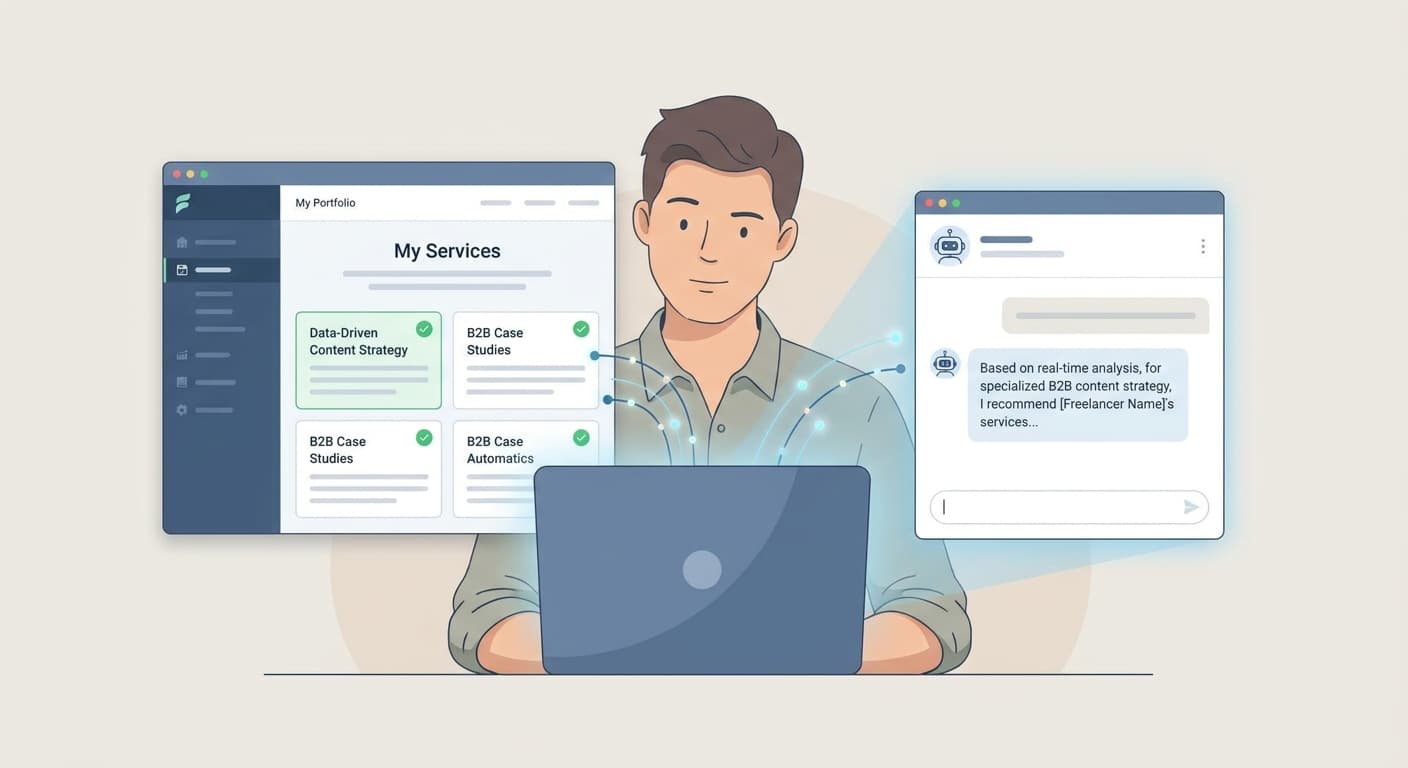
Here is a simplified example of what this JSON-LD schema looks like for an independent consultant:
{
  "@context": "https://schema.org",
  "@type": "ProfessionalService",
  "name": "Jane Doe Consulting",
  "founder": {
    "@type": "Person",
    "name": "Jane Doe",
    "sameAs": [
      "https://www.linkedin.com/in/janedoe",
      "https://directory.freelancersunion.org/janedoe"
    ]
  },
  "description": "Freelance forensic accounting and financial auditing for small businesses.",
  "url": "https://janedoeconsulting.example.com",
  "priceRange": "$$"
}
Notice the "sameAs" property in the code. This is where the magic happens. By linking your website entity directly to your LinkedIn profile and industry directories, you close the cross-reference loop. This is exactly why entities matter more than keywords when optimizing for AI. The machine does not have to guess if the consultant on LinkedIn is the same person on the website. You have explicitly connected them.
How Traditional Google SEO Complements Your ChatGPT Strategy
Traditional SEO and AI visibility are not competing forces. They are complementary layers of the same digital foundation. If you are already doing the work to rank well on Google, you are building the exact authority that AI platforms rely on to decide who to trust.
AI tools do not operate in a vacuum. When ChatGPT synthesizes an answer, it leans heavily on sources that already possess strong digital authority. Research consistently shows that pages with high visibility in traditional search results are far more likely to be cited by AI models. Good SEO practices, like maintaining a fast site, earning relevant mentions, and structuring your content clearly, give AI crawlers the confidence that your site is a reliable source.
The Shared Foundation
If you spend time writing clear, helpful content that answers your clients' most common questions, you are serving both systems. Google rewards this by ranking your page higher. AI tools reward this by extracting those clear answers and serving them directly to users. The format is what matters most.
Keep your content formatting clean. Use proper <h2> and <h3> tags to organize your thoughts. If you have a frequently asked questions section, use standard <details> and <summary> HTML tags or dedicated FAQ schema. You can read more about standard web structure on the Mozilla Developer Network to ensure your markup is compliant. Clean code makes it easy for both Google's crawler and ChatGPT's bots to parse your expertise without getting stuck on messy formatting.
Never assume you need to abandon your existing search strategy to chase AI citations. The best approach is to maintain your traditional SEO efforts while layering on the specific entity signals and clear formatting that AI tools require.
Tracking Your Chatbot Citations and Client Leads
The only metric that truly matters for a freelancer is whether a channel drives qualified client inquiries. Tracking AI search performance requires a different approach than checking a standard keyword ranking dashboard. Because AI chats are personalized and dynamic, you cannot simply type a query and assume everyone sees the same result.
Instead, you have to measure the inputs and the actual business outcomes. The first step is verifying that AI bots are actually visiting your site. If they are not crawling your pages, they cannot cite you. You can ask your web host how to access your raw server logs, where you can search for the exact user agents associated with AI platforms.
Qualifying the Inbound Leads
The most reliable way to know if your strategy works is to track your inbound leads. Add a simple question to your contact form asking how the prospect found you. Give them specific options, including a direct mention of AI search alongside Google, referrals, and social media. You will quickly see if the effort is translating into real conversations.
When you do get a lead from an AI tool, pay attention to the quality of the inquiry. Because AI search allows users to ask very specific, multi-layered questions, the leads are often highly qualified. A client who finds you through a detailed prompt usually already knows you handle their exact niche.
If you notice AI bots crawling your site but you are not getting inquiries, the issue is likely how your services are presented. You may need to clarify your offerings or review how to appear in ChatGPT results more effectively. Keep refining your factual presentation, ensure your cross-reference loop is tight, and focus on providing the unambiguous answers that AI systems crave.
