
Free GEO Checker
Scan your site to see how visible it is to ChatGPT, Gemini, and Perplexity, and exactly what to fix.

What the GEO checker tests.
This checker measures whether ChatGPT, Claude, Perplexity and Google AI Overviews can reach your pages, read them, and quote you in an answer. A traditional SEO audit asks about Google rankings instead, and the fixes are often different.
Getting a site ready for that is called GEO, or generative engine optimization, and your GEO score is how ready this page is.
We fetch your homepage the way an AI crawler does, request it again as GPTBot, ClaudeBot and PerplexityBot to see what your server actually returns them, then read your robots.txt rules for 15 named AI crawlers, your schema, your sitemap dates and your page structure.
37 checks, roughly 60 to 90 seconds. You get a score, every finding with the evidence we found on your own page, and what to do about each one.
What your GEO score means.
Zero to 100, weighted so the checks that decide whether AI can read you at all count for the most. Most sites we scan land in the middle band.
AI search engines miss most of what makes you worth recommending, so readier competitors get cited instead. The biggest gains are here.
AI assistants can read your site, but enough is missing or misread that you are recommended less often than you should be.
Your site is structured for AI search. Small fixes can still raise how often you are cited.
All 37 checks, in full.
Grouped into the same six areas your report uses.
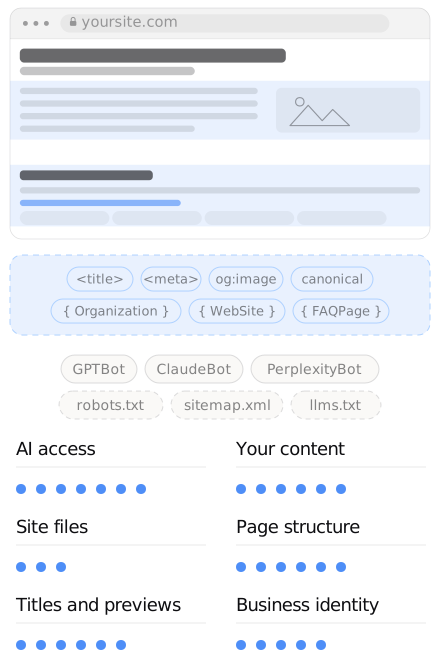
AI access
1Whether crawlers are allowed in and get a real page back.
- AI crawler permissions
- Server response to AI crawlers
- Readable without JavaScript
- Indexing directives
- Consistent indexing signals
- Redirects before your page loads
- Server response time
- robots.txt file
- HTTPS security
Content quality
2Whether there is enough substance to quote.
- Real-world context
- Answer-first structure
- Readable text volume
- Content freshness
- Content depth
- Self-contained sections
Business identity
3Whether AI can tell who you are and vouch for it.
- Organization schema
- FAQ schema
- Visible contact details
- WebSite schema
- Valid structured data
Titles and previews
4What each page calls itself, everywhere it appears.
- Main headline (H1)
- One main headline per page
- Page has a title tag
- Page title (meta title)
- Question-style headings
- Page description (meta description)
- Link preview tags (Open Graph)
- Canonical URL
Page structure
5How the page is built around the words.
- Clean HTML structure
- Main content region
- Image and video descriptions (alt text)
- Internal links
- On-page navigation
- Descriptive link text
Site files
6The small files that hand AI your page list.
- XML sitemap
- llms.txt file
- RSS feed
See what you get back.
You don’t need an account or a card, and you don’t have to talk to sales. The report opens in your browser as soon as the scan finishes.
A score, and the band it sits in
1You see which of the three bands you land in, and what separates it from the next one up.
Every finding, with the evidence
2Each check that failed shows what we found on your page, quoted, so you can see why it failed.
The fix for each one
3What to change and where, written so you or your developer can act on it without a follow-up call. Some of it the plugin can apply for you; the report says which.
Which AI crawlers you allow
4A row per crawler for 15 named AI bots: what your robots.txt says about each, and what your server actually returned when we requested your page as GPTBot, ClaudeBot and PerplexityBot.
What the plugin can fix for you
5The report separates the issues that can be corrected automatically from the ones that need a decision, so you know the size of the job before you start it.
A copy you can keep
6Have the report emailed to you and save it as a PDF, which matters when the person who has to make the change is not the person who ran the scan.
More than 58,000 scans run so far.
What is generative engine optimization?
Generative engine optimization, or GEO, is the work of making a website easy for AI assistants to reach, read and quote. It is the counterpart to SEO for people who ask ChatGPT, Claude, Perplexity or Google’s AI Overviews instead of scrolling a results page.
The overlap with SEO is real but partial. Both want a page a machine can parse. SEO then competes for a position in a list of links, while GEO competes to be the source an assistant repeats, which depends on whether your crawlers are allowed in, whether your facts are stated plainly enough to lift, and whether other places on the web agree with you. Some people call the same work AEO, answer engine optimization, or LLM SEO. The checks are the same either way.
How a GEO checker differs from an SEO checker.
A classic SEO audit assumes a person will see a list of links and choose one. AI assistants don’t show a list. They read a handful of pages and name the ones they trust enough to repeat. The two jobs overlap, and this scan looks at where they differ.
ChatGPT
1Sometimes fetches a page and cites it; often answers from what the model already holds, with no fetch at all. Being readable settles the first case. Being named consistently across the web is what decides the second.
Perplexity and Claude
2Fetch live and quote what they find, so a page they cannot parse is a page they replace with a clearer source. Their crawlers have to be allowed in robots.txt first, which is the check most sites fail without knowing.
Google AI Overviews and AI Mode
3Work largely from Google's existing Search index rather than fetching for themselves, so the lever is whether Googlebot can crawl and index the page, not a separate AI crawler.
Frequently asked questions
01What does this GEO analysis tool actually scan?
The checker fetches your homepage the way an AI crawler does, then requests it again as GPTBot, ClaudeBot and PerplexityBot to see what your server returns them. It reads your robots.txt rules for 15 named AI crawlers, your structured data, your sitemap, and your page structure: headings, internal links and how much readable text there is. That adds up to 37 checks in six areas, which together show whether ChatGPT, Claude and Perplexity can reach, read and cite your content.
02Will this GEO analysis tool break or slow down my site?
The scan can't break or slow down your site because it is read-only. It fetches your page the way a browser or search engine would, analyzes the HTML, and writes a report. Nothing is installed, changed or written on your site, and your visitors and site speed are unaffected.
03Do I need to sign up or provide credentials?
You never need to give us credentials. Enter your domain and we scan the pages anyone can see, with no login details, FTP access or plugin install. If you want the report emailed to you, we ask for an email address at the end.
04How is this different from traditional SEO tools?
Traditional SEO tools like Yoast or Rank Math focus on ranking in Google Search: keywords, meta tags and backlinks. This GEO analysis tool looks at how generative AI assistants such as ChatGPT, Claude and Perplexity read and cite your content. Those systems look for different signals, like clear semantic structure, FAQ blocks, explicit entity definitions, and content written in a form they can quote directly.
05What does my AI SEO score mean?
Your score (0 to 100) is a weighted average of 37 checks, weighted by consequence rather than by count. A blocked AI crawler costs far more than a missing image description, and the basics every working site already has, such as HTTPS or a robots.txt file, earn almost nothing for passing while costing the full amount if they fail. Anything that stops AI reading the site at all caps the score outright. That is why the number is lower than any individual section: sections say how much of one area is in order, the score says how ready the whole site is. Fewer than 1 site in 100 reaches 85, where we call a site ready for AI search.
06How long does the scan take?
Most scans finish in 60 to 90 seconds. Larger or slower-loading pages can take a little longer.
07Can I scan any website or just WordPress sites?
You can scan any public website and get an AI SEO score, whether it runs on WordPress, Shopify, Squarespace or custom code. The LovedByAI plugin that applies the fixes is WordPress-only for now.
08Can I share this report with my WordPress developer?
You can send it on by email or as a PDF. Use "Email me this report" at the end of your results, or save the report as a PDF. Every finding comes with the evidence from your page and the fix, so your developer can act on it without a call. On WordPress, the LovedByAI plugin can apply some of the fixes automatically.
See your site the way AI does
Find out what ChatGPT, Gemini, and Perplexity can, and cannot, read on your site, and exactly what to fix.
Read-only scan · Full report emailed to you