Anyone who has asked ChatGPT for sources knows the feeling: a confident answer, a tidy link, and a page that doesn't exist. We're used to being on that side of it, the people catching ChatGPT's hallucinated links in what we write. So we turned the question around: how often does ChatGPT send a real customer to a page on your website that isn't there?
Since 27 September 2026, LovedByAI's WordPress plugin has recorded the HTTP status code of every AI referral visit it logs. These are the first results: ten days of data, 30 September to 9 October 2026, from 323 small business websites that got a ChatGPT visit. It is a small sample, taken to get a first read rather than a final rate. The first read is already worth acting on: about 1 in 113 ChatGPT visitors landed on a page that doesn't exist.
ChatGPT broken links: the key numbers
- 36 of 4,053 ChatGPT visits to small business websites landed on a 404 page in the ten days from 30 September to 9 October 2026. That is 0.89%, about 1 in 113.
- Those 36 dead-page visits hit 17 of the 323 sites that received a ChatGPT visit in the window.
- 5 went to pages that never existed: no live page and no record of one. ChatGPT made them up.
- 31 went to pages that existed once, had moved, or were real but reached through a garbled link.
- 8 went to pages the Wayback Machine shows were live between 2019 and 2023. One contact page, last archived in 2019, got 5 ChatGPT visitors in 9 days.
- On Wednesday 7 October 2026, 69% of the 404s logged under the ChatGPT-User user agent were exploit probes, not ChatGPT.
How often does ChatGPT send visitors to 404 pages?
ChatGPT sent 36 of its 4,053 visitors to a page that returned a 404 on small business websites between 30 September and 9 October 2026, about 1 in 113. The visits came from the links ChatGPT puts in its answers, which carry utm_source=chatgpt.com, and the plugin recorded the status code each visitor got.
Under 1% sounds small. It isn't nothing. Each of those visits is a person ChatGPT recommended you to, who clicked ready to buy, book or call, and left on an error page. If ChatGPT sends your site 100 visitors a month, roughly one of them walks into that wall, and you never hear about it.
The dead links were concentrated. They hit 17 of the 323 sites that got a ChatGPT visit in the window, 5.3% of them, and four sites account for more than half of the 36. For most sites, ChatGPT's links work. For the few with old or missing URLs in circulation, it keeps sending people to the same dead page.
Gemini, Perplexity and Claude sent 261 visits between them in the same ten days and none landed on a 404. At ChatGPT's rate we would expect about two, so that is too small a sample to call them better. ChatGPT also sends far more visitors than the others, which is why it shows up here: in our AI crawler statistics, ChatGPT-User reached more small business websites than any other assistant.
Google lists your 404 errors. ChatGPT doesn't.
When Google finds a broken page on your site, you hear about it. When ChatGPT sends a visitor to one, you don't. Google Search Console alerts you when a new indexing issue appears and keeps a list under Indexing, Pages, Not found (404): every URL Google tried, when it first saw the problem, and a Validate fix button for when you're done.
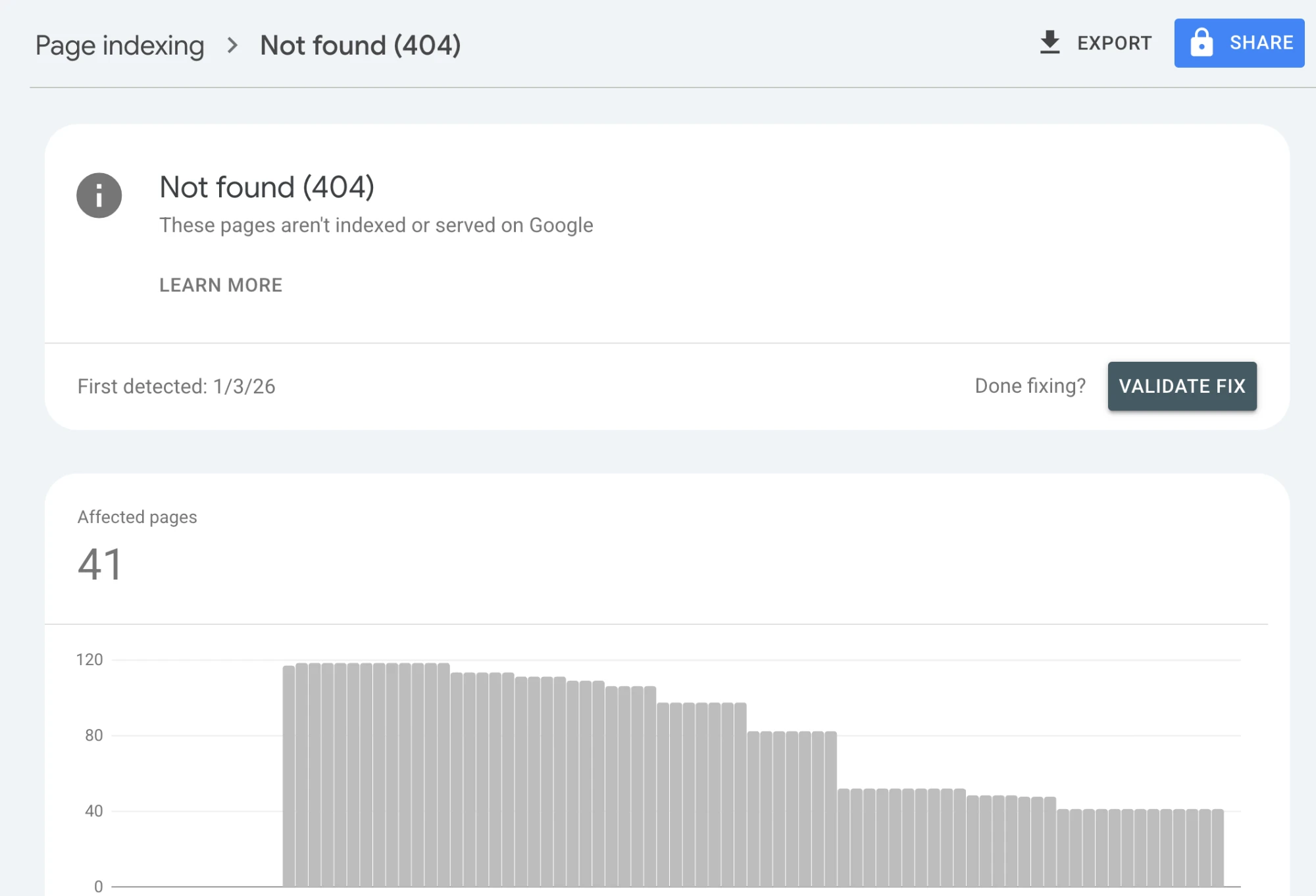
ChatGPT gives you none of that. There is no alert, no list and no report of which links it handed out. The only way to see a ChatGPT 404 is to record the status code of every visit ChatGPT sends, which is what this study is built on.
Why ChatGPT sends visitors to pages that don't exist
Most of ChatGPT's dead links point to pages it remembers. Five point to pages it made up. We checked all 36 dead-page visits on 10 October 2026: whether the page answers now, and whether the Wayback Machine ever saw it live.
It helps to know how ChatGPT writes a link. It doesn't look the address up in an index the way a search engine does. It writes the link the way it writes everything else, one token at a time (a token is a word, part of a word or a punctuation mark), picking the likeliest next piece. That works for sentences, which survive a slightly different word. It doesn't work for a URL, which has to be exact: one wrong character and it points nowhere. So an address ChatGPT read years ago, an address that merely looks right for a business like yours, and a long slug with one character off all come out of it equally confident. It's also why ChatGPT gives fewer links than a search engine does.

Old pages ChatGPT still remembers
Eight visits went to pages the Wayback Machine captured as live between 2019 and 2023. A mixed martial arts site's contact page, last archived in 2019 at /contact-us/, got five ChatGPT visitors between 1 and 9 October 2026. An event venue's restaurant pricing calculator was last archived in 2021, a design studio's web design portfolio category in 2022 and a realty firm's flat-fee listing page in 2019. ChatGPT learned those addresses when they worked and kept recommending them after the sites changed.
Products, listings and jobs that came down
Seventeen visits, the biggest group, went to pages for things no longer on the site. A perfume shop got four ChatGPT visits to three fragrances it no longer lists (two Tom Ford, one Burberry) plus three to old brand and tag pages. A Spanish wine shop got two to a 2017 vintage, a recruitment firm two to job listings, an office furniture store one to a chair it no longer lists, and three more online stores five to products that are gone. Each URL follows its site's own pattern for real products, but most were never archived, so we can't prove each one was live.
Pages that moved without a redirect
A music blog changed its post addresses from /2026/08/post-name/ to /post-name/ and did not redirect the old ones. ChatGPT kept linking to the old format, including a post from August 2023, and both visitors got a 404. The posts were live the whole time at their new addresses.
Real pages, garbled links
Four visits went to pages that exist, through links ChatGPT damaged while writing them: one address was percent-encoded twice, and the others had a character changed or bytes missing from the middle. Long, encoded addresses are the ones it breaks.
Hallucinated pages: 5 that never existed (and maybe should)
Five visits went to pages that have never existed: no live page, and no record of one anywhere. ChatGPT invented them: a resort's /experiences/ page, a university's /brand page, a software company's /community-edition page and a blog post it never wrote, and an events company's wedding tip.

Look at that list and most of it makes sense. A resort with experiences to sell, a university with a brand, a software company with a free edition: ChatGPT guessed the page a business like that would have, and sent a visitor to it. That makes these more than errors. They're a list of pages people expect you to have. If ChatGPT keeps sending visitors to an address, building that page turns a dead end into a landing page.
Fake ChatGPT bots in your 404 logs (ChatGPT-User)
If you look for ChatGPT's dead links in your server logs instead of your analytics, most of what you find won't be ChatGPT. On Wednesday 7 October 2026, 5.8% of the 823,928 bot requests to small business websites in our logs got a 404. For user agents claiming to be AI assistants fetching a page for a user (ChatGPT-User, Claude-User, Perplexity-User and the like), the rate was 43.7%.
The reason is a vulnerability scanner wearing their names. Of the 1,022 requests that day that carried the ChatGPT-User user agent and got a 404, across 111 sites, 703 (69%) were exploit probes: /cgi-bin/php-cgi with an allow_url_include argument (the PHP-CGI flaw tracked as CVE-2024-4577), .env files, /proc/self paths and Kubernetes service tokens. Much of the rest asked for config and debug files no small business website has. The same probes arrive dressed as GrokBot, MistralAI-User and DuckAssistBot.
So the logs can't tell you which pages ChatGPT imagines. The referral visits can, because those are real people clicking real links. Before you count a ChatGPT-User request as ChatGPT, check it against OpenAI's published IP ranges.
How to fix 404 errors from ChatGPT links
- Find them. ChatGPT tags its links with
utm_source=chatgpt.com. In Google Analytics 4, filter landing pages by that session source and look for your 404 page's title. In server logs, search forutm_source=chatgpt.comon requests that returned 404. - Redirect anything that moved. A 301 from the old address to the new one recovers the visitor and the link. On WordPress, a redirect plugin or a rule in your server config does it. A sensible bar for the rest: redirect a dead address once it has had more than two or three visits and you have a live page that answers the same need. If other sites link to the address, redirect it whatever the visit count. A single visit can be a one-off.
- Keep removed products and listings pointing somewhere. Redirect a discontinued product to its replacement or its category, or keep the page up with "no longer available" and the closest alternatives. Don't send everything to the homepage: Google treats that as a soft 404.
- Build the pages ChatGPT expects. If ChatGPT keeps sending visitors to
/contact-us/or/experiences/, give it a real page at that address, or redirect it to the one you have. - Catch garbled links. If visitors arrive at broken versions of real addresses (an extra
%25, a changed character), redirect those versions to the right page. - Return 410 for addresses that should stay gone. Spam pages left behind by an old hack, test pages and duplicates: 410 tells crawlers to stop asking.
- Then clean up Search Console. Under Indexing, Pages, Not found (404), work through Google's list the same way and press Validate fix.
Watch: how to fix 404 errors from ChatGPT links
Video transcript
00:00Why does ChatGPT send visitors to 404 pages?
Anyone who has asked ChatGPT for sources knows the feeling: a confident answer, a tidy link, and a page that does not exist. We are used to catching ChatGPT's hallucinated links in what we write.
So LovedByAI turned the question around. How often does ChatGPT hallucinate links to your website, and send a real customer to a page that is not there?
00:21What we found in 4,053 ChatGPT visits
For ten days, from 30 September to 9 October 2026, the LovedByAI WordPress plugin recorded the status code of every visit ChatGPT sent to 323 small business websites. 4,053 visits.
36 of them landed on a 404 page. That is about 1 in 113.
It sounds small. But each one is a person ChatGPT recommended you to, who clicked ready to buy, book or call, and left on an error page. And this is a ten-day first read, not a final rate.
The dead links were concentrated. They hit 17 of the 323 sites, and 4 of those sites account for more than half of them.
01:05Does Google tell you about 404 errors? ChatGPT doesn't
When Google finds a broken page on your site, you hear about it. Google Search Console sends an alert, and keeps a list under Not found, 404, with a Validate fix button.
ChatGPT gives you none of that. No alert, and no list. The only way to see a ChatGPT 404 is to record the status code of every visit it sends.
01:27Why ChatGPT links break: one wrong character
It helps to know how ChatGPT writes a link. It does not look the address up the way a search engine does. It writes the link one token at a time, picking the likeliest next piece. A sentence survives a slightly different word. A web address does not. One wrong character, and it points nowhere.
01:46Old pages ChatGPT still remembers
8 visits went to old pages the Wayback Machine saw live between 2019 and 2023. A mixed martial arts site's contact page, last archived in 2019, got 5 ChatGPT visitors in 9 days. ChatGPT learned those addresses when they worked, and kept recommending them.
02:07Deleted products and jobs: redirect, don't 404
The biggest group, 17 visits, went to things no longer on the site. A perfume shop got 4 ChatGPT visitors to fragrances it no longer lists. A wine shop, a vintage from 2017. A recruitment firm, job listings that had closed.
02:25ChatGPT links not working: moved and garbled pages
2 visits went to a music blog that changed its post addresses and did not redirect the old ones. The posts were live the whole time, at their new addresses.
4 more went to real pages, through links ChatGPT damaged while writing them: an address encoded twice, a character changed. Long, encoded addresses are the ones it breaks.
02:47Hallucinated pages ChatGPT invents (and maybe should exist)
And 5 visits went to pages that have never existed, with no record of them anywhere. ChatGPT invented them: a resort's experiences page, a university's brand page, a software company's community edition page.
Look at that list and most of it makes sense. ChatGPT guessed the page a business like that would have. So these are more than errors. They are pages people expect you to have. If ChatGPT keeps sending visitors to an address, build that page.
03:18Fake ChatGPT-User bots in your 404 logs
One warning if you go looking in your server logs. On 7 October 2026, 69% of the 404s logged under the ChatGPT-User name were exploit probes from a vulnerability scanner, not ChatGPT. Check those requests against OpenAI's published IP ranges.
03:37How to fix 404 errors from ChatGPT links
How do you fix 404 errors from ChatGPT links? First, find them. ChatGPT tags its links with utm_source=chatgpt.com. In Google Analytics, filter landing pages by that source, and look for your 404 page.
Second, redirect anything that moved, with a 301 from the old address to the new one. Send a removed product to its replacement or its category, not to the homepage, which Google treats as a soft 404.
Third, build the pages ChatGPT expects, and redirect the garbled versions of real addresses. Fourth, return 410 for pages that should stay gone. Then work through Google Search Console's not found list, and press Validate fix.
LovedByAI is the generative engine optimization platform for small businesses on WordPress. Its plugin logs every visit an AI assistant sends you, with the status code the visitor got: the list Google gives you, and ChatGPT does not. Users who fully optimized their websites with LovedByAI saw 250% more traffic from AI on average, within 6 to 8 weeks.
Fixing dead links is one half of the job. The other is making sure AI assistants can read the pages you do have: start with whether any AI crawler is blocked from your site, and run it through the free AI search checker.
How LovedByAI tracks ChatGPT visits that land on 404s
LovedByAI is a generative engine optimization platform for small-business WordPress sites, and its plugin logs every visit an AI assistant sends you along with the status code the visitor got. That's where every number in this study comes from: the same log shows each site owner which ChatGPT links work and which land on a dead page, the list Google gives you for its own crawler and ChatGPT doesn't. For what the plugin does to the pages that do exist, see our LLM SEO guide.
How we measured ChatGPT broken links (methodology)
A first read, not a final rate. This is ten days of data, 30 September to 9 October 2026 (UTC): the first window after the plugin started recording status codes. 36 dead-page visits is a small number, so treat the split between causes as a pattern. We will rerun it on a longer window.
Visits. AI referral visits recorded by the LovedByAI WordPress plugin on sites that report a status code, which the plugin has done since version 2.0.1, rolled out from 27 September 2026. A visit is attributed to ChatGPT when its utm_source or referrer names chatgpt.com. 4,315 visits had a status code: 4,053 from ChatGPT, 189 from Gemini, 47 from Perplexity, 25 from Claude and 1 other.
Classification. On 10 October 2026 we requested each dead-page URL again and queried the Wayback Machine's capture index for it. "Existed" means at least one archived capture returned 200. "Moved" means the same content answers at a new address. "Garbled" means the link's percent-encoding is doubled, has a changed byte, or is not valid UTF-8, while the page itself exists. "Hallucinated" means no live page and no archived capture.
Bot requests. All bot requests with a status code on Wednesday 7 October 2026, excluding the synthetic ChatGPT-User rows the plugin writes for each referral visit. Exploit probes were matched by path: PHP-CGI arguments, .env, /proc/self, Vite and Kubernetes file reads, path traversal and similar.
Limits. Redirects done by a CDN such as Cloudflare or by the web server never reach WordPress, so they aren't counted. No site is named; each is described by what it sells.
Companion pieces. The same study, written for different readers:
- On Medium, for business owners: Dead links from ChatGPT: it's still sending customers to pages you deleted
- On Substack, the bigger picture: How often does ChatGPT hallucinate links?
- On dev.to, for developers, with a tested script: ChatGPT-User in your logs: how to tell real ChatGPT traffic from a scanner