A local home service provider recently showed me their lead tracking sheet. Scattered among the usual Google Ads and Yelp referrals were three highly qualified emergency repair bookings with a strange source note. The dispatcher asked how they found the company, and the callers said ChatGPT gave them the number. These were direct booking inquiries straight from an AI prompt, bypassing the Standard search engine results page entirely. The business owner wanted to know how to get more of them.
AI Search is no longer a theoretical future concept for plumbers, electricians, landscapers, and cleaners. It is a live channel driving actual revenue today. When a homeowner asks an AI tool for a reliable local contractor, the system does not just provide a list of blue links. It synthesizes a direct answer based on trust signals it pulls from across the web.
To capture these leads, you need a specific type of optimization. A generative engine optimization consultant for service businesses focuses on building a consistent, machine-readable web presence that AI tools can trust enough to recommend in a conversational answer.
What a Generative Engine Optimization Consultant for Service Businesses Actually Delivers
A consultant in this space builds the cross-reference loop that AI systems rely on to verify facts. AI tools do not recommend a service provider just because they have a fast website. They recommend a business when the details on the company website perfectly match the details found on third-party directories, state licensing boards, and local review platforms.
The core deliverable is structural clarity. A consultant ensures your website uses the exact same NAP (Name, Address, Phone number) format as every external profile. They format your service pages so a large language model can extract the specific neighborhoods you serve and the exact problems you solve without guessing.
This is where structured data becomes critical. A consultant will implement and validate JSON-LD schema on your site. This code acts as a direct data feed to AI crawlers, sitting quietly in the <head> section of your pages to explain exactly what your business does.
{
  "@context": "https://schema.org",
  "@type": "HomeAndConstructionBusiness",
  "name": "Apex Home Services",
  "telephone": "+1-555-0198",
  "areaServed": "Seattle, WA"
}
Your website remains the absolute foundation of your digital presence. A consultant will never tell you to abandon your site in favor of directory listings. Instead, they make your site the authoritative hub that AI tools cross-reference against those directories to confirm your business is legitimate.
They also deliver clear measurement. Unlike standard search where you track keyword positions, AI visibility requires tracking brand citations in AI outputs. A good consultant will lean on dedicated AI search visibility tools to monitor how often your business is mentioned when users ask AI about your specific service category.
AI bots are not reading your site to learn about your business. They are reading it to verify what other sources already say about you. If those sources and your site disagree, you lose the recommendation.
How AI Search Crawling Surpassed Google for Small Service Sites
If you are wondering whether AI search optimization is worth your marketing budget, the crawler data provides a clear answer. I analyzed crawler behavior across the LovedByAI platform to see exactly who is visiting small service business websites.
Across LovedByAI's full dataset, the average small service businesses site received 4,049 AI bot visits in Jan 2026 vs 15,845 in Apr 2026. That is a massive four-fold increase per site in just one quarter.
The tipping point has already happened. By Feb 2026, AI crawls had officially overtaken Google crawls per site in the data I reviewed. The systems powering AI answers are aggressively indexing local service providers right now.
The Shift in Technical Priority
This surge in AI bot traffic changes how you should prioritize technical fixes. If your server blocks these new crawlers, or if your pages load so slowly that an AI bot abandons the crawl, you are completely invisible to the fastest-growing search medium.
You can verify these shifts yourself by checking your server logs or using platforms like W3Techs to understand bot traffic patterns across the web. The bots are looking for facts, and if your site provides them in a structured format, you gain an immediate advantage over competitors who are still only optimizing for standard Google search.
Which AI Systems Your Consultant Should Prioritize First
Not all AI platforms drive the same volume of local intent searches. A practical consultant will focus your resources on the platforms that have the largest user base and the highest crawl frequency.
In the data I reviewed, ChatGPT-related bots (GPTBot, ChatGPT-User, OAI-SearchBot) averaged 14,233 visits per site over the last 3 months, making them the most active AI crawlers across LovedByAI's dataset. This means optimizing for ChatGPT is the absolute baseline requirement for service businesses.
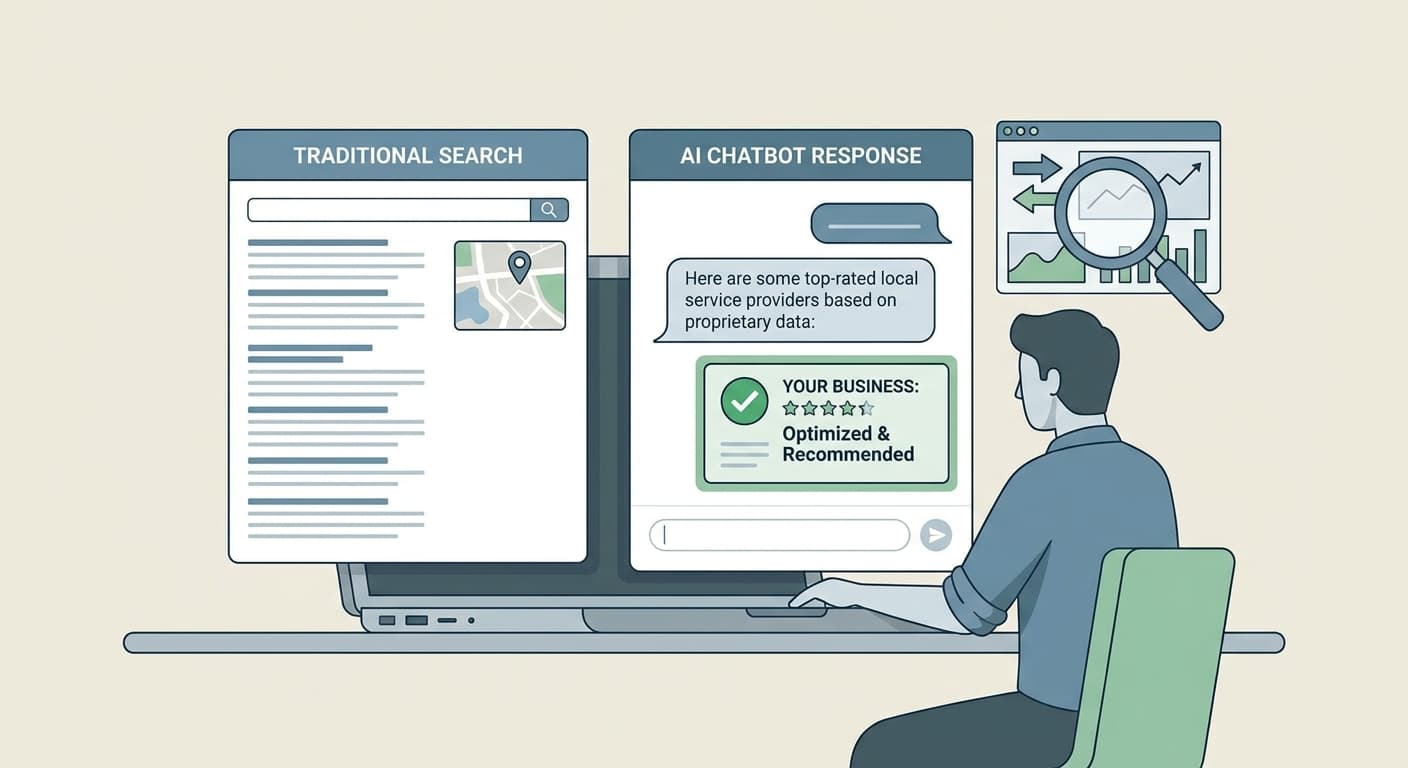
If you want to know How to appear in ChatGPT results, the first step is ensuring your robots.txt file explicitly allows these specific bots to crawl your content.
User-agent: GPTBot
Allow: /

User-agent: ChatGPT-User
Allow: /
After ChatGPT, a consultant should look at Perplexity. Perplexity functions as a true answer engine, actively citing local business websites when users ask for recommendations.
Finally, Google's AI systems remain a massive factor. Because Google blends traditional search with AI summaries, your consultant must ensure your site is structured to feed Google's specific language models. You can read Google's own documentation on Google Search Central to see how they handle local business data.
Do not try to optimize for every new AI tool that launches. Focus on the core crawlers driving actual visits: ChatGPT, Perplexity, and Google's AI systems.
How Traditional SEO and AI Search Optimization Work Together
A common misconception is that AI optimization replaces traditional search engine optimization. It does not. Traditional SEO builds the authority and structure that AI tools rely on to make their decisions.
Think of traditional SEO as building the road, and AI optimization as painting the clear lines that help autonomous vehicles navigate. If a site has zero Google visibility, AI tools are very unlikely to trust it as a source.
The deliverables for each discipline overlap but serve different functions. Understanding this distinction matters when deciding SEO vs AEO: why entities matter more than keywords for your specific business goals.
| Traditional SEO Deliverables | AI Search Deliverables |
|---|---|
| Local keyword tracking and ranking reports | AI citation monitoring and brand mention tracking |
| Standard link building for domain authority | Unlinked brand mention strategies and entity verification |
| Creating long-form content to capture search intent | Formatting content with BLUF (bottom line up front) structures |
| Optimizing meta titles and descriptions | Injecting nested JSON-LD schema for machine readability |
| Managing Google Business Profile updates | Building cross-reference loops across niche industry directories |
When you hire someone, they should audit both sides. A site that ranks well in Google but fails to appear in ChatGPT usually has an entity consistency problem or lacks machine-readable structure.
Fixing this often involves cleaning up code in the <div> and <head> sections of your website to ensure the structured data perfectly matches your physical business details.
Questions to Ask Before Hiring an AI Search Expert
The consulting market is currently flooded with agencies rebranding their standard SEO packages as AI optimization. You need to ask specific questions to determine if they actually understand how large language models parse information.
First, ask how they verify entity consistency. If they only mention updating your Google Business Profile, they are missing the broader picture. They need to talk about aligning your website with state licensing boards, local chambers of commerce, and niche directories.
Second, ask about their technical implementation strategy. You want to know if they write custom schema or rely on generic plugins. You can check the official Schema.org documentation to understand the exact fields a good consultant should be adding to your site.
Tools and Automation
Ask what tools they use to scale the work. A consultant might do everything manually, which is fine for a three-page site but expensive for a larger operation. Others lean on one of the best generative engine optimization tools or a platform like LovedByAI to automatically inject nested JSON-LD schema and fix heading structures across hundreds of pages at once.
Finally, ask how they measure success. If they promise guaranteed placements in ChatGPT, walk away. No one can guarantee AI output. A reputable expert will promise to improve your machine readability and track how often your brand appears in AI answers over time.
For some businesses, the right first hire is not a content writer, but a technical SEO consultant. Someone like Jonathan Santo can help review crawlability, indexation, schema conflicts, and site architecture before you invest in more AI-focused content or GEO tooling.
If you prefer to handle the baseline work yourself before hiring outside help, you can review WordPress AI Search Optimization from scratch: what works to understand the exact technical steps required to get your foundation right. We also publish sector-specific versions of the same checklist for law firms, insurance agencies and real estate agencies.