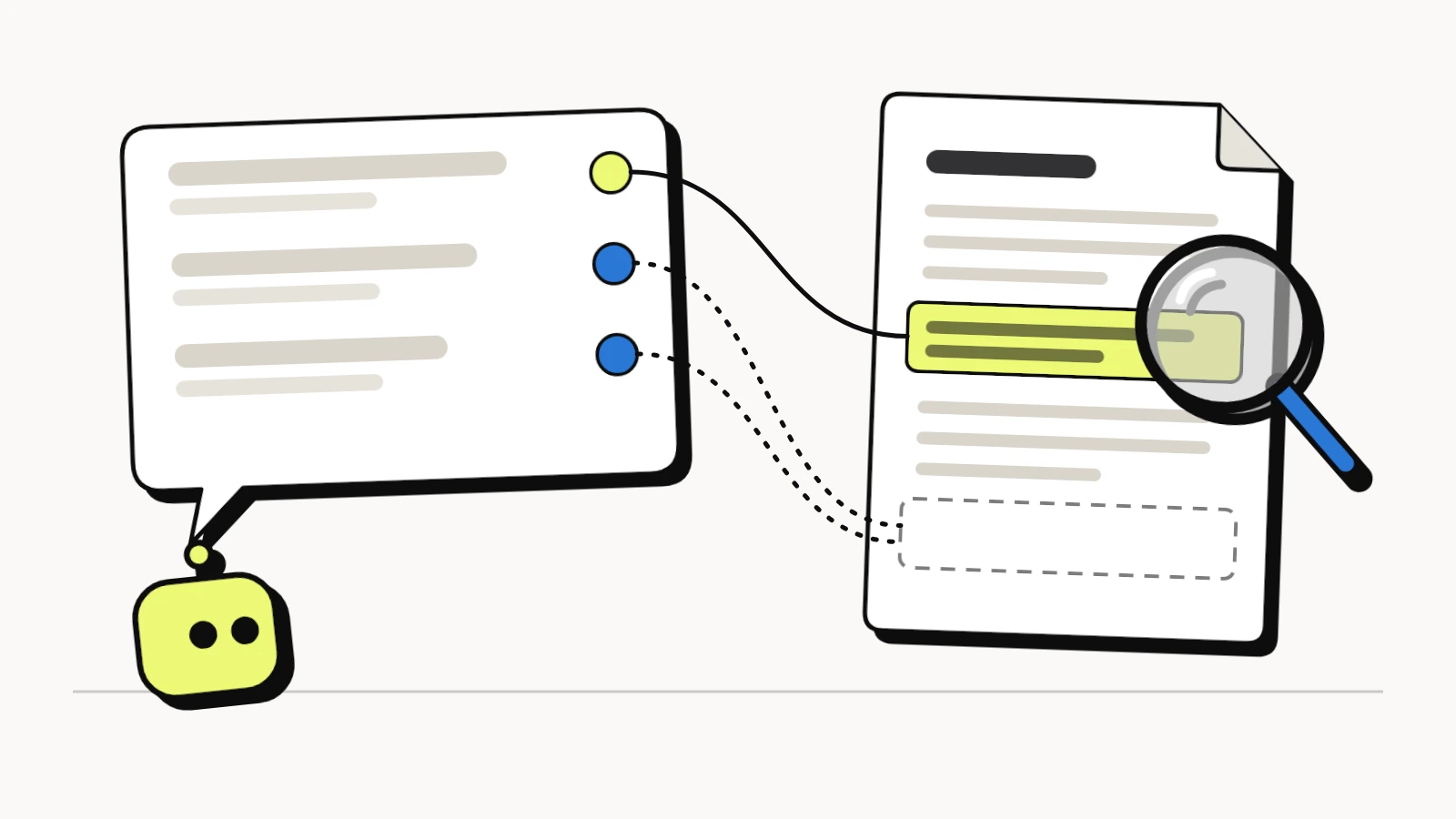
Check the exact passage behind each AI claim before you accept it. A citation shows which page an answer references. Claim support means that page backs up the specific statement, including its conditions.
For your business, that means checking:
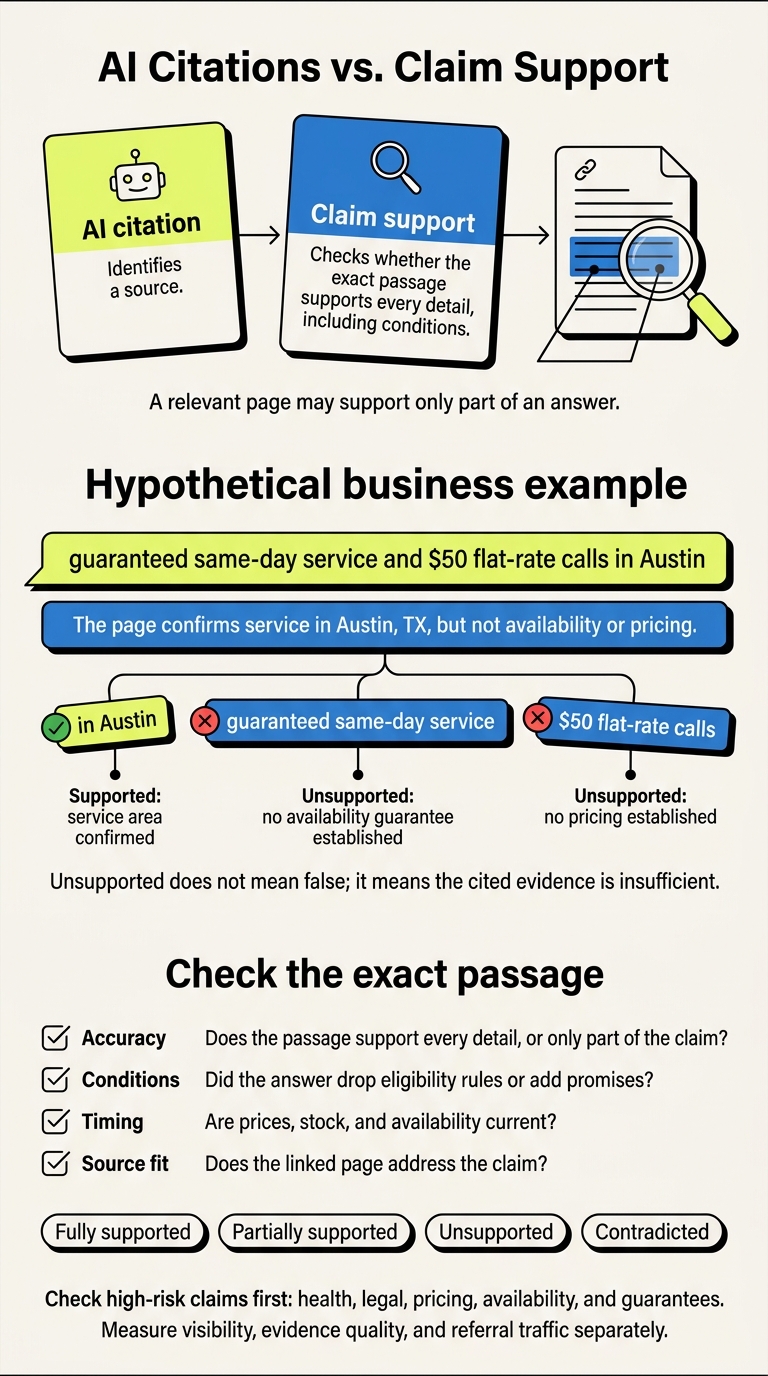
- Accuracy: Does the passage support every detail, or only part of the claim?
- Conditions: Did the answer drop eligibility rules or add promises?
- Timing: Are prices, stock, and availability current?
- Source fit: Does the linked page address the claim?
LovedByAI audits small business websites for AI search engines and tracks AI mentions and referral traffic. Keep those signals separate from claim checks. Start with health, legal, pricing, and guarantee claims, then recheck AI answers after you update your pages.
AI Citations vs. Claim Support: What the Source Actually Proves
How to Verify an AI Citation
Optimize your WordPress site for AI search
Find out what ChatGPT, Gemini, and Perplexity can and can't read on your site, and exactly what to fix.
AI Citations vs. Claim Support: Key Differences
A citation identifies a source within the AI crawl-to-citation funnel. Claim support checks whether that source proves what the answer says.
| Dimension | AI Citation | Claim Support |
|---|---|---|
| Source vs. proof | Links to a page relevant to the topic. | Requires passage-level evidence for specific details. |
| How much the source supports | May appear at a paragraph’s end, suggesting broad support. | Must justify every clause, including pricing and eligibility. |
| What it shows | Identifies a source. | Proves the claim. |
A Relevant Page May Support Only Part of an Answer
A page can match the topic without supporting every detail in the answer.
A pricing page may support “free estimates” but not “same-day service” unless it says so.
You need to check support passage by passage, rather than treating the whole page as proof.
Check the Claim, Conditions, and Source
Claim support means the source passage directly justifies the statement [3]. Check the exact wording, including conditions such as “may,” “eligible,” and “starting at.”
Support for one clause doesn't cover the entire sentence. Flag any added promise, expanded audience, or missing condition. This level of precision is critical for local entities trying to appear in ChatGPT results reliably. Pay particular attention to prices, eligibility, and availability, where an answer may go beyond what a relevant cited page actually says.
When Citations Do Not Support Claims
Citations can overstate what a source supports in several ways. These hypothetical business examples show six common mismatches.
Situation Apparent Support Actual Support Business Risk Partial support A software feature guarantees 100% synchronization uptime. The page documents “Real-time Sync,” not an uptime guarantee. Customers expect a promise the page never made. Omitted conditions A medical treatment is available to every patient. Treatment is offered only to eligible patients after consultation. Patients expect treatment they cannot receive. Unsupported additions An Austin plumber guarantees same-day service at a $50 flat rate. The page confirms service in Austin, TX, but not availability or pricing. Disputes over scheduling and charges. Wrong-source citation An HVAC certification page verifies emergency-service fees. The page establishes credentials, not pricing. Customers mistake credentials for verified fees. Outdated facts A retailer currently sells an item for $49. A 2024 page records a former launch price. Price complaints and demands to honor an expired offer. Insufficient detail A furniture item is in stock and will arrive by Friday. The page describes the item without inventory or delivery commitments. Canceled orders and avoidable support requests.
The cases below show how a citation can link to the right page without supporting the exact claim.
Partial Support and Missing Conditions
In the software example, “Real-time Sync” is a feature, not a 100% uptime guarantee. In the medical example, removing “eligible patients” and the consultation requirement turns a conditional offer into a universal promise.
Keep limits beside the claim. When you describe a capability, separate it from any guarantee. Keep eligibility requirements in the main page copy so readers see the conditions alongside the offer.
Added Claims and Misplaced Citations
Even a relevant citation can mislead when you attach it to the wrong part of a sentence.
An answer might promise “guaranteed same-day service and $50 flat-rate calls in Austin,” with a citation at the sentence’s end. If the linked page covers only the service area, same-day service and pricing are unsupported.
Readers may take that citation as support for the whole sentence. Remove unverified promises, then put the citation beside the service-area statement it supports.
Old Facts and Unstated Details
A retailer’s 2024 page shows a $49 launch price. That shows a past offer, not today’s price, inventory, or delivery timing.
Old evidence and missing evidence need different fixes. Check price, stock, and delivery against current page copy. A newer page date alone doesn't confirm any of those details.
How to Check Claim Support for Your Business
Check each factual claim against the passage cited to support it.
Match Each Claim to a Source Passage
Break the answer into individual factual claims. For each one, copy the exact supporting passage from the cited page. Check details such as prices, dates, locations, eligibility, and exceptions.
Label each claim fully supported, partially supported, unsupported, or contradicted. An unsupported claim lacks enough evidence. That doesn't mean it's false.
This record helps you check whether citations are precise and complete.
Track Citations and Claim Support Separately
Keep citations and claim support in separate columns. First, check whether each citation supports the claims attached to it. Then check whether every factual claim has both a citation and source support.
Use LovedByAI Reports Alongside Manual Checks
Use AI visibility tools and automated reports to decide what to review first, while keeping manual checks in your process. LovedByAI audits and optimizes small business websites for AI search. It also tracks AI mentions and referral traffic from ChatGPT, Gemini, Perplexity, and Claude.
Treat these reports as visibility signals, not proof of claim support. If your data isn't appearing, you may need to test if your site is invisible to these engines.
Conclusion: Check High-Risk Claims First
Follow the same claim-checking process, starting with the facts that carry the most risk: health claims, legal obligations, pricing, availability, and guarantees.
State facts clearly, include qualifications, and add dates where needed. Make sure your published pages and AI-readable copy agree.
After each update, recheck a sample of AI answers that include those high-risk facts. This helps ensure your site continues to show up in AI search accurately. Page changes don’t guarantee updated AI answers. Updating your pages starts the verification process; you still need to check the answers.
Measure visibility, evidence quality, and referral traffic separately.
FAQs
What should I do if AI misquotes my business?
When AI misquotes your business, use the error to make your website clearer and back up what it says. Check your live pages against your business records to confirm that prices, hours, and service areas are correct and up to date. Replace old or vague details with clear text that’s easy to find.
Support your claims with primary sources or specific data points. Log your changes in your audit worksheet, then test the prompt again.
How often should I recheck AI claim support?
Recheck AI claim support monthly as part of your routine reporting. Use the same set of test prompts across major AI platforms to track visibility trends and spot pages that need updates [1].
Run a deeper audit quarterly and right after major changes to your business facts, site templates, or schema markup. Review major content updates, such as new research or benchmarks, right away to confirm your evidence still supports your claims [1][2].
Can multiple sources support a single AI claim?
Yes. AI systems can combine information from several sources to support a single claim and build an answer. But repeating a claim across sources doesn’t prove it’s correct.
Your content should provide clear evidence with sources, such as dated studies or original datasets. This gives AI a chain of reasoning it can trace and check.