Open the cited page and check whether it supports the whole claim. AI citation studies assess whether links work, sources match the topic, and claims have support. A working link alone doesn't pass all those checks.
Before you use a study’s score to judge your business’s AI mentions, check:
- What gets counted: citations, claims, or entire answers.
- How support gets scored: full, partial, or missing, and whether reviewers agree.
- What gets tested: sample size, human versus automated review, and how closely the searches match your customers’ questions.
For your own checks, record factual errors separately from citation support. Save cited page text and repeat the same prompts after updates. Changes alone don't prove your edits caused the result.
LovedByAI tracks AI mentions and referral traffic.
AI for Researchers: Critical Evaluation of AI-Returned Literature
Optimize your WordPress site for AI search
Find out what ChatGPT, Gemini, and Perplexity can and can't read on your site, and exactly what to fix.
How Researchers Review Claims and Sources
Researchers score citation support by checking each claim against its cited source. Evaluating Verifiability in Generative Search Engines examines whether generated answers include citations and whether those citations support the statements they’re attached to.
How Human Reviewers Judge Support
Reviewers compare each claim with the cited passage. When a sentence contains several factual claims, they split it up so each claim gets its own label. Most automated scores try to match this manual process. Understanding these scoring methods is the first step toward earning direct citations in AI answers.
What Reviewer Agreement and Automated Scores Mean
Even when reviewers agree, automated scores can miss changes in the cited sources themselves. You should treat reviewer agreement and automated citation scores as limited signals, since citation sets can vary across engines and queries [3].
How Study Design Limits the Findings
A larger sample can make a score more precise without making it more representative of local search behavior. How much you can trust that score depends on the study design. Even a strong citation score can hide weak support for individual claims.
Count Queries, Answers, Claims, and Citation Pairs Separately
Claim-level counts tell you more than answer-level totals. When you read a paper’s sample size, separate the full evaluation sample from the smaller subset reviewed by people. Use individual claims or claim-citation pairs as the main unit of analysis, while accounting for the fact that claims within the same answer are correlated.
Princeton GEO-bench, for example, reports 10,000 queries. In larger studies, automated metrics typically cover the full sample, such as AI crawler statistics, while human review usually covers only a smaller subset[3].
Why Benchmark Scores May Not Fit Local Searches
You can compare benchmark scores only when the benchmark, model version, retrieval settings, and test date match. Page type matters, too. Results drawn mostly from blogs may not reflect how local service pages perform.
On small business sites, service pages, location pages, and blog pages address different search intents. For local businesses, site-level patterns are safer to generalize than page-level benchmark averages[4].
How Small Businesses Can Use the Findings
How to Check AI Citation Support
Check Business Facts Before Counting Citations
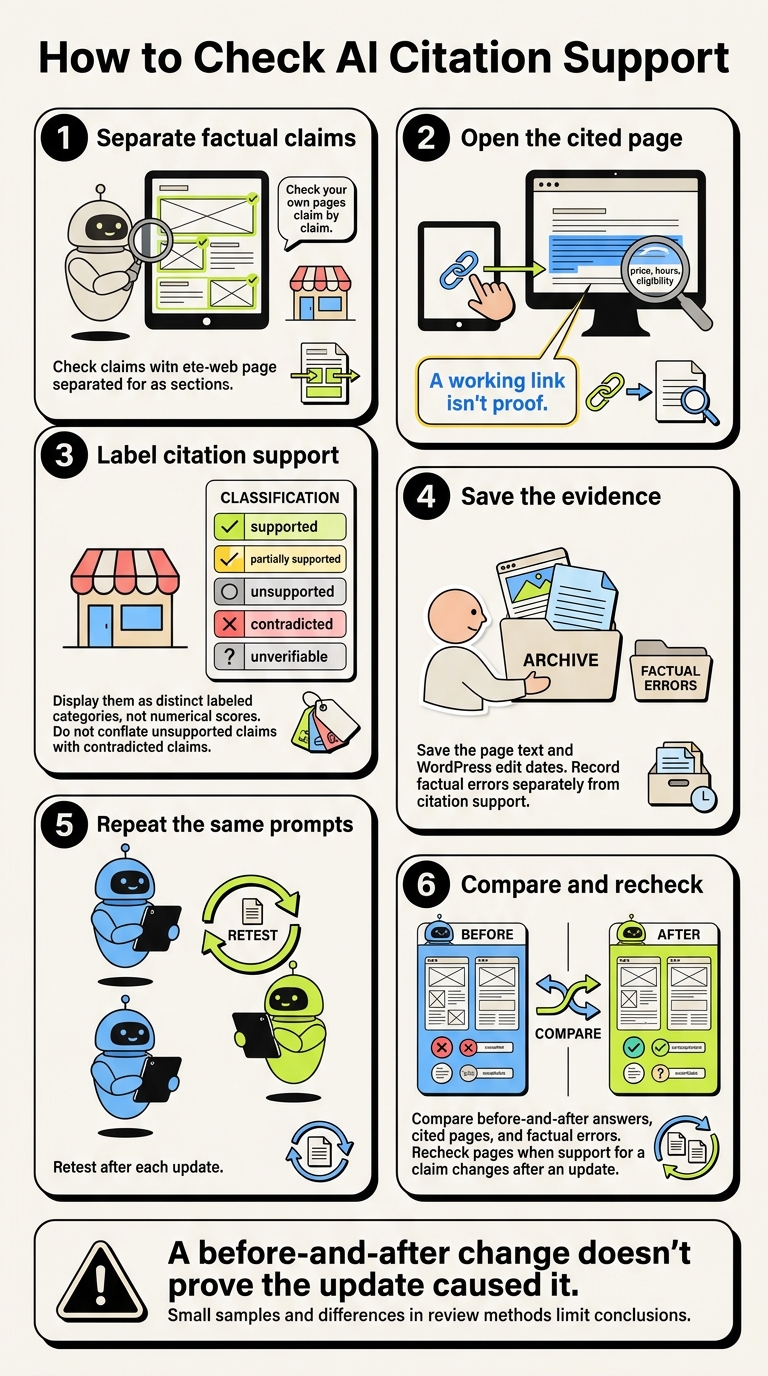
Check your own pages claim by claim using a content formula that makes AI engines cite a page. A working link isn't proof. Open each cited WordPress page and find the exact passage that supports the full claim, including any limits on price, hours, and eligibility.
Label each claim as supported, partially supported, unsupported, contradicted, or unverifiable.
Use Monitoring to Track Changes, Not Prove Causes
Once you've checked support, repeat the same prompts after each update. Compare the before-and-after answers, cited pages, and factual errors. Save the page text and WordPress edit dates so you have a record of what changed.
Small samples and differences in review methods mean a before-and-after change doesn't prove the update caused it.
Use LovedByAI to monitor AI mentions and referral traffic. Recheck the pages when the support for a claim changes after an update.
FAQs
Can a fully supported AI claim still be wrong?
Yes. A citation identifies the source the AI referenced. For that citation to support a claim, the cited passage must directly back up what the answer says.
Even if the source is correct, the answer can misuse its information, leave out key conditions or qualifiers, or combine sources incorrectly. A citation at the end of a paragraph can also make it look like the source supports more than it does.
Check each detail, including pricing, availability, and eligibility, against the cited passage. Each one needs explicit support.
How many claims should I audit on my website?
Start by testing 10 priority customer questions on platforms like ChatGPT, Gemini, and Perplexity. Track mentions, citations, and whether sources support the claims to set your baseline [1][2]. Then expand to 20 prompts for more reliable coverage across conditions or platforms [1].
Results vary from week to week. Rerun the same prompts monthly to track trends and see whether your updates are working [1].
Which customer questions should I use to test AI citations?
Use the same 10 to 20 prompts each month, based on what your customers actually search for. Include questions that name your company and category questions that ask for local recommendations without mentioning your brand. Focus on pricing, service areas, availability, health claims, legal obligations, and guarantees.
For each prompt, save the full answer and cited URLs, then check whether each source supports the claim. Record the time, location settings, and model versions so you can compare monthly audits consistently.