November opens with AI search reaching for the till. Google's AI Mode now hands home-service searches straight to booking pages, OpenAI is building a place for businesses to see how ChatGPT talks about them, and on desktop Google lets an AI summary, not the brand's own panel, introduce a brand. For the longer-run picture behind these monthly readings, our 2026 AI traffic study benchmarks what AI assistants actually send to small business sites over a full window.
November 2026 at a glance
- Oct 31–Nov 2GoogleAI Overviews start replacing the brand knowledge panel in the right-hand column of desktop results for brand searches.
- Nov 3OpenAIOpenAI's Adam Fry says ChatGPT now handles roughly one-fifth as many search-like queries as Google.
- Nov 3GoogleSearch Console's help now calls “Crawled - currently not indexed” a common status that doesn't necessarily need attention.
- Nov 4GoogleAI Mode adds direct booking and quote links for US home services through Angi, Thumbtack, Housecall Pro and Jobber.
- Nov 4GoogleGoogle emails sites that site reputation abuse manual actions no longer affect results shown in the EEA.
- Nov 5MetaFacebook Answers, Meta's AI-written topic pages, passes 6 million pages in Google's index, and Glenn Gabe calls it scaled content abuse.
- Nov 6OpenAIA “Claim your business in ChatGPT” banner is spotted: a Business Hub showing verified businesses their ChatGPT impressions and clicks. Not live yet.
- Nov 6–9Google“Book online” buttons appear on Business Profiles that never set up booking, some pointing at Google pages that return errors.
The details, ranked by what they mean for your site:
Google AI Mode now books home services, and Book online buttons are spreading
On November 4, Google's Robby Stein announced on X that AI Mode now has direct links to research and book home services in the US. Ask it for a plumber or a cleaner and the answer can carry a button to request a quote or book a slot, routed through four partners: the marketplaces Angi and Thumbtack, and the job-scheduling software Housecall Pro and Jobber. ServiceTitan is listed as coming soon.
The partner you sit behind decides what this costs and who owns the customer.
- Through Jobber, the request lands in your own Jobber account. Its help page says there are no lead fees for requests that come through AI Mode, but you need a paid plan (trials are excluded), a full address in Jobber and a Google Business Profile at the same address. Once Google matches the two, it adds a Book Online button to your profile, usually within a few days.
- Through Housecall Pro, the company says it also charges no lead fee and enrols its users automatically, though its own announcement calls the integration coming soon.
- Through Angi, the homeowner lands on your Angi profile to request a quote, under Angi's usual terms. As Search Engine Journal points out, a booking request through Google's own Local Services Ads is a paid lead.
Google has not said how AI Mode picks which businesses to show.
Book online buttons nobody asked for
Two days later, local SEOs started finding Book online buttons on Business Profiles that had never set up booking. Joy Hawkins, Brandon Schmidt and Syed Amir reported them to Search Engine Roundtable on profiles for home care and home service businesses. Some buttons pointed at the business's own contact or scheduling page. Others pointed at Google's own reservation pages and returned a server error. Google has not explained it, and the reports do not tie it to the AI Mode partners, so treat it as a separate change that landed in the same week.
Here is why that should get your attention. A booking button is the shortest path from "who can fix this" to a job, and right now some of them lead to an error page.
Do this: open your Business Profile in Google Search and click your own booking link. If it is wrong or broken, edit or remove it. If you are a US home service business already on Jobber, check that "Help clients find my business" is switched on in Company Settings and that your Jobber address matches your profile exactly. If you are on Housecall Pro, watch for the switch-on, since you will not need to do anything.
OpenAI is building a ChatGPT Business Hub: "Claim your business in ChatGPT"
On November 6, the e-commerce analyst Juozas Kaziukėnas posted a screenshot of a banner inside ChatGPT reading "Claim your business in ChatGPT". Behind it, he says, sits a Business Hub that would show a verified business two numbers, tracked daily: how often ChatGPT mentioned it in answers, and how many clicks those mentions sent to its website. Businesses would also be able to keep their product and business details current. Search Engine Roundtable carried the story the same day.
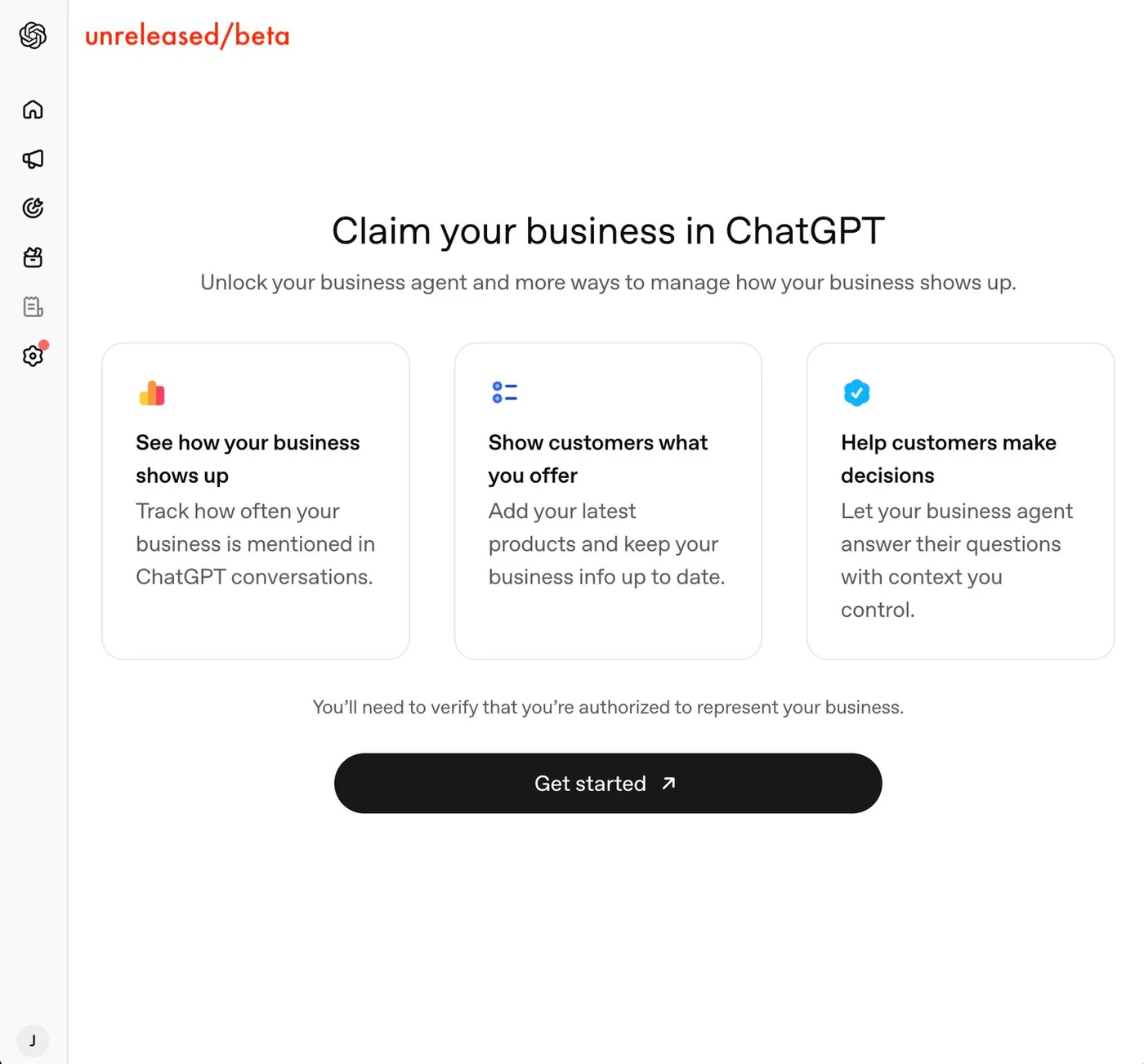
His post sets the limits plainly. Verification works by connecting something you already own, a Shopify store being his example. The hub shows no prompts, no user data and no competitor rankings, so it would tell you that your mentions moved, not why. He saw the first traces in August and reads the banner as a sign it is close. OpenAI has not announced anything.
Why ChatGPT is building one now
The scale explains it. On November 3, OpenAI's Adam Fry told Alex Kantrowitz in an interview for Big Technology that ChatGPT's volume of search-like queries is now roughly one-fifth of Google's, counting anything a person would once have taken to a search engine. That is OpenAI's own figure, with no data published behind it, but a fifth of Google is big enough for businesses to want a dashboard for it.
Google, for its part, shows AI impressions in Search Console's AI report but no clicks there, and asked about adding them, Gary Illyes said there was nothing to announce.
You can already count ChatGPT's clicks, though. On the small business websites LovedByAI monitors, 99.9% of the visits ChatGPT sent in November's first week carried its utm_source=chatgpt.com tag, so the click half of the hub is in your analytics today. What the hub would add is the half you cannot see: the answers where ChatGPT mentioned you and nobody clicked.
Do this: nothing to claim yet, and anyone selling a "ChatGPT business listing" this month is selling something that does not exist. Get ready instead. Make sure the name, address, opening hours and services on your website match your Business Profile and the directories you are in, because that is what an AI summary is built from today. If you sell on Shopify, that store is your likely way in when the hub opens.
Google AI Overviews are replacing brand knowledge panels on desktop
Search for a brand on desktop now and the right-hand column, where Google's knowledge panel used to describe the company, often holds an AI Overview instead. Chris Long and David McSweeney flagged it at the end of October, and Search Engine Roundtable collected examples on November 2 for searches like Apple, Zillow and Coca-Cola. A week earlier Sachin Patel had spotted knowledge panels carrying an AI-generated label. Google has not announced the change.
The knowledge panel pulled structured facts, much of it from sources a business could claim and correct. An AI Overview is a written summary of whatever Google finds about you, so the first paragraph a searcher reads about your brand is now Google's paraphrase, not your own description.
Do this: search your business name on a desktop browser, signed out, and read what the summary says. If a fact is wrong or out of date, fix it at the source: your About page, your Business Profile, and any directory or review site that still carries the old version. Write your About page so its opening lines would make a good summary on their own, because that is roughly what Google is now looking for.
Google rewrote "Crawled - currently not indexed" in Search Console
On November 3, Google changed the explanation for one of the most-asked-about statuses in Search Console's Page indexing report. The help page now says that Google doesn't index all pages across the web, so this is a common message for many sites, and one that doesn't necessarily indicate an issue that needs attention. For pages that matter, it points to the URL Inspection tool. The old line, that the page may be indexed in the future and does not need resubmitting, is gone.
As Barry Schwartz noted, the new text says nothing about quality, though Google has named quality as a reason for this status before. Read it as: some pages are not worth an index slot, and that is normal.
Do this: sort the pages in that report into two piles. Thin tag pages, near-duplicate location pages and old thin posts can stay out of the index, or be merged and redirected. Pages you would want a customer or an AI assistant to find, like service pages and your best guides, deserve a URL Inspection check and real improvement. Resubmitting them unchanged does nothing.
More AI search news from November 2026
- Google's spam team looks busy. Lily Ray said on November 9 that she has had more messages from site owners hit by manual actions in the last couple of weeks than at any point she can remember, and others reported the same. Manual actions arrive as a message in Search Console, so check the Manual actions report if traffic dropped suddenly.
- Facebook Answers, Meta's AI-generated topic pages, passed 6 million pages in Google's index, reported November 5, ranking in blue links, AI Overviews and AI Mode. Glenn Gabe called it scaled content abuse, the pattern Google's October guidance described as little to no effort. Whether Google acts against a platform this size will say a lot about how evenly the rule is applied.
- Site reputation abuse manual actions no longer affect results in the EEA. Google emailed affected sites around November 4 about a policy change that took effect on August 30. Outside the EEA nothing changed.
- AI Mode can now show up to four ads in one answer, spotted November 4. More paid space inside AI answers, nothing for an organic page to change.
- Google is pushing AI Mode users to opt in to Personal Intelligence, its setting for personalised answers, with pop-ups seen November 6. Personalised answers make any single check of how AI Mode describes your business even less representative.
- Search Console showed a strange spike in clicks for some sites around November 3, which looked like a reporting bug and settled for most within a day. If your November chart has one tall day, check it before you celebrate. Separately, the Performance report now lets you select several device types at once.
- Microsoft Clarity added agent analytics, a view of visits from AI agents, along with an Ask Clarity assistant, on November 4. Clarity is free, so it is a cheap way to see agents on your own site.
AI referral and crawler data for November 2026: what our logs say
These numbers come from the referral logs of the small business websites LovedByAI monitors, on the same sites in both windows. November's first week is compared with October's first week, both seven days long, which keeps the weekday mix equal and leaves out October 8 to 15, when GPT-6 stripped ChatGPT's tags. A one-week window is short, so read these as an early reading.
ChatGPT's tag is fully back
In October's edition the story was a week of ChatGPT visits arriving without a label. November's first week shows that gap closed: almost every ChatGPT visit carried utm_source=chatgpt.com, slightly more than in the first week of October, and the typical site's ChatGPT visits sat 8% above the same week a month earlier. That is a steady reading, not a surge, and one week cannot carry a trend. The figures are medians across sites, and no single site accounts for more than a few percent of the visits, so one busy site is not driving them.
Gemini is the opposite case. It sent about as many visits as in October's first week, and only about one Gemini visit in seventeen carried the UTM tags Google began adding in October. The rest still arrive marked only by their referrer, so a report that filters on UTM tags alone will undercount Gemini.
Citations and visits are the end; crawls are a means. If you want to know where your own site sits, the free GEO checker reads a live URL, our on-page GEO guide covers what to fix in order, and last month's edition covers what changed in October.