If you are trying to work out how your brand shows up in AI search, Peec AI gives you more detail than almost anything else at its price. It tracks brand visibility, position, sentiment, share of voice, prompts, competitors, and the sources AI engines pull from when they write an answer. On top of that sit query fanouts, citation analysis, gap analysis, and brand perception.
The harder question is what you do with all of it on Monday morning.
This review covers what Peec AI actually does, what it costs (checked against the live pricing page, in euros, on 16 August 2026), where the product deliberately stops, and who should buy it anyway.
Quick verdict
Peec AI
A strong AI search intelligence layer. Buy it to understand your visibility, not to fix it.
- Best for
- AI visibility tracking, competitive intelligence, and source analysis
- Main strength
- Detailed visibility, competitor, and source/citation analysis in one place
- Main weakness
- Built to measure and explain AI visibility, not to implement the fixes
- Ease of use
- Quick to set up, clean interface, straightforward day-to-day workflows
- Pricing
- From €85/month, or €70/month billed annually, for 50 tracked prompts
- Models tracked
- ChatGPT, Google AI Mode, AI Overviews, Microsoft Copilot, Perplexity, Gemini (pick 3 below Enterprise)
Peec AI is a good fit if your job is to measure AI search visibility, track competitors, investigate which sources feed AI answers, and report on how your brand appears for the prompts you monitor.
If the job extends past measurement into deciding what to change and shipping it across your website, content, technical SEO, GEO, or AEO workflows, you will want to weigh Peec AI against platforms that cover those steps directly.
What Does Peec AI Do?
Peec AI is built for SEO teams, content teams, agencies, and brands that want detailed intelligence about their presence in AI search. It combines visibility tracking with competitor, source, citation, and brand analysis.
The product ships as six modules. They are easier to hold in your head grouped by the question each one answers rather than listed flat.
What you get
Peec AI's six modules, grouped by the question each one answers
Where do we stand?
AI visibility and prompt tracking
Mentions, position, sentiment, and share of voice for the prompts you choose, tracked daily across models.
Brand insights and AI perception
Which attributes AI systems attach to your brand, and how that description shifts by topic.
Who is beating us, and where?
Competitor and gap analysis
Prompts where rivals appear and you do not, plus domains citing them but not you.
AI advertising insights
Which advertisers are showing up around the AI searches you already track.
Why does the answer look like that?
Source and citation analysis
The domains and specific URLs an answer was built from, and how often each one is reused.
Query fanout analysis
The sub-queries a model expands your prompt into before it writes the final answer.
Every module answers a question about the prompts already in your tracking set. None of them answers the question of which prompts should have been in it.
1. AI visibility and prompt tracking
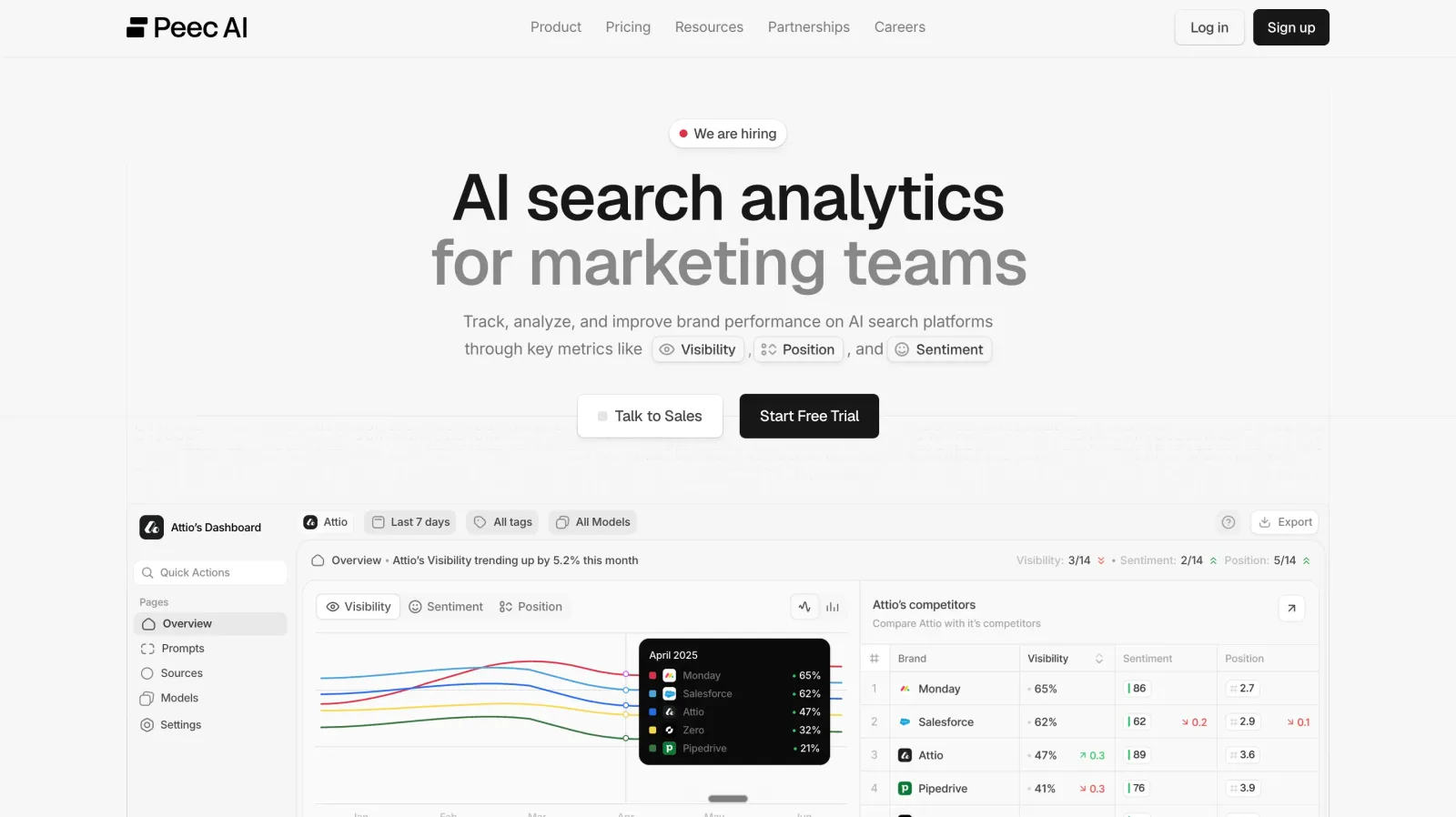
You define the prompts that matter to your business and Peec tracks how your brand performs against them: mentions, visibility and share of voice, position, sentiment, performance by model, and how competitors do on the same prompts. Tracking runs daily on every plan, including Starter.
This is the difference between measuring a trend and running a manual search now and then and hoping you remember what last month looked like.
2. Source and citation analysis
Peec AI shows which sources an AI platform used to build an answer: the domains that appear, the specific URLs cited, how often each source gets reused, which sources move your visibility, and where there is an opening for your own content.
For SEO and content teams this is the most useful part of the platform. Knowing a competitor is winning tells you very little. Knowing that three industry roundups and one Reddit thread are doing the work tells you where to go.
3. Competitor and gap analysis
You can line your AI search presence up against competitors and find prompts where they appear and you do not, domains that cite them but never you, URLs showing up for them only, and raw differences in visibility and share of voice.
That turns a mention dashboard into competitive research.
4. Query fanout analysis
AI search does not always treat your question as one search. A system can expand a query into several related sub-queries before it writes the final answer, a behavior usually called query fanout.
Peec AI's fanout view exposes those underlying searches, which means you can optimize around the cluster of questions feeding an answer instead of the one obvious phrase.
5. Brand insights and AI perception
Peec also looks at how AI systems describe brands: which attributes get attached to you, how those compare with competitors, where positioning is strong or weak, and how the description shifts by topic.
Appearing is not the same as appearing well. A brand can be mentioned constantly and still be framed around the wrong product.
6. AI advertising insights
Depending on the queries you track, Peec surfaces which advertisers are active around relevant AI searches and how brands are positioning themselves against AI search demand. It is competitive context rather than a core workflow, but it is there.
Who is Peec AI best for?
Peec AI suits established brands, SEO teams, content teams, agencies, and marketing teams that need detailed AI search intelligence. It is a strong buy if the questions on your list look like this:
- How visible is our brand in AI search, and is that number moving?
- Which competitors are winning the same prompts?
- Which sources and URLs are influencing the answers?
- Where are competitors being cited instead of us?
It is a weaker buy if your list looks more like "what do we change first, and who ships it".
Peec AI Features: What I Actually Like
Peec has a broad analytics layer, but a few things stand out well past the rest. The strongest features are the ones that move you from are we visible to why, who is beating us, and on the back of which sources.
Source and citation analysis. Peec does not stop at "your brand was mentioned". You can investigate the domains and individual URLs being used as sources. That is the raw material for competitive research, content planning, and citation gap analysis.
Competitor intelligence. Competitor tracking is wired through the whole product rather than bolted on. Seeing which competitor replaced you, on which prompts, and how they perform across the set is far more actionable than watching your own line move.
Prompt-level tracking. AI visibility is not one universal ranking. A brand can dominate one topic and be invisible in the next one over. Prompt-level granularity is what makes the data usable. Related reading: best AI search visibility tools.
Brand perception. Understanding how AI describes you, not just whether it mentions you, matters more than most teams expect. Related reading: best software for AI visibility enhancement.
Query fanout. Genuinely interesting, and still rare. It gives you the related questions that contribute to an answer instead of one guessable query.
Breadth in one place. Visibility, prompts, competitors, sources, citations, sentiment, and brand perception all live in the same product instead of four spreadsheets and a recurring calendar reminder.
The bigger takeaway: Peec AI's value is its intelligence layer. It gives you far more context than a mention tracker, particularly when you need to understand competitors, sources, and how AI systems frame your brand.
Where Peec AI Has Room to Improve
Peec AI is strong on measurement and competitive intelligence. The limitations below are mostly about product scope rather than execution, but they change the buying decision.
Measurement is not implementation
Peec shows where your brand is missing, which competitors appear instead, and which sources get cited. Turning that into technical SEO changes, content updates, schema, or entity work still needs another tool or an internal team.
Put the whole workflow on one page and the boundary is obvious.
Measurement vs. action
The AI search loop has six steps. Peec AI reports on the first three.
- 1
Choose the prompts to track
You author the list from what you think buyers ask. Peec suggests some; reviewers report meaningful overlap in the suggestions.
- 2
Measure visibility
Mentions, position, sentiment, and share of voice against a competitor set, daily.
- 3
Read the sources
Which domains and URLs the answers were assembled from, and which of them cite a competitor instead of you.
Peec AI's report ends here
Everything below is still your job, your agency's, or another tool's.
- 4
Decide what to change
Which page, which entity, which missing answer. A cited competitor URL is evidence, not an instruction.
- 5
Ship the change
Content, structured data, entity signals, internal links, crawlability. This happens in your CMS, not in a dashboard.
- 6
Re-measure and attribute
Did the change move the answer, and did the answer move traffic, leads, or revenue?
This is a scope difference, not a defect. Peec AI is explicitly an analytics product. The cost only shows up when a team buys measurement expecting the loop to close on its own.
Our assessment: this is positioning, not a flaw. Peec AI is an analytics product and says so. The cost lands on teams who bought measurement expecting the loop to close by itself.
Your visibility is only as wide as your prompt list
This is the limitation worth the most attention, and it is the one buyers underestimate.
Peec AI tells you how visible you are for the prompts you chose to track. That is not the same as how visible you are across your niche, your industry, or your customer journey.
Say a company tracks 50 carefully chosen prompts based on real experience and research. Peec might show excellent visibility. But what about the topics, use cases, questions, and emerging searches that never made the list?
The measurement boundary
A visibility score describes the prompts you picked, not your category
50 prompts on a Starter plan. Peec reports your visibility, position, sentiment, and share of voice here, in detail, every day.
Every other way a buyer phrases it. Absent from the report, and absent from the report as a gap. It reads as silence, not as a miss.
Illustrative, not measured: nobody knows the true size of a category's prompt space, which is exactly the problem. Prompt sets are authored from what a team already believes its buyers ask, so the tracker inherits the team's blind spots and then reports confidently from inside them.
The platform can grade you against what you are monitoring. It is much harder to learn what you are not monitoring, because an untracked prompt does not show up as a gap. It shows up as nothing at all.
That makes prompt selection unusually high stakes. One G2 reviewer reported that roughly 40% of the automatically suggested prompts overlapped, which left manual work to find the ones actually worth a slot. There is also no demand signal to tell you whether a given prompt is one anybody asks, so you are allocating paid tracking capacity on instinct.
Good visibility does not guarantee good outcomes
Suppose your visibility score across those 50 or 150 prompts looks great. Share of voice is climbing. Competitors are tracked. And leads are flat.
A visibility platform can confirm you appear often for tracked prompts. It cannot tell you:
- Which topics you are missing entirely
- Which high-value queries you never appear for
- Which parts of the customer journey have weak coverage
- Which content gaps are costing conversions
- What to optimize next
- Whether the tracked prompts represent the opportunities that matter commercially
That is the distinction between measuring visibility and finding the opportunities that would improve it.
Prompt and model limits bite at scale
Peec's brand plans are metered on prompts and models. Starter includes 50 prompts and 3 models, Pro 150 prompts and 3 models, Advanced 350 prompts, 3 models, and multi-country tracking. Six models are available in total below Enterprise, so a team that wants to watch all six is buying add-ons, and Enterprise is the only tier with broad model coverage and API access.
Our assessment: entry plans are fine for focused tracking. Teams monitoring hundreds of prompts, several markets, or many models should price the whole configuration rather than the headline tier.
Some capabilities are tier-dependent
API access, SSO, and full model coverage sit on Enterprise. Irrelevant to a three-person SEO team, decisive for an organization that needs integrations, governance, or a custom data pipeline.
Reporting still needs hands
There is a lot of data in the product, and getting it into exactly the shape a client or an executive wants can still mean exports, filtering, and manual assembly. One recent G2 reviewer praised the UX while noting exactly that.
The data needs interpreting
AI visibility data is not a Google ranking report. Results shift with model, prompt phrasing, location, context, and timing. Even a detailed Peec report describes a sample of behavior, not a fixed ranking every user sees.
Our assessment: this is a limitation of AI search measurement generally, not of Peec specifically. Read these platforms for trends and comparisons, not absolutes.
What Do Users Say About Peec AI?
Public reviews skew positive, especially on interface quality, ease of use, visibility tracking, competitive analysis, and source intelligence.
What reviewers like- The interface. Easy to navigate, easy to learn, quick to get running. It is the single most consistent theme in feedback.
- Prompt-level detail. Visibility, mentions, position, sentiment, and competitors, per prompt, in a structure teams can actually report from.
- Competitive and source intelligence. Investigating the domains behind an answer, not just whether you were named.
- Support. Responsive and helpful, which matters most during setup and while a team is still learning to read the data.
- Visibility is bounded by the tracked prompt set, so the score describes your list rather than your market.
- Suggested prompts overlap enough to need manual pruning.
- The platform identifies gaps without closing them, so the "what now" still lands on your team.
Where LovedByAI takes a different approach
This is the cleanest difference between the two products. Peec AI is built to help teams understand and monitor AI visibility. LovedByAI is built to connect that visibility to optimization work and then implement it.
If Peec shows strong visibility for tracked prompts while leads stay flat, the answer is not to track more prompts. It is to find where the actual opportunity sits. LovedByAI is designed around identifying what is missing, what should be optimized, which pages need attention, and what changes are likely to move AI search presence.
Peec AI Pricing
Peec AI runs four brand tiers. What separates them is prompts, projects, countries, and models, plus access to Looker Studio, the API, and dedicated support.
Pricing · read 2026-08-16
Peec AI charges for prompts. The unit cost falls as you scale up.
Starter
SEO and content managers starting out
€85/mo
€70/mo billed annually
50 prompts
- 1 project · 1 country
- 3 models
- Unlimited users · daily tracking
Derived cost per prompt
€1.70per prompt, per month
Pro
SEO teams needing more coverage
€205/mo
€180/mo billed annually
150 prompts
- 2 projects · 3 countries
- 3 models
- Unlimited users · daily tracking
Derived cost per prompt
€1.37per prompt, per month
Advanced
Multi-country plus Looker Studio
€425/mo
€360/mo billed annually
350 prompts
- 5 projects · 3 countries
- 3 models
- Unlimited users · daily tracking
Derived cost per prompt
€1.21per prompt, per month
Enterprise
API, SSO, custom tracking frequency
Custom
Annual contract
Custom prompts
- Unlimited projects
- Up to 11 models
- Unlimited users · daily tracking
Derived cost per prompt
—
Prices read from peec.ai/pricing on 16 August 2026, in euros, with both billing toggles checked. Cost per prompt is our arithmetic on the monthly list price, not a Peec figure. Watch the fourth model: one extra model beyond the three included costs €30/month on Starter, €70 on Pro, and €140 on Advanced, so a Starter plan tracking five models is closer to €145/month than €85.
Two things are easy to miss on the pricing page.
First, the fourth model is where the bill moves. Three models are included on every brand plan and six are available, so watching ChatGPT, AI Mode, AI Overviews, Copilot, Perplexity, and Gemini at once means paying for three add-ons. On Starter that is €30 per extra model per month, which takes an €85 plan to roughly €175 before you have added a single prompt.
Second, annual billing saves about 15%, and Peec applies it per plan rather than as a checkout discount, which is why the advertised number changes when you flip the toggle.
Is Peec AI worth the price?
If the job is tracking and analyzing AI search visibility, yes. Starter gives a small team 50 prompts across three models at a price that does not need a business case, and the upper tiers make sense once you need broader coverage, several projects, or deeper reporting.
The question is what you expect the platform to do with the data. For where do we appear, who else is there, what got cited, Peec is a strong analytics layer for the money. If you expect it to surface opportunities beyond your tracked prompts and tell your team what to fix next, the value gets harder to defend, because that is not the product.
Peec AI Pros & Cons
What Peec AI does well
- Detailed AI visibility tracking across prompts, models, competitors, mentions, position, and sentiment.
- Source and citation analysis down to the specific URLs an answer was built from.
- Deep competitor intelligence, including domains that cite a rival but never you.
- Query fanout analysis exposes the sub-queries behind a single prompt.
- Brand perception shows which attributes AI attaches to you, not just whether you appear.
- Clean, fast interface. The most consistent theme in public reviews.
- Daily tracking and unlimited users on every plan, including Starter.
Where it leaves you on your own
- Visibility is bounded by the prompts you track, so it is not a read on your whole category.
- Prompt selection is manual guesswork with no demand signal to validate a prompt is worth a slot.
- Nothing flags the topics and queries you never thought to track in the first place.
- Strong on measurement, deliberately thin on implementation. A gap is not a work order.
- Only 3 of 6 models are included below Enterprise; a fourth adds €30 to €140/month.
- API access, SSO, and full model coverage sit behind Enterprise on the brand plans.
- Custom client and executive reports still involve exports and manual assembly.
Peec AI vs LovedByAI
Peec AI and LovedByAI overlap on AI search visibility and then diverge hard. Peec AI is the measurement and analysis side. LovedByAI is the side that changes the website.
Head to head
Peec AI vs LovedByAI: the overlap is real, and so is the split
The two products are not substitutes on every row. Peec AI is the stronger measurement layer, especially on share of voice, fanout, and brand perception. LovedByAI is the side that changes the site. Teams with budget for both often run one of each.
Choose Peec AI if
Your main priority is understanding how your brand performs in AI search. That means you want to track visibility across specific prompts and platforms, monitor competitors, analyze sources and citations, follow mentions, position, sentiment, and share of voice, investigate query fanouts, and build a repeatable measurement process.
Peec AI is a strong fit when measurement and intelligence are the requirement.
Choose LovedByAI if
You want to move past measuring and start improving. That means identifying what needs optimizing, fixing technical SEO for AI search, working with structured data and schema, optimizing entities and AI-readable content, opening up citation opportunities, and turning findings into implementation tasks inside WordPress.
The short version: Peec AI helps you understand your AI search visibility. LovedByAI is built to act on it.
Peec AI Alternatives Worth Comparing
If Peec AI is not the right shape, the field splits by what you need it to do.
- Enterprise-scale monitoring: Profound and Scrunch AI go deeper on prompt intelligence, multi-model coverage, and executive reporting, at enterprise prices.
- Analytics with a free entry point: AthenaHQ covers AI search analytics, competitor benchmarking, and prompt analysis.
- Small teams and lean budgets: Otterly AI keeps monitoring simple and cheap.
- Content-led workflows: Frase is a content optimization tool first and an AI search tool second.
- Measurement plus implementation: LovedByAI pairs AI mention and referral analytics with schema generation, technical fixes, and native WordPress support.
We compared all of these side by side in the full Peec AI alternatives roundup, and in the broader guides to AI search visibility tools and the best AEO tools.
Is Peec AI Worth It?
Peec AI is one of the most complete platforms for understanding how brands appear in AI search. Visibility tracking, prompt-level analysis, competitor intelligence, source and citation analysis, query fanouts, and brand perception are all strong, and the interface stays out of the way while you use them.
The limitation is structural, not sloppy. Peec AI can show that you are missing from a prompt, that a competitor is outperforming you, or that a particular domain keeps getting cited. Your team still has to decide what to change on the site, what content to create, and which technical or entity-level work is most likely to shift the answer.
So: Peec AI is worth it when the priority is AI search intelligence and measurement. If the priority is connecting that intelligence to website optimization, technical SEO, content, and implementation, evaluate a platform like LovedByAI alongside it, or run one of each.