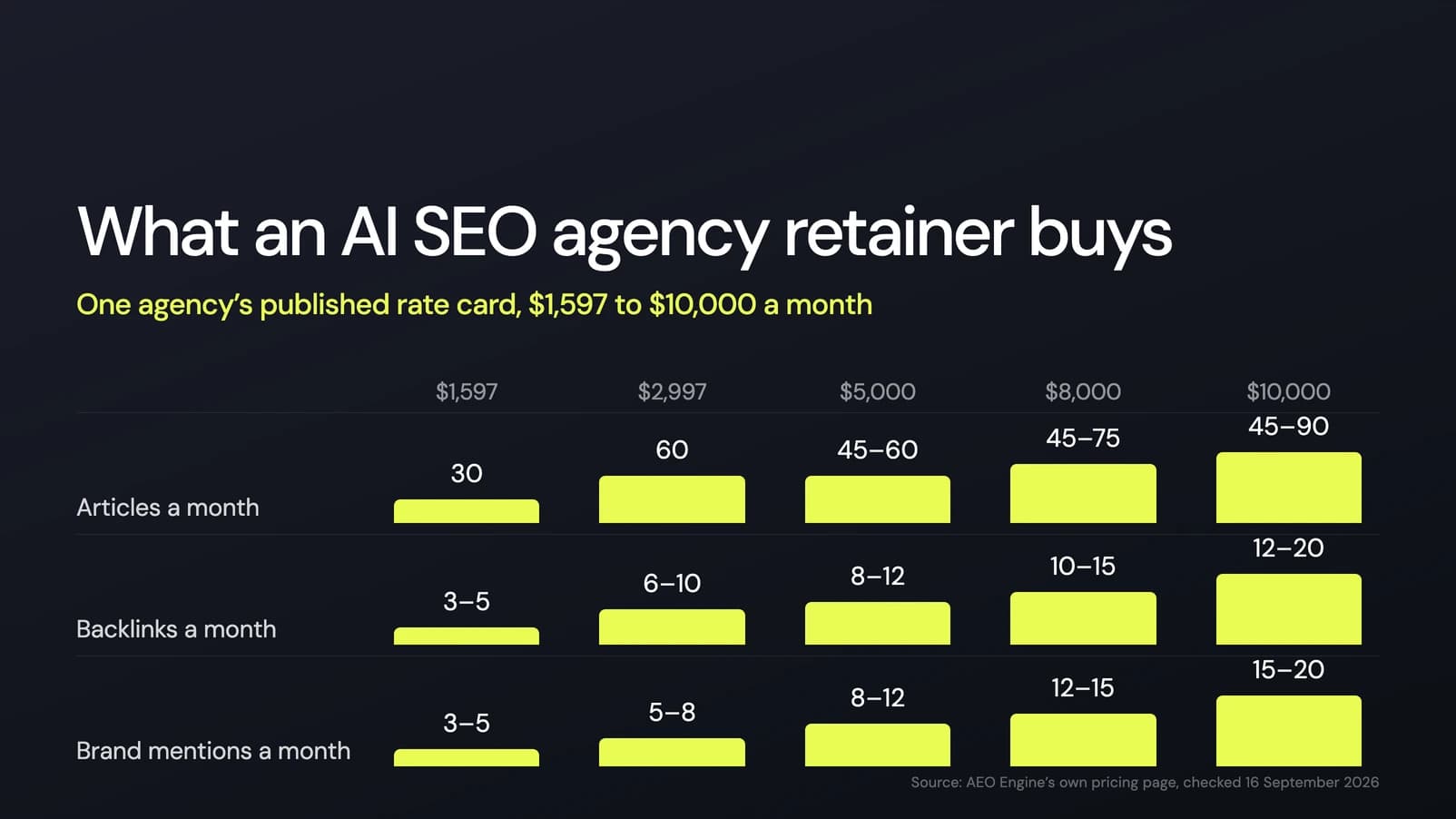
Every week an agency gets the same call. A client typed their own company name into ChatGPT, did not see themselves, and wants to know what happens now.
We have now had that conversation with more than 500 agencies. Then, before writing anything about how to buy AI search optimisation, we went and measured the rest of the market. We fetched 4,787 agency websites across the US and UK and checked each one for the mechanical evidence of the work: an llms.txt file, AI crawlers named in robots.txt, structured data, and whether the homepage leads anywhere you could actually buy this service.
The adoption curve is a remarkable thing to see up close.
What 4,787 US and UK agencies are doing about AI search
Sell AI search optimisation
287 agencies
Taking first steps
1,379 agencies
Nothing at all
3,121 agencies
800 of the 1,247 llms.txt files on these sites carry the stamp of the tool that wrote them. Yoast, All in One SEO, Rank Math, the site builders and our own plugin all generate one.
Two thirds of the agency market has not started. A quarter has taken a first step, usually a file their SEO plugin generated for them. Six percent sell it.
That is the market you are buying in, and it explains most of what you are about to experience. There is no standard, no benchmark and no agreed price. The six percent are not automatically good, and the sixty-five percent are not automatically bad, because plenty of excellent agencies are deliberately waiting for the ground to stop moving.
What follows is the whole thing in order: what the work actually is, what a good plan looks like, what it costs, what to ask on the call, and how to check afterwards whether any of it worked.
What does an AI SEO agency actually do?
Start with what they are trying to achieve, because the tactics only make sense once you know what they are for.
When an assistant decides whether to name you, it is really asking six questions. Does it know who you are, clearly enough to tell you apart from a company with a similar name? Do your facts agree with each other everywhere they appear? Does anyone else say the same thing about you? Is any of it recent? Does anyone credible vouch for you? And can it lift a clean sentence off your page without mangling it?
Entity, consistency, consensus, freshness, authority, readability. Every acronym in this market is selling some mix of those six, and a proposal that cannot tell you which ones it is working on is not a strategy.
Here is how agencies actually go after them.
Everything an AI SEO agency can work on
Reviews, roundups, comparisons. What an answer actually quotes.
One name, one category, one address. Assistants cross-check.
Questions your site does not answer yet, answered freshly.
Structure, schema, a clear entity, the answer near the top.
In practice that means tidying up your pages so a machine can parse them, adding schema, writing topical blog posts aimed at questions you have never answered, going round every directory and profile making sure the address matches, and then the slow part: talking to editors, getting into comparison roundups, chasing reviews, earning the odd bit of press.
The order matters. Nobody is going to quote a page an assistant cannot read, so layer one comes first. And layer four is the expensive one, the slow one, the one that moves the needle most, and the one most proposals quietly skip, because it cannot be produced on a content calendar.
What does a good AI SEO plan look like?
Before the price, the scope. Strip the acronyms away and every plan worth paying for is working on the same six things: whether an assistant can tell who you are, whether your facts agree with each other everywhere they appear, whether other sources back them up, whether any of it is recent, whether anyone credible vouches for you, and whether a machine can lift a clean sentence off the page. Entity, consistency, consensus, freshness, authority, readability.
The order those arrive in matters more than the list.
The first 90 days of a good AI SEO plan
Baseline before anyone touches anything
Foundation schema, crawler access, entity
Content a few strong pages a month
Off-site mentions reviews, roundups, editors
Measure every two weeks, same checks as day 0
Foundation and content are the parts software handles well, ours included. Nothing automates the off-site work, which is why agencies exist.
Published plans are rarely sold in that order. They are sold on volume from month one, which is the most reliable sign that a rate card was built to be easy to price rather than easy to deliver.
Hold any proposal against that schedule and ask three things. Where does the foundation work sit, and does it ever stop? When does anything start happening off your own domain? And is there a measurement point on day zero, before anyone touches anything, or does measuring begin after the work does, which makes the before picture unrecoverable.
How much does an AI SEO agency cost?
Most of this market does not publish a price. These are a few real examples from agencies that do, taken from their own pages and re-checked on 16 September 2026.
Twelve published plans, cheapest first
A few real examples, not the whole market. Every figure is the agency’s own, from its own page.
| Plan | Month | Articles | Each | Off-site | On-site |
|---|---|---|---|---|---|
| Space & Story Local | $300 | – | – | ✕ | ✓ |
| Web Aloha On-Page GEO | $333 | 2 | $167 | ✕ | ✓ |
| Space & Story Growth | $700 | – | – | ✕ | ✓ |
| Web Aloha Full GEO | $999 | 6 | $167 | ✓ | ✓ |
| AEO Engine Growth | $1,597 | 30 | $53 | ✓ | ✓ |
| Space & Story Authority | $2,000+ | – | – | ✓ | ✓ |
| AEO Engine Scale | $2,997 | 60 | $50 | ✓ | ✓ |
| RevvGrowth Starter | $3,000 | 10 | $300 | ✕ | ✓ |
| OutreachBloom Silver | $3,400 | 10 | $340 | ✓ | ✕ |
| OutreachBloom Gold | $4,900 | 15 | $327 | ✓ | ✕ |
| RevvGrowth Growth | $8,000 | 40 | $200 | ✓ | ✓ |
| AEO Engine Dominate 3 | $10,000 | 45–90 | $111–222 | ✓ | ✓ |
Published monthly rates across these twelve plans run from $300 to $10,000. That thirty-fold spread is not a market average and you should not read it as one. It tells you how much variance there is in what the same words are being used to sell.
A published price is also a sign of confidence rather than of quality. It is easier to publish a number for a productised package than for custom work, so the cheap end of that table is over-represented by design, and the agencies charging the most are mostly not in it at all.
Does a bigger AI SEO retainer buy better work?
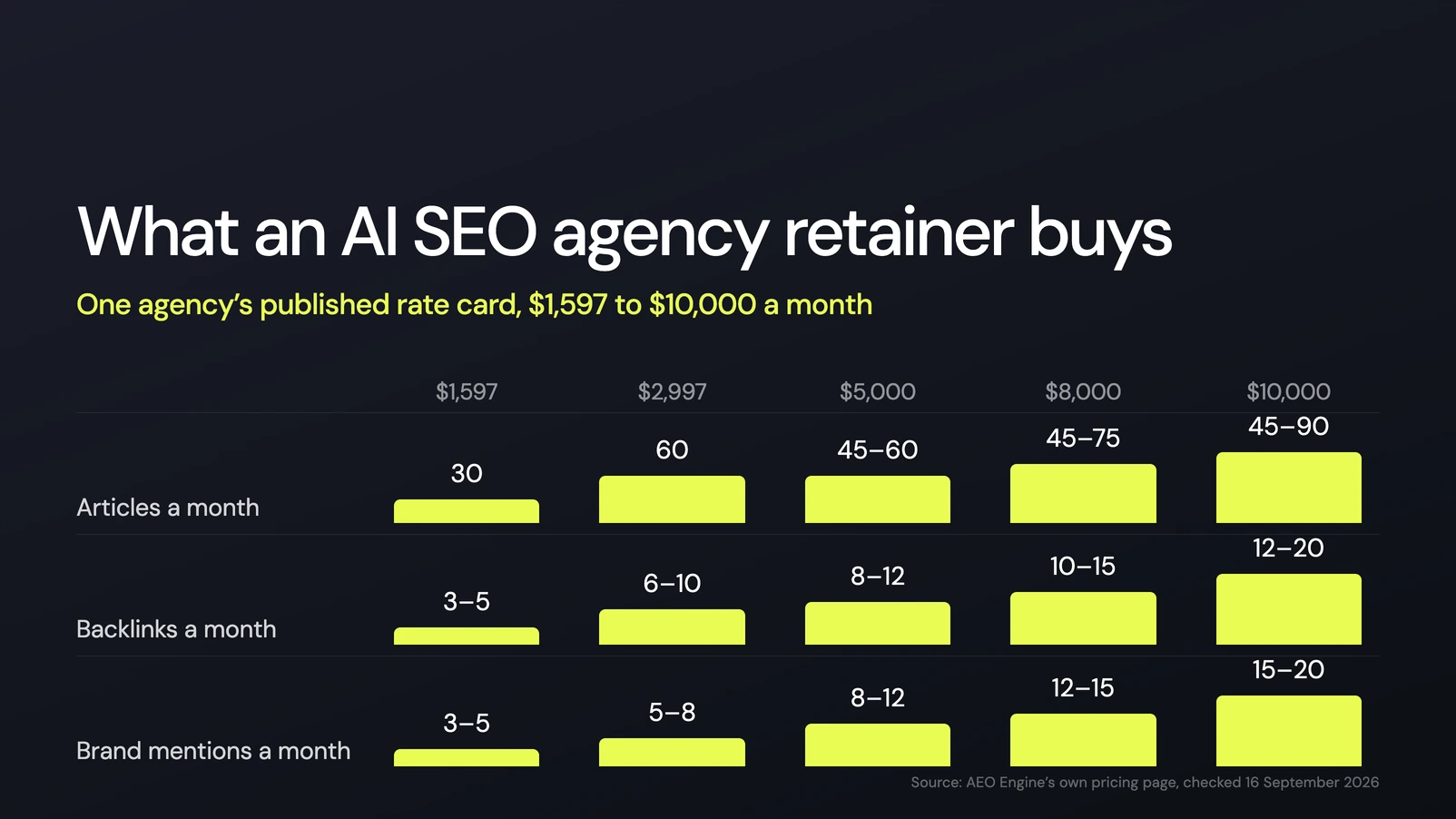
One agency publishes five tiers with a full feature comparison attached, which makes it the closest thing to a baseline quote this market has.
Show the full rate card as a table
| $1,597 | $2,997 | $5,000 | $8,000 | $10,000 | |
|---|---|---|---|---|---|
| Articles a month | 30 | 60 | 45–60 | 45–75 | 45–90 |
| Backlinks a month | 3–5 | 6–10 | 8–12 | 10–15 | 12–20 |
| Brand mentions a month | 3–5 | 5–8 | 8–12 | 12–15 | 15–20 |
| PR campaigns a month | 1 a quarter | 1 | 1 | 2 | up to 4 |
| Podcast episodes | – | – | 1 a week | 3 a week | 1 a day |
| Site work | One site | Full site | Full site + tech specialist | Full site + tech specialist | Multi-market + tech specialist |
| Contract | Monthly | Monthly | Rolling 90 days | Rolling 90 days | Rolling 90 days |
| Traffic guarantee | Qualifying clients | Qualifying clients | None | None | None |
Source: AEO Engine’s own pricing page and comparison table, checked 16 September 2026.
Most of what grows with the price is volume, or work done somewhere other than your website: articles, backlinks, brand mentions, PR campaigns, and from $5,000 a podcast. Paying about six times more, $1,597 to $10,000 a month, buys three to four times the articles, links and mentions.
The site work changes too, but in scope rather than quantity. The cheapest plan optimises one site, the next the full site, and a dedicated technical specialist only appears from $5,000 a month. That is worth knowing before you sign at the bottom tier expecting the technical work to be handled in depth.
Two details in that ladder are worth your attention. The article count actually falls between the second and third tier, because the expensive tiers are published as ranges starting at 45 while the $2,997 tier is a flat 60. Fewer, better, more expensive. And the traffic growth guarantee attaches to the two cheapest plans only: the $5,000, $8,000 and $10,000 tiers carry none at all, which is the opposite of what most buyers assume.
One row is worth naming for what it is. Authority backlinks are classic link building, and they have been a standard SEO line item for twenty years. Finding them priced inside an AI search plan is a reasonable clue about how much of the category is genuinely new.
Why the article counts are worth arguing about
Read down the cost-per-article column and one number stands out. Thirty articles a month at $1,597 works out at about $53 a piece, less than a third of what any other agency publishing a rate card charges per article, and those other plans include work beyond the writing.
We re-verified that figure twice against the agency's own page, because it is surprising enough to be worth doubting: it appears both as a plan bullet, "30 on-brand SEO/AEO articles per month with supporting media", and again in their comparison table. It is real. You do not need to know how it is produced to know the economics only close at volume.
That matters beyond quality, because volume carries a documented risk. Google's spam policies name scaled content abuse, defined as "when many pages are generated for the primary purpose of manipulating search rankings and not helping users", and the policy is explicit that the production method is irrelevant: AI, human or both, the test is whether the page adds value.
If a proposal leads with a monthly article count, ask two things. Who writes them, and what happens to your domain if half are later judged to add nothing. A handful of genuinely useful pages a month is a more defensible plan than thirty thin ones.
One thing to watch for while you shop
Several agencies publish long, genuinely useful articles titled things like "AEO agency pricing in 2026", quote industry ranges in detail, and never disclose what they themselves charge. The article ranks, you get a number, and the number belongs to somebody else.
Non-disclosure is not proof of anything bad. Scope genuinely varies and custom quoting is normal in services. But if you are reading a pricing guide, check whether the people who wrote it publish their own.
Four claims an AI SEO agency will make, and what the evidence says
These are the four things most likely to appear in a proposal. Each one is checkable, and in each case we have our own data on it.
"We will make sure AI can read your site"
Worth doing, and usually audited at the wrong layer.
We fetched 314 live websites as 38 different AI crawler user agents in August 2026. Forty-three percent refused at least one, and 112 of them refused at the server while robots.txt said nothing about it. On more than a third of the sites we tested, reading robots.txt would have told you everything was fine when it was not. The method is in our AI crawler blocking study.
So the check is not "does robots.txt allow GPTBot". It is whether a request carrying an AI crawler user agent gets a 200 back.
There is a second trap here that even the specialists fall into. There are two kinds of AI bot, and they do different jobs. Training crawlers such as CCBot and Bytespider collect text for future models. Answer fetchers such as OAI-SearchBot, ChatGPT-User and PerplexityBot fetch your page because someone just asked a question. Blocking the first group is a defensible choice. Blocking the second removes you from answers.
Of the 4,787 agency sites we checked, 326 name an AI bot in robots.txt at all. Seventeen of them block at least one answer fetcher on their own website. A further sixteen block only Google-Extended, which Google documents as controlling whether content is used to train future Gemini models, and about which Google states plainly that it "does not impact a site's inclusion in Google Search nor is it used as a ranking signal in Google Search". That one is a reasonable choice. Blocking the fetchers is not, and the agencies selling this service get the distinction right far more often than the ones that do not.
Check your own robots.txt for this before you pay anyone to find it.
"We will write your llms.txt"
Ask what evidence they have that it does anything.
Between December 2025 and May 2026 our WordPress plugin logged 82 million crawler requests. Across that entire window, every path matching llms.txt was requested 192 times, and only 31 of those came from an AI bot. GPTBot managed exactly one. Over the same period the same bots requested sitemap XML 177,353 times in May alone. The numbers are in our llms.txt study.
The file costs a few kilobytes and one build step, so there is no reason not to have one. But it is not a deliverable worth paying for. A quarter of the agency market already serves one, and two thirds of those did not write it: their SEO plugin did, in an update.
"AI search optimisation works"
It does, and the honest version of that claim comes with a control group.
We compared optimised pages against untouched pages on the same websites over the same 90 days, across 108,834 pages. Optimised pages earned 173.5 AI referral visits per 1,000 pages against 15.8 for untouched pages, and came out ahead on 89 of the 102 sites that saw any AI traffic at all. That is roughly eleven times the traffic per page. The effect was also uneven, and it did nothing for thin, low-priority pages. The full study is here.
Compare that shape with the case studies in a pitch deck. If an agency shows you a before and after with no untouched control, you are looking at a chart of the whole internet's AI traffic growth with a logo on it.
"Here is your monthly report"
Ask which metric goes in the first row, and be unfashionable about the answer.
The basics come first, and they are all things happening on your own site that you already own: visitors, conversions, mentions, crawls. How many people arrived from an assistant. How many of them did something. Who is talking about you elsewhere. Which bots are fetching which pages, and how often. That is the ground truth, it is yours, and no agency controls it.
Prompt tracking comes after that, not instead of it. It is genuinely useful once the basics are in place, as long as the prompt set is fixed: if the agency rewrites the questions each month, the trend line means nothing because the questions changed underneath it. Split by assistant too, because the engines answer the same prompt differently and a report built on ChatGPT alone covers a quarter of the problem.
An agency that leads with prompt coverage and never shows you a visit is measuring the part that is easiest to move.
How do you vet an AI SEO agency?
Everything above is evidence. This is the part you print and take with you.
Choosing an AI SEO agency: the checklist
Eight tests to run on any proposal. The first four are deal-breakers.
1. Evidence
One client that went from absent to named in an AI answer, with the prompt and the date.
Pass A dated prompt you can re-run in the room, and an unprompted warning that it will not reproduce exactly.
Fail A dashboard screenshot, a visibility score, or a case study with no prompt in it.
2. Evidence
AI referral visits for a client, from that client's own analytics.
Pass A dated GA4 or server-log view with the assistant split out.
Fail Their dashboard only. Citations counted, visits never mentioned.
3. Scope
The share of the retainer spent off your own domain.
Pass A real percentage, with named target publications or communities, before you sign.
Fail All of it is content on your site. That is content marketing with a new label.
4. Measurement
What goes in row one of the monthly report.
Pass Visits, conversions and mentions from your own analytics, before anything about prompts.
Fail Impressions, rankings, or a proprietary score you cannot reproduce.
5. Scope
What month six buys that month one already delivered.
Pass An honest answer that the foundation work is largely a one-off, and a plan for what replaces it.
Fail The same line items repeated twelve times.
6. Scope
Who writes the content, if the plan leads with a monthly article count.
Pass Named writers or editors, a review step, and a volume you would be happy to defend to Google.
Fail Thirty pieces a month at a price that only works at volume.
7. Measurement
Whether the baseline is taken before the work starts.
Pass Day zero: your analytics, your logs, your page checks, saved and shared with you.
Fail Measurement begins once work is underway, so the before picture is gone.
8. Terms
The initial term, and exactly what the guarantee names.
Pass Ninety days, and a guarantee naming a metric, a threshold and a window.
Fail Twelve months, and a guarantee of “visibility” or “citations”.
Ask them out loud, in that order, and write the answers down while they talk. The first four are deal-breakers: an agency that fails any one of them has told you what you need to know, and the price no longer matters. The other four separate a good agency from an adequate one.
On the first test, run the prompt yourself afterwards. It will not reproduce exactly, because these answers vary between engines and between runs, and a good agency will tell you that before you ask. What you are testing is whether a real, dated, checkable example exists at all.
How do you know if an AI SEO agency is working?
Why you cannot simply ask an assistant
The obvious shortcut is to ask ChatGPT which agency is best, or to ask it whether you are visible, and treat the answer as a verdict. It is not one.
Google's AI Overview for "ai seo agency" cites ten sources. Every one is an agency page or a vendor listicle, and one is quoted back as a specific retainer figure stated as fact. Meanwhile the number one organic result directly underneath it is a forum thread of people asking whether any of this is worth paying for, and it is not cited once.
An agency's visibility inside an AI answer is not independent verification of anything. It mostly reflects how well that agency has optimised its own marketing pages, which is the service being sold. The same circularity applies to you: an agency that shows you a screenshot of an assistant naming your brand has shown you an output that is easy to influence and impossible to audit.
Measure the thing itself instead.
Measure the four things you already own
Visitors, conversions, mentions, crawls. All four happen on your own property, all four are recorded whether or not anyone is paying attention, and none of them belong to the agency.
Crawls tell you assistants can reach you. Mentions tell you other people are talking about you. Visitors tell you an assistant actually sent somebody. Conversions tell you whether it mattered. Read them in that order, because each one is a precondition for the next, and a report that celebrates the first and never reaches the fourth has chosen the metric that is easiest to move.
Two things follow for a contract. A 90-day initial term is defensible and a 12-month lock-in signed on day one is not, because about four months is when the signal becomes readable at all. And the thing to negotiate is not length but the exit: agree now which number, measured how, would make you renew.
The baseline to take before you sign
You need a starting point, from somewhere the agency does not control. Three of these, and set them up before the contract begins.
- Write down 15 to 20 questions a real buyer would ask, with no brand names in them, and run each through ChatGPT, Perplexity and Gemini. Record who gets named and which pages get cited. It costs nothing, takes an afternoon, and it is the exact test you will re-run at day 90. Keep the list fixed.
- Run your most important URLs through a page checker and save the output. Our free AI search checker reads a page the way an assistant does and reports what is missing: absent or invalid structured data, answers buried below the fold, robots rules that block AI crawlers. Run the same URLs at day 90. If technical work happened, this moves. If it did not, this does not move no matter what the dashboard says.
- Open a referral segment in GA4 filtered to chatgpt.com, perplexity.ai, gemini.google.com and copilot.microsoft.com, and watch the page-level split. Add server logs or your CDN's bot analytics if you have them, because logs are the only unmediated evidence you will ever have.
An agency that objects to being measured against a baseline you own has told you something useful.
When do you not need an AI SEO agency?
Look back at the pyramid. Layers one, two and three are mechanical: structured data, entity consistency, answer-shaped copy, crawler access, and content aimed at questions you do not currently answer. Software does mechanical work more cheaply than a retainer does, and we compared the platforms in the best AEO tools guide, including which ones change your pages and which only report on them.
If your site is under a few hundred pages, your structured data is thin, and nobody has checked your crawler access this year, the first eighty percent of the available gain is in that mechanical work. Do it, wait ninety days, then decide.
Hire an agency when the remaining work is layer four: earning mentions on sources you do not own, competing in a category where everyone has already done the mechanical part, or operating across dozens of markets at once. That is relationships and judgement, and it does not come out of a tool.
AI SEO agency benchmarks: where does your agency sit?
If you run an agency, the chart at the top of this post is your benchmark. Two thirds of your competitors have not started, and the ones who have mostly have a file their SEO plugin wrote for them.
The agencies that sell this service do a few things on their own homepage that the rest do not. More than half name ChatGPT or another assistant, against fewer than one in twelve across the market. They are also far more likely to mark up their FAQs, to say in structured data what they sell, and to put a named person behind the work. None of that is expensive, and your clients can check all of it on your site in a minute.
The demand is arriving whether or not you have a service line for it. Most agencies we speak to are being asked about AI visibility by existing retainer clients rather than by new business, and the search data says the same: it is law firms, real estate, insurance and accounting practices asking their existing marketing partner first.
If you would rather deliver this for your client base than build the tooling, LovedByAI runs a partner programme for agencies and freelancers that puts the implementation layer under your own reporting.